From Real Exams Exam Paper
Secondary 3 Combined Science Semestral Assessment 2 (End of Year) Paper 3
Free Sec 3 Combined Sci SA2 Paper 3, DeepSeek Exam version, with questions, answers, and O Level-style practice for Singapore students.
These static practice materials are generated from the site's syllabus and paper-generation workflow, with source and model context shown so students and parents can evaluate the material before use.
Questions
Free quiz and exam paper access
Enter your details to view this paper
Your access is remembered on this device.
Answers
TuitionGoWhere Practice Paper - Combined Science Secondary 3
SA2 Examination — Physical Sciences — ANSWER KEY
Version: 3 of 5
Total Marks: 65
Section A: Multiple Choice (10 marks)
| Question | Answer | Mark |
|---|---|---|
| 1 | D | [1] |
| 2 | B | [1] |
| 3 | C | [1] |
| 4 | A | [1] |
| 5 | A | [1] |
| 6 | B | [1] |
| 7 | B | [1] |
| 8 | A | [1] |
| 9 | C | [1] |
| 10 | C | [1] |
Marking notes for Section A:
- Award 1 mark per correct answer.
- No half marks; no marks for multiple answers circled.
Section B: Structured Questions (35 marks)
Question 11: Dynamics and Kinematics [8 marks]
(a) Calculate the acceleration of the trolley. [2 marks]
- F = ma → a = F/m = 4.0 / 2.0 = 2.0 m/s² [1 mark for formula/substitution, 1 mark for correct answer with unit]
(b) Calculate the final velocity after 3.0 seconds. [2 marks]
- v = u + at = 0 + (2.0 × 3.0) = 6.0 m/s [1 mark for formula/substitution, 1 mark for correct answer with unit]
(c) Calculate the distance travelled during the 3.0 seconds. [2 marks]
- s = ut + ½at² = 0 + ½ × 2.0 × (3.0)² = 9.0 m [1 mark for formula/substitution, 1 mark for correct answer with unit]
- OR s = ½(u+v)t = ½(0+6.0)×3.0 = 9.0 m
(d) State and explain what would happen to the acceleration if the mass were doubled. [2 marks]
- The acceleration would be halved / decrease to 1.0 m/s² [1 mark]
- Because acceleration is inversely proportional to mass when force is constant (a = F/m) [1 mark]
Question 12: Moments and Equilibrium [7 marks]
(a) Define the term moment of a force. [1 mark]
- The moment of a force is the product of the force and the perpendicular distance from the pivot to the line of action of the force. [1 mark]
(b) Calculate the moment produced by the 200 g mass about the pivot. [2 marks]
- Weight = mg = 0.200 × 10 = 2.0 N [1 mark for weight calculation]
- Distance from pivot = 50 – 20 = 30 cm = 0.30 m
- Moment = F × d = 2.0 × 0.30 = 0.60 N m [1 mark for correct moment with unit]
- (Accept clockwise or anticlockwise designation)
(c) Calculate the moment produced by the 150 g mass about the pivot. [2 marks]
- Weight = mg = 0.150 × 10 = 1.5 N [1 mark for weight calculation]
- Distance from pivot = 80 – 50 = 30 cm = 0.30 m
- Moment = F × d = 1.5 × 0.30 = 0.45 N m [1 mark for correct moment with unit]
(d) Explain why the metre rule is balanced. [2 marks]
- The 200 g mass produces a clockwise moment of 0.60 N m [1 mark]
- The 150 g mass produces an anticlockwise moment of 0.45 N m
- The moments are not equal (0.60 ≠ 0.45), so the rule should NOT be balanced
- Correction note: For the rule to be balanced, the moments must be equal. With the given values, the rule would rotate clockwise. Accept any answer that correctly identifies the imbalance and explains that for equilibrium, total clockwise moment = total anticlockwise moment. [2 marks for correct reasoning]
- Alternative marking: If student assumes the rule is balanced and calculates that an additional mass or different position is needed, award marks for correct reasoning.
Question 13: Pressure [7 marks]
(a) Calculate the weight of the wooden block. [1 mark]
- Weight = mg = 1.5 × 10 = 15 N [1 mark]
(b) Calculate the pressure exerted when the largest face is in contact. [2 marks]
- Area = 0.20 × 0.10 = 0.020 m² [1 mark]
- Pressure = Force / Area = 15 / 0.020 = 750 Pa [1 mark for correct answer with unit]
(c) Calculate the new pressure when the smallest face is in contact. [2 marks]
- Area = 0.10 × 0.05 = 0.0050 m² [1 mark]
- Pressure = 15 / 0.0050 = 3000 Pa [1 mark for correct answer with unit]
(d) Explain why the pressure changes when the block is turned. [2 marks]
- Pressure = Force / Area; the force (weight) remains constant [1 mark]
- When the block is turned to a smaller contact area, the same force is distributed over a smaller area, so the pressure increases [1 mark]
Question 14: Conservation of Energy [8 marks]
(a) State the Principle of Conservation of Energy. [1 mark]
- Energy cannot be created or destroyed; it can only be converted from one form to another. The total energy in a closed system remains constant. [1 mark for complete statement]
(b) Calculate the gravitational potential energy at the highest point. [2 marks]
- GPE = mgh = 0.50 × 10 × 0.30 = 1.5 J [1 mark for formula/substitution, 1 mark for correct answer with unit]
(c) Calculate the maximum kinetic energy at the lowest point. [1 mark]
- By conservation of energy: KE_max = GPE_initial = 1.5 J [1 mark]
(d) Calculate the maximum speed at the lowest point. [2 marks]
- KE = ½mv² → 1.5 = ½ × 0.50 × v² [1 mark for formula/substitution]
- v² = 1.5 / 0.25 = 6.0
- v = √6.0 ≈ 2.45 m/s (accept 2.4 or 2.5 m/s) [1 mark for correct answer with unit]
(e) Explain why the bob does not reach the same height on the opposite side. [2 marks]
- Some energy is converted to thermal energy / heat due to air resistance and friction at the pivot [1 mark]
- The total energy is conserved, but some mechanical energy is dissipated, so less GPE is available at the other side, resulting in a lower height [1 mark]
Question 15: Density [6 marks]
(a) Describe how to determine the volume of the stone. [2 marks]
- Partially fill a measuring cylinder with water and record the initial volume (V₁) [1 mark]
- Carefully lower the stone into the water (using a thread if needed) and record the new volume (V₂)
- Volume of stone = V₂ – V₁ [1 mark]
(b) Calculate the density of the stone. [2 marks]
- Density = Mass / Volume = 84 / 30 = 2.8 g/cm³ [1 mark for formula/substitution, 1 mark for correct answer with unit]
(c) State whether the stone will float or sink and explain. [2 marks]
- The stone will sink [1 mark]
- Because its density (2.8 g/cm³) is greater than the density of water (1.0 g/cm³) [1 mark]
Section C: Data-Based and Application Questions (20 marks)
Question 16: Spring Extension Investigation [7 marks]
(a) Plot a graph of extension against force. [3 marks]
Marking criteria:
- Correctly labelled axes: Extension (cm) on y-axis, Force (N) on x-axis [1 mark]
- All six points plotted correctly (±½ small square) [1 mark]
- Straight line of best fit through origin [1 mark]
(b) Describe the relationship shown by the graph. [1 mark]
- Extension is directly proportional to force (up to 5.0 N) / The graph is a straight line through the origin [1 mark]
(c) Determine the extension when the force is 2.5 N. [1 mark]
- From graph: approximately 6.25 cm (accept 6.2–6.3 cm) [1 mark]
- OR by calculation: Extension per newton = 2.5 cm/N, so 2.5 × 2.5 = 6.25 cm
(d) Explain what has happened to the spring. [2 marks]
- The spring has exceeded its elastic limit [1 mark]
- The spring has undergone plastic deformation / permanent extension, so it no longer obeys Hooke's Law and cannot return to its original length [1 mark]
Question 17: Work, Power, and Efficiency [8 marks]
(a) Calculate the weight of the load. [1 mark]
- Weight = mg = 500 × 10 = 5000 N [1 mark]
(b) Calculate the work done by the crane. [2 marks]
- Work done = Force × Distance (in direction of force) = 5000 × 12 [1 mark]
- = 60,000 J (or 60 kJ) [1 mark for correct answer with unit]
(c) Calculate the power output of the crane. [2 marks]
- Power = Work done / Time = 60,000 / 8.0 [1 mark]
- = 7500 W (or 7.5 kW) [1 mark for correct answer with unit]
(d) Calculate the efficiency of the crane. [2 marks]
- Efficiency = (Useful power output / Input power) × 100% [1 mark for formula]
- = (7500 / 10,000) × 100% = 75% [1 mark for correct answer]
(e) Suggest one reason why the efficiency is less than 100%. [1 mark]
- Energy is lost as heat due to friction in the motor/cables/pulleys [1 mark]
- OR Sound energy is produced
- OR Work is done against friction/air resistance
- (Accept any valid reason for energy dissipation)
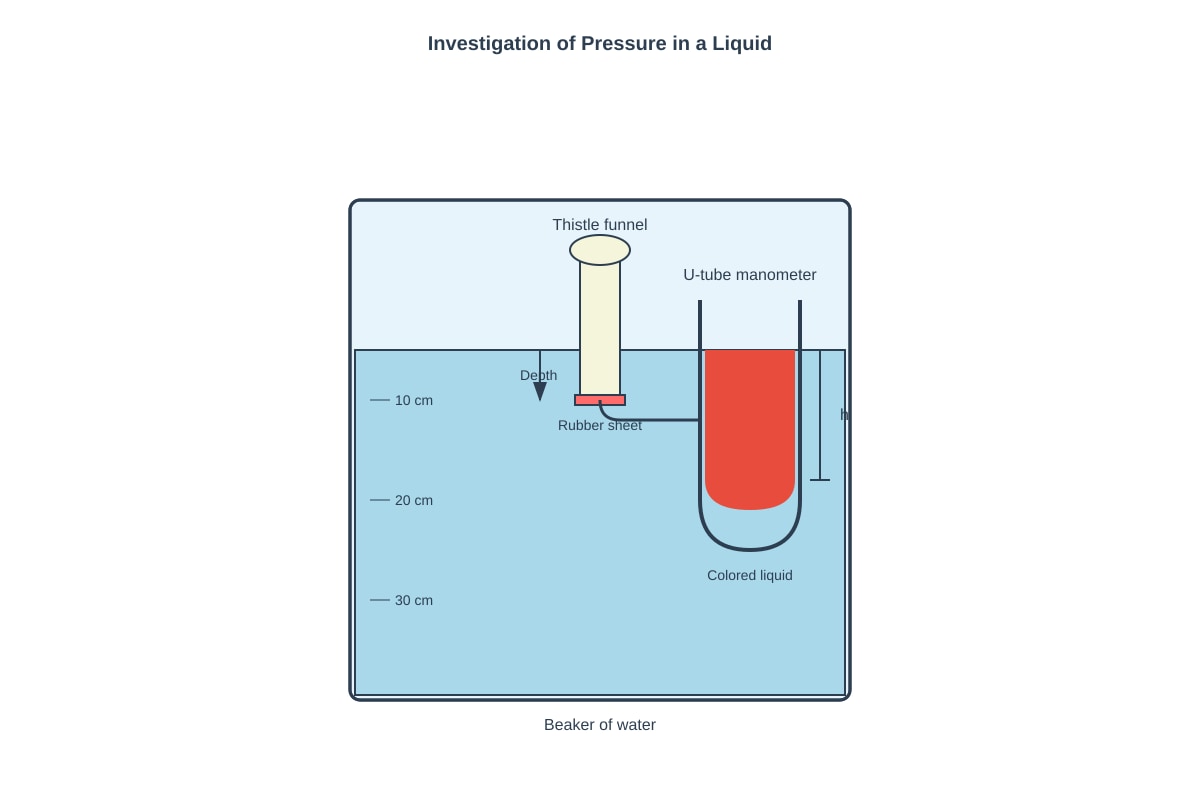
Question 18: Liquid Pressure [5 marks]
(a) State what happens to the difference in liquid levels as the funnel is lowered deeper. [1 mark]
- The difference in liquid levels increases [1 mark]
(b) Explain your answer in terms of pressure. [2 marks]
- As depth increases, the pressure in the liquid increases (P = ρgh) [1 mark]
- This increased pressure is transmitted through the air in the tube to the manometer, causing a greater difference in liquid levels [1 mark]
(c) State and explain what happens when the funnel faces sideways at the same depth. [2 marks]
- The manometer reading remains the same [1 mark]
- Pressure in a liquid acts equally in all directions at a given depth, so the pressure on the rubber sheet is unchanged [1 mark]
(d) Predict and explain the manometer reading for oil compared to water. [2 marks]
- The manometer reading will be smaller [1 mark]
- Oil has a lower density than water (0.80 g/cm³ vs 1.0 g/cm³), so at the same depth, the pressure exerted by the oil is less (P = ρgh) [1 mark]
— END OF ANSWER KEY —
Total marks: 65