From Real Exams Exam Paper
Secondary 3 Combined Science Semestral Assessment 2 (End of Year) Paper 2
Free Sec 3 Combined Sci SA2 Paper 2, HY3 Exam version, with questions, answers, and O Level-style practice for Singapore students.
These static practice materials are generated from the site's syllabus and paper-generation workflow, with source and model context shown so students and parents can evaluate the material before use.
Questions
TuitionGoWhere Exam Practice (AI) — SA2 Practice Paper
School: TuitionGoWhere Secondary School (AI)
Subject: Combined Science
Level: Secondary 3
Paper: SA2 Physical Sciences Practice (Version 2 of 5)
Duration: 1 hour 15 minutes
Total Marks: 65
Name: ______________________
Class: _________
Date: ___________
Instructions:
- Answer all questions in the spaces provided.
- Show all working clearly where calculation is required.
- Use SI units in your answers.
- Section A: Short structured questions (1–8)
- Section B: Data and diagram interpretation (9–14)
- Section C: Extended structured response (15–20)
Section A (22 marks)
1. State the Principle of Conservation of Energy. [2]
2. A box of mass 4.0 kg is lifted vertically by 2.0 m. Calculate the gain in gravitational potential energy of the box. (g=10 N/kg) [2]
3. A car travels 100 m in 5.0 s at constant speed. Calculate its speed. [2]
4. State one form of energy that is produced when a moving bicycle is brought to rest by its brakes. [1]
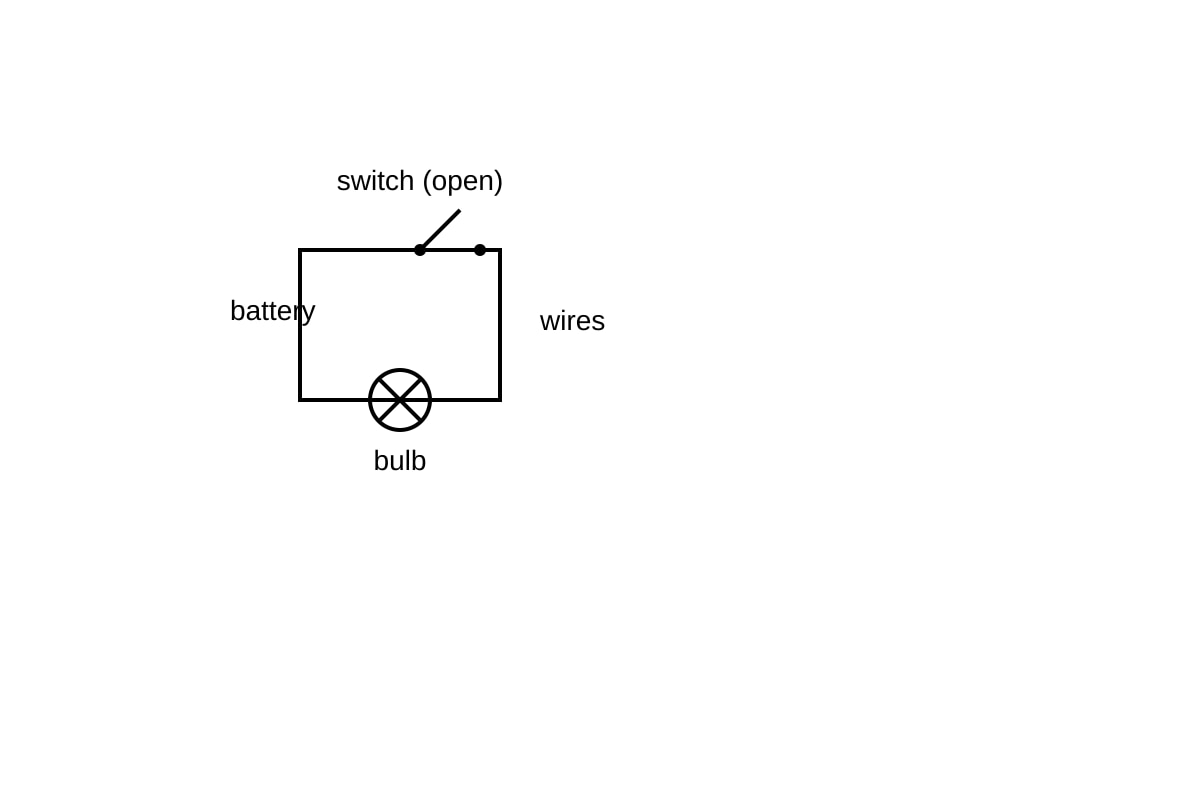
5. The diagram below shows a simple circuit. State the function of the battery. [1]
Image pending generation: diagram for Q5.
6. A metal block is heated and expands. Name the process by which thermal energy travels through the metal without bulk movement of the material. [1]
7. A student pushes a book across a table with a force of 3.0 N over a distance of 0.50 m. Calculate the work done on the book. [2]
8. State the difference between a scalar and a vector quantity. Give one example of each. [3]
Scalar: __________________________________________________
Vector: __________________________________________________
Difference: _______________________________________________
Section B (20 marks)
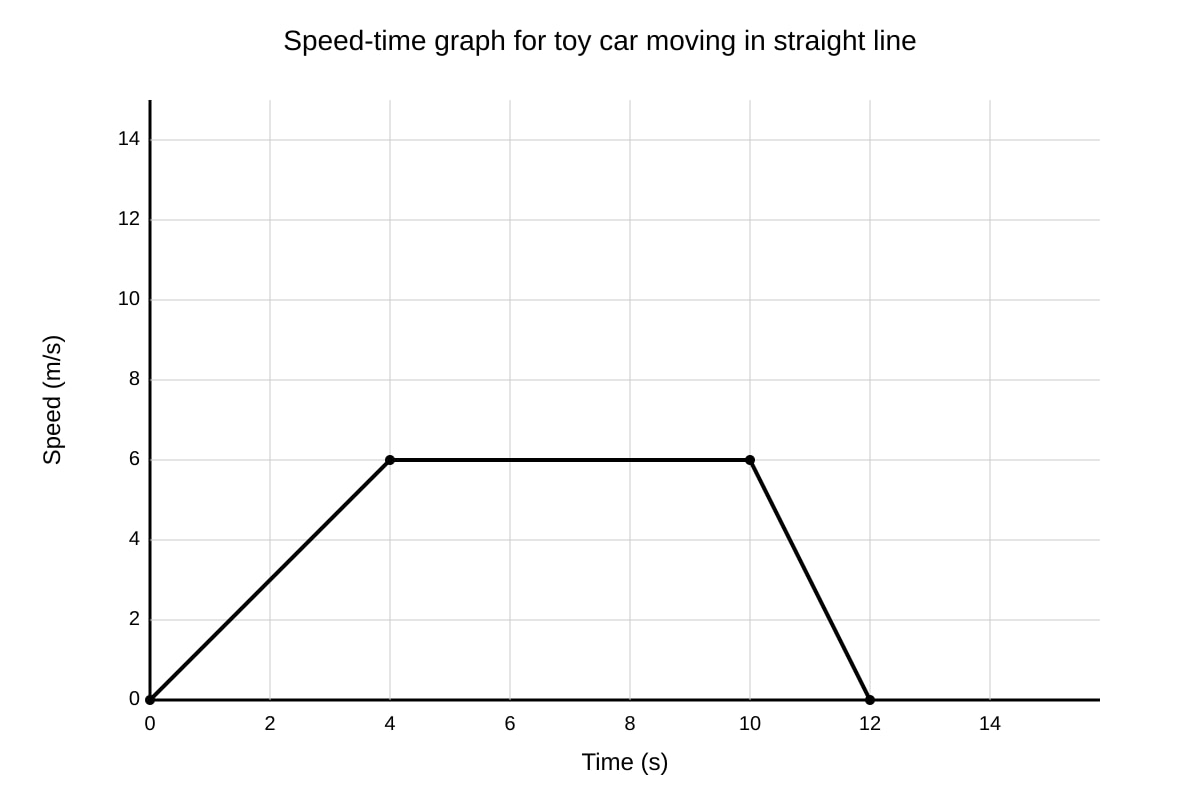
9. The graph shows the speed of a toy car over time.
Image pending generation: graph for Q9.
(a) Calculate the acceleration of the car between t=0 and t=4 s. [2]
(b) Calculate the total distance travelled by the car. [3]
10. A 12 V battery is connected to a resistor of 4.0 Ω. Calculate the current in the circuit. [2]
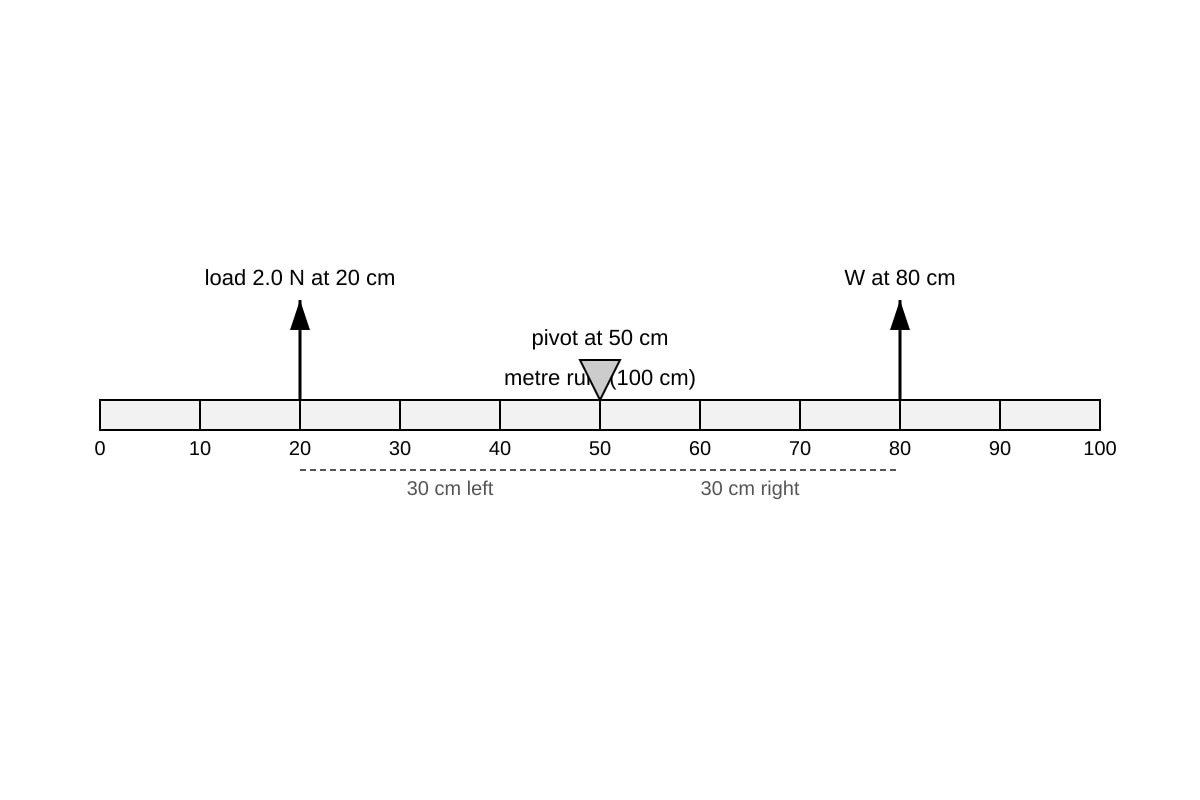
11. The diagram shows a uniform metre rule pivoted at its centre. A 2.0 N weight is hung at the 20 cm mark.
Image pending generation: diagram for Q11.
Calculate the weight W needed to balance the rule. [3]
12. The table shows temperature readings of water heated in a beaker.
| Time (min) | Temperature (°C) |
|---|---|
| 0 | 25 |
| 2 | 45 |
| 4 | 65 |
| 6 | 85 |
State the energy transfer process from the heater to the water. [1]
13. A ball of mass 0.20 kg is dropped from a height of 5.0 m. Calculate its kinetic energy just before hitting the ground. (g=10 N/kg, ignore air resistance) [3]
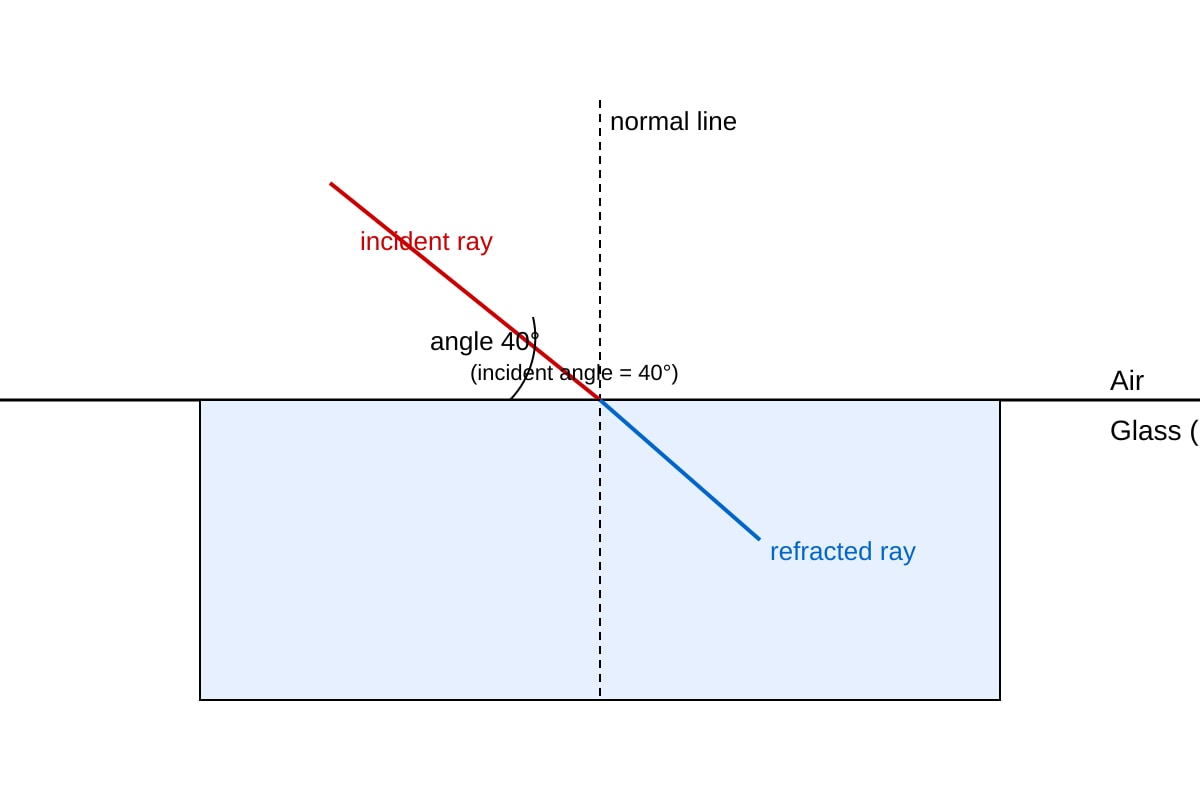
14. The diagram shows a ray of light entering a glass block.
Image pending generation: diagram for Q14.
Calculate the angle of refraction in the glass. [3]
Section C (23 marks)
15. Describe how energy is conserved when a pendulum swings from its highest point on one side to the lowest point. [4]
16. A crane lifts a 500 kg load at constant speed through 10 m in 20 s. (g=10 N/kg)
(a) Calculate the work done by the crane. [2]
(b) Calculate the power output of the crane. [2]
(c) State one assumption made in your calculation. [1]
17. Explain why a metal spoon left in a hot bowl of soup becomes warm at the handle, using the concept of thermal energy transfer. [3]
18. A student connects two resistors, R1=6.0 Ω and R2=3.0 Ω, in parallel to a 9.0 V supply.
(a) Calculate the total resistance. [3]
(b) Calculate the total current from the supply. [2]
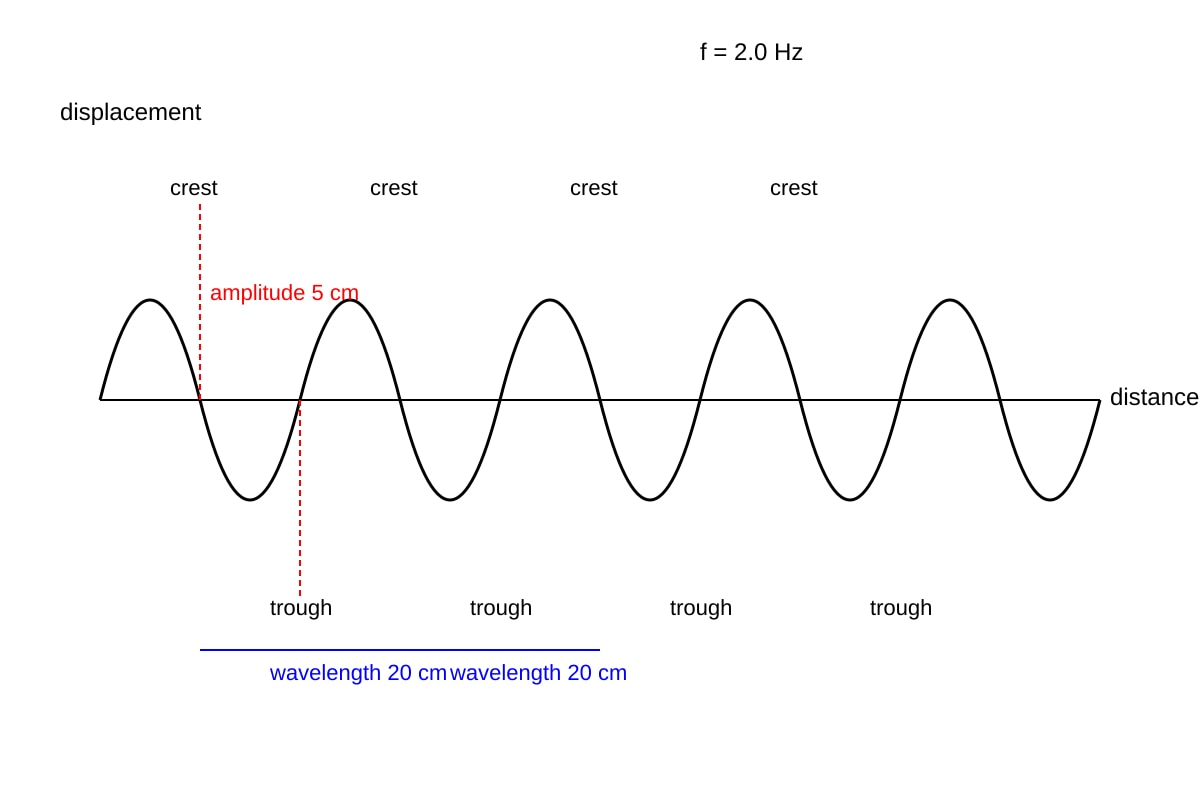
19. The diagram shows a wave on a string.
Image pending generation: diagram for Q19.
(a) State the type of wave. [1]
(b) Calculate the wave speed. [2]
(c) State one difference between transverse and longitudinal waves. [1]
20. A car of mass 800 kg moving at 20 m/s is brought to rest in 4.0 s by a constant braking force.
(a) Calculate the initial kinetic energy of the car. [2]
(b) Calculate the average braking force. [3]
(c) State what happens to the kinetic energy of the car. [1]
End of Paper
Answers
TuitionGoWhere Exam Practice (AI) — SA2 Practice Paper Answer Key
Subject: Combined Science
Level: Secondary 3
Paper: SA2 Physical Sciences Practice (Version 2 of 5)
Total Marks: 65
Section A (22 marks)
1. [2 marks]
Energy cannot be created or destroyed, only converted from one form to another (or transferred). Total energy in a closed system is constant.
Teaching note: Must include both “not created/destroyed” and “converted/transferred” for full marks. Common mistake: stating only “energy is conserved” without explanation.
2. [2 marks]
GPE=mgh=4.0×10×2.0=80 J
Working: m=4.0 kg, g=10 N/kg, h=2.0 m. Substitute into mgh.
Marking: 1 mark for correct formula and substitution, 1 mark for final answer with unit.
3. [2 marks]
v=td=5.0100=20 m/s
Working: speed = distance ÷ time.
Marking: 1 for method, 1 for answer with unit.
4. [1 mark]
Thermal energy (heat) / sound energy.
Note: Accept “heat” as correct.
5. [1 mark]
The battery provides electrical energy / pushes charges around the circuit (source of emf).
Based on image: Battery shown as two lines (long/short) in series loop with bulb.
6. [1 mark]
Conduction.
7. [2 marks]
W=Fd=3.0×0.50=1.5 J
Marking: 1 for formula/substitution, 1 for answer.
8. [3 marks]
Scalar: quantity with magnitude only, e.g. mass / speed / time. [1]
Vector: quantity with magnitude and direction, e.g. force / velocity / weight. [1]
Difference: vector has direction, scalar does not. [1]
Common mistake: giving distance as vector or displacement as scalar.
Section B (20 marks)
9.
(a) [2] a=ΔtΔv=4−08−0=2.0 m/s2. 1 mark method, 1 answer.
(b) [3] Distance = area under graph = triangle + rectangle + triangle
= 21(4)(8)+(6)(8)+21(2)(8)=16+48+8=72 m.
Marking: 1 for identifying areas, 1 for partial calc, 1 for final.
10. [2 marks]
I=RV=4.012=3.0 A. 1 method, 1 answer.
11. [3 marks]
Clockwise moment = anticlockwise moment about pivot.
2.0×30=W×30⇒W=2.0 N.
Marking: 1 for principle of moments, 1 for distances (30 cm each), 1 for W.
Image: pivot at 50 cm, load at 20 cm (30 cm left), W at 80 cm (30 cm right).
12. [1 mark]
Convection (if heater below) or conduction; for immersion heater, conduction/convection. In typical beaker, thermal energy transferred by convection in water and conduction from heater. Accept “convection”.
13. [3 marks]
Loss in GPE = gain in KE.
KE=mgh=0.20×10×5.0=10 J.
Marking: 1 for concept, 1 substitution, 1 answer.
(If using v2=2gh then KE = 21mv2 same result.)
14. [3 marks]
Snell’s law: n1sini=n2sinr. Air n1=1.0, glass n2=1.5.
sinr=1.5sin40∘=1.50.643=0.429⇒r=25.4∘≈25∘.
Marking: 1 formula, 1 calc, 1 answer.
Image: incident 40° to normal, refracted closer to normal.
Section C (23 marks)
15. [4 marks]
At highest point: max gravitational PE, zero KE. [1]
As it falls, PE converts to KE. [1]
At lowest point: max KE, min PE. [1]
Total mechanical energy constant (ignoring air resistance). [1]
Teaching: Energy changes form, total conserved.
16.
(a) [2] W=mgh=500×10×10=50000 J=50 kJ. 1 method, 1 answer.
(b) [2] P=tW=2050000=2500 W. 1 method, 1 answer.
(c) [1] Constant speed / no friction / g=10.
17. [3 marks]
Spoon is metal, good conductor. [1]
Thermal energy conducted from hot soup through spoon material. [1]
Particles vibrate more, pass energy to neighbouring particles to handle. [1]
Note: Process is conduction.
18.
(a) [3] RT1=6.01+3.01=61+2=63=0.5⇒RT=2.0 Ω. 1 formula, 1 calc, 1 answer.
(b) [2] I=RTV=2.09.0=4.5 A. 1 method, 1 answer.
19.
(a) [1] Transverse wave.
(b) [2] v=fλ=2.0×0.20=0.40 m/s. (λ=20 cm=0.20 m) 1 method, 1 answer.
(c) [1] Transverse: oscillations perpendicular to direction of travel; longitudinal: parallel.
20.
(a) [2] KE=21mv2=0.5×800×202=160000 J. 1 method, 1 answer.
(b) [3] a=40−20=−5 m/s2; F=ma=800×5=4000 N.
Or using work: F=dKE, d=2vt=40 m, F=160000/40=4000 N. 1 method, 1 calc, 1 answer.
(c) [1] Converted to heat/sound by brakes.
Total marks check: Section A 22 + B 20 + C 23 = 65 ✓
Free quiz and exam paper access
Enter your details to view this paper
Your access is remembered on this device.