AI Generated Quiz
Secondary 3 Chemistry Redox Electrochemistry Quiz
Free Sec 3 Chemistry Redox Electrochemistry quiz, Kimi2.6 AI version, with questions, answers, and O Level-style practice for Singapore students.
These static practice materials are generated from the site's syllabus and paper-generation workflow, with source and model context shown so students and parents can evaluate the material before use.
Questions
Free quiz and exam paper access
Enter your details to view this paper
Your access is remembered on this device.
Answers
Secondary 3 Chemistry Quiz - Redox Electrochemistry: Answer Key
Total Marks: 40 marks
Section A: Multiple Choice and Short Response
Question 1 [1 mark]
Answer: B (+6)
Explanation: To find the oxidation state of sulfur in H₂SO₄:
- Hydrogen has oxidation state +1 (rule: +1 in compounds, except with metals)
- Oxygen has oxidation state −2 (rule: −2 in compounds, except peroxides)
- The compound is neutral, so sum of oxidation states = 0
Let oxidation state of S = x:
Marking note: Deduct mark if working not shown or arithmetic error made.
Question 2 [1 mark]
Answer: B (Zinc is oxidised from 0 to +2)
Explanation: In the reaction: Zn(s) + CuSO₄(aq) → ZnSO₄(aq) + Cu(s)
- Zinc starts as elemental metal: oxidation state = 0
- In zinc sulfate, Zn²⁺ ion has oxidation state = +2
- Increase in oxidation state = oxidation (loss of electrons)
- Zinc loses 2 electrons: Zn → Zn²⁺ + 2e⁻
This is a displacement reaction where more reactive zinc displaces less reactive copper. The oxidation state increases because electrons are lost to copper ions.
Common mistake: Students confuse oxidation and reduction. Use OILRIG: Oxidation Is Loss (of electrons), Reduction Is Gain (of electrons).
Question 3 [1 mark]
Answer: Oxidation is the loss of electrons.
Explanation: Oxidation and reduction can be defined in three ways:
- Electron transfer: Oxidation is loss of electrons (OIL)
- Oxygen gain: Oxidation is gain of oxygen
- Hydrogen loss: Oxidation is loss of hydrogen
For ionic/electrochemical contexts, the electron transfer definition is most precise and universally applicable. When a species loses electrons, it becomes more positively charged (or less negatively charged), which we describe as an increase in oxidation state.
Question 4 [3 marks]
(a) [1 mark] Answer: −1
Explanation: In H₂O₂, using normal rules would give oxygen as −2, but this is a peroxide (contains O−O single bond). For peroxides, the special rule applies: oxygen has oxidation state −1.
Calculation: 2(+1) + 2(x) = 0, so x = −1.
(b) [2 marks] Answer: In H₂O₂, oxygen has an intermediate oxidation state of −1, between the values in O₂ (0) and typical oxides (−2). Therefore oxygen in H₂O₂ can be:
- Reduced to −2 (acting as oxidising agent, gaining electrons)
- Oxidised to 0 (acting as reducing agent, losing electrons)
Explanation for oxidation half-equation: H₂O₂ → O₂ + 2H⁺ + 2e⁻ (oxygen oxidised from −1 to 0)
Explanation for reduction half-equation: H₂O₂ + 2H⁺ + 2e⁻ → 2H₂O (oxygen reduced from −1 to −2)
Marking breakdown:
- [1 mark] for explaining that −1 is an intermediate oxidation state
- [1 mark] for identifying both directions of change with correct species
Question 5 [2 marks]
Answer:
Working:
- Given reduction: Cl₂ + 2e⁻ → 2Cl⁻ (chlorine gains electrons, is reduced)
- Oxidation of bromide: 2Br⁻ → Br₂ + 2e⁻ (bromide loses electrons, is oxidised)
- Electrons cancel: add the half-equations directly
Explanation: This is a displacement reaction where more reactive chlorine (stronger oxidising agent) displaces less reactive bromine from its compound. The E° value for Cl₂/Cl⁻ (+1.36 V) is more positive than Br₂/Br⁻ (+1.07 V), so chlorine has greater tendency to be reduced.
Marking breakdown:
- [1 mark] for correct formula of products and reactants
- [1 mark] for correctly balanced equation (species and charge)
Section B: Structured Questions
Question 6 [3 marks]
(a) [2 marks] Answer: Magnesium is oxidised. It loses two electrons to form Mg²⁺ ions: Mg → Mg²⁺ + 2e⁻. The oxidation state increases from 0 to +2.
Explanation:
- In elemental Mg, oxidation state = 0
- In MgCl₂, Mg has oxidation state = +2
- Increase in oxidation state indicates oxidation
- Magnesium is more reactive than hydrogen, so it displaces H⁺ from the acid
Marking breakdown:
- [1 mark] for identifying Mg as oxidised
- [1 mark] for correct explanation with electron loss/oxidation state change
(b) [1 mark] Answer: 2H⁺ + 2e⁻ → H₂
Explanation: Hydrogen ions from the acid gain electrons (reduction). This is the reduction half-equation. Two protons combine with two electrons to form one molecule of hydrogen gas.
Question 7 [3 marks]
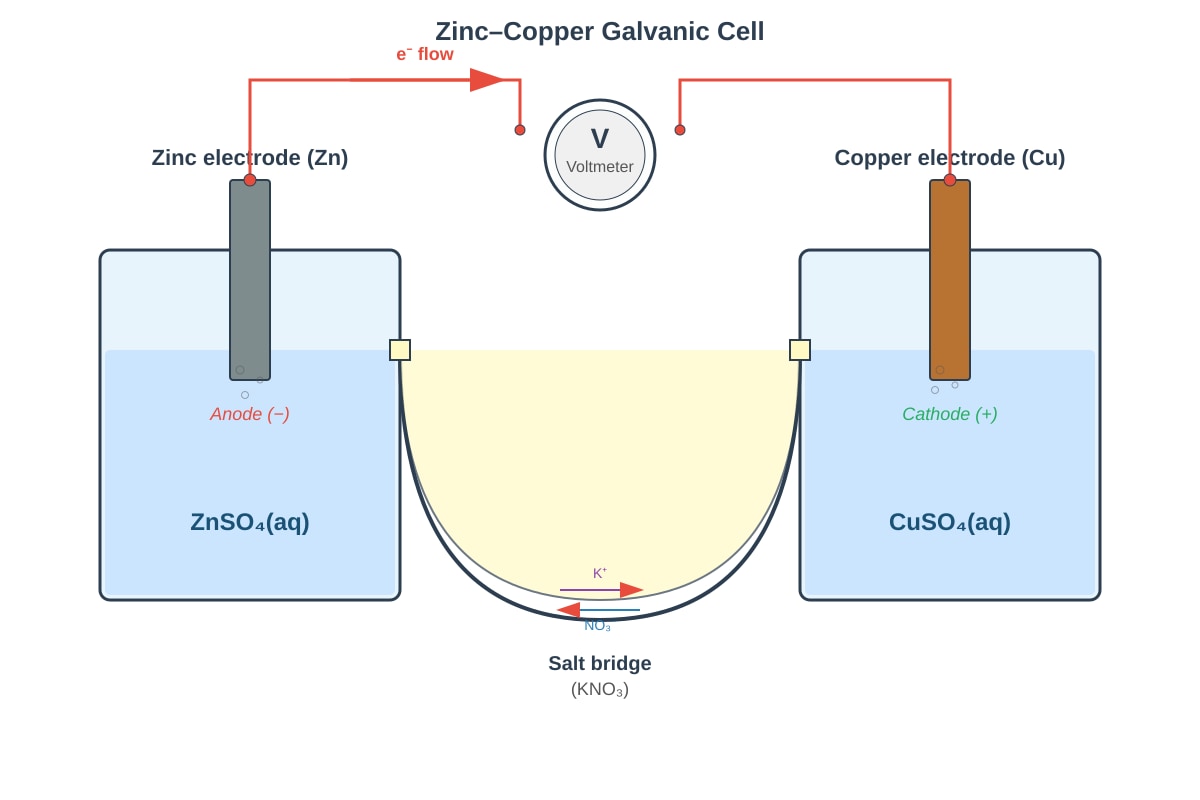
(a) [1 mark] Answer: The salt bridge completes the circuit by allowing ions to flow between the two half-cells, maintaining electrical neutrality.
Explanation: Without the salt bridge, positive charge would build up in the anode compartment (as Zn²⁺ enters solution) and negative charge would build up in the cathode compartment (as Cu²⁺ is removed). The salt bridge allows NO₃⁻ ions to flow toward the anode and K⁺ ions to flow toward the cathode, balancing charge without mixing solutions.
(b) [1 mark] Answer: Electrons flow from zinc electrode (negative) to copper electrode (positive), or left to right as drawn.
Explanation: Zinc is more reactive than copper, so zinc metal is oxidised (loses electrons). Electrons travel through the external wire from the zinc half-cell to the copper half-cell, where Cu²⁺ ions are reduced to Cu metal.
(c) [1 mark] Answer: Cu²⁺ + 2e⁻ → Cu
Explanation: At the copper electrode (cathode), copper ions gain electrons and are reduced to copper metal. This is where reduction occurs because copper has a more positive reduction potential than zinc.
Question 8 [4 marks]
(a) [2 marks] Answer: A standard hydrogen electrode (SHE) consists of hydrogen gas at 1 atm pressure bubbled over a platinum electrode coated with platinum black, immersed in a solution containing H⁺ ions at 1 mol/dm³ concentration, at 298 K (25°C). By convention, its electrode potential is defined as 0.00 V.
Marking breakdown:
- [1 mark] for correct physical description (H₂ gas, Pt electrode, H⁺ at 1 mol/dm³)
- [1 mark] for standard conditions (298 K, 1 atm, 1 mol/dm³) and E° = 0.00 V
(b) [2 marks] Answer: Yes, Fe³⁺ will oxidise I⁻ to I₂. E°cell = E°(cathode) − E°(anode) = +0.77 − (+0.54) = +0.23 V. Since E°cell is positive, the reaction is feasible.
Explanation:
- Fe³⁺/Fe²⁺ has more positive E° (+0.77 V) than I₂/I⁻ (+0.54 V)
- Therefore Fe³⁺ is the stronger oxidising agent (more tendency to be reduced)
- Fe³⁺ will accept electrons from I⁻, oxidising I⁻ to I₂ while being reduced to Fe²⁺
Marking breakdown:
- [1 mark] for correct prediction with reasoning about E° values
- [1 mark] for calculating or stating that E°cell is positive
Question 9 [3 marks]
(a) [1 mark] Answer: From +4 to +2, a decrease of 2.
Working:
- In MnO₂: x + 2(−2) = 0, so x = +4
- In MnCl₂: x + 2(−1) = 0, so x = +2
- Change: +4 → +2
(b) [2 marks] Answer:
- Manganese is reduced: oxidation state decreases from +4 to +2, gaining electrons
- Chlorine is oxidised: in HCl, Cl has oxidation state −1; in Cl₂, Cl has oxidation state 0. Some chloride ions lose electrons to form chlorine gas
Explanation: Not all HCl is oxidised—only the chloride ions that form Cl₂. The chloride in MnCl₂ remains at −1. This is a disproportionation-related observation where HCl acts as both acid source and reducing agent.
Marking breakdown:
- [1 mark] for identifying manganese reduction with oxidation state evidence
- [1 mark] for identifying chlorine oxidation with correct oxidation states
Question 10 [3 marks]
(a) [1 mark] Answer: Graphite electrodes are inert because they do not react with the molten electrolyte or products; they merely provide a surface for electron transfer without being consumed or altered.
(b) (i) [1 mark] Answer: Pb²⁺ + 2e⁻ → Pb
Explanation: Lead ions are attracted to the negative cathode, where they gain electrons and are reduced to molten lead metal.
(ii) [1 mark] Answer: 2Br⁻ → Br₂ + 2e⁻
Explanation: Bromide ions are attracted to the positive anode, where they lose electrons and are oxidised to bromine vapour.
Question 11 [3 marks]
(a) [1 mark] Answer: This is electroplating, because a thin layer of one metal (copper) is deposited onto another metal object (the rod) using electricity.
(b) [2 marks] Answer: Iron is more reactive than copper, so if the iron surface is not perfectly clean and oxide-free, or if the electrolyte composition is not carefully controlled, the copper deposit may be powdery, non-uniform, or poorly adherent. Iron may also form a thin oxide layer that prevents direct metal-to-metal bonding.
Marking breakdown:
- [1 mark] for noting iron's greater reactivity or oxide layer issues
- [1 mark] for explaining consequence (poor adhesion, powdery deposit)
Question 12 [2 marks]
(a) [1 mark] Answer: Mg > Zn > Fe > Cu (most reactive to least reactive)
Explanation from results:
- Mg displaces Cu (Mg most reactive so far)
- Cu cannot displace Zn (Zn more reactive than Cu)
- Zn displaces Fe (Zn more reactive than Fe, but we need to place Fe relative to Mg)
Order: Mg > Zn > Fe > Cu
(b) [1 mark] Answer: Copper is less reactive than zinc, so copper cannot displace zinc from zinc nitrate; zinc ions have greater tendency to remain as ions than copper ions have to displace them.
Question 13 [3 marks]
(a) [1 mark] Answer: 2:1 (hydrogen:oxygen)
(b) [2 marks] Answer: At cathode: 4H⁺ + 4e⁻ → 2H₂ (two molecules of H₂ from 4 electrons) At anode: 4OH⁻ → O₂ + 2H₂O + 4e⁻ (one molecule of O₂ from 4 electrons)
Since the same quantity of electricity (4 moles of electrons) produces 2 volumes of H₂ and 1 volume of O₂, the ratio is 2:1.
Alternative using water as source: Cathode: 2H₂O + 2e⁻ → H₂ + 2OH⁻ Anode: 2H₂O → O₂ + 4H⁺ + 4e⁻
To match electrons: multiply cathode equation by 2: 4H₂O + 4e⁻ → 2H₂ + 4OH⁻
Now 4 electrons produce 2H₂ and 1O₂, giving 2:1 ratio.
Marking breakdown:
- [1 mark] for correct relevant half-equations
- [1 mark] for electron matching leading to 2:1 ratio
Question 14 [3 marks]
(a) [1 mark] Answer: The bicycle handlebar (steel) is made the cathode (negative electrode).
(b) [2 marks] Answer: A low current for longer time allows controlled, gradual deposition of chromium ions, permitting them to arrange regularly in the metallic lattice and settle smoothly on the surface. A high current causes rapid deposition, producing a rough, brittle, nodular coating with internal stress and poor adhesion.
Marking breakdown:
- [1 mark] for explaining that low current allows ordered/gradual deposition
- [1 mark] for explaining that high current causes rapid, uneven, rough deposition
Question 15 [4 marks]
(a) (i) [1 mark] Answer: −1
Working: Let oxidation state of N = x. In NH₂OH: x + 2(+1) + (−2) + (+1) = 0, so x + 2 − 2 + 1 = 0, thus x = −1.
(Alternatively: x + 2 + (−2) + 1 = 0 for H₂N-O-H structure)
(ii) [1 mark] Answer: +1
Working: In N₂O: 2x + (−2) = 0, so 2x = +2, x = +1.
(b) [2 marks] Answer: Nitrogen's oxidation state increases from −1 in NH₂OH to +1 in N₂O (increase of 2 per N atom, or 4 overall for N₂O formation). An increase in oxidation state indicates loss of electrons, which is oxidation. The species that is oxidised causes reduction in another species, so hydroxylamine acts as a reducing agent.
Marking breakdown:
- [1 mark] for correct oxidation state change (−1 to +1)
- [1 mark] for linking oxidation to reducing agent function
Section C: Extended Response
Question 16 [3 marks]
Answer structure and marking guidance:
Electrochemical corrosion process [2 marks]:
- Anodic region (iron surface impurities/stressed areas): Fe → Fe²⁺ + 2e⁻ (oxidation, iron loses electrons) [1 mark]
- Cathodic region (oxygen-rich areas): O₂ + 2H₂O + 4e⁻ → 4OH⁻ (reduction) [1 mark]
- Fe²⁺ and OH⁻ combine, further oxidise to Fe(OH)₃, which dehydrates to rust (Fe₂O₃·nH₂O)
Sacrificial protection with zinc [1 mark]:
- Zinc is more reactive than iron (higher in reactivity series), so zinc is oxidised preferentially: Zn → Zn²⁺ + 2e⁻
- Zinc sacrifices itself, protecting iron from oxidation; electrons flow from zinc to iron, keeping iron as the cathode in local cells
- Zinc blocks must be replaced periodically as they corrode away
Common mistakes to flag:
- Students describe zinc as "coating" rather than understanding electrochemical protection
- Confusing anode and cathode in rusting mechanism
- Not mentioning that zinc is oxidised preferentially due to higher reactivity
Question 17 [2 marks]
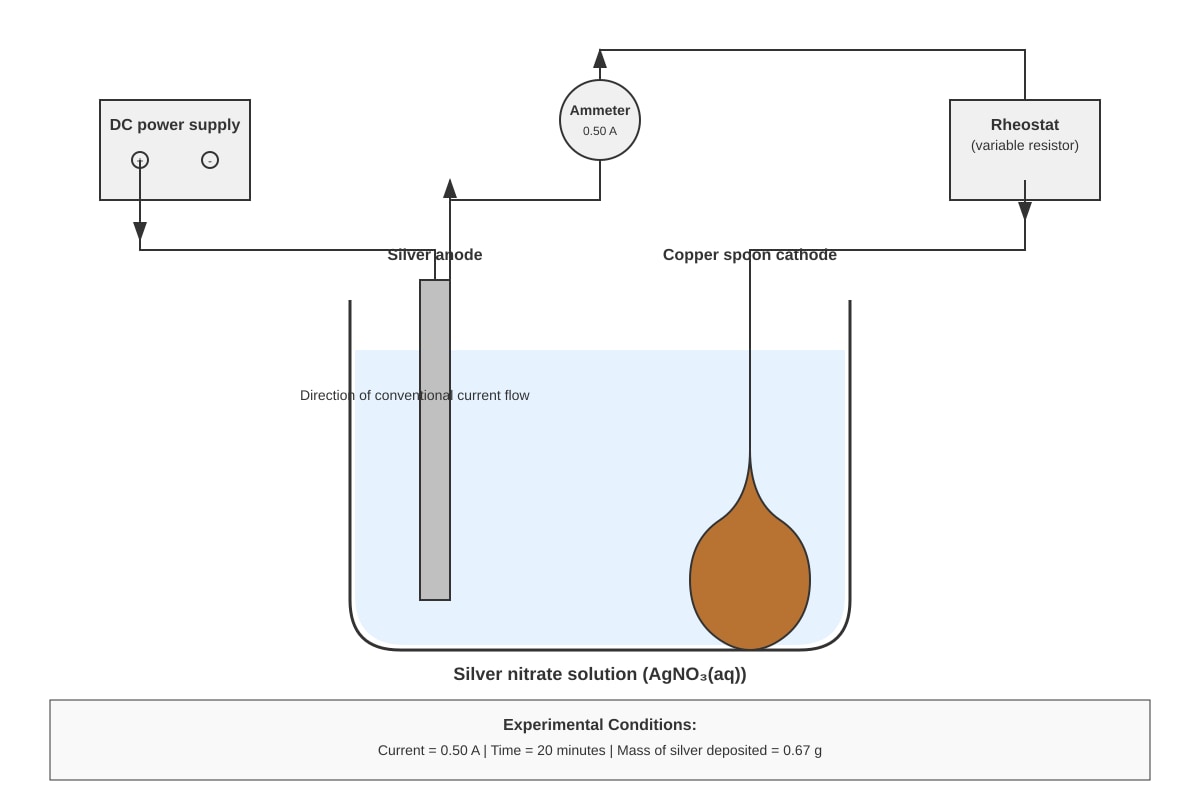
(a) [1 mark] Answer: The silver anode dissolves as Ag → Ag⁺ + e⁻, releasing silver ions into the solution to replace those deposited on the cathode, maintaining constant Ag⁺ concentration in the electrolyte.
(b) [1 mark] Answer:
Or approximately 6.204 × 10⁻³ mol
Calculation:
Question 18 [3 marks]
(a) [1 mark] Answer: In SO₂: +4; In SO₄²⁻: +6
Working for SO₂: x + 2(−2) = 0, x = +4 Working for SO₄²⁻: x + 4(−2) = −2, x − 8 = −2, x = +6
(b) [2 marks] Answer: The oxidising agent is Cr₂O₇²⁻ (potassium dichromate(VI) / dichromate ion).
Explanation: Chromium's oxidation state decreases from +6 in Cr₂O₇²⁻ to +3 in Cr³⁺. A decrease in oxidation state indicates gain of electrons (reduction). The species that is reduced is the oxidising agent because it causes oxidation in another species (SO₂ to SO₄²⁻, where sulfur increases from +4 to +6).
Marking breakdown:
- [1 mark] for correct identification with oxidation state evidence for Cr
- [1 mark] for explaining the oxidising agent is the species being reduced, linking to oxidation of sulfur
Question 19 [3 marks]
(a) [2 marks] Answer:
Working:
- MnO₄⁻ equation needs 5e⁻, H₂C₂O₄ equation produces 2e⁻
- LCM of 5 and 2 = 10 electrons
- Multiply MnO₄⁻ equation by 2 (10 electrons, 2 MnO₄⁻, 16 H⁺, 2 Mn²⁺, 8 H₂O)
- Multiply H₂C₂O₄ equation by 5 (10 electrons, 5 H₂C₂O₄, 10 CO₂, 10 H⁺)
- Add and simplify: 16H⁺ − 10H⁺ (from products side when reversing) = 6H⁺ remaining, but check carefully:
Actually: 2 × [MnO₄⁻ + 8H⁺ + 5e⁻ → Mn²⁺ + 4H₂O] gives 2MnO₄⁻ + 16H⁺ + 10e⁻ → 2Mn²⁺ + 8H₂O
5 × [H₂C₂O₄ → 2CO₂ + 2H⁺ + 2e⁻] gives 5H₂C₂O₄ → 10CO₂ + 10H⁺ + 10e⁻
Adding: 2MnO₄⁻ + 16H⁺ + 5H₂C₂O₄ → 2Mn²⁺ + 8H₂O + 10CO₂ + 10H⁺
Simplify: 2MnO₄⁻ + 6H⁺ + 5H₂C₂O₄ → 2Mn²⁺ + 8H₂O + 10CO₂
Check atoms and charges balance on both sides.
Marking breakdown:
- [1 mark] for correct multiplication to balance electrons
- [1 mark] for correctly simplified final equation with all species balanced
(b) [1 mark] Answer: Purple/pink to colourless (very pale pink) / or decolourised
Explanation: MnO₄⁻ ions are intensely purple. As they are reduced to nearly colourless Mn²⁺ ions (very pale pink, appears colourless in dilute solution), the purple colour disappears. This colour change makes the reaction self-indicating.
Question 20 [3 marks]
Answer structure with marking guidance:
| Aspect | Chemical oxidation (acidified K₂Cr₂O₇) | Biochemical oxidation (bacteria + O₂) |
|---|---|---|
| Oxidising agent | Dichromate(VI) ions (Cr₂O₇²⁻), inorganic compound | Oxygen (O₂) from air, catalysed by enzymes in Acetobacter bacteria |
| Reaction conditions | Strongly acidic (H₂SO₄), elevated temperature, controlled concentration | Room temperature, neutral/slightly acidic pH, requires bacterial culture, longer time |
| Atom economy / Environmental impact | Produces Cr³⁺ waste; chromium compounds are toxic and require disposal; lower atom economy due to by-products | High atom economy; O₂ as oxidant becomes H₂O; biodegradable, environmentally friendly; renewable process |
Marking breakdown [3 marks]:
- [1 mark] for correct identification and comparison of oxidising agents
- [1 mark] for clear contrast of reaction conditions (temperature, pH, time, catalyst/enzyme)
- [1 mark] for environmental comparison: chemical method produces toxic waste vs biochemical method being green/sustainable with oxygen/water as by-products
Teaching note: The biochemical method is the basis of traditional vinegar production. Acetobacter bacteria oxidise ethanol to ethanoic acid aerobically. Industrially, this is done in aerated tanks (acetifiers) at ~30°C, with the bacteria living as a biofilm on wood shavings or synthetic packing material.
END OF ANSWER KEY