AI Generated Quiz
Secondary 3 Chemistry Redox Electrochemistry Quiz
Free Sec 3 Chemistry Redox Electrochemistry quiz, HY3 AI version, with questions, answers, and O Level-style practice for Singapore students.
These static practice materials are generated from the site's syllabus and paper-generation workflow, with source and model context shown so students and parents can evaluate the material before use.
Questions
Secondary 3 Chemistry Quiz - Redox Electrochemistry
Name: ___________________________
Class: ______________
Date: ______________
Score: _______ / 40
Duration: 50 minutes
Total Marks: 40
Instructions:
- Answer all 20 questions.
- Section A: Multiple-choice style short items (1 mark each).
- Section B: Structured short answers (2 marks each).
- Section C: Extended reasoning and calculation (3–4 marks each).
- Write your answers clearly in the spaces provided.
- Use chemical symbols and equations where appropriate.
Note: This quiz is generated from syllabus-first LLM templates. Past-year paper evidence for Redox & Electrochemistry at Sec 3 is weak (≈2% of extracted blocks); content is aligned to the 2023 O-Level Chemistry syllabus but is not claimed to be exam-derived.
Section A (Questions 1–5, 1 mark each)
1. Which of the following processes is an example of oxidation?
A. Gain of electrons
B. Loss of oxygen
C. Loss of electrons
D. Gain of hydrogen
2. In the reaction Zn+Cu2+→Zn2++Cu, which species is reduced?
A. Zn
B. Cu2+
C. Zn2+
D. Cu
3. What is the oxidation state of iron in Fe2O3?
A. +2
B. +3
C. –2
D. –3
4. Which metal is most likely to be the strongest reducing agent among Zn, Cu, and Ag?
A. Zn
B. Cu
C. Ag
D. They are equal
5. In a simple electrochemical cell, electrons flow from the __________ electrode to the __________ electrode externally.
A. cathode, anode
B. anode, cathode
C. positive, negative
D. neutral, charged
Section B (Questions 6–10, 2 marks each)
6. Define oxidation and reduction in terms of oxygen transfer.
7. Write the ionic half-equation for the reduction of Cu2+ ions at a copper electrode.
8. A student places a zinc rod in copper(II) sulfate solution. Describe what is observed after 10 minutes.
9. State two differences between a chemical redox reaction in a test tube and a reaction in an electrochemical cell.
10. Given the reactivity series: Mg > Zn > Fe > Cu > Ag, predict whether iron will displace copper from copper(II) nitrate solution. Explain.
Section C (Questions 11–20, 3–4 marks each)
11. (a) Assign oxidation states to each element in H2SO4. [2]
(b) Hence state whether sulfur is oxidised or reduced compared to elemental sulfur (oxidation state 0). [1]
12. Magnesium reacts with hydrochloric acid:
Mg+2HCl→MgCl2+H2
(a) Identify the reducing agent. [1]
(b) Write the two half-equations. [2]
(c) Explain why the reaction stops if excess acid is used but magnesium is finished. [1]
13. A simple cell is made using zinc and copper electrodes in their own sulfate solutions, connected by a salt bridge.
(a) Label the anode and cathode. [1]
(b) Write the overall cell reaction. [1]
(c) State the direction of electron flow in the external wire. [1]
(d) Give one reason why a salt bridge is needed. [1]
14. Calculate the mass of copper deposited when 0.020 mol of electrons pass through a Cu2+ electroplating cell.
(Relative atomic mass of Cu = 63.5; Cu2++2e−→Cu) [3]
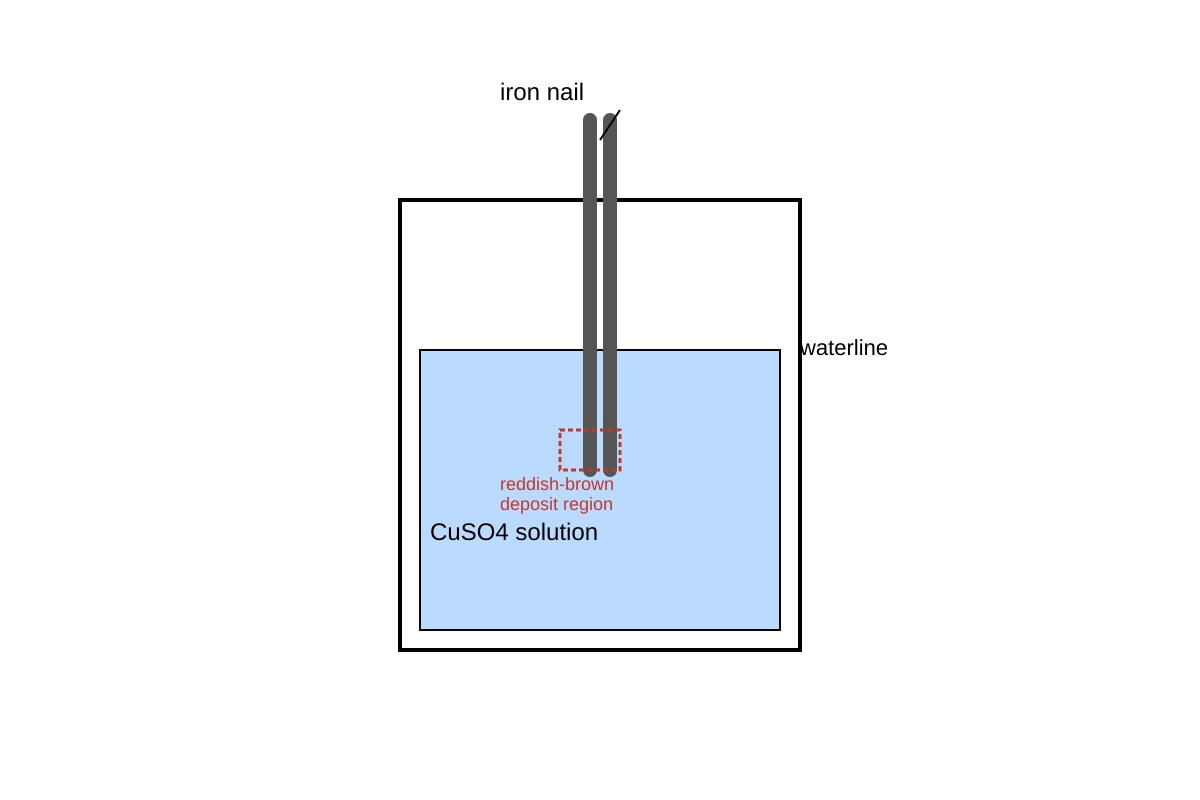
15. The diagram below shows an experimental setup.
Image pending generation: experimental_setup for Q15.
Explain the redox reaction occurring and name the observed product on the nail. [3]
16. (a) What is meant by "oxidising agent"? [1]
(b) Give one example of a common oxidising agent in the lab and write its reduction half-equation. [2]
17. Using the reactivity series K > Na > Ca > Mg > Al > Zn > Fe > Sn > Pb > Cu > Ag > Au, arrange the following in order of increasing strength as reducing agents: Au, Zn, Fe. [2]
Explain your order. [1]
18. A student constructs a cell with lead and silver electrodes.
Given: Pb is more reactive than Ag.
(a) Which is the anode? [1]
(b) Write the half-equation at the anode. [1]
(c) State the overall reaction. [2]
19. Hydrogen peroxide can act as both oxidising and reducing agent.
(a) In the reaction H2O2+2I−+2H+→I2+2H2O, state the oxidation state change of iodine and identify the role of H2O2. [2]
(b) Explain how the same substance can have both roles in different reactions. [1]
20. A copper electroplating circuit uses a current of 0.50 A for 30 minutes with Cu2+ solution.
(Faraday constant = 96500 C/mol; Cu = 63.5)
(a) Calculate charge passed. [1]
(b) Calculate moles of electrons. [1]
(c) Calculate mass of Cu deposited. [2]
Answers
Secondary 3 Chemistry Quiz - Redox Electrochemistry (Answer Key)
Total Marks: 40
Teaching notes included for each item. Syllabus-first generated content; not past-year derived.
Section A
1. C [1]
Oxidation is loss of electrons (OIL: Oxidation Is Loss). Gain of electrons is reduction; loss of oxygen and gain of hydrogen are reduction in the older oxygen/hydrogen definitions.
2. B [1]
Cu2+ gains 2 electrons to become Cu, so it is reduced. Zn loses electrons (oxidised).
3. B [1]
In Fe2O3: O = –2 each (total –6). Two Fe must total +6, so each Fe = +3.
4. A [1]
Zn is highest in reactivity series among the three, loses electrons most readily → strongest reducing agent.
5. B [1]
Electrons flow externally from anode (negative, oxidation) to cathode (positive, reduction).
Section B
6. [2]
- Oxidation: gain of oxygen (or loss of hydrogen). [1]
- Reduction: loss of oxygen (or gain of hydrogen). [1]
Teaching: These are the classical definitions before electron-transfer idea.
7. [2]
Cu2+(aq)+2e−→Cu(s) [2]
Teaching: Reduction is gain of electrons; copper ion gains 2 electrons to form metal.
8. [2]
- Blue solution becomes paler (Cu²⁺ removed). [1]
- Reddish-brown copper metal deposits on zinc rod. [1]
Teaching: Zn displaces Cu²⁺: Zn+Cu2+→Zn2++Cu.
9. [2]
Any two:
- Cell separates oxidation and reduction at different electrodes; test tube reaction occurs at same place. [1]
- Cell produces electric current; test tube reaction does not. [1]
- Cell uses salt bridge / external circuit; test tube mixes directly.
10. [2]
- Yes, iron will displace copper. [1]
- Fe is above Cu in series, so Fe is more reactive and reduces Cu²⁺ to Cu. [1]
Section C
11. [3]
(a) H = +1 (×2 = +2), O = –2 (×4 = –8), so S = +6. [2]
(b) S in H2SO4 is +6, higher than 0, so it is oxidised relative to elemental S. [1]
12. [4]
(a) Mg (it is oxidised, loses electrons). [1]
(b) Mg→Mg2++2e−; 2H++2e−→H2. [2]
(c) Mg is limiting; once consumed, no species left to supply electrons. [1]
13. [4]
(a) Anode = Zn, Cathode = Cu. [1]
(b) Zn+Cu2+→Zn2++Cu. [1]
(c) Zn → Cu (anode to cathode). [1]
(d) Completes circuit / allows ion migration to maintain neutrality. [1]
14. [3]
Step 1: Cu2++2e−→Cu → 2 mol e⁻ deposit 1 mol Cu. [1]
Step 2: mol Cu = 0.020 ÷ 2 = 0.010 mol. [1]
Step 3: mass = 0.010 × 63.5 = 0.635 g. [1]
Answer: 0.635 g Cu.
15. [3]
- Redox: Fe (more reactive) oxidised: Fe→Fe2++2e−. [1]
- Cu²⁺ reduced: Cu2++2e−→Cu. [1]
- Product on nail: reddish-brown copper metal. [1]
Image must show nail with deposit and blue solution.
16. [3]
(a) Substance that accepts electrons / causes oxidation of another. [1]
(b) e.g., acidified KMnO4 or H2O2; reduction: MnO4−+8H++5e−→Mn2++4H2O (or H2O2+2H++2e−→2H2O). [2]
17. [3]
Order: Au < Fe < Zn (increasing reducing strength). [2]
Explanation: Lower in series = less reactive = weaker reducer; Zn highest among them. [1]
18. [4]
(a) Pb anode. [1]
(b) Pb→Pb2++2e−. [1]
(c) Pb+2Ag+→Pb2++2Ag. [2]
19. [3]
(a) I: –1 → 0 (oxidised); H2O2 is oxidising agent. [2]
(b) O in H2O2 is –1, can go to –2 (oxidising) or 0 (reducing). [1]
20. [4]
(a) Q = I × t = 0.50 × (30×60) = 900 C. [1]
(b) n(e⁻) = 900 ÷ 96500 = 0.00933 mol. [1]
(c) mol Cu = 0.00933 ÷ 2 = 0.00466 mol; mass = 0.00466 × 63.5 = 0.296 g. [2]
Answer: 0.296 g Cu.
Free quiz and exam paper access
Enter your details to view this paper
Your access is remembered on this device.