AI Generated Quiz
Secondary 3 Chemistry Periodic Table Quiz
Free Sec 3 Chemistry Periodic Table quiz, Kimi2.6 AI version, with questions, answers, and O Level-style practice for Singapore students.
These static practice materials are generated from the site's syllabus and paper-generation workflow, with source and model context shown so students and parents can evaluate the material before use.
Questions
Free quiz and exam paper access
Enter your details to view this paper
Your access is remembered on this device.
Answers
Secondary 3 Chemistry Quiz - Periodic Table: Answer Key
Total Marks: 40
Section A: Multiple Choice
Question 1 [2 marks]
Answer: C) They all have one electron in their outermost shell
Explanation: Group I metals (alkali metals) are characterized by having one electron in their outermost shell. This single valence electron is readily lost, giving them similar chemical properties.
- Option A is incorrect: Group I metals form ionic compounds, not covalent compounds, due to their tendency to lose electrons.
- Option B is incorrect: Reactivity increases down Group I because the outermost electron is farther from the nucleus and more easily lost.
- Option D is incorrect: Melting points generally decrease down Group I due to weaker metallic bonding as atomic size increases.
Common mistake: Confusing trends in reactivity and melting points—remember that increased ease of losing electrons means increased reactivity.
Question 2 [2 marks]
Answer: B) Period 3, Group VII
Explanation: The electron configuration 2.8.7 tells us:
- Period number = number of electron shells = 3 (electrons arranged in shells 2, 8, and 7)
- Group number = number of valence electrons = 7
The element is chlorine (Cl), located in Period 3, Group VII.
Common mistake: Counting the 8 electrons in the second shell as valence electrons. Only the outermost shell electrons are valence electrons.
Question 3 [2 marks]
Answer: A) Forming coloured compounds
Explanation: Transition metals are distinguished by their ability to form coloured compounds due to partially filled d-orbitals that allow d-d electron transitions.
- Option B: Both transition metals and Group II metals form basic oxides.
- Option C: Both have relatively high melting points (though transition metals generally higher).
- Option D: Both react with dilute acids to produce hydrogen.
Common mistake: Assuming all metals with high melting points or acid reactivity are transition metals—coloured compounds and variable oxidation states are the key distinguishing features.
Question 4 [2 marks]
Answer: B) Decreases due to increasing nuclear charge
Explanation: Across Period 3, protons are added to the nucleus while electrons enter the same principal shell. The increasing nuclear charge (more protons) pulls the electron cloud more tightly inward, reducing the atomic radius.
- The same number of electron shells means shielding is roughly constant.
- The effective nuclear charge increases, drawing electrons closer.
Common mistake: Choosing A—more electron shells are added going down a group, not across a period.
Question 5 [2 marks]
Answer: C) Group V
Explanation: For oxide Y₂O₅:
- Total oxygen valency = 5 × 2 = 10 (each O has valency 2)
- Total element Y valency = 10 (balancing the oxide)
- Y has valency = 10 ÷ 2 = 5
Elements with valency 5 belong to Group V (5 valence electrons, can form 5 covalent bonds or share 5 electrons).
Alternatively: The formula shows Y has oxidation state +5 (since O is -2: 2Y + 5(-2) = 0, so Y = +5). Group V elements commonly exhibit +5 oxidation state.
Section B: Short Answer
Question 6 [2 marks]
Answer: A group (or family) is a vertical column of elements in the Periodic Table [1] that have the same number of electrons in their outermost shell (same number of valence electrons) [1], giving them similar chemical properties.
Teaching note: There are 18 groups in the modern Periodic Table. The main groups (I, II, III, IV, V, VI, VII, 0) are numbered conventionally in many Singapore contexts, though IUPAC uses 1-18.
Question 7 [3 marks]
Answer:
- Potassium has electron configuration 2.8.8.1; sodium has 2.8.1 [1]
- Potassium has more electron shells (4 vs 3), so the outermost electron is farther from the nucleus [1]
- The outermost electron in potassium is more shielded from the nuclear attraction and less strongly attracted, so it is more easily lost [1]
Therefore, potassium reacts more vigorously as it can lose its valence electron more readily.
Marking breakdown: [1] for correct configurations, [1] for distance/shielding explanation, [1] for linking to ease of electron loss and reactivity.
Common mistake: Stating simply "potassium is more reactive" without explaining the electronic reason—examiners want the underlying mechanism.
Question 8 [3 marks]
(a) [1 mark]
Answer: 2.8.2 (or 1s² 2s² 2p⁶ 3s²)
(b) [2 marks]
Answer:
- Period 3: Magnesium has three electron shells (electrons in shells up to n=3) [1]
- Group II: Magnesium has two electrons in its outermost shell (valence electrons = 2) [1]
Question 9 [4 marks]
(a) [2 marks]
Answer: Bromine has the higher boiling point [1]
Explanation: Both are simple molecular substances with London dispersion forces (instantaneous dipole-induced dipole forces). Bromine molecules (Br₂) are larger and have more electrons than chlorine molecules (Cl₂), so there are stronger intermolecular forces that require more energy to overcome [1].
Common mistake: Confusing bond strength with intermolecular force strength—the covalent bond within each Cl₂/Br₂ molecule is strong, but the weak forces between molecules determine boiling point.
(b) [2 marks]
Answer: Cl₂(aq) + 2KBr(aq) → 2KCl(aq) + Br₂(aq) [1 for correct formulas, 1 for state symbols and balancing]
Or ionic: Cl₂(aq) + 2Br⁻(aq) → 2Cl⁻(aq) + Br₂(aq)
Explanation: Chlorine is more reactive than bromine (higher up Group VII), so it displaces bromine from its compound. This is a redox reaction where chlorine is reduced (gains electrons) and bromide is oxidized (loses electrons).
Question 10 [3 marks]
(a) [1 mark]
Answer: Silicon is a semiconductor (conducts electricity under certain conditions); phosphorus is a non-conductor/poor conductor (insulator).
(b) [2 marks]
Answer:
- Silicon has a giant covalent structure (network solid) [0.5] where each silicon atom is bonded to four others in a tetrahedral arrangement; at room temperature, few electrons are free to move, but some can be excited [0.5]
- Phosphorus exists as simple molecules (P₄) [0.5] with no free electrons and all valence electrons involved in bonding, so it cannot conduct electricity [0.5]
Question 11 [3 marks]
(a) [1 mark]
Answer: None of these elements is a transition metal [0.5]
Reason: Transition metals typically have high densities (much higher than 2.70 g/cm³), high melting points, and variable oxidation states/coloured compounds [0.5]. Element W (aluminium, atomic number 13) has good conductivity but is not a transition metal—it has a fixed +3 oxidation state and forms colourless compounds.
Teaching note: Atomic number 13 confirms W is aluminium, a Group III metal, not a transition metal. Transition metals start at atomic number 21 (scandium).
(b) [2 marks]
Answer:
- Silicon has a giant covalent structure/network solid with strong covalent bonds between atoms [1]
- Element Y (chlorine, atomic number 17) has a simple molecular structure with weak intermolecular forces between Cl₂ molecules [0.5]
- Much more energy is needed to break the strong covalent bonds in silicon than the weak intermolecular forces in chlorine [0.5]
Question 12 [3 marks]
(a) [1 mark]
Answer: 2.8 (or 1s² 2s² 2p⁶)
Explanation: Aluminium (2.8.3) loses its 3 valence electrons to form Al³⁺, achieving a stable noble gas configuration like neon.
(b) [2 marks]
Answer:
- Amphoteric means aluminium oxide/hydroxide can react with both acids and bases [0.5]
- Aluminium oxide reacts with acid: Al₂O₃ + 6HCl → 2AlCl₃ + 3H₂O [0.5]
- Aluminium oxide reacts with base: Al₂O₃ + 2NaOH + 3H₂O → 2Na[Al(OH)₄] (or Al₂O₃ + 2NaOH → 2NaAlO₂ + H₂O) [0.5]
- Sodium oxide is only basic, reacting with acids but not bases, because sodium is a more reactive metal with purely ionic bonding [0.5]
Section C: Structured Response
Question 13 [5 marks]
(a) [1 mark]
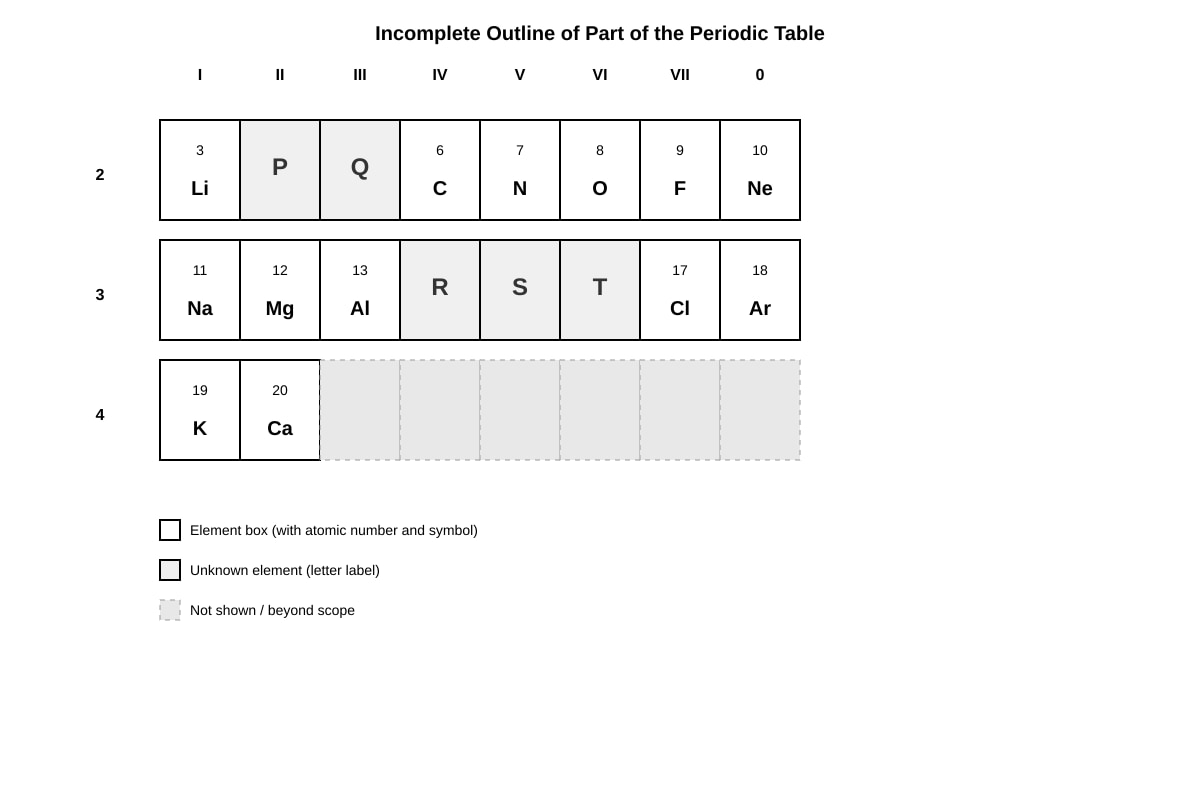
Answer: Element P is in the p-block, Group III
Reasoning: P is in Period 3, Group III position (next to magnesium, Group II). Electron configuration would be 2.8.3.
(b) [2 marks]
Answer:
- Q is in Group VI (forms 2⁻ ion, needs 2 electrons to complete octet) [1]
- Calcium is in Group II, forms Ca²⁺
- Formula: CaQ (or CaS if Q is sulfur, etc.) [1]
Balancing charges: Ca²⁺ and Q²⁻ give neutral compound CaQ.
(c) [2 marks]
Answer:
- Ionic radius of R⁺ is smaller than atomic radius of R [1]
- R⁺ has lost its outermost electron shell (one fewer shell of electrons) [0.5]
- The remaining electrons experience greater effective nuclear charge (same number of protons pulling fewer electrons), pulling electron cloud inward [0.5]
Question 14 [5 marks]
(a) [3 marks]
Answer: First ionization energy generally increases across Period 3 [1]
Explanation:
- Nuclear charge increases (more protons) [0.5]
- Electrons are added to the same principal shell, so shielding is roughly constant [0.5]
- Outer electrons are held more tightly, requiring more energy to remove [0.5]
- Atomic radius decreases, so electrons are closer to the nucleus [0.5]
(b) [2 marks]
Answer:
- Magnesium has electron configuration [Ne] 3s² with fully filled 3s subshell, which is relatively stable [1]
- Aluminium has configuration [Ne] 3s² 3p¹; the 3p electron is higher in energy and slightly farther from the nucleus (shielded by 3s electrons), so it is easier to remove despite the extra proton [1]
Question 15 [5 marks]
(a) [2 marks]
Answer: Any two from:
- Higher density than calcium (iron: 7.87 g/cm³ vs calcium: 1.55 g/cm³) [1]
- Variable oxidation states (Fe²⁺ and Fe³⁺ vs only Ca²⁺) [1]
- Forms coloured compounds [1]
- Higher melting point (1538°C vs 842°C) [1]
- Catalytic properties [1]
- Forms complex ions [1]
(b) [1 mark]
Answer: Iron(III) chloride / FeCl₃ — yellow-brown solution [0.5 each] OR Iron(II) sulfate / FeSO₄ — pale green solution OR Iron(III) oxide / Fe₂O₃ — reddish-brown solid
(c) [2 marks]
Answer: FeO (iron(II) oxide, where iron is +2) [1] FeCl₃ (iron(III) chloride, where iron is +3) [1]
Question 16 [4 marks]
(a) [2 marks]
Answer:
- "Inert" meant these gases were thought to be completely unreactive and unable to form compounds [1]
- This is now considered less accurate because some noble gases do form compounds under special conditions (e.g., xenon compounds with fluorine and oxygen, krypton difluoride) [1]
(b) [2 marks]
Answer:
- Xenon has very large atomic radius with the outermost electrons far from the nucleus [1]
- The nuclear attraction on these outer electrons is weakened (shielded by inner electrons), and the energy gap between filled and empty orbitals is small enough that electrons can be promoted or shared with highly electronegative atoms like fluorine [1]
Question 17 [3 marks]
(a) [2 marks]
Answer:
- Titanium is more reactive than carbon in the reactivity series (or: carbon cannot displace titanium from its compound) [1]
- Sodium is more reactive than titanium, so it can reduce titanium(IV) chloride to titanium metal [1]
(b) [1 mark]
Answer: Any suitable answer:
- Sodium is highly reactive/dangerous to handle, reacting violently with water/moisture [1]
- High energy costs of producing sodium by electrolysis [1]
- Chlorine gas produced as a by-product is toxic and must be contained [1]
Section D: Application and Analysis
Question 18 [4 marks]
(a) [2 marks]
Answer: Group II (alkaline earth metals) [1]
Reasoning:
- Formula MCl₂ shows M has valency 2 (two chloride ions, each -1, balance M's +2 charge)
- Relative atomic mass 40 suggests calcium (actual Ar = 40.08)
- White solid chloride, colourless solution—these properties match Group II metal chlorides [1]
(b) [2 marks]
Answer: M(s) + 2HCl(aq) → MCl₂(aq) + H₂(g) [1 for formulas, 1 for balancing and state symbols]
Or specifically: Ca(s) + 2HCl(aq) → CaCl₂(aq) + H₂(g)
Question 19 [6 marks]
(a) [2 marks]
Answer:
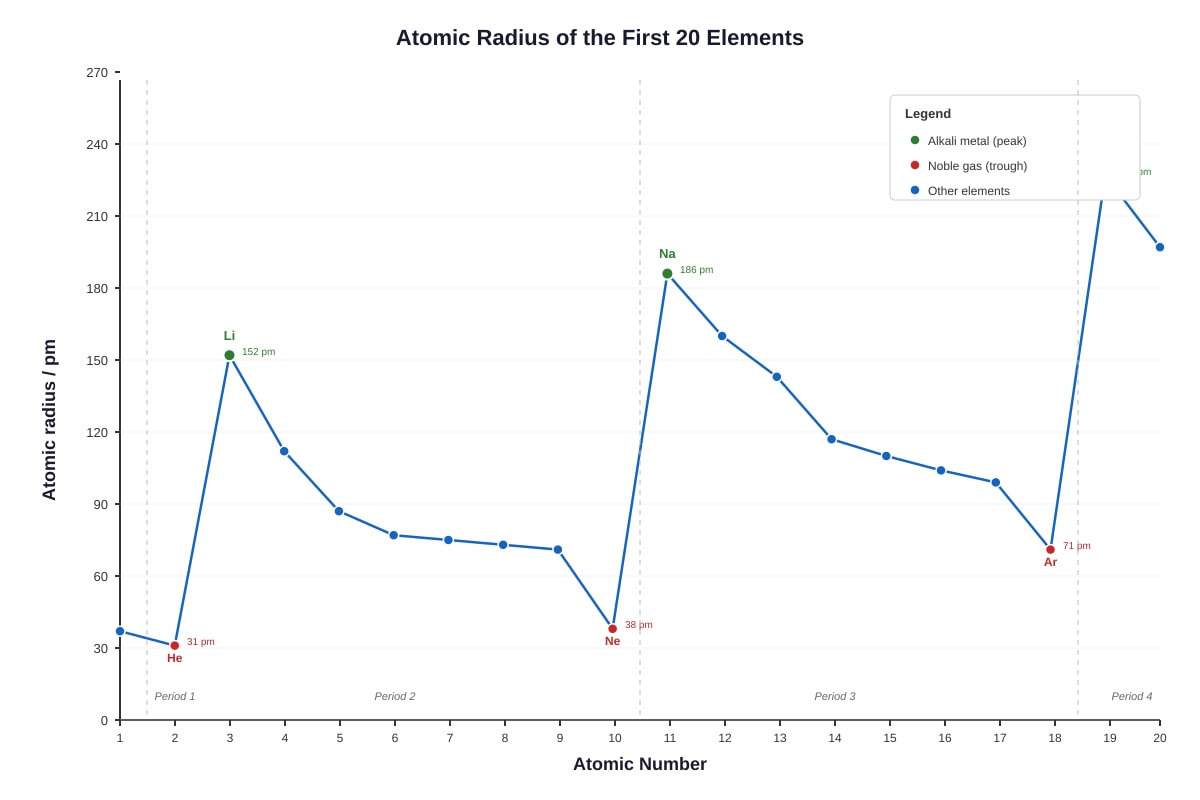
- From Li to F, nuclear charge increases (more protons) [1]
- Electrons are added to the same shell (n=2), so shielding is similar; the effective nuclear charge increases, pulling electrons closer and reducing radius [1]
(b) [2 marks]
Answer:
- Fluorine has electron configuration 2.7; sodium has 2.8.1 [0.5]
- Sodium has a new, third electron shell (n=3) that is farther from the nucleus [1]
- This new shell increases the atomic radius significantly despite the increased nuclear charge [0.5]
(c) [2 marks]
Answer:
- Argon would appear at a minimum/trough on the graph (between Ne and K in the pattern, actually at atomic number 18) [1]
- Argon has a full outer shell (2.8.8); the electron-electron repulsion in the filled shell and the effective nuclear charge create a very compact electron cloud, giving the smallest radius in Period 3 [1]
Teaching note: Noble gas atomic radii are measured differently (van der Waals radius vs covalent/metallic radii), but the general pattern shows minima at noble gases.
Question 20 [6 marks]
(a) [1 mark]
Answer: C < B < A < D (or: C, B, A, D in order of increasing reactivity)
(b) [1 mark]
Answer: Element C is aluminium [1]
Reasoning: Electron configuration 2.8.3 (13 electrons, atomic number 13), density 2.70 g/cm³ matches aluminium; it does not react with cold water due to its protective oxide layer.
(c) [2 marks]
Answer: Basic oxide [1]
Explanation: B is magnesium (Group II). Group II metals form basic oxides (MgO) that react with acids to form salts and water. The oxide ion O²⁻ accepts protons from acids [1].
(d) [2 marks]
Answer:
- Element A is sodium (2.8.1, density 0.97 g/cm³). It is stored under oil to prevent contact with air and moisture [1]
- If exposed: sodium would tarnish (lose shiny surface), react with oxygen to form sodium oxide (4Na + O₂ → 2Na₂O), react with water vapour to form sodium hydroxide, and eventually corrode completely [1]
END OF ANSWER KEY