AI Generated Quiz
Secondary 3 Chemistry Periodic Table Quiz
Free Sec 3 Chemistry Periodic Table quiz, HY3 AI version, with questions, answers, and O Level-style practice for Singapore students.
These static practice materials are generated from the site's syllabus and paper-generation workflow, with source and model context shown so students and parents can evaluate the material before use.
Questions
Free quiz and exam paper access
Enter your details to view this paper
Your access is remembered on this device.
Answers
Secondary 3 Chemistry Quiz - Periodic Table (Answer Key)
Total Marks: 40
Note: This is syllabus-first practice content from LLM-inferred templates. Not past-year exam derived.
Section A Answers (1–5)
1. [1] Noble gases have a full outer shell of electrons (stable octet/duplet), so they do not need to gain, lose, or share electrons.
Teaching note: Group 18 elements have 8 valence electrons (except He with 2). A full outer shell means low tendency to react.
2. [1] Proton number (atomic number).
Teaching note: Elements are placed left to right by increasing proton number, which defines the element.
3. [1] Atomic radius increases down the group.
Teaching note: More electron shells are added; inner shells shield the outer electron from the nucleus.
4. [1] Aluminium (Al) — best conductor in Period 3 among the listed context; if strictly Period 3 solid elements, Al is the most conductive metal.
Teaching note: Metals conduct due to delocalised electrons; Al is a metal in Period 3.
5. [1] MgO
Teaching note: Mg (Group 2) forms Mg, O forms O; formula is MgO.
Section B Answers (6–10)
6. [2]
(a) [1] A vertical column of elements with the same number of electrons in the outer shell.
(b) [1] 7 electrons.
Teaching note: Group number = number of valence electrons for Groups 1–2 and 13–18 (IUPAC 1–18). Group 17 has 7.
7. [3]
(a) [1] 2,8,7
(b) [2] Fluorine has fewer electron shells and a smaller atomic radius, so the outer electrons are closer to the nucleus and experience stronger attraction; it therefore gains an electron more readily.
Teaching note: Reactivity of halogens decreases down the group because atomic radius increases and shielding reduces effective nuclear pull.
8. [3]
(a) [1] Melting point decreases down the group.
(b) [2] 2K(s) + 2HO(l) → 2KOH(aq) + H(g)
Teaching note: State symbols required; K is solid, water liquid, KOH aqueous, hydrogen gas.
9. [3]
(a) [1] Be
(b) [2] Beryllium's outer electron is removed from a 2s orbital which is lower in energy and closer to nucleus than boron's 2p electron; also boron has one more proton but the 2p electron is easier to remove due to higher energy level and slight shielding by 2s.
Teaching note: Anomaly in Period 2 trend due to s-p subshell energy difference.
10. [2]
(a) [1] Crimson red / red
(b) [1] Group 1 (alkali metals)
Teaching note: Flame colours: Li red, Na yellow, K lilac.
Section C Answers (11–20)
11. [4]
(a) [1] Magnesium (Mg)
(b) [1] One valence electron / react with water / form +1 ions.
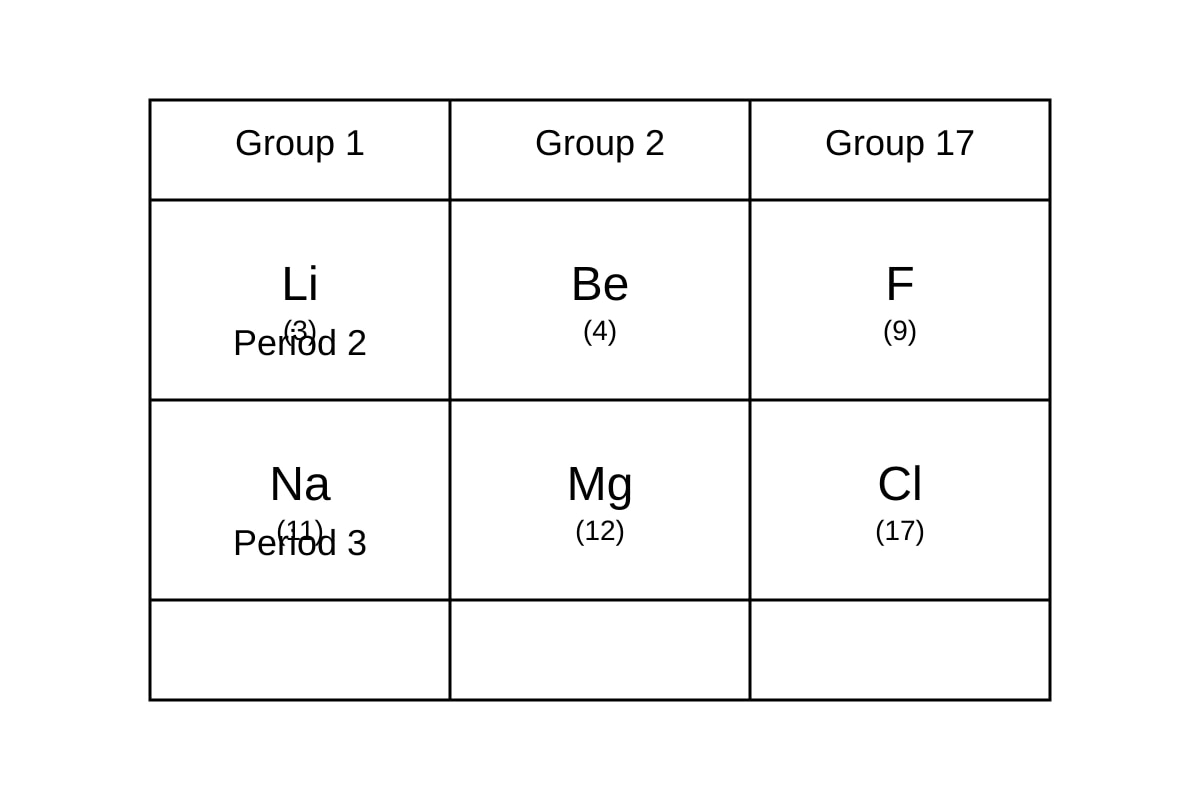
(c) [2] Cl has larger atomic radius. Reason: Cl is below F in Group 17, so it has more electron shells.
Image note: Placeholder must show Mg at atomic number 12 in Period 3 Group 2; F above Cl.
12. [3] Electronegativity increases from Na to Cl across Period 3. Reason: nuclear charge increases while atomic radius decreases, so the attraction for bonding electrons is stronger.
Marking: Trend (1), reason nuclear charge (1), reason radius (1).
13. [4]
(a) [1] Incorrect.
(b) [3] Atomic radius increases down the group due to more shells; shielding increases, so outer electron is easier to lose, making elements MORE reactive, not less.
Common mistake: Confusing radius decrease with increase.
14. [3]
(a) [1] Existing as single atoms not bonded to others.
(b) [2] Full outer shell means no need to form bonds; weak intermolecular forces only.
15. [4]
(a) [1] Atoms of same element with same proton number but different nucleon number (different neutrons).
(b) [3] RAM = (35 × 0.758) + (37 × 0.242) = 26.53 + 8.954 = 35.484 ≈ 35.5
Working shown line by line; final 35.5 to 1 d.p.
16. [4]
(a) [2] Effervescence (gas released), metal moves/melts, red litmus turns blue. (any two)
(b) [2] Ca(s) + 2HO(l) → Ca(OH)(aq) + H(g)
17. [4]
(a) [1] Melting point decreases down Group 1.
(b) [3] Metallic bond weakens because atomic radius increases and delocalised electrons are further from nucleus; less attraction so less energy to melt.
18. [4]
(a) [1] Carbon
(b) [1] Graphite has layers, diamond is 3D network.
(c) [2] Delocalised electrons between layers can move and carry charge.
19. [3]
(a) [1] No characteristic colour (Mg gives no flame colour).
(b) [2] Each metal ion gives a unique flame colour due to electron energy transitions, allowing identification.
20. [4]
(a) [1] Left and centre (below staircase).
(b) [2] They have intermediate properties between metals and non-metals.
(c) [1] Silicon used in semiconductors / computer chips.