AI Generated Quiz
Secondary 3 Chemistry Organic Chemistry Quiz
Free Sec 3 Chemistry Organic Chemistry quiz, Kimi2.6 AI version, with questions, answers, and O Level-style practice for Singapore students.
These static practice materials are generated from the site's syllabus and paper-generation workflow, with source and model context shown so students and parents can evaluate the material before use.
Questions
Free quiz and exam paper access
Enter your details to view this paper
Your access is remembered on this device.
Answers
Secondary 3 Chemistry Quiz - Organic Chemistry — Answer Key
Section A: Multiple Choice and Short Response
1. Answer: B — [1]
Teaching note: Alkenes are unsaturated hydrocarbons containing one carbon–carbon double bond. The general formula reflects that alkenes have two fewer hydrogen atoms than alkanes () due to the presence of the double bond. Ethene () and propene () follow this pattern. Option A is for alkanes, C for alkynes, and D is not a standard hydrocarbon formula.
2. Answer: B — the –OH functional group [1]
Teaching note: Alcohols are defined by the presence of the hydroxyl (–OH) functional group attached to a carbon atom. This distinguishes them from carboxylic acids (–COOH, option A), alkenes (C=C, option C), and compounds containing carbonyl groups (C=O, option D).
3. (a) [2]
Mark breakdown: [1] for correct formulae of all substances, [1] for correct balancing
Teaching note: Combustion reacts a hydrocarbon with oxygen. For complete combustion, sufficient oxygen must be available. Balance step-by-step: count C (3 on left, so 3 CO₂), count H (8 on left, so 4 H₂O), then count O needed (10 from 3×2 + 4×1 = 10, so 5 O₂).
Common error: Forgetting that oxygen is diatomic () or not balancing hydrogen first.
(b) Incomplete combustion produces carbon monoxide (CO), which is toxic/ poisonous. [1] In enclosed spaces, CO displaces oxygen in the blood, preventing oxygen transport, and can be fatal. [1]
Teaching note: Incomplete combustion occurs when oxygen supply is limited. Instead of CO₂, CO forms. CO binds to haemoglobin 200× more strongly than O₂, causing asphyxiation. This is why gas heaters need ventilation.
4. (a) [1]
Teaching note: Count directly from the structural formula: 4 carbon atoms and 10 hydrogen atoms total.
(b) Any correct structural formula of 2-methylpropane (isobutane):
or drawn showing central carbon bonded to three –CH₃ groups and one H.
[2]
Mark breakdown: [1] for correct carbon skeleton (branched chain), [1] for correct number of hydrogen atoms attached to each carbon
Teaching note: Isomers have the same molecular formula but different structural arrangements. Butane has a straight chain; 2-methylpropane has a branched structure with a central carbon bonded to three methyl groups. Both satisfy the tetravalency of carbon (4 bonds each).
5. (a) Addition reaction [1]
Teaching note: The double bond in ethene "opens up" and bromine atoms add across it. This is characteristic of alkenes — they undergo addition reactions where atoms add across the C=C bond.
(b) The orange/brown colour of bromine water (or bromine in an inert solvent) is decolourised. [1]
Teaching note: This is the standard test for unsaturation. The bromine colour disappears because the bromine molecules are consumed in the reaction. If using pure bromine liquid (red-brown), it also becomes colourless.
(c) 1,2-dibromoethane:
or drawn with both Br atoms on adjacent carbons.
[2]
Mark breakdown: [1] for two bromine atoms in structure, [1] for correct bonding (each carbon with single bonds only, 2 H on one C and 2 H on other, or 1 H + 1 Br on each carbon)
Teaching note: The double bond breaks to form single bonds, and each carbon gets a bromine atom. The product is saturated — an alkane derivative with bromine substituents.
6. Boiling point increases because:
- The molecules become larger with more carbon atoms [1]
- There are more electrons, so stronger London dispersion forces (temporary induced dipole–dipole forces) between molecules [1]
- More energy is needed to overcome these stronger intermolecular forces, so a higher temperature is required to boil [1]
Teaching note: This is a key pattern in homologous series. As molecular size increases, electron cloud size increases, making temporary dipoles stronger despite being non-polar molecules. Intermolecular forces, not covalent bonds, are broken during boiling. The increase is roughly linear for small alkanes.
7. pH: Any value in range 3–5 (accept approximately 4–5) [1]
Reason: Ethanoic acid is a weak acid / partially ionises in water to produce a low concentration of H⁺ ions [1]
Teaching note: Strong acids like HCl have pH ~1 at 0.1 mol/dm³. Weak acids like ethanoic acid (CH₃COOH ⇌ CH₃COO⁻ + H⁺) reach equilibrium with mostly undissociated molecules, giving higher pH (less acidic) at the same concentration. The pKa of ethanoic acid is 4.76, so 0.1 mol/dm³ ≈ pH 2.9; dilute solutions may be pH 3–5.
8. (a) Addition polymerisation [1]
Teaching note: The double bond in ethene opens up, and thousands of ethene molecules link together. No small molecule is eliminated. This contrasts with condensation polymerisation (e.g., making nylon or polyester), where water is lost.
(b) Poly(ethene) consists of very long hydrocarbon chains with strong carbon–carbon single bonds [1] that are not easily broken down by enzymes or microorganisms in the environment. [1]
Teaching note: The C–C bond strength (about 348 kJ/mol) makes poly(ethene) chemically inert. Natural polymers like starch or proteins have bonds that enzymes can hydrolyse, but synthetic plastics lack these susceptible linkages.
Section B: Structured Questions
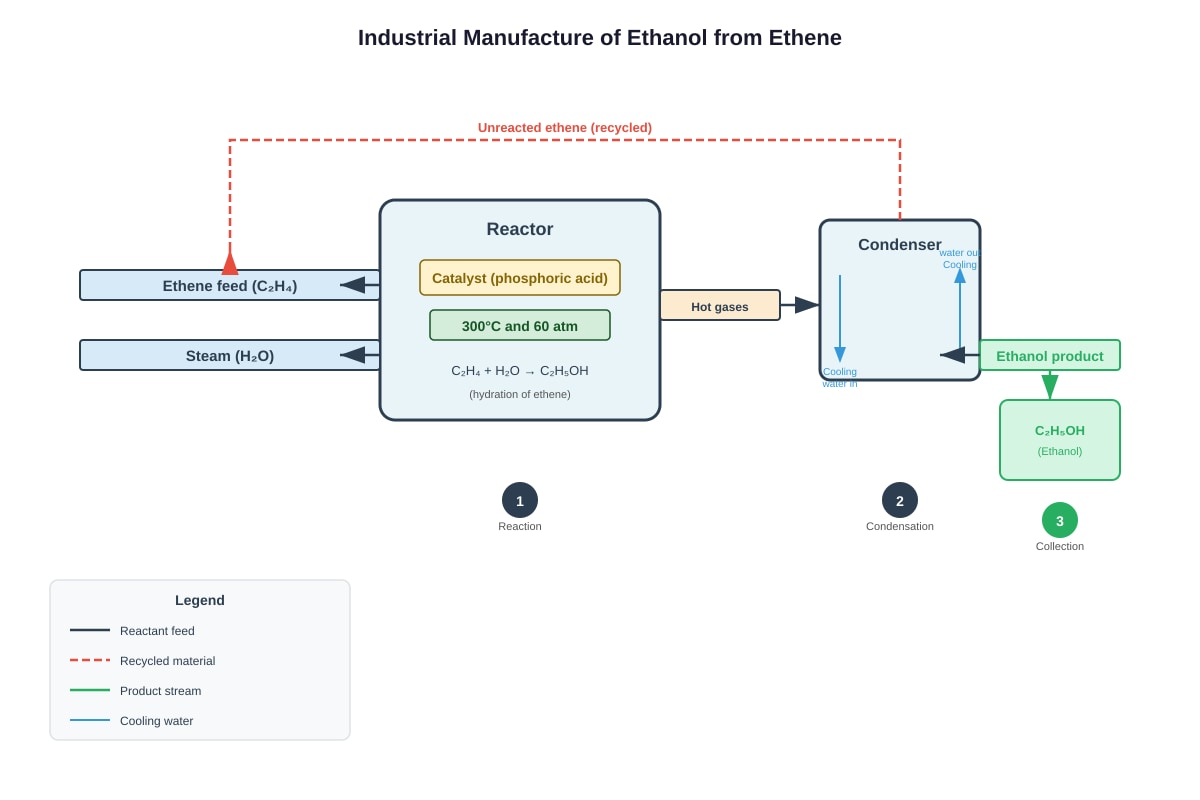
9. (a) Addition reaction / hydration [1]
Accept: Catalytic addition of steam
Teaching note: Water adds across the double bond of ethene. This is specifically called hydration when adding water, and it's an addition reaction because the π bond breaks and atoms add across the carbons.
(b) Any two from:
- Temperature of 300°C [1]
- Pressure of 60 atm / high pressure [1]
- Phosphoric acid catalyst [1]
Teaching note: These conditions balance rate and yield. High pressure favours the side with fewer gas molecules (2 → 0 moles of gas change; 1 ethene + 1 steam → 1 ethanol). The catalyst lowers activation energy. Lower temperatures favour exothermic forward reaction but are too slow; 300°C is a compromise.
(c) [2]
Mark breakdown: [1] correct formulae and identification of reactants and products, [1] balance and correct state symbols if given (not required here)
Teaching note: Ethene + steam → ethanol. No other products. This is an important industrial process. The reaction is reversible in reality (hence recycling), but the forward reaction dominates with good conditions.
(d) Recycling unreacted ethene:
- Increases the overall yield / conversion rate of ethene to ethanol [1]
- Reduces waste and makes the process more economical / efficient [1]
Teaching note: Industrial processes maximize atom economy and economic efficiency. Unreacted feedstock is expensive; recycling means less fresh ethene needed per tonne of product. This is standard practice in continuous-flow industrial chemistry.
10. (a) A homologous series is a family of organic compounds with:
- The same functional group [1]
- Similar chemical properties, with each successive member differing by –CH₂– [1]
Teaching note: The –CH₂– increment means each member has one more carbon and two more hydrogens than the previous (for alcohols, also one more oxygen conceptually in the molecular formula pattern). Properties change gradually — boiling points increase predictably.
(b) [1]
Teaching note: Following the pattern: methanol CH₄O, ethanol C₂H₆O, propan-1-ol C₃H₈O, butan-1-ol C₄H₁₀O. Each adds CH₂. So pentan-1-ol = C₅H₁₂O. The structural formula is CH₃CH₂CH₂CH₂CH₂OH.
(c) From orange to green [2]
Mark breakdown: [1] orange, [1] green
Teaching note: Acidified potassium dichromate(VI) (K₂Cr₂O₇) is an oxidising agent. In its oxidised form, Cr is in +6 oxidation state (orange). When it oxidises the alcohol, Cr is reduced to +3 (green). This colour change is characteristic of oxidation reactions in organic chemistry.
11. (a) Esterification / condensation [1]
Teaching note: This is a reversible reaction between a carboxylic acid and an alcohol, producing an ester and water. It is also a condensation reaction because a small molecule (water) is eliminated.
(b) Any valid use: flavourings / perfumes / solvents / food additives / cosmetics [1]
Teaching note: Esters have distinctive, often fruity smells. Unlike carboxylic acids which smell pungent/vinegary, esters are pleasant, making them useful in flavours and fragrances.
(c) Methyl ethanoate: [2]
Mark breakdown: [1] for correct ester linkage (–COO–), [1] for correct arrangement (ethanoate part from acid, methyl part from alcohol)
Teaching note: The naming is "methyl" (from methanol) + "ethanoate" (from ethanoic acid, with –oate ending). Structurally: CH₃–C(=O)–O–CH₃. The carbonyl carbon is bonded to O–CH₃, not to OH as in the acid.
12. (a) Crude oil can be separated by fractional distillation because:
- The hydrocarbons in crude oil have different boiling points [1]
- When heated, they vaporise at different temperatures and can be condensed and collected separately [1]
Teaching note: Fractional distillation works on differences in intermolecular forces. Smaller molecules (lower boiling point) rise higher in the fractionating column before condensing; larger molecules (higher boiling point) condense lower down.
(b) is an alkane [1] It is converted to ethene by cracking / thermal decomposition: heated to high temperature (450–700°C) with a catalyst (aluminium oxide/silica) [1] Breaking the long chain into smaller, more useful molecules including ethene and other alkenes [1]
Teaching note: Cracking is essential because there's higher demand for shorter alkenes (for plastics) and gasoline fractions than for heavy fuel oil. The reaction: C₈H₁₈ → C₂H₄ + C₆H₁₄ (or other combinations), producing useful smaller molecules from less valuable heavy fractions.
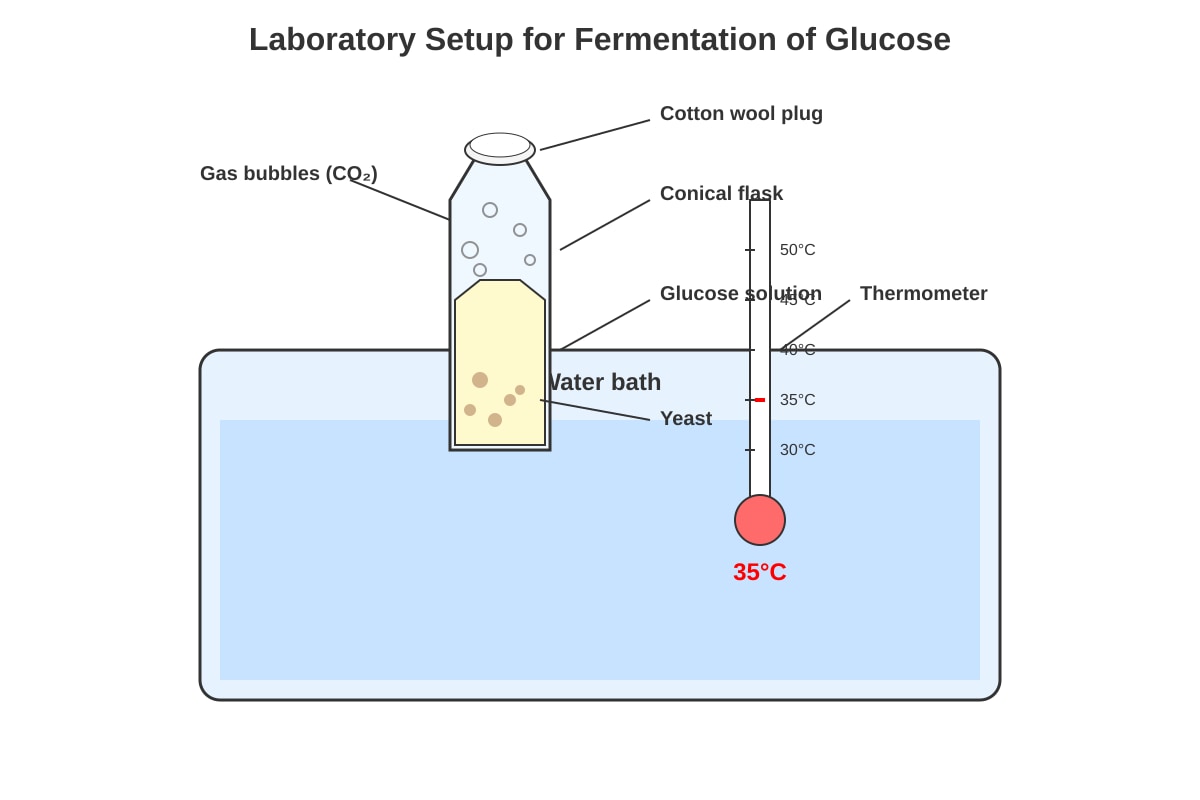
13. (a) 25–40°C / approximately 35°C [1]
**Accept any value in reasonable range; optimal is 37°C (body temperature of yeast), but 35°C is commonly used in schools.
(b) The cotton wool plug:
- Allows carbon dioxide gas to escape [1]
- Prevents entry of oxygen and airborne microorganisms that would contaminate the fermentation / cause aerobic respiration instead [1]
Teaching note: Fermentation is anaerobic — oxygen must be excluded or yeast will respire aerobically, producing CO₂ and H₂O but no ethanol. The cotton wool is porous to gas (stops pressure buildup) but acts as a filter barrier. A rubber stopper would trap CO₂ and risk explosion, or if completely sealed, stop the reaction.
(c) glucose → ethanol + carbon dioxide [1]
Or with formulae: C₆H₁₂O₆ → 2C₂H₅OH + 2CO₂
Teaching note: Yeast contains enzymes (zymase) that catalyse this. It's anaerobic respiration in yeast. The ethanol produced is impure (about 10–15% by volume); distillation is needed to concentrate it. This is the basis of brewing and biofuel production.
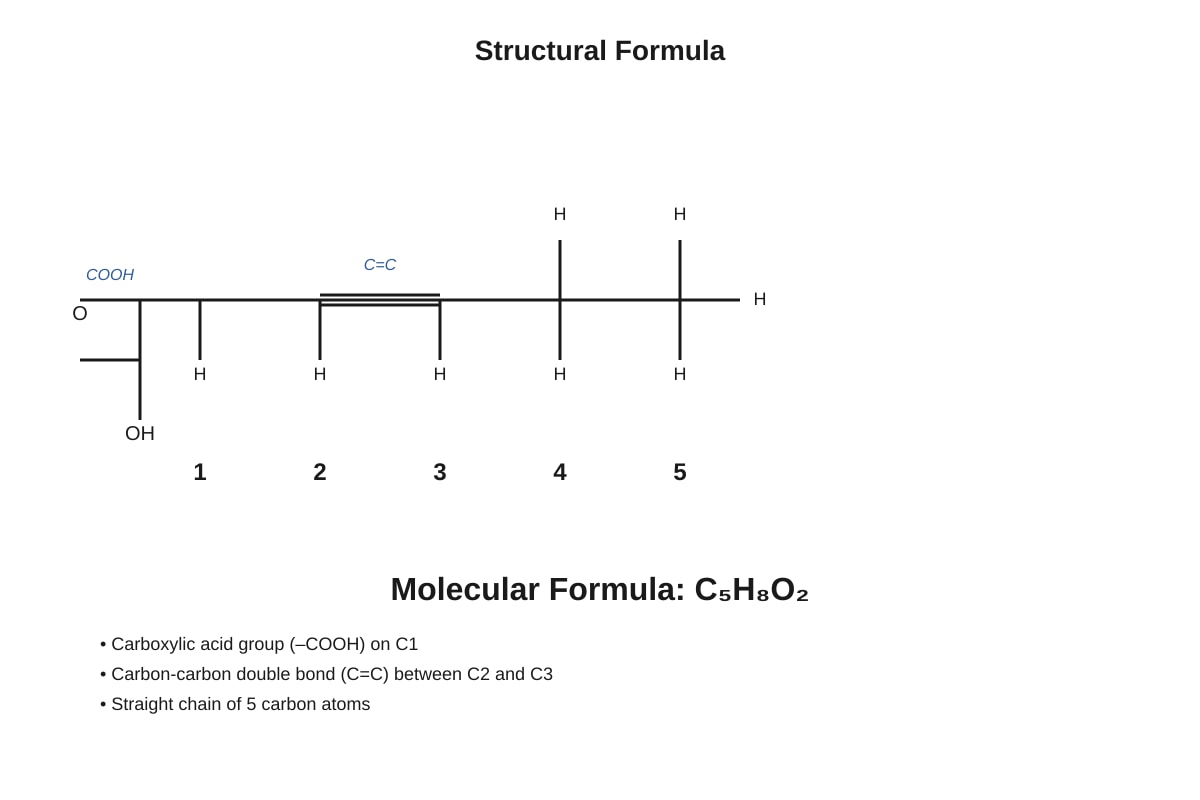
14. (a) Two functional groups:
- Carbon–carbon double bond (C=C) / alkene [1]
- Carboxylic acid (–COOH) [1]
Teaching note: This compound belongs to two functional classes simultaneously — an unsaturated carboxylic acid. Identifying multiple functional groups is important for predicting all of a compound's reactions.
(b) [1]
Teaching note: Count from the structure: 5 carbons, count hydrogens (8 total: 1 on COOH carbon, 1 on C5, 2 each on C4 and C1 — wait, recount carefully from the described structure: COOH has 1 H, C2=C3 each have 1 H (2 total), C4 has 2 H, C5 has 3 H in CH₃… Actually with structure as drawn: HOOC–CH=CH–CH₂–CH₃ gives: COOH group (C₁ with 1 H, and OH), C₂ (1 H), C₃ (1 H), C₄ (2 H), C₅ (3 H) — but the molecular formula given in the image placeholder says C₅H₈O₂, which suggests a different arrangement. Ensure students count from the actual displayed structure.
(c) Yes, it would decolourise bromine water [1] because it contains a carbon–carbon double bond that undergoes addition with bromine [1]
Teaching note: The –COOH group does not react with bromine water. Only the C=C double bond causes decolourisation. This is the distinguishing test between alkenes and alkanes (or saturated vs. unsaturated compounds generally).
Section C: Data Analysis and Extended Response
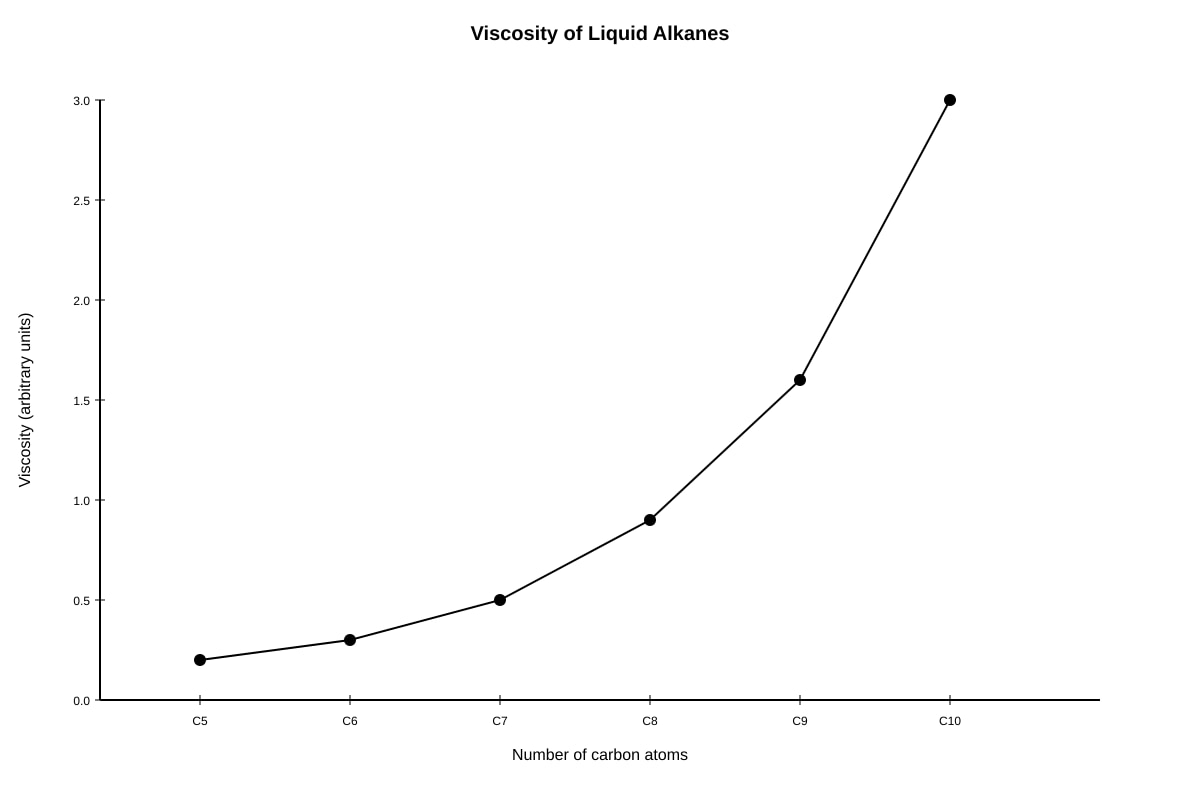
15. (a) Viscosity increases as the number of carbon atoms increases / shows an exponential-like increase [1]
Teaching note: "Exponential" is acceptable description; "increasing at an increasing rate" is also correct.
(b) Viscosity increases because:
- Larger molecules have greater surface area / more electrons [1]
- Stronger London dispersion forces between molecules [1]
- These stronger intermolecular forces make it harder for molecules to slide past each other, so the liquid flows less easily [1]
Teaching note: Viscosity is resistance to flow, directly related to how strongly molecules attract each other in the liquid state. Longer hydrocarbon chains can interlock/tangle more, increasing resistance to flow beyond just intermolecular force strength.
16. Magnesium reacts faster with hydrochloric acid [1]
Explanation:
- Hydrochloric acid is a strong acid that completely ionises in water, producing a high concentration of H⁺ ions [1]
- Ethanoic acid is a weak acid that only partially ionises, so at the same concentration, it has a lower concentration of H⁺ ions [1]
- Reaction rate depends on collision frequency with H⁺ ions; more H⁺ means more frequent successful collisions [1]
Mark breakdown: [1] faster with HCl, [1] strong vs. weak distinction with complete/partial ionisation, [1] link to H⁺ concentration and collision theory
Teaching note: This is a crucial conceptual point. Concentration in mol/dm³ refers to total acid molecules, not H⁺ concentration. For weak acids, most molecules remain as HA. With metals, H⁺ is reduced to H₂ gas; the rate depends on [H⁺], not total acid concentration.
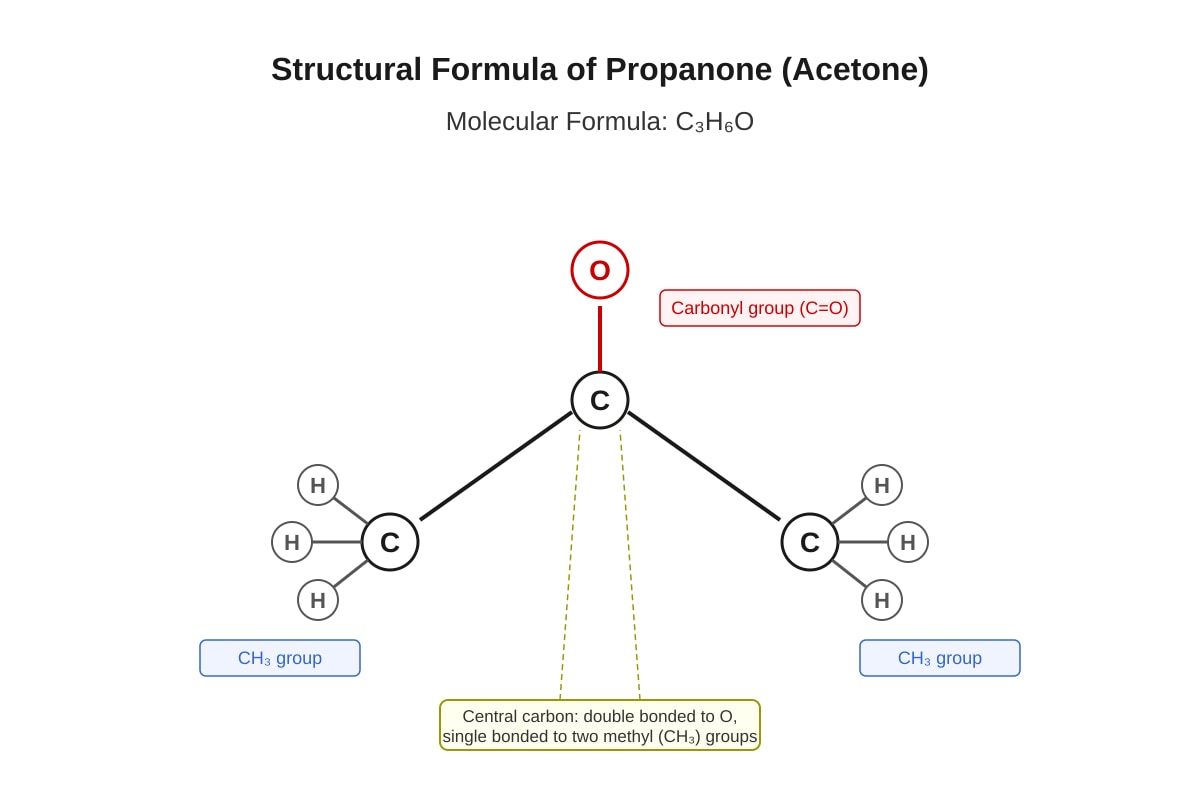
17. (a) Propanone / acetone [1]
Teaching note: The IUPAC name is propan-2-one or simply propanone. The common name acetone is widely known. It's the simplest ketone.
(b) Propanone belongs to the ketone homologous series, while propan-1-ol belongs to the alcohol series [1] They have different structural formulae and different functional groups (C=O vs. –OH) even though their molecular formulae differ — actually propanone is C₃H₆O, while propan-1-ol is C₃H₈O, so they are not isomers. The question contains an error in the molecular formula given; propanone has one fewer H₂ unit due to the double bond to oxygen. [1]
Accept: If student notes the molecular formulae are actually different, credit for careful observation.
Teaching note: This corrects the question's stated molecular formula. Propanone CH₃COCH₃ has formula C₃H₆O; propan-1-ol CH₃CH₂CH₂OH has C₃H₈O. They are not isomers. Isomers need identical molecular formulas. The ketone has a C=O (less hydrogen capacity), while alcohol has C–OH.
18. (a) Hydrogenation is carried out by:
- Reacting the vegetable oil with hydrogen gas [1]
- Using a nickel catalyst at about 150–200°C [1]
Teaching note: This "hardens" the oil by converting C=C bonds to C–C single bonds, making saturated fats. The process is used to make margarine and shortening from liquid oils. It's an addition reaction (hydrogen adds across double bonds).
(b) Unsaturated means the fatty acid chains contain one or more carbon–carbon double bonds [1]
Teaching note: "Unsaturated" in organic chemistry refers to any compound with C=C (or C≡C) bonds — capable of adding hydrogen. In dietary terms, unsaturated fats (with C=C) are generally considered healthier than saturated fats.
19. (a) [2]
Mark breakdown: [1] correct formulae, [1] balancing (1 CH₄, 2 O₂, 1 CO₂, 2 H₂O)
Teaching note: Methane is the simplest hydrocarbon. Complete combustion always gives CO₂ and H₂O. Check: C balanced (1 each side), H: 4 on left, 2×2=4 on right, O: 4 on left, 2+2=4 on right.
(b) Methane is more potent because:
- It absorbs infrared radiation more effectively per molecule than CO₂ [1]
- It has a higher global warming potential (GWP) over short timescales — about 80× more effective than CO₂ over 20 years [1]
Teaching note: Potency vs. quantity is an important distinction in climate science. CO₂ causes more total warming because there's much more of it, but methane traps more heat per molecule and has a shorter atmospheric lifetime (about 12 years vs. hundreds for CO₂). This is why reducing methane leaks (from agriculture, waste, fossil fuels) is a priority for near-term warming reduction.
20. Add bromine water (or bromine in organic solvent) to separate samples of each liquid [1]
Expected observations:
- Hexane (saturated): No change / bromine remains orange-brown [1]
- Hex-1-ene (unsaturated, contains C=C): Bromine decolourises rapidly / becomes colourless [1]
Teaching note: This is the standard test for unsaturation. Any compound with C=C or C≡C will decolourise bromine water. Hexane, being an alkane with only C–C single bonds, cannot react with bromine at room temperature (no addition possible). The test is simple, rapid, and definitive.
END OF ANSWER KEY
Total marks: 40