AI Generated Quiz
Secondary 3 Chemistry Atomic Structure Bonding Quiz
Free Sec 3 Chemistry Atomic Structure Bonding quiz, Kimi2.6 AI version, with questions, answers, and O Level-style practice for Singapore students.
These static practice materials are generated from the site's syllabus and paper-generation workflow, with source and model context shown so students and parents can evaluate the material before use.
Questions
Free quiz and exam paper access
Enter your details to view this paper
Your access is remembered on this device.
Answers
Secondary 3 Chemistry Quiz - Atomic Structure Bonding: ANSWER KEY
Total Marks: 40
Section A: Multiple Choice (Questions 1-5)
1. B – Proton [1]
Teaching note: The nucleus contains protons (positively charged) and neutrons (neutral). Electrons are found in shells/orbitals outside the nucleus. Ions are charged particles formed when atoms gain or lose electrons; they are not subatomic particles found in all atoms.
2. B – 18 [1]
Method: Number of neutrons = Mass number − Atomic number = 35 − 17 = 18 neutrons.
- Protons = 17 (from atomic number)
- Electrons = 17 (in neutral atom)
- Neutrons = 35 − 17 = 18
Common mistake: Students often confuse atomic number with neutron number. Remember: atomic number = protons, and mass number = protons + neutrons.
3. C – Covalent bonding [1]
Teaching note:
- Ionic bonding: Transfer of electrons from metal to non-metal
- Metallic bonding: Delocalized electrons in a "sea" around metal cations
- Covalent bonding: Sharing of electron pairs between non-metal atoms
- "Electrostatic bonding" is not a standard term; electrostatic forces exist within ionic and metallic bonding but describe the attraction, not a bond type itself.
4. C – Diamond [1]
Teaching note:
- Sodium chloride: Giant ionic lattice
- Water: Simple molecular (covalent) – H₂O molecules with weak intermolecular forces
- Diamond: Giant covalent structure – each carbon bonded to four others in a rigid 3D network
- Copper: Metallic structure with delocalized electrons
5. C – −1 [1]
Teaching note: A fluoride ion (F⁻) gains one electron compared to a fluorine atom. Since a fluorine atom has 9 protons (+9) and 9 electrons (−9), gaining one extra electron gives 10 electrons (−10), so net charge = +9 + (−10) = −1.
Section B: Structured Questions (Questions 6-15)
6. Isotopes are atoms of the same element that have the same number of protons but different numbers of neutrons (and therefore different mass numbers). [2]
Mark allocation:
- [1] Same element/same proton number/same atomic number
- [1] Different number of neutrons/different mass number
7. Completed table: [3]
| Particle | Relative Mass | Relative Charge | Location in Atom |
|---|---|---|---|
| Proton | 1 | +1 | Nucleus |
| Neutron | 1 | 0 | Nucleus |
| Electron | 1/1840 ≈ 0 | −1 | Shells (around nucleus) |
Mark allocation: 1 mark per correct row (must have all three entries in row correct for the mark).
Teaching note: Electron mass is sometimes written as "negligible" or "1/1836 to 1/1840." What matters chemically is that electrons have virtually no mass compared to protons/neutrons, and they occupy the space outside the nucleus.
8. (a) 12 protons [1]
Method: Atomic number = number of protons. Magnesium has atomic number 12.
(b) A magnesium atom has 2 electrons in its outer shell. It tends to lose these 2 electrons to achieve a stable noble gas electron configuration (like neon, 2.8). [2]
Mark allocation:
- [1] Loses 2 electrons from outer shell
- [1] To achieve stable/full outer shell/octet/noble gas configuration
(c) 2.8 (or 2,8) [1]
Teaching note: When Mg loses its 2 outer electrons, only the 10 electrons in shells 1 and 2 remain. This gives the same electron configuration as neon.
9. (a)
- Lithium atom: 2.1 [1]
- Fluorine atom: 2.7 [1]
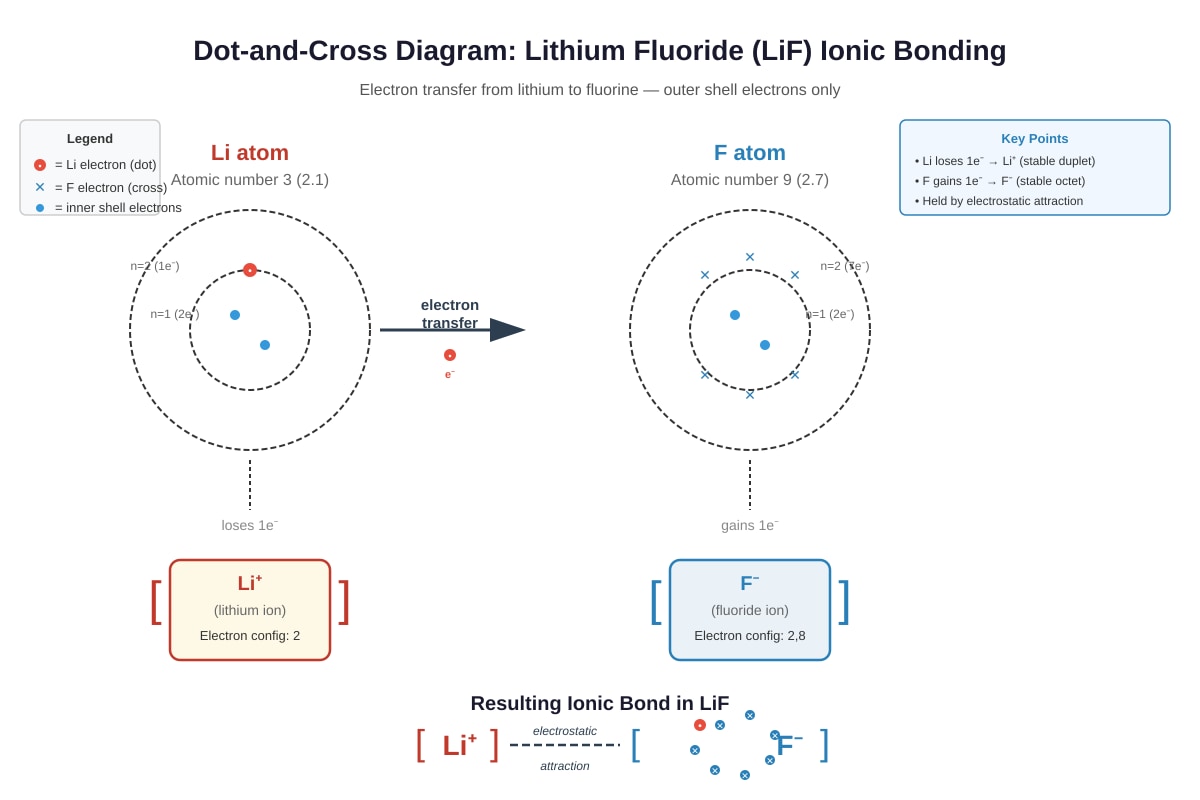
(b) Expected dot-and-cross diagram features (matching Q9b image placeholder): [2]
- Lithium atom shown with 1 outer electron (dot)
- Fluorine atom shown with 7 outer electrons (crosses)
- Arrow showing electron transfer from Li to F
- Resulting Li⁺ ion with no outer electrons shown, in square brackets with + charge
- Resulting F⁻ ion with 8 outer electrons (7 crosses + 1 dot), in square brackets with − charge
Mark allocation:
- [1] Correct electron transfer shown (Li loses 1, F gains 1)
- [1] Correct charges and complete outer shells on both ions
(c) Strong electrostatic forces of attraction between the positively charged lithium ions (Li⁺) and negatively charged fluoride ions (F⁻) hold the ions together in a giant ionic lattice. [2]
Mark allocation:
- [1] Mention of electrostatic forces/attraction between oppositely charged ions
- [1] Correct identification of ion charges (Li⁺ and F⁻)
Common mistake: Some students say "opposite charges attract" without naming the force as electrostatic or identifying the specific ions.
10. (a) The relative atomic mass is a weighted average of the masses of all the isotopes present, taking into account their natural abundances. Since chlorine exists as a mixture of two isotopes with different masses, the average is not a whole number. [2]
Mark allocation:
- [1] It is an average/mean of isotope masses
- [1] Weighted by abundance/existence of two different isotopes
(b) Let percentage of chlorine-35 = x%, so percentage of chlorine-37 = (100−x)%
Percentage abundance of chlorine-35 = 75% [2]
Mark allocation:
- [1] Correct equation set up
- [1] Correct answer with working shown
Alternative valid method: Using ratio approach — the average 35.5 is closer to 35 than 37, so chlorine-35 is more abundant. The distance from 35.5 to 35 is 0.5, and to 37 is 1.5. Ratio of abundances is inversely proportional: 1.5 : 0.5 = 3:1, giving 75% and 25%.
11. (a) [2]
- Likely to be a metal: P
- Likely to be a simple molecular covalent compound: S
(b) Substance Q is ionic (or "giant ionic structure"). [3]
Reasoning:
- High melting point due to strong electrostatic forces between ions in the giant lattice
- Poor electrical conductivity when solid because ions are fixed in position and cannot move
- Good electrical conductivity when molten because ions are free to move and carry charge
- Soluble in water because water molecules can separate the ions (hydration)
Mark allocation:
- [1] Identifies ionic bonding/structure
- [1] Explains conductivity difference (fixed vs. mobile ions)
- [1] Links solubility to ionic nature/ability to separate ions
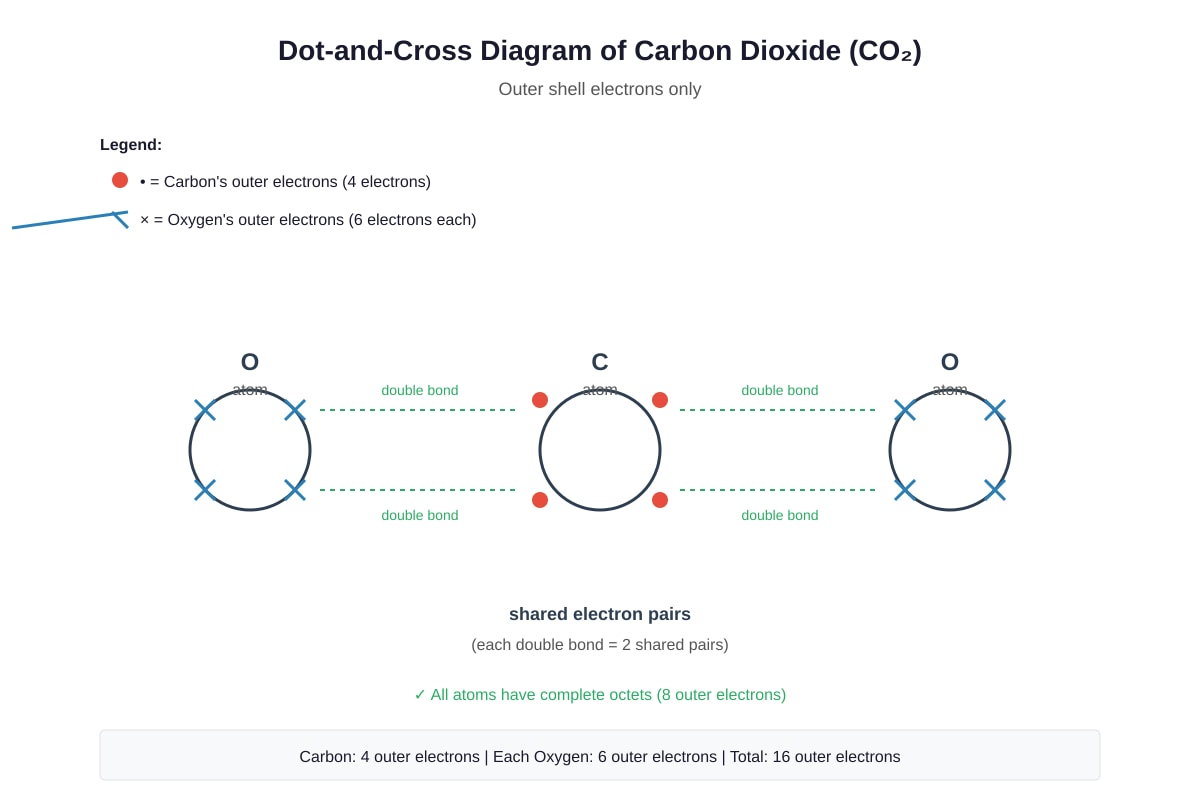
12. (a) Expected dot-and-cross diagram features (matching Q12a image placeholder): [2]
- Carbon atom with 4 outer electrons (4 dots)
- Each oxygen atom with 6 outer electrons (6 crosses)
- Two double bonds formed (4 shared electrons between C and each O)
- Each atom achieves a complete octet (8 electrons)
Mark allocation:
- [1] Correct number of shared electrons/double bonds shown
- [1] All atoms have complete outer shells, correct electron distribution
(b) Carbon dioxide consists of simple discrete molecules with weak intermolecular forces between molecules, so little energy is needed to separate them (low melting/boiling point). [3]
Silicon dioxide has a giant covalent structure where each silicon atom is covalently bonded to four oxygen atoms, and each oxygen to two silicon atoms, in a continuous 3D network. Many strong covalent bonds must be broken to melt it, requiring a lot of energy.
Mark allocation:
- [1] CO₂: simple molecular structure with weak intermolecular forces
- [1] SiO₂: giant covalent structure with continuous network
- [1] Many strong covalent bonds need to be broken (high energy requirement)
Key distinction: Both C and Si are in Group 14, but CO₂ forms simple molecules while SiO₂ forms a giant structure. This is because silicon cannot form stable double bonds with oxygen due to its larger atomic size; instead it forms single bonds creating a 3D network.
13. (a) +3 (or 3+) [1]
Method: In Al₂O₃, total positive charge must balance total negative charge. Oxygen is oxide (O²⁻), so total negative charge = 3 × (−2) = −6. Total positive charge from 2 Al ions = +6, so each Al ion = +3.
(b) O²⁻ [1]
(c) When solid, the ions are held in fixed positions in the lattice and cannot move to carry charge. When molten, the ions are free to move as mobile charge carriers. [2]
Mark allocation:
- [1] Solid: ions fixed/cannot move
- [1] Molten: ions mobile/free to move
14. (a) [3]
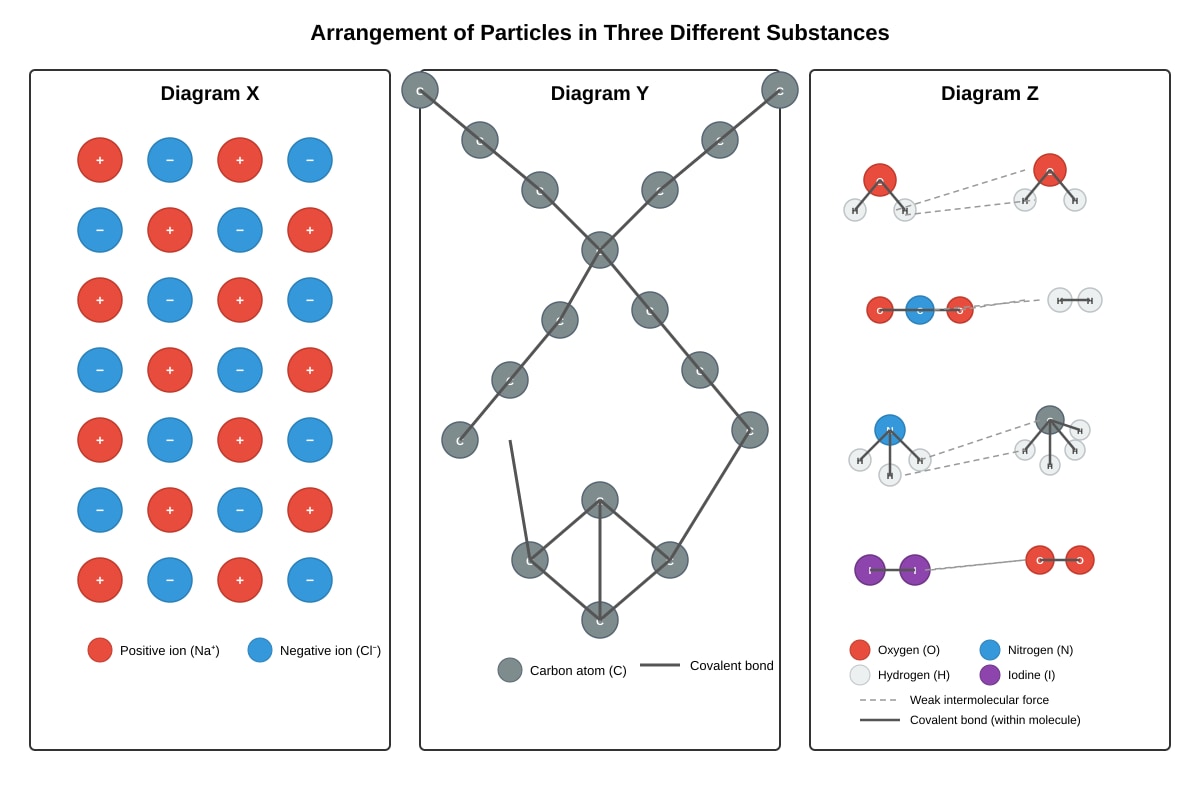
- Diagram X: Giant ionic structure (or ionic lattice)
- Diagram Y: Giant covalent structure (or macromolecular/covalent network)
- Diagram Z: Simple molecular structure
Teaching note: X shows alternating positive and negative ions; Y shows atoms each bonded to multiple others in an extended network; Z shows separate small molecules with spaces between them.
(b) Diamond or silicon dioxide (or silicon, germanium, graphite) [1]
Note: Any correct giant covalent substance accepted. Graphite is technically giant covalent but layered; diamond and SiO₂ are the classic 3D network examples.
15. (a) First ionization energy generally increases across Period 3 (from left to right). [1]
(b) Aluminium's electron configuration is 2.8.3 or [Ne] 3s² 3p¹. The outermost electron to be removed is in a 3p orbital. [3]
Magnesium's electron configuration is 2.8.2 or [Ne] 3s². The outermost electron to be removed is in a 3s orbital.
The 3p orbital is higher in energy (further from nucleus/more shielded) than the 3s orbital. Alternatively: the 3p electron is slightly more shielded or experiences less effective nuclear charge than a 3s electron. Therefore, less energy is needed to remove the 3p electron from Al compared to the 3s electron from Mg.
Mark allocation:
- [1] Correct electron configurations or identification of different subshells (3p vs 3s)
- [1] The electron removed from Al is in a 3p orbital (higher energy/more shielded)
- [1] Less energy required to remove 3p electron / 3s electron more strongly held
Teaching note: This "dip" at Al is one of two characteristic anomalies in Period 3 (the other being at S, due to paired electrons in 3p). The general trend is increasing due to increasing nuclear charge and decreasing atomic radius.
Section C: Extended Response (Questions 16-20)
16. (a) Sodium: 2.8.1 [1] Chlorine: 2.8.7 [1]
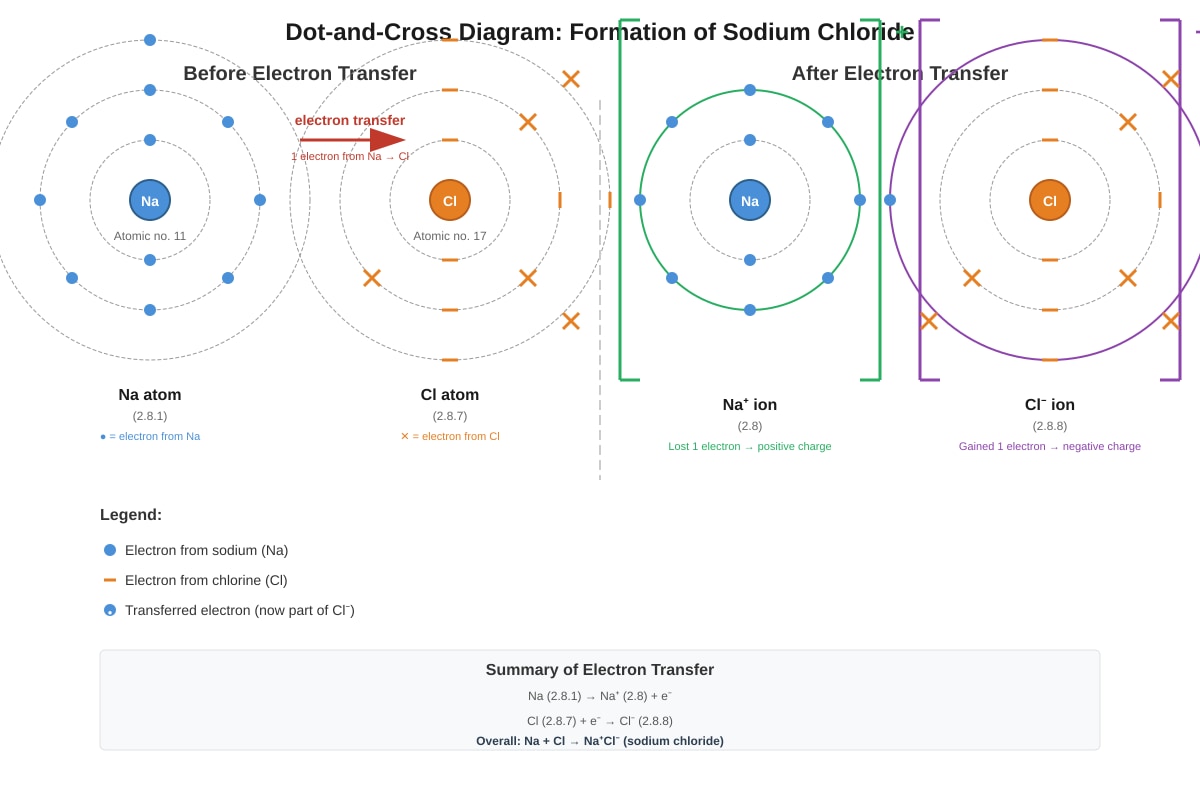
(b) Dot-and-cross diagram reference (matching Q16b image placeholder): [4]
(i) A sodium atom has 1 electron in its outer shell. A chlorine atom has 7 electrons in its outer shell. The sodium atom transfers its outer electron to the chlorine atom. [1]
(ii) The sodium atom becomes a positively charged sodium ion (Na⁺). The chlorine atom becomes a negatively charged chloride ion (Cl⁻). [1]
(iii) The sodium atom's electron configuration changes from 2.8.1 to 2.8 (same as neon, a noble gas). The chlorine atom's electron configuration changes from 2.8.7 to 2.8.8 (same as argon, a noble gas). Both atoms achieve stable full outer shells (octet). [2]
Mark allocation for (iii):
- [1] Both achieve stable electron configurations/full outer shells
- [1] Specific reference to both configurations matching noble gases or correct configurations stated
(c) Sodium chloride has a giant ionic lattice structure with strong electrostatic forces between Na⁺ and Cl⁻ ions. A large amount of energy is required to overcome these strong forces and separate the ions. [2]
Mark allocation:
- [1] Giant ionic structure with strong electrostatic forces mentioned
- [1] Large amount of energy needed to break these forces
17. (a) 2.8 (or 2,8) [1]
(b) Noble gases have stable full outer electron shells (complete octet, or duplet for helium). They have no tendency to gain, lose, or share electrons, so they do not form chemical bonds under normal conditions. [2]
Mark allocation:
- [1] Full/complete outer shell (octet/duplet)
- [1] No need to gain/lose/share electrons / already stable
(c) Argon is unreactive/inert so it will not react with the hot tungsten filament in the light bulb. This prevents the filament from oxidizing/burning out and extends the life of the bulb. [2]
Mark allocation:
- [1] Argon is unreactive/inert / does not react with filament
- [1] Prevents oxidation of filament / extends bulb life
18. (a) Completed table: [3]
| Property | Magnesium chloride | Hydrogen chloride |
|---|---|---|
| Type of bonding | Ionic | Covalent |
| Type of structure | Giant ionic lattice | Simple molecular |
| Melting point | High | Low |
Mark allocation: 1 mark per correct row
(b) MgCl₂ has a giant ionic structure with strong electrostatic attractions between Mg²⁺ and Cl⁻ ions in a continuous lattice. To melt it, many strong ionic bonds must be broken, requiring a lot of energy. [3]
HCl has a simple molecular structure. The molecules are held together by weak intermolecular forces (van der Waals forces/dipole-dipole interactions). Little energy is needed to overcome these weak forces, so HCl has a low melting point.
Mark allocation:
- [1] MgCl₂: giant ionic with strong electrostatic forces/many bonds to break
- [1] HCl: simple molecular with weak intermolecular forces
- [1] Comparison: much more energy needed for MgCl₂ / clear distinction in bond strength
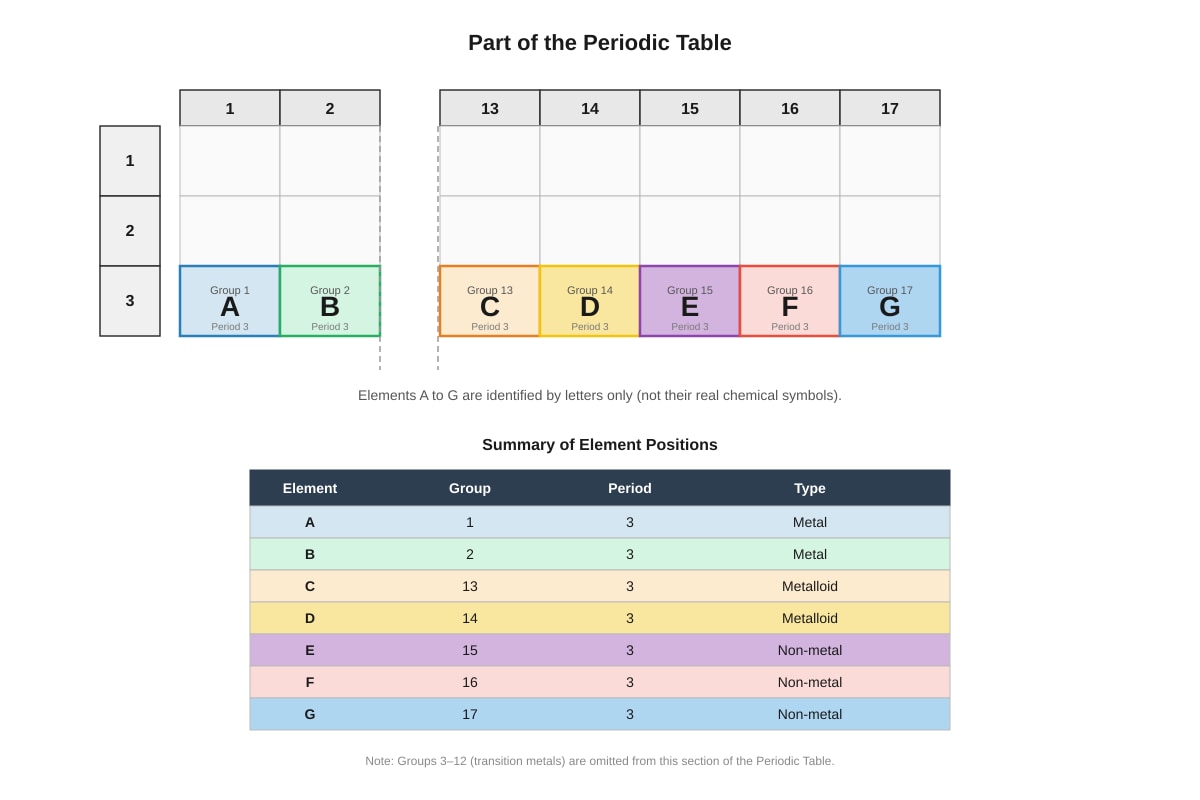
19. (a) (i) D (or E, F, G — any Group 14-17 element that forms covalent hydrides) [1]
Most likely intended answer: D (Group 14, silicon) or G (Group 17, chlorine) or F (Group 16, sulfur) or E (Group 15, phosphorus). Any non-metal that forms covalent bonds with hydrogen.
(ii) B (Group 2, magnesium) [1]
(iii) G (Group 17, chlorine) — or A (Na) if considering lowest; but highest IE in Period 3 is actually Ar, which is not labeled. Among labeled elements, G (Cl) has highest first ionization energy as you move across. [1]
Correction/clarification: Looking at the label specification: G is Group 17. Argon (Group 18/0) has the highest IE in Period 3 but is not among A-G. Chlorine (G) has the highest IE among the labeled elements that are reactive non-metals.
However, noble gas Ar would be to the right of G. If the table only shows to Group 17, then G (chlorine) is correct for highest among labeled.
(b) AG (or NaG depending on group; with G in Group 17, this would be NaCl-type, so AG) [1]
Teaching note: If A is Na (Group 1, forms +1) and G is Cl (Group 17, forms −1), formula is AG.
(c) Atom A (sodium) has 1 electron in its outer shell. It loses this electron to form a positive ion (A⁺). Atom G (chlorine) has 7 electrons in its outer shell. It gains 1 electron to form a negative ion (G⁻). The oppositely charged ions attract each other to form an ionic bond. [2]
Mark allocation:
- [1] Electron transfer described correctly (A loses 1, G gains 1)
- [1] Formation of oppositely charged ions and electrostatic attraction
20. (a) Graphite consists of layers of carbon atoms arranged in hexagonal rings. Each carbon atom is bonded to three other carbon atoms by strong covalent bonds. The layers are held together by weak van der Waals forces. [2]
Mark allocation:
- [1] Layers/hexagonal rings/2D structure with strong covalent bonds within layers
- [1] Weak forces between layers mentioned
(b) The weak forces between layers allow the layers to slide over each other easily. This reduces friction between surfaces, making graphite suitable as a lubricant. [2]
Mark allocation:
- [1] Weak forces between layers allow sliding
- [1] Link to lubricant function/reduced friction
(c) Property 1: Good electrical conductivity [2]
Graphite has delocalized electrons — one free electron per carbon atom that is not used in bonding. These electrons can move freely throughout the layers and carry electric charge. This makes graphene (and graphite) useful in electronics.
Property 2: High strength/very strong (or lightweight/high surface area) [2]
Graphene is one atom thick yet has very strong covalent bonds throughout its structure. The hexagonal arrangement distributes forces efficiently. This strength combined with flexibility makes it ideal for electronic components.
Alternative properties accepted: High thermal conductivity, transparency, large surface area to volume ratio, flexibility.
Mark allocation per property (×2):
- [1] Correct property stated
- [1] Clear link to structure explaining why property arises
END OF ANSWER KEY