AI Generated Quiz
Secondary 3 Chemistry Atomic Structure Bonding Quiz
Free Sec 3 Chemistry Atomic Structure Bonding quiz, HY3 AI version, with questions, answers, and O Level-style practice for Singapore students.
These static practice materials are generated from the site's syllabus and paper-generation workflow, with source and model context shown so students and parents can evaluate the material before use.
Questions
Secondary 3 Chemistry Quiz - Atomic Structure Bonding
Name: ___________________________
Class: ___________________________
Date: ___________________________
Score: _______ / 40
Duration: 50 minutes
Total Marks: 40
Instructions:
- Answer all 20 questions.
- Section A: Multiple-choice style short items (1 mark each).
- Section B: Structured short answers (2 marks each).
- Section C: Extended response (3–4 marks each).
- Write your answers clearly in the spaces provided.
- Use proper chemical notation where needed.
Section A (Questions 1–5, 1 mark each)
1. An atom of element X has 11 protons and 12 neutrons. What is its nucleon number? [1]
Answer: __________
2. Which sub-atomic particle has a relative charge of –1 and negligible mass? [1]
Answer: __________
3. Which type of bonding is present in a sample of magnesium metal? [1]
Answer: __________
4. Dot-and-cross diagrams are most commonly used to show the formation of which type of bond? [1]
Answer: __________
5. An isotope of chlorine has 17 protons and 18 neutrons. What is its mass number? [1]
Answer: __________
Section B (Questions 6–15, 2 marks each)
6. Element aluminium has atomic number 13. Write the electron configuration of a neutral aluminium atom. [2]
Answer: __________
7. A sodium atom forms a Na⁺ ion. State the number of electrons lost and write the electron configuration of Na⁺. [2]
Answer: __________
8. Draw a dot-and-cross diagram to show the formation of magnesium chloride (MgCl₂) from Mg and Cl atoms. Show only outer shell electrons. [2]
Answer: (draw in space below)
9. Oxygen molecule (O₂) is held by a covalent bond. Explain what is meant by "electron sharing" in this context. [2]
Answer: __________
10. State two physical properties of ionic compounds and briefly explain each using bonding ideas. [2]
Answer: __________
11. Diamond and graphite are both forms of carbon. State one structural difference and link it to a property. [2]
Answer: __________
12. A compound is formed between potassium (metal) and oxygen (non-metal). Predict the type of bonding and give a reason. [2]
Answer: __________
13. Chlorine has two common isotopes: Cl-35 (75%) and Cl-37 (25%). Calculate the relative atomic mass of chlorine. [2]
Answer: __________
14. State the charge of the following ions: (a) oxide ion, (b) aluminium ion. [2]
Answer: (a) ______ (b) ______
15. Explain why metals are good conductors of electricity using the "sea of electrons" model. [2]
Answer: __________
Section C (Questions 16–20, 3–4 marks each)
16. Compound A is formed between sodium and chlorine.
(a) Predict the type of bonding in A. [1]
(b) Explain your answer in terms of electronegativity. [2]
(c) Predict one physical property of A based on its bonding. [1]
Answer:
(a) __________
(b) __________
(c) __________
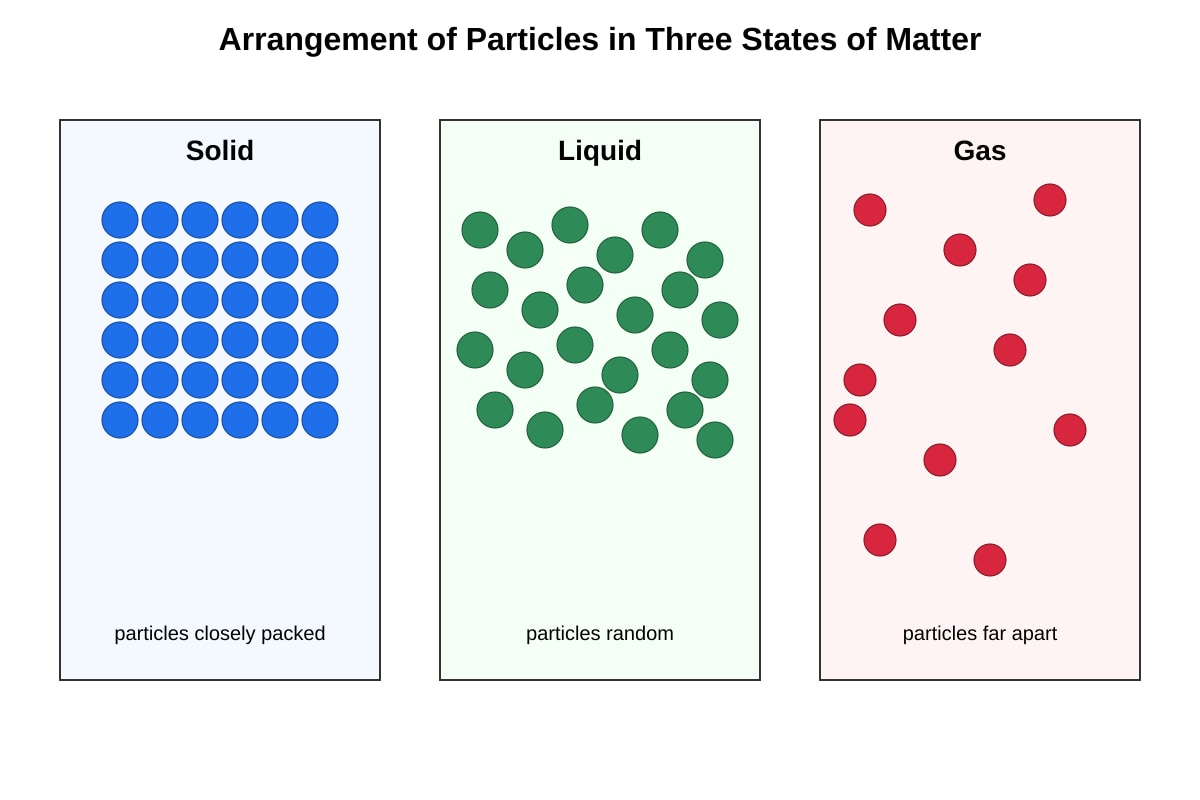
17. The diagram below shows the arrangement of particles in three states of matter.
Image pending generation: diagram for Q17.
Using kinetic particle theory, describe the arrangement and movement of particles in the liquid state and explain how diffusion occurs in gases. [4]
Answer: __________
18. A student is given a dot-and-cross diagram of a molecule of methane (CH₄).
(a) State the type of bonding in methane. [1]
(b) Explain why methane has a low melting point compared to sodium chloride. [3]
Answer:
(a) __________
(b) __________
19. Compare the structure of diamond and graphite. Include how the bonding leads to their uses. [4]
Answer: __________
20. An atom has the symbol 2040Ca.
(a) State the number of protons, neutrons, and electrons. [2]
(b) Write the electron configuration. [1]
(c) Would Ca form a cation or anion? Give reason. [1]
Answer:
(a) Protons: ____ Neutrons: ____ Electrons: ____
(b) __________
(c) __________
Answers
Secondary 3 Chemistry Quiz - Atomic Structure Bonding (Answer Key)
Total Marks: 40
Topic: Atomic Structure Bonding
Note: Content generated from syllabus-first LLM templates (Stage 4/5). Not claimed as past-year exam derived.
Section A Answers (1 mark each)
1. Nucleon number = protons + neutrons = 11 + 12 = 23
Teaching note: Nucleon number (mass number) is the total of protons and neutrons in the nucleus.
2. Electron
Teaching note: Electrons have charge –1 and mass ~1/1840, taken as negligible.
3. Metallic bonding
Teaching note: Metals consist of positive ions in a sea of delocalised electrons.
4. Ionic and covalent bonding
Teaching note: Dot-and-cross diagrams show transfer (ionic) or sharing (covalent) of outer electrons.
5. Mass number = 17 + 18 = 35
Teaching note: Isotopes differ by neutron number; mass number is protons + neutrons.
Section B Answers (2 marks each)
6. Electron configuration: 2,8,3 or 1s²2s²2p⁶3s²3p¹ [2]
Marking: 1 mark for correct shell split, 1 mark for total 13 electrons.
7. Na (11 e⁻) → Na⁺ loses 1 electron → 1 electron lost; configuration 2,8 [2]
Teaching note: Metals lose electrons to achieve noble gas config.
8. Mg: •• (2 outer e), 2×Cl: ×× (7 outer e each). Mg gives 1 e to each Cl. Show [Mg]²⁺ with [Cl]⁻ and [Cl]⁻. [2]
Marking: 1 for correct electron transfer, 1 for charges shown.
9. Oxygen atoms share a pair of electrons so each achieves stable duplet/octet; no electrons transferred. [2]
Teaching note: Covalent bond = shared pair; both nuclei attracted to shared e⁻.
10. (i) High melting point – strong ionic bonds need lots of energy. (ii) Conducts when molten/dissolved – ions free to move. [2]
11. Diamond: 3D network; very hard. Graphite: layers; soft/slippery. [2]
Link: Layers slide → lubricant.
12. Ionic bonding; K is metal (low EN), O non-metal (high EN) → electron transfer. [2]
13. RAM = (35×0.75)+(37×0.25)=26.25+9.25=35.5 [2]
Working shown for marks.
14. (a) O²⁻ (b) Al³⁺ [2]
15. Delocalised electrons free to move throughout metal; carry charge when potential applied. [2]
Section C Answers
16. [4 total]
(a) Ionic [1]
(b) Na low EN, Cl high EN; Cl gains e⁻, Na loses e⁻ → oppositely charged ions attract. [2]
(c) High mp / conducts when molten [1]
17. [4]
Liquid: particles close but can move/slide; gas diffusion: particles move randomly, spread from high to low concentration due to kinetic energy. [4]
18. [4]
(a) Covalent [1]
(b) Methane has weak intermolecular forces; little energy to overcome. NaCl has strong ionic bonds. [3]
19. [4]
Diamond: each C bonded to 4 others tetrahedral, giant covalent, hard, cutting. Graphite: layers of hex rings, delocalised e⁻ between layers, conducts, lubricant. [4]
20. [4]
(a) Protons 20, neutrons 20, electrons 20 [2]
(b) 2,8,8,2 [1]
(c) Cation; metal loses 2 e⁻ to form Ca²⁺. [1]
Free quiz and exam paper access
Enter your details to view this paper
Your access is remembered on this device.