AI Generated Quiz
Secondary 3 Chemistry Atomic Structure Bonding Quiz
Free Sec 3 Chemistry Atomic Structure Bonding quiz, DeepSeek AI version, with questions, answers, and O Level-style practice for Singapore students.
These static practice materials are generated from the site's syllabus and paper-generation workflow, with source and model context shown so students and parents can evaluate the material before use.
Questions
Free quiz and exam paper access
Enter your details to view this paper
Your access is remembered on this device.
Answers
Secondary 3 Chemistry Quiz - Atomic Structure Bonding
Answer Key and Marking Scheme
Total Marks: 40
Section A: Atomic Structure (Questions 1–5)
1. An atom of element X has 19 protons and 20 neutrons.
(a) State the nucleon number of this atom. [1]
- Answer: 39
- Marking: 1 mark for correct answer. Nucleon number = protons + neutrons = 19 + 20 = 39.
(b) Write the nuclide notation for this atom, using X as the symbol. [1]
- Answer: ³⁹₁₉X
- Marking: 1 mark for correct notation with nucleon number as superscript and proton number as subscript.
(c) State the number of electrons in an ion of X that has a charge of +1. [1]
- Answer: 18
- Marking: 1 mark for correct answer. Neutral atom has 19 electrons; +1 ion has lost one electron, so 18 electrons.
2. Chlorine exists as two isotopes: chlorine-35 and chlorine-37. The relative atomic mass of chlorine is 35.5.
(a) Explain what is meant by the term isotope. [2]
- Answer: Isotopes are atoms of the same element with the same number of protons (same proton number) but different numbers of neutrons (different nucleon numbers).
- Marking: 1 mark for "same number of protons/same element"; 1 mark for "different number of neutrons/different nucleon number".
(b) Suggest why the relative atomic mass of chlorine is not a whole number. [1]
- Answer: Chlorine exists as a mixture of isotopes (chlorine-35 and chlorine-37). The relative atomic mass is the weighted average of the masses of these isotopes, so it is not a whole number.
- Marking: 1 mark for reference to mixture of isotopes or weighted average.
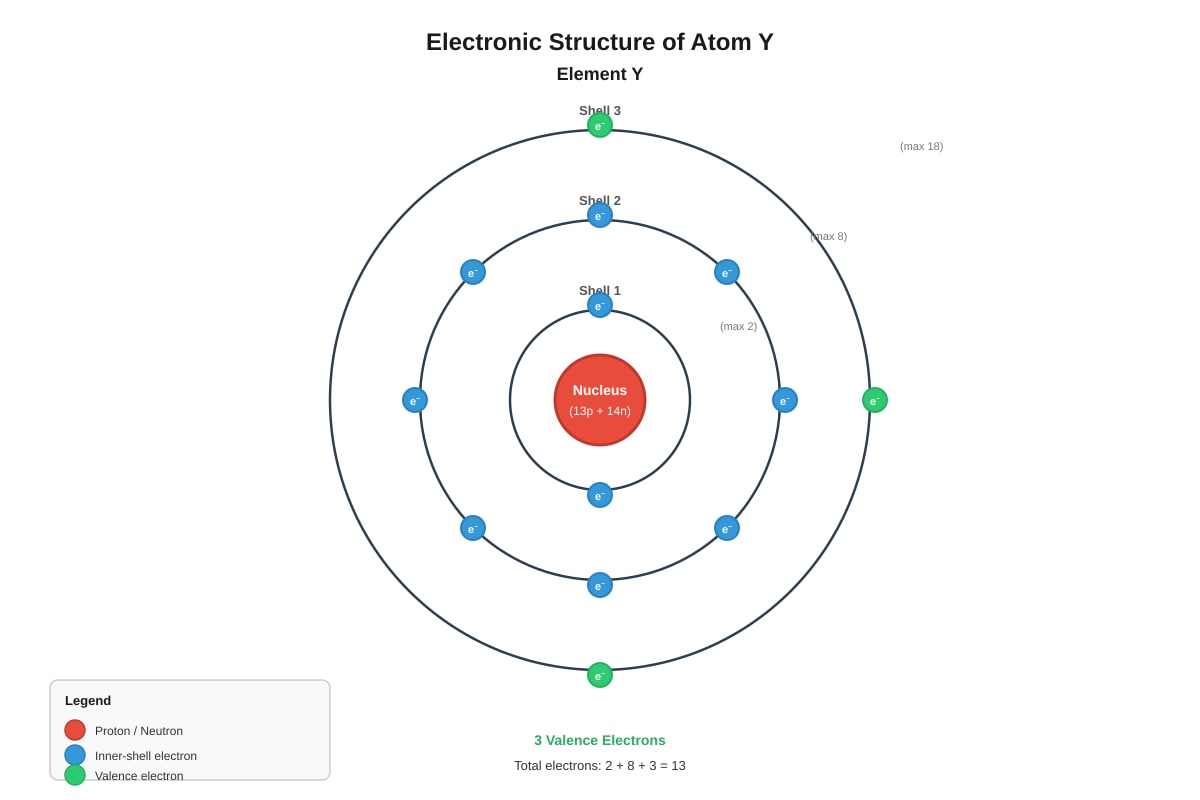
3. The diagram below shows the electronic structure of an atom of element Y.
Generated diagram for this question.
(a) State the total number of electrons in an atom of Y. [1]
- Answer: 13
- Marking: 1 mark for correct answer (2 + 8 + 3 = 13).
(b) Identify the group and period of element Y in the Periodic Table. [2]
- Answer: Group: 13 (or III); Period: 3
- Marking: 1 mark for correct group; 1 mark for correct period. Group determined by number of valence electrons (3); period determined by number of electron shells (3).
4. An atom of element Z has the electron configuration 2,8,8,1.
(a) State the proton number of Z. [1]
- Answer: 19
- Marking: 1 mark for correct answer (2 + 8 + 8 + 1 = 19).
(b) Explain why element Z is classified as a metal. [1]
- Answer: Element Z has one valence electron, which it can lose easily to form a positive ion. Metals tend to lose electrons to form positive ions.
- Marking: 1 mark for reference to losing electron(s) to form positive ion OR having few valence electrons.
5. The table below shows the number of protons, neutrons, and electrons in two particles, A and B.
| Particle | Protons | Neutrons | Electrons |
|---|---|---|---|
| A | 17 | 18 | 18 |
| B | 17 | 20 | 17 |
(a) Explain why particles A and B are considered to be the same element. [1]
- Answer: Both particles have the same number of protons (17), which determines the element (chlorine).
- Marking: 1 mark for reference to same number of protons/same proton number.
(b) State the term used to describe the relationship between particles A and B. [1]
- Answer: Isotopes
- Marking: 1 mark for correct term.
Section B: Ionic and Covalent Bonding (Questions 6–10)
6. Sodium reacts with chlorine to form sodium chloride.
(a) Draw a 'dot and cross' diagram to show the formation of sodium chloride from sodium and chlorine atoms. Show only the valence electrons and the charges on the ions formed. [3]
- Answer: Diagram should show:
- Sodium atom with 1 valence electron (dot or cross)
- Chlorine atom with 7 valence electrons (cross or dot)
- Arrow showing electron transfer from sodium to chlorine
- Resulting Na⁺ ion with no valence electrons (charge clearly labelled)
- Resulting Cl⁻ ion with 8 valence electrons (charge clearly labelled)
- Both ions with full outer shells
- Marking: 1 mark for correct valence electrons on each atom; 1 mark for showing electron transfer; 1 mark for correct ion charges and full outer shells.
7. Magnesium oxide (MgO) has a melting point of 2852 °C, while carbon dioxide (CO₂) has a melting point of −78 °C.
Explain, in terms of structure and bonding, why magnesium oxide has a much higher melting point than carbon dioxide. [3]
- Answer: Magnesium oxide has a giant ionic lattice structure with strong electrostatic forces of attraction between Mg²⁺ and O²⁻ ions throughout the lattice. A large amount of energy is required to overcome these strong forces, so the melting point is very high. Carbon dioxide has a simple molecular structure consisting of discrete CO₂ molecules held together by weak intermolecular forces (van der Waals forces). Only a small amount of energy is required to overcome these weak forces, so the melting point is very low.
- Marking: 1 mark for identifying MgO as giant ionic with strong electrostatic forces; 1 mark for identifying CO₂ as simple molecular with weak intermolecular forces; 1 mark for linking bond/force strength to energy required and melting point.
8. The table below shows the melting points of four substances.
(a) Identify which substance (A, B, C, or D) is most likely to be an ionic compound. Explain your choice. [2]
- Answer: Substance A. It has a high melting point (characteristic of ionic compounds), does not conduct electricity when solid (ions are fixed in the lattice), but conducts when molten (ions are free to move).
- Marking: 1 mark for identifying A; 1 mark for explanation linking conductivity pattern to ionic structure.
(b) Identify which substance is most likely to be a metal. Explain your choice. [1]
- Answer: Substance C. It has a high melting point and conducts electricity in both solid and molten states, which is characteristic of metallic bonding with delocalised electrons.
- Marking: 1 mark for identifying C with correct reasoning.
9. Ammonia (NH₃) is a covalent compound.
(a) Draw a 'dot and cross' diagram to show the bonding in a molecule of ammonia. Show only the valence electrons. [2]
- Answer: Diagram should show:
- Nitrogen atom with 5 valence electrons
- Three hydrogen atoms, each with 1 valence electron
- Three shared pairs of electrons (one between N and each H)
- One lone pair of electrons on nitrogen
- All atoms with full outer shells (N with 8, each H with 2)
- Marking: 1 mark for correct electron arrangement and shared pairs; 1 mark for lone pair on nitrogen and full outer shells.
(b) State the total number of shared pairs of electrons in one molecule of ammonia. [1]
- Answer: 3
- Marking: 1 mark for correct answer.
10. Oxygen (O₂) is a diatomic molecule.
(a) Draw a 'dot and cross' diagram to show the bonding in an oxygen molecule. Show only the valence electrons. [2]
- Answer: Diagram should show:
- Two oxygen atoms, each with 6 valence electrons
- Two shared pairs of electrons (a double bond) between the oxygen atoms
- Two lone pairs of electrons on each oxygen atom
- Each oxygen atom with a full outer shell of 8 electrons
- Marking: 1 mark for correct electron arrangement and shared pairs; 1 mark for lone pairs and full outer shells.
(b) State the number of shared pairs of electrons in one oxygen molecule. [1]
- Answer: 2
- Marking: 1 mark for correct answer.
Section C: Structure and Properties (Questions 11–15)
11. Diamond and graphite are both forms of carbon.
(a) Describe the structure of diamond. [2]
- Answer: Diamond has a giant covalent structure. Each carbon atom is covalently bonded to four other carbon atoms in a tetrahedral arrangement, forming a strong three-dimensional network lattice.
- Marking: 1 mark for "giant covalent structure"; 1 mark for "each carbon bonded to four others in tetrahedral arrangement" or "3D network".
(b) Explain why graphite can conduct electricity but diamond cannot. [2]
- Answer: In graphite, each carbon atom is bonded to three other carbon atoms, forming layers of hexagonal rings. Each carbon atom has one delocalised electron that is free to move between the layers, allowing electrical conductivity. In diamond, all four valence electrons of each carbon atom are used in covalent bonding; there are no free-moving electrons, so diamond cannot conduct electricity.
- Marking: 1 mark for explaining delocalised electrons in graphite; 1 mark for explaining all electrons used in bonding in diamond.
12. Silicon dioxide (SiO₂) is a giant covalent compound found in sand and quartz.
Explain why silicon dioxide has a high melting point and does not conduct electricity in any state. [3]
- Answer: Silicon dioxide has a giant covalent structure with strong covalent bonds between silicon and oxygen atoms throughout the lattice. A large amount of energy is required to break these strong covalent bonds, so silicon dioxide has a very high melting point. All valence electrons are used in covalent bonding; there are no free-moving electrons or ions in any state (solid, liquid, or dissolved), so silicon dioxide does not conduct electricity.
- Marking: 1 mark for identifying giant covalent structure with strong covalent bonds; 1 mark for linking strong bonds to high melting point; 1 mark for explaining no free-moving charged particles in any state.
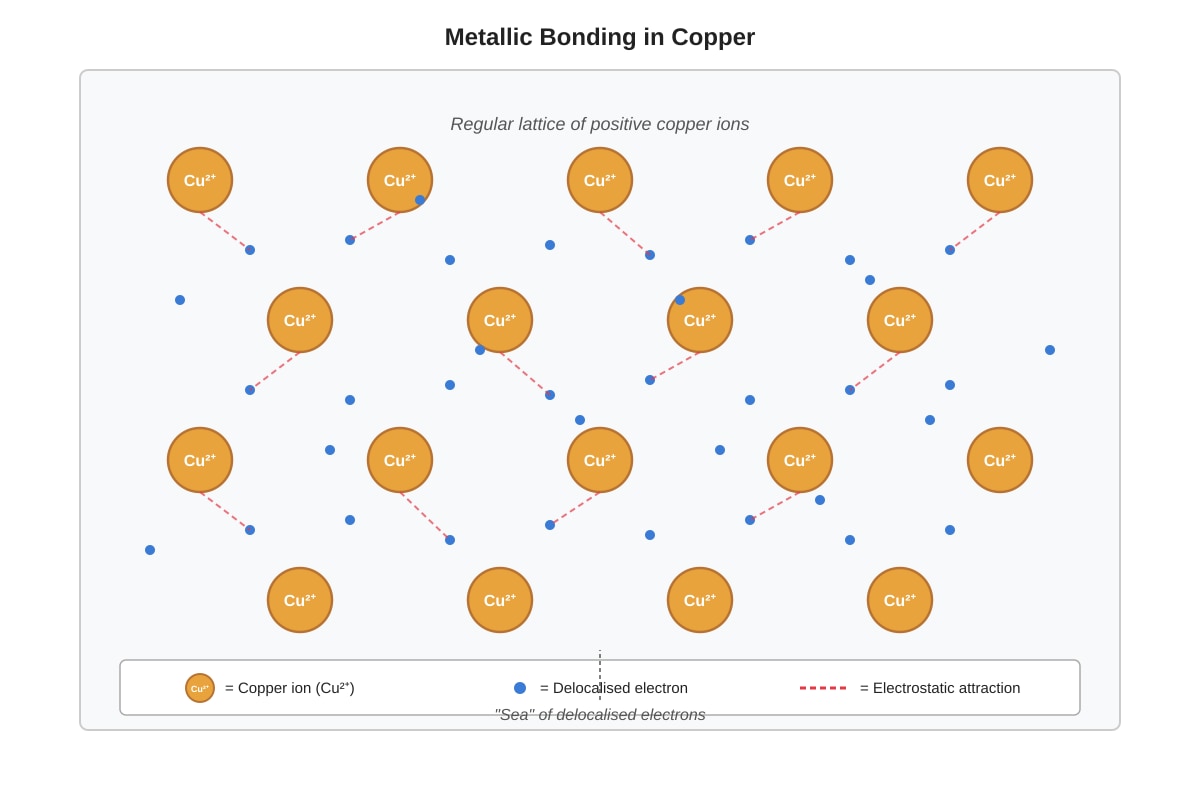
13. The diagram below represents the metallic bonding in copper.
Generated diagram for this question.
(a) Describe metallic bonding in copper, referring to the diagram. [2]
- Answer: Metallic bonding in copper consists of a regular lattice of positive copper ions surrounded by a "sea" of delocalised electrons. The electrostatic attraction between the positive ions and the delocalised electrons holds the structure together.
- Marking: 1 mark for describing lattice of positive ions and delocalised electrons; 1 mark for mentioning electrostatic attraction between them.
(b) Explain why copper can be hammered into different shapes without breaking. [1]
- Answer: The layers of positive ions in the metal lattice can slide over each other when a force is applied. The delocalised electrons can move to accommodate this, so the metallic bonding is maintained and the metal does not break.
- Marking: 1 mark for explaining that layers of ions can slide without breaking the metallic bonds.
14. Explain why sodium chloride conducts electricity when molten but not when solid. [2]
- Answer: In solid sodium chloride, the Na⁺ and Cl⁻ ions are held in fixed positions in the giant ionic lattice and are not free to move, so it cannot conduct electricity. When molten, the ions gain enough energy to break free from the lattice and become mobile. These mobile ions can carry electric charge, allowing the molten sodium chloride to conduct electricity.
- Marking: 1 mark for stating ions are fixed in solid; 1 mark for stating ions are free to move in molten state.
15. Tetrachloromethane (CCl₄) is a liquid at room temperature with a low boiling point of 77 °C.
(a) State the type of bonding present in a molecule of tetrachloromethane. [1]
- Answer: Covalent bonding
- Marking: 1 mark for correct answer.
(b) Explain why tetrachloromethane has a low boiling point. [2]
- Answer: Tetrachloromethane has a simple molecular structure consisting of discrete CCl₄ molecules. The intermolecular forces between these molecules are weak van der Waals forces. Only a small amount of energy is required to overcome these weak forces, so the boiling point is low.
- Marking: 1 mark for identifying simple molecular structure; 1 mark for linking weak intermolecular forces to low boiling point.
Section D: Mixed Bonding and Application (Questions 16–20)
16. The table below gives information about four elements: W, X, Y, and Z.
(a) Which two elements would form an ionic compound when reacted together? Explain your answer. [2]
- Answer: Y and Z (or magnesium and chlorine). Y is a metal (2,8,2) that tends to lose 2 electrons to form a positive ion. Z is a non-metal (2,8,7) that tends to gain 1 electron to form a negative ion. Electron transfer from a metal to a non-metal results in ionic bonding.
- Marking: 1 mark for identifying Y and Z; 1 mark for explaining metal and non-metal electron transfer.
(b) Write the formula of the ionic compound formed between the two elements you identified in (a). [1]
- Answer: YZ₂ (or MgCl₂)
- Marking: 1 mark for correct formula.
17. An unknown solid substance has the following properties:
(a) Identify the type of bonding and structure present in this substance. [1]
- Answer: Ionic bonding with a giant ionic lattice structure.
- Marking: 1 mark for correct identification.
(b) Name one compound that matches this description. [1]
- Answer: Sodium chloride (or any other soluble ionic compound, e.g., potassium nitrate).
- Marking: 1 mark for a correct example.
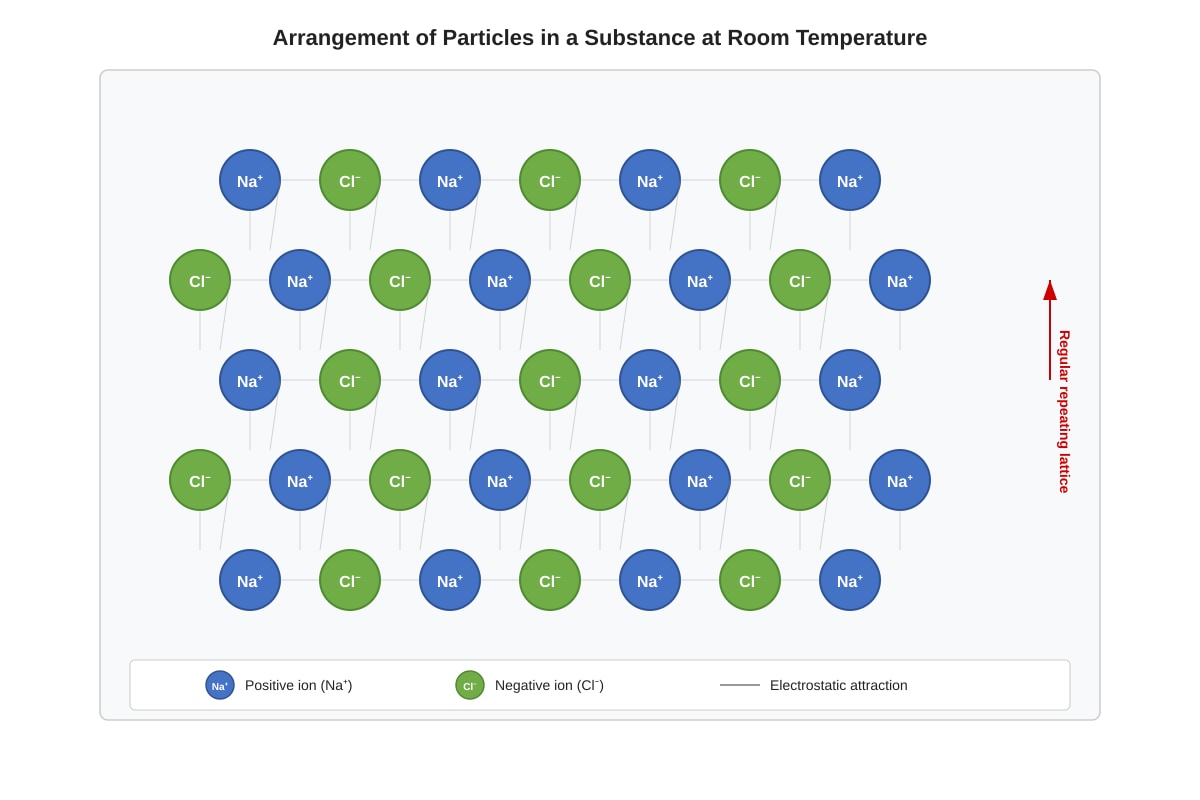
18. The diagram below shows the arrangement of particles in a substance at room temperature.
Generated diagram for this question.
(a) State the type of structure shown in the diagram. [1]
- Answer: Giant ionic lattice
- Marking: 1 mark for correct answer.
(b) Explain why this substance is brittle and shatters when hit with a hammer. [2]
- Answer: The substance consists of alternating positive and negative ions in a regular lattice. When a force is applied, layers of ions slide, causing ions of the same charge to align next to each other. The strong repulsion between these like-charged ions causes the lattice to shatter.
- Marking: 1 mark for describing layers sliding; 1 mark for explaining repulsion between like charges causing shattering.
19. Explain why metals are good conductors of heat. [2]
- Answer: Metals have a "sea" of delocalised electrons that are free to move throughout the metal lattice. When heated, these electrons gain kinetic energy and move rapidly, transferring the energy quickly throughout the metal. The closely packed positive ions also vibrate and pass energy to neighbouring ions.
- Marking: 1 mark for mentioning delocalised electrons; 1 mark for explaining energy transfer by electron movement/vibration.
20. Compare the bonding in sodium chloride and hydrogen chloride (HCl). [2]
- Answer: Sodium chloride has ionic bonding, formed by the transfer of an electron from sodium to chlorine, resulting in Na⁺ and Cl⁻ ions held together by strong electrostatic forces in a giant ionic lattice. Hydrogen chloride has covalent bonding, formed by the sharing of a pair of electrons between hydrogen and chlorine atoms, forming discrete HCl molecules with weak intermolecular forces between them.
- Marking: 1 mark for identifying NaCl as ionic with electron transfer; 1 mark for identifying HCl as covalent with electron sharing.