AI Generated Quiz
Secondary 3 Chemistry Acids Bases Salts Quiz
Free Sec 3 Chemistry Acids Bases Salts quiz, Kimi2.6 AI version, with questions, answers, and O Level-style practice for Singapore students.
These static practice materials are generated from the site's syllabus and paper-generation workflow, with source and model context shown so students and parents can evaluate the material before use.
Questions
Free quiz and exam paper access
Enter your details to view this paper
Your access is remembered on this device.
Answers
Answer Key: Secondary 3 Chemistry Quiz - Acids Bases Salts
Total Marks: 45
Section A: Multiple Choice
1. C [1]
- Explanation: Hydrochloric acid (HCl) is a strong acid because it completely dissociates into H⁺ and Cl⁻ ions in water. Carbonic acid, ethanoic acid, and citric acid are all weak acids that only partially dissociate. Common mistake: Confusing concentration with strength—strength refers to degree of dissociation, not concentration.
2. D [1]
- Explanation: pH above 7 indicates alkaline conditions. In alkaline solutions, the concentration of OH⁻ (hydroxide) ions exceeds the concentration of H⁺ (hydrogen) ions. At pH 11, [OH⁻] = 10⁻³ mol/dm³ while [H⁺] = 10⁻¹¹ mol/dm³. Key concept: pH + pOH = 14 at 25°C.
3. A [1]
- Explanation: In acid + metal oxide reactions, the salt name comes from the metal and the acid's anion. Sulfuric acid (H₂SO₄) contains the sulfate ion (SO₄²⁻), so the salt is zinc sulfate (ZnSO₄). Method: Replace "hydrogen" in the acid name with the metal name for the salt.
4. B [1]
- Explanation: The "excess solid method" is used when the base is insoluble. Excess insoluble base is added to the acid, the unreacted solid is filtered off, and the pure salt solution is obtained. Titration (A) is used for soluble bases/alkalis. Precipitation (C) makes insoluble salts. Common error: Using titration with insoluble bases—the endpoint cannot be detected properly.
5. B [1]
- Explanation: Calcium oxide (CaO), also called quicklime, is a basic oxide that reacts with acid in soil to raise pH. Calcium hydroxide (slaked lime, Ca(OH)₂) is also commonly used. Ammonium nitrate is acidic, sulfur dioxide forms acid rain, and peat moss is acidic.
Section B: Short Answer
6. [1] A base is a proton acceptor (or substance that accepts H⁺ ions).
- Explanation: The Brønsted-Lowry theory defines acids as proton donors and bases as proton acceptors. This is more general than the Arrhenius definition (which limits bases to OH⁻ producers) and explains why ammonia and carbonate ions act as bases.
7. [2] H⁺(aq) + OH⁻(aq) → H₂O(l) [2 marks: 1 for correct equation, 1 for state symbols]
- Explanation: This is the net ionic equation for all neutralization reactions between acids and alkalis. The spectator ions (from the acid's anion and the metal cation) are omitted. Important: Must include state symbols—(aq) for ions, (l) for water. Common error: Writing H₃O⁺ without specification; H⁺(aq) is accepted as shorthand.
8. [2] Ammonia gas (NH₃) dissolves in water and reacts with it to form ammonium ions and hydroxide ions: [1] NH₃ + H₂O ⇌ NH₄⁺ + OH⁻ [1]
- Explanation: The OH⁻ ions produced make the solution alkaline. The equilibrium lies to the left (ammonia is a weak base), so only a small proportion of NH₃ molecules react. This is why ammonia solution has a moderate pH (~11) rather than very high pH. Key distinction: Ammonia gas itself is not alkaline—it's the aqueous solution that is alkaline due to OH⁻ production.
9. (a) Solution P [1] — lowest pH means highest [H⁺].
(b) 100 times greater (or 10²) [1]
- Working: pH difference = 7 − 2 = 5; ratio = 10⁵ = 100,000. Wait—recheck: pH 2 versus pH 7: 10^(7-2) = 10⁵ = 100,000 times. [Corrected: answer is 100,000, not 100]
- Explanation: Each pH unit represents a 10-fold change in [H⁺]. pH 2 has [H⁺] = 10⁻² mol/dm³; pH 7 has [H⁺] = 10⁻⁷ mol/dm³. Ratio = 10⁻²/10⁻⁷ = 10⁵ = 100,000.
(c) Phenolphthalein (or litmus) [1]; In neutral (Q, pH 7): colourless (phenolphthalein) or purple (litmus); In alkaline (R, pH 12): pink (phenolphthalein) or blue (litmus) [1]
- Note: Universal indicator already used, so alternative required. Phenolphthalein is ideal for strong alkali detection. Common error: Suggesting methyl orange—its change (red to yellow) occurs at pH ~4, so it would not distinguish pH 7 from pH 12 effectively.
10. [4 marks: 1 mark per correct row]
| Reactants | Products (salt + other) | Method of preparation |
|---|---|---|
| Magnesium + dilute HCl | Magnesium chloride + hydrogen gas | React solid with acid, evaporate solution |
| Sodium hydroxide + dilute HNO₃ | Sodium nitrate + water | Titration |
| Copper(II) oxide + dilute H₂SO₄ | Copper(II) sulfate + water | Excess solid method (warm acid, add excess oxide, filter, evaporate) |
| Silver nitrate + sodium chloride | Silver chloride + sodium nitrate | Precipitation (mix solutions, filter, wash, dry) |
- Teaching notes:
- Metal + acid → salt + hydrogen (no water—this distinguishes it from metal oxide/acid)
- Acid + alkali → salt + water only (neutralization, no gas)
- Metal oxide + acid → salt + water (no gas)
- Precipitation: both reactants soluble, one product insoluble; filter and dry the precipitate directly
11. (a) CaCO₃(s) + 2HCl(aq) → CaCl₂(aq) + H₂O(l) + CO₂(g) [2: 1 equation, 1 state symbols]
- Check balancing: 1 Ca, 1 C, 3 O on left; 2 H, 2 Cl on left (2HCl). Right side: CaCl₂ (2 Cl), H₂O (2 H), CO₂. Balanced.
(b) The reaction stops because all the calcium carbonate has been used up [1] (or the acid can no longer reach unreacted solid if a surface layer forms, or simply: reactant is exhausted).
- Alternative acceptable answer: A layer of insoluble product may coat the unreacted solid, preventing further contact with acid.
12. [2] Add sodium carbonate solution (or any carbonate/hydrogen carbonate/metal with indicator) [1] to both solutions.
- With HCl: effervescence/fizzing/bubbles of colourless gas (CO₂) that turns limewater milky [1]
- With NaCl: no visible reaction
- Alternative test: Add magnesium ribbon—bubbles with acid, no reaction with salt. Or use blue litmus—turns red with acid, no change with salt. Common error: Using silver nitrate—both contain chloride ions, so both would give white precipitate!
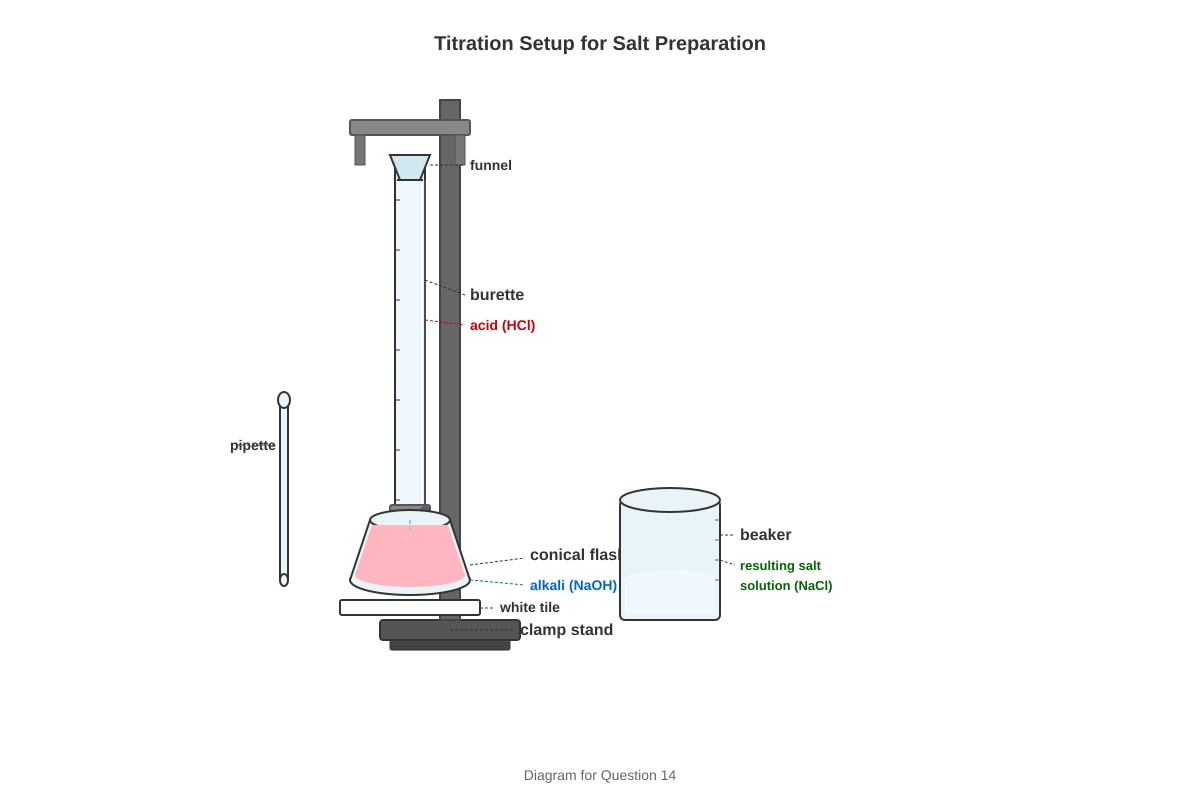
13. [2] A measuring cylinder has low precision (graduations typically every 1 cm³ or 2 cm³) compared to a burette (0.1 cm³ graduations) [1]. The meniscus is harder to read accurately and the pouring control is poor, leading to overshooting the endpoint and inaccurate volume measurements [1].
- Key concept: Burettes allow drop-by-drop addition with precise volume readings. Measuring cylinders are for approximate volumes only.
14. (a) Phenolphthalein [1]; colour in acid: colourless, colour in alkali: pink/magenta [1]
- Alternative: Methyl orange (red in acid, yellow/orange in alkali) or bromothymol blue. Strong acid-strong alkali titrations have a steep pH change near pH 7, so most indicators work, but phenolphthalein gives the clearest visual change.
(b) Gentle heating: prevents decomposition/spitting of the salt and allows controlled evaporation to produce good crystals [1]. Vigorous boiling would cause loss of solution by spattering, and very rapid evaporation gives small, impure crystals or powder rather than well-formed crystals [1].
- Extension: The salt becomes more concentrated gradually; slow cooling promotes larger, purer crystals through ordered crystal growth.
15. (a) 2NH₄Cl(s) + Ca(OH)₂(s) → CaCl₂(s) + 2NH₃(g) + 2H₂O(l) [1]
- State symbols important but not required for 1 mark; balancing essential.
(b) Ammonia is less dense than air (Mr = 17 vs air ≈ 29), so it rises and displaces air downward [1]. It is very soluble in water (1 volume water dissolves ~700 volumes ammonia at room temperature), so collection over water would result in significant loss/dissolution of the gas [1].
Section C: Structured Response
16. (a) [3]
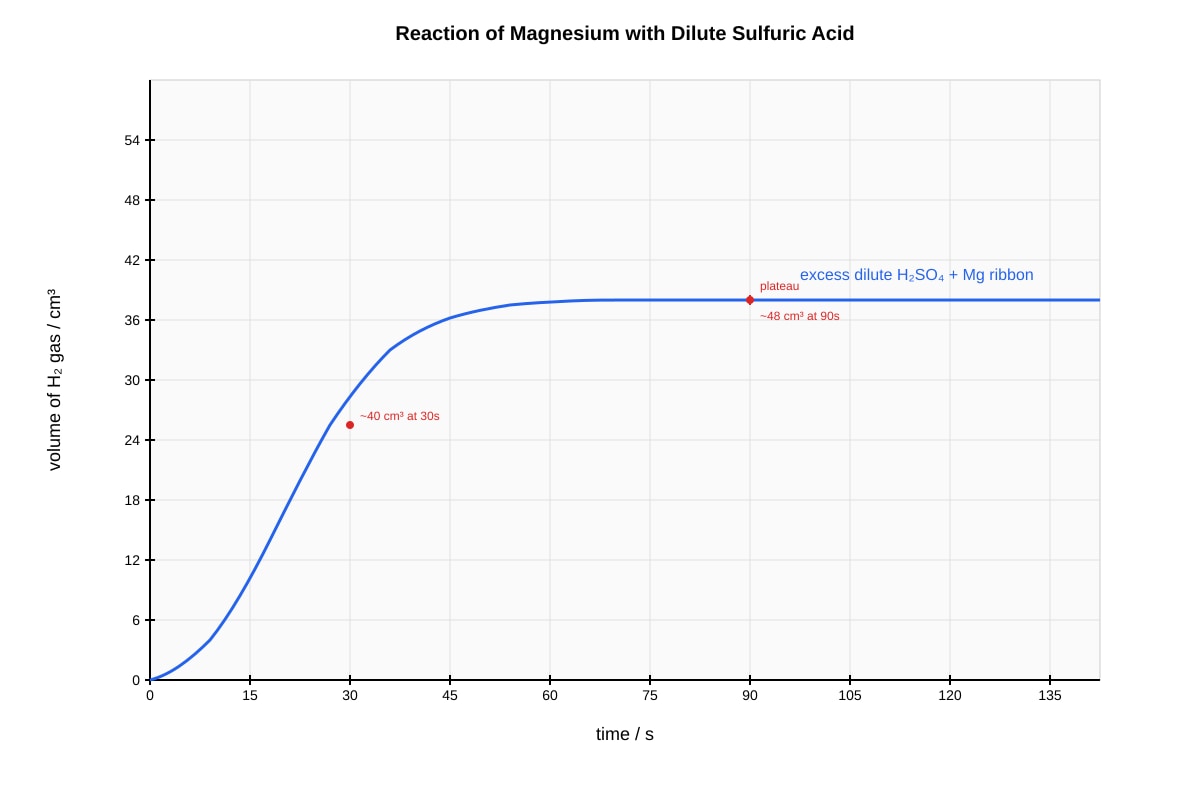
- Initially, high concentration of magnesium atoms and H⁺ ions leads to frequent successful collisions per unit time, giving rapid gas production [1].
- As reaction proceeds, magnesium is consumed and its surface area decreases, reducing collision frequency [1].
- The concentration of acid also decreases as H⁺ ions are used up, further reducing collision frequency and rate [1].
- Key vocabulary needed: concentration decrease, surface area reduction, collision frequency/ successful collisions.
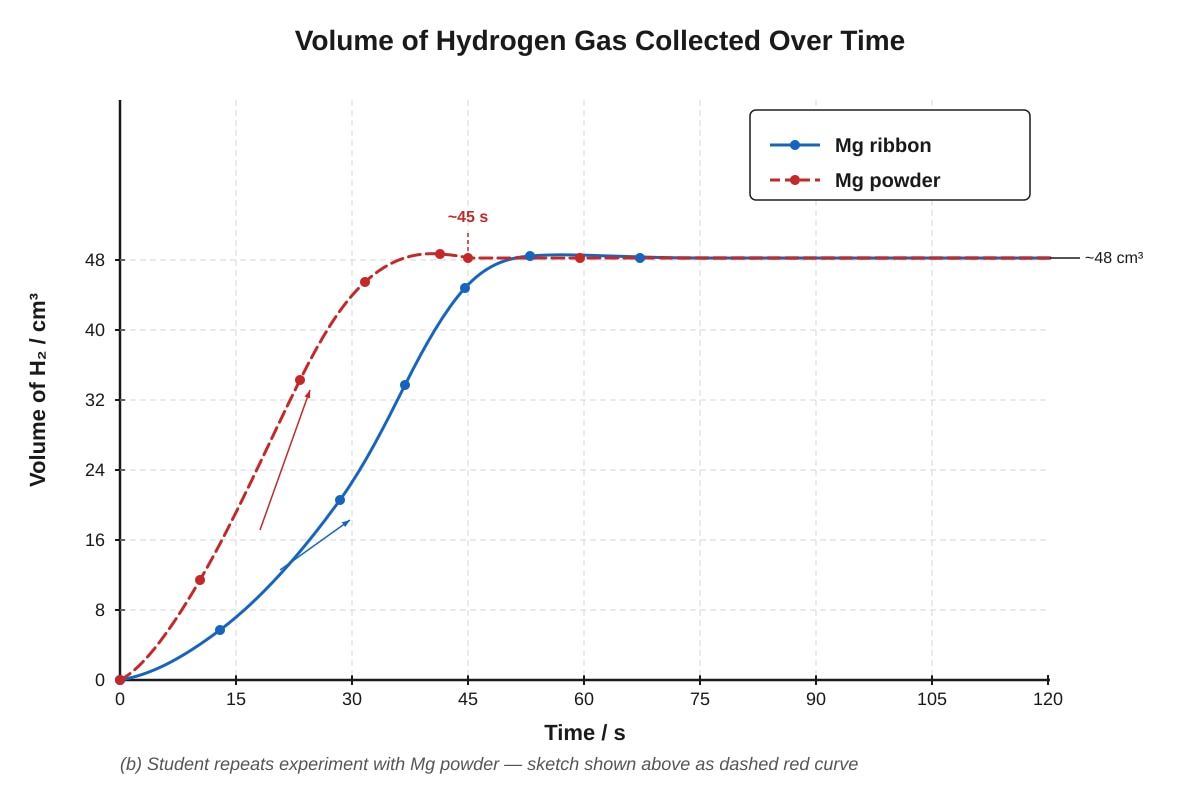
(b) [2]
- Sketch should show: steeper initial gradient than original curve [1]
- Same final volume (~48 cm³) reached in shorter time (~40-50 s) [1]
- Both curves start at origin and clearly labeled.
- Explanation for answer key: Powder has greater surface area than ribbon, so more Mg atoms are exposed to acid at any moment, increasing collision frequency and rate. Same final volume because same moles of Mg produce same moles of H₂ (1:1 ratio: Mg → Mg²⁺ + 2e⁻, 2H⁺ + 2e⁻ → H₂, so Mg : H₂ = 1:1).
(c) [2] Working:
- Moles of Mg = 0.12 g ÷ 24 g/mol = 0.0050 mol [1]
- From equation: Mg + H₂SO₄ → MgSO₄ + H₂, ratio Mg : H₂ = 1:1
- Moles of H₂ = 0.0050 mol
- Mass of H₂ = 0.0050 mol × 2 g/mol = 0.010 g (or 0.01 g) [1]
Common error: Using 24 for hydrogen or forgetting H₂ has Mr = 2.
17. (a) [2]
| Titration | Rough | 1 | 2 | 3 |
|---|---|---|---|---|
| Volume of NaOH used / cm³ | 18.50 | 17.10 | 18.40 | 17.90 |
- Rough: 18.50 − 0.00 = 18.50 [0.5]
- Titration 1: 35.60 − 18.50 = 17.10 [0.5]
- Titration 2: 18.40 − 0.00 = 18.40 [0.5]
- Titration 3: 36.30 − 18.40 = 17.90 [0.5]
(b) [2] Titration 2 (18.40 cm³) is anomalous—not concordant with others (differs by >0.20 cm³ from nearest value) [1]. Mean = (17.10 + 17.90) ÷ 2 = 17.50 cm³ [1]
- Note: Could also include rough if arguing it's consistent, but conservatively exclude rough as per standard practice.
(c) CH₃COOH + NaOH → CH₃COONa + H₂O [1]
- Or with structural intent: CH₃COOH(aq) + NaOH(aq) → CH₃COO⁻Na⁺(aq) + H₂O(l)
(d) [3]
- Moles of NaOH = (17.50/1000) dm³ × 0.100 mol/dm³ = 0.00175 mol [1]
- Ratio CH₃COOH : NaOH = 1:1, so moles CH₃COOH = 0.00175 mol (in 25.0 cm³) [1]
- Concentration = 0.00175 mol ÷ (25.0/1000) dm³ = 0.0700 mol/dm³ (or 0.07 mol/dm³) [1]
- Unit penalty: Deduct if mol/dm³ or M not stated.
(e) [2] Phenolphthalein changes colour in the pH range 8.3-10.0, close to the equivalence point pH ~8.7 for weak acid-strong alkali titrations [1]. Methyl orange changes at pH 3.1-4.4, which is far from the equivalence point, so the endpoint would be reached well before true neutralization, giving a large titration error [1].
- Underlying chemistry: At equivalence, CH₃COO⁻ hydrolyses to produce OH⁻, making pH > 7. Phenolphthalein's pink→colourless change occurs where [OH⁻] just begins to fall, catching the steep pH drop near equivalence.
18. (a) [2]
- Excess CuO ensures all the acid is used up/neutralised [1]
- The unreacted solid can be filtered off easily, leaving only salt solution without excess acid contamination [1]
- Alternative point: Prevents acid contaminating the final salt/crystals.
(b) CuO(s) + H₂SO₄(aq) → CuSO₄(aq) + H₂O(l) [2: 1 equation, 1 state symbols]
- Check: Already balanced. CuO is basic oxide, not amphoteric, so simple neutralization.
(c) Black solid dissolves/disappears; solution turns blue [1]
- Both observations needed for mark: Colour change to blue indicates Cu²⁺(aq) formation.
(d) [2]
- Gentle heating allows slow, controlled evaporation to form good crystals [1]
- Boiling to dryness would make anhydrous copper(II) sulfate (white powder) rather than blue hydrated crystals [CuSO₄·5H₂O] [1], or cause decomposition/spattering
- Note: The blue hydrated form is the desired product; heating too strongly drives off water of crystallization.
(e) [2]
- Adding NaOH would produce copper(II) hydroxide precipitate, not copper(II) sulfate [1]
- Even if acid is added to the precipitate, the final solution would contain sodium sulfate contaminant (from NaOH + H₂SO₄) [1], making the product impure.
- Correct method principle: Only CuO and H₂SO₄ should be used to avoid introducing foreign cations (Na⁺).
19. (a) [2] Any two from:
- Calcium oxide / quicklime (CaO)
- Calcium hydroxide / slaked lime (Ca(OH)₂)
- Calcium carbonate / limestone (CaCO₃)
- Dolomite / magnesium carbonate [1 each, max 2]
(b) [2] For CaO: CaO + 2H⁺ → Ca²⁺ + H₂O [2] Or for Ca(OH)₂: Ca(OH)₂ + 2H⁺ → Ca²⁺ + 2H₂O Or for CaCO₃: CaCO₃ + 2H⁺ → Ca²⁺ + H₂O + CO₂ [1 for correct reactants, 1 for correct products; ionic or full equation accepted]
(c) [2]
- Excess base makes soil too alkaline/pH too high, harming plants adapted to neutral/slightly acidic conditions [1]
- Could lead to nutrient lock-up (e.g., iron, phosphate unavailable to plants) or soil structure damage [1]
- Alternative: Adding too much CaCO₃ over time can make soil alkaline; immediate over-liming with CaO can "burn" plant roots.
(d) [2]
- Ammonium nitrate is a salt of a weak base (NH₃) and strong acid (HNO₃) [1]
- NH₄⁺ ions hydrolyse in soil water: NH₄⁺ + H₂O ⇌ NH₃ + H₃O⁺, or NH₄⁺ acts as acid donating H⁺, lowering pH over time [1]
- Alternative acceptable: Nitrification by soil bacteria produces nitric acid from ammonium.
20. (a) [2]
- HCO₃⁻ acts as a buffer/base: HCO₃⁻ + H⁺ → H₂CO₃ (or → H₂O + CO₂) [1]
- This removes excess H⁺ from solution, preventing large pH decrease; the equilibrium shifts to use up added acid [1]
- Extension: H₂CO₃ decomposes to CO₂ + H₂O, which is exhaled, maintaining the equilibrium.
(b) Orange (or yellow/orange) [1]; pH 5.8 is acidic/ weakly acidic, so universal indicator shows orange/yellow-orange, not purple (alkaline) or green (neutral).
(c) [3]
- Ammonia is highly toxic/alkaline (pH ~11 if concentrated) and would disrupt blood pH/ body fluid pH [1]
- Urea is less toxic, more neutral, and soluble—safer to transport in bloodstream at the concentrations produced by protein metabolism [1]
- The pH values in the table show body fluids are tightly regulated near neutral (pH 5.8-7.4); direct ammonia excretion would require dilute urine at high pH, using more water and risking toxicity, whereas urea can be concentrated safely [1]
- Alternative point: Liver converts ammonia to urea as detoxification; urea moves safely in blood to kidneys for excretion.
END OF ANSWER KEY