Secondary 3 Chemistry Quiz - Acids Bases Salts
Name: ___________________________
Class: _________
Date: ____________
Score: _______ / 40
Duration: 50 minutes
Total Marks: 40
Instructions:
- Answer all 20 questions.
- Section A: Multiple-choice style short responses (1 mark each).
- Section B: Structured questions with working required.
- Section C: Extended response and data interpretation.
- Write your answers clearly in the spaces provided.
- Use chemical formulae and equations where requested.
- This quiz is generated from syllabus-aligned AI templates (Stage 4/5). It is not derived from official past-year papers.
Section A: Basic Concepts (Questions 1–5)
1. A farmer adds calcium oxide to his acidic soil. State whether calcium oxide increases or decreases the soil pH. [1]
2. Lemon juice has a pH of 2. State whether lemon juice is acidic, neutral, or alkaline. [1]
3. Name the salt formed when hydrochloric acid reacts with sodium hydroxide in a neutralization reaction. [1]
4. Give the formula of the ion responsible for alkalinity in aqueous solutions of bases. [1]
5. Which of the following is an indicator that is green in neutral solution and red in acidic solution?
A. Litmus
B. Universal indicator
C. Methyl orange
D. Phenolphthalein [1]
Section B: Neutralization and Salt Preparation (Questions 6–12)
6. A student adds nitric acid to potassium hydroxide until the solution becomes neutral.
(a) Write a balanced chemical equation for this neutralization reaction, including state symbols. [2]
(b) Name the salt formed. [1]
(a) _______________________________________________________
(b) _______________________________________________________
7. State the colour change observed when hydrochloric acid is gradually added to a solution of sodium hydroxide containing phenolphthalein indicator. [1]
8. Describe how you would prepare pure, dry crystals of copper(II) sulfate starting from copper(II) oxide and dilute sulfuric acid. Include the method name and key steps. [3]
9. Classify each of the following salts as soluble or insoluble in water:
(a) Sodium chloride [1]
(b) Silver chloride [1]
(c) Calcium nitrate [1]
(a) _________ (b) _________ (c) _________
10. Calculate the number of moles of hydrochloric acid in 0.500 dm³ of a 0.200 mol/dm³ solution. Show your working. [2]
11. A student prepares a soluble salt by reacting an excess of insoluble metal oxide with an acid.
(a) Name a suitable method to obtain the salt from the mixture after reaction. [1]
(b) Give one reason why excess metal oxide is used. [1]
(a) _______________________________________________________
(b) _______________________________________________________
12. The pH values of four solutions are shown below:
- Solution P: pH 3
- Solution Q: pH 7
- Solution R: pH 11
- Solution S: pH 1
Arrange the solutions from most acidic to most alkaline. [2]
Section C: Data Interpretation and Extended Reasoning (Questions 13–20)
13. A student performed a titration between 25.0 cm³ of sodium hydroxide solution of unknown concentration and 0.100 mol/dm³ hydrochloric acid. The readings from the burette are shown below (in cm³):
| Trial | Final reading | Initial reading | Volume used |
|---|
| 1 (rough) | 24.6 | 0.0 | 24.6 |
| 2 | 24.5 | 0.0 | 24.5 |
| 3 | 24.4 | 0.0 | 24.4 |
| 4 | 24.5 | 0.0 | 24.5 |
(a) Identify the concordant titres. [1]
(b) Calculate the average volume of hydrochloric acid used, excluding the rough titration. [1]
(a) _______________________________________________________
(b) _______________________________________________________
14. Using your answer from Q13(b), calculate the number of moles of HCl used to neutralize the 25.0 cm³ of NaOH. [2]
15. From Q14, calculate the concentration of the sodium hydroxide solution in mol/dm³. [2]
16. Zinc oxide is an amphoteric oxide.
(a) Write a balanced equation for the reaction of zinc oxide with dilute hydrochloric acid. [1]
(b) Write a balanced equation for the reaction of zinc oxide with aqueous sodium hydroxide. [1]
(c) Explain what is meant by the term "amphoteric". [1]
(a) _______________________________________________________
(b) _______________________________________________________
(c) _______________________________________________________
17. The diagram below shows the pH change during the titration of an acid with an alkali using a pH probe.
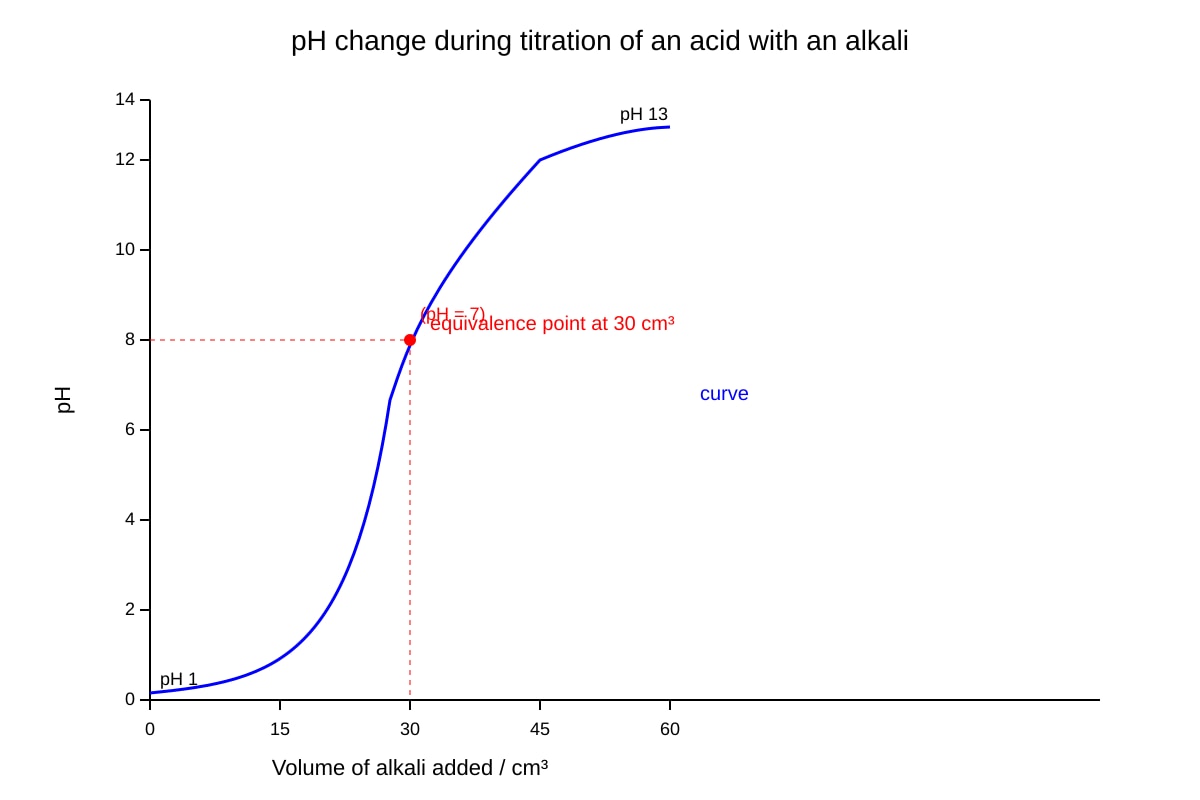
Generated graph for Q17.
(a) State the pH at the equivalence point. [1]
(b) Explain why the pH increases rapidly near the equivalence point. [2]
(a) _________
(b) _______________________________________________________
18. A sample of impure calcium carbonate (chalk) was reacted with excess hydrochloric acid. The gas produced was collected in a gas syringe.
(a) Name the gas produced. [1]
(b) Write a balanced equation for the reaction between calcium carbonate and hydrochloric acid. [2]
(a) _______________________________________________________
(b) _______________________________________________________
19. A student tested three solutions with red litmus paper and blue litmus paper with the following results:
| Solution | Red litmus | Blue litmus |
|---|
| A | stays red | turns blue |
| B | stays red | stays red |
| C | turns red | stays blue |
Classify each solution A, B, and C as acidic, alkaline, or neutral. [3]
A: _________ B: _________ C: _________
20. A fertiliser factory produces ammonium sulfate by reacting ammonia with sulfuric acid.
(a) Write a balanced equation for this reaction. [2]
(b) State one use of ammonium sulfate. [1]
(a) _______________________________________________________
(b) _______________________________________________________
</stage5_quiz_answers_md>
Secondary 3 Chemistry Quiz - Acids Bases Salts: Answer Key
Total Marks: 40
Topic: Acids, Bases & Salts (Syllabus-aligned AI-generated; not past-year derived)
Section A: Basic Concepts (Q1–5)
1. [1 mark] Increases.
Teaching note: Acidic soils have pH below 7. Bases such as CaO neutralise acid in soil, raising pH toward 7. Common mistake: thinking CaO lowers pH.
2. [1 mark] Acidic.
Teaching note: pH < 7 is acidic; pH 2 is strongly acidic. Lemon juice is a familiar acid.
3. [1 mark] Sodium chloride (NaCl).
Teaching note: HCl + NaOH → NaCl + H₂O. Salt name from metal (Na) + non-metal (Cl) = sodium chloride.
4. [1 mark] Hydroxide ion, OH⁻.
Teaching note: Bases release OH⁻ in water, causing alkalinity.
5. [1 mark] C. Methyl orange.
Teaching note: Methyl orange is red in acid, yellow in alkali, green in neutral. Litmus is red/blue only; universal indicator gives a range; phenolphthalein is pink in alkali.
Section B: Neutralization and Salt Preparation (Q6–12)
6. [3 marks total]
(a) [2] HNO₃(aq) + KOH(aq) → KNO₃(aq) + H₂O(l)
Marking: 1 for correct formulae, 1 for balancing + state symbols.
(b) [1] Potassium nitrate.
Teaching note: Acid + alkali → salt + water. Nitric acid + potassium hydroxide → potassium nitrate + water.
7. [1 mark] Pink to colourless (or red/pink to colourless).
Teaching note: Phenolphthalein is pink in alkali, colourless in acid. As acid is added, pH drops below ~8.3, colour disappears.
8. [3 marks] Method: Neutralization / direct combination.
Marking descriptors: 1 = method name; 1 = excess CuO + warm acid until no more dissolves; 1 = filter, evaporate, cool, dry.
Sample answer: Add excess CuO to dilute H₂SO₄ and warm. Filter off excess CuO. Evaporate filtrate to crystallisation point, cool, filter crystals, dry between paper.
Teaching note: Insoluble base + acid → soluble salt; excess ensures complete reaction.
9. [3 marks]
(a) [1] Soluble (b) [1] Insoluble (c) [1] Soluble
Teaching note: All sodium and nitrate salts are soluble; AgCl is a common insoluble chloride.
10. [2 marks]
n = c × V = 0.200 × 0.500 = 0.100 mol.
Marking: 1 for formula, 1 for answer with unit.
Teaching note: n (mol) = concentration (mol/dm³) × volume (dm³).
11. [2 marks]
(a) [1] Filtration.
(b) [1] To ensure all acid reacts / drive reaction to completion.
Teaching note: Excess insoluble base is removed by filtering; excess guarantees no acid remains.
12. [2 marks] Most acidic = S (pH 1), then P (3), Q (7), R (11) most alkaline.
Marking: 1 for order S, P, Q, R; 1 for correct reasoning (lower pH = more acidic).
Teaching note: pH scale: lower = more acidic.
Section C: Data Interpretation and Extended Reasoning (Q13–20)
13. [2 marks]
(a) [1] 24.4, 24.5, 24.5 cm³ (trials 2–4).
(b) [1] (24.4 + 24.5 + 24.5) ÷ 3 = 24.47 ≈ 24.5 cm³.
Teaching note: Concordant = within 0.1 cm³, exclude rough. Average of concordant only.
14. [2 marks]
n(HCl) = c × V = 0.100 × 0.0245 = 0.00245 mol.
Marking: 1 formula, 1 substitution + unit.
Teaching note: V must be in dm³: 24.5 cm³ = 0.0245 dm³.
15. [2 marks]
At equivalence: n(NaOH) = n(HCl) = 0.00245 mol.
c(NaOH) = 0.00245 ÷ 0.0250 = 0.0980 mol/dm³.
Marking: 1 mole equality, 1 final concentration.
Teaching note: 25.0 cm³ = 0.0250 dm³. Monoacid–monobase 1:1 ratio.
16. [3 marks]
(a) [1] ZnO + 2HCl → ZnCl₂ + H₂O
(b) [1] ZnO + 2NaOH + H₂O → Na₂[Zn(OH)₄] (or ZnO + 2NaOH → Na₂ZnO₂ + H₂O)
(c) [1] Reacts with both acids and alkalis.
Teaching note: Amphoteric = acts as base with acid, acid with alkali.
17. [3 marks]
(a) [1] pH 7.
(b) [2] Near equivalence, tiny alkali addition neutralises most H⁺, so pH jumps sharply.
Marking: 1 pH value, 2 explanation of steep rise due to neutralisation.
Visual support: Graph shows equivalence at 30 cm³, pH 7.
18. [3 marks]
(a) [1] Carbon dioxide, CO₂.
(b) [2] CaCO₃ + 2HCl → CaCl₂ + CO₂ + H₂O
Teaching note: Carbonate + acid → salt + CO₂ + water.
19. [3 marks]
A: Alkaline; B: Acidic; C: Neutral.
Marking: 1 each.
Teaching note: Blue litmus turns red in acid; red turns blue in alkali; no change = neutral.
20. [3 marks]
(a) [2] 2NH₃ + H₂SO₄ → (NH₄)₂SO₄
(b) [1] Fertilisers / nitrogen source for plants.
Teaching note: Ammonia (base) + acid → ammonium salt.
</stage5_quiz_answers_md>
<stage5_quiz_md>
Secondary 3 Chemistry Quiz - Acids Bases Salts
Name: ___________________________
Class: _________
Date: ____________
Score: _______ / 40
Duration: 50 minutes
Total Marks: 40
Instructions:
- Answer all 20 questions.
- Section A: Multiple-choice style short responses (1 mark each).
- Section B: Structured questions with working required.
- Section C: Extended response and data interpretation.
- Write your answers clearly in the spaces provided.
- Use chemical formulae and equations where requested.
- This quiz is generated from syllabus-aligned AI templates (Stage 4/5). It is not derived from official past-year papers.
Section A: Basic Concepts (Questions 1–5)
1. A farmer adds calcium oxide to his acidic soil. State whether calcium oxide increases or decreases the soil pH. [1]
2. Lemon juice has a pH of 2. State whether lemon juice is acidic, neutral, or alkaline. [1]
3. Name the salt formed when hydrochloric acid reacts with sodium hydroxide in a neutralization reaction. [1]
4. Give the formula of the ion responsible for alkalinity in aqueous solutions of bases. [1]
5. Which of the following is an indicator that is green in neutral solution and red in acidic solution?
A. Litmus
B. Universal indicator
C. Methyl orange
D. Phenolphthalein [1]
Section B: Neutralization and Salt Preparation (Questions 6–12)
6. A student adds nitric acid to potassium hydroxide until the solution becomes neutral.
(a) Write a balanced chemical equation for this neutralization reaction, including state symbols. [2]
(b) Name the salt formed. [1]
(a) _______________________________________________________
(b) _______________________________________________________
7. State the colour change observed when hydrochloric acid is gradually added to a solution of sodium hydroxide containing phenolphthalein indicator. [1]
8. Describe how you would prepare pure, dry crystals of copper(II) sulfate starting from copper(II) oxide and dilute sulfuric acid. Include the method name and key steps. [3]
9. Classify each of the following salts as soluble or insoluble in water:
(a) Sodium chloride [1]
(b) Silver chloride [1]
(c) Calcium nitrate [1]
(a) _________ (b) _________ (c) _________
10. Calculate the number of moles of hydrochloric acid in 0.500 dm³ of a 0.200 mol/dm³ solution. Show your working. [2]
11. A student prepares a soluble salt by reacting an excess of insoluble metal oxide with an acid.
(a) Name a suitable method to obtain the salt from the mixture after reaction. [1]
(b) Give one reason why excess metal oxide is used. [1]
(a) _______________________________________________________
(b) _______________________________________________________
12. The pH values of four solutions are shown below:
- Solution P: pH 3
- Solution Q: pH 7
- Solution R: pH 11
- Solution S: pH 1
Arrange the solutions from most acidic to most alkaline. [2]
Section C: Data Interpretation and Extended Reasoning (Questions 13–20)
13. A student performed a titration between 25.0 cm³ of sodium hydroxide solution of unknown concentration and 0.100 mol/dm³ hydrochloric acid. The readings from the burette are shown below (in cm³):
| Trial | Final reading | Initial reading | Volume used |
|---|
| 1 (rough) | 24.6 | 0.0 | 24.6 |
| 2 | 24.5 | 0.0 | 24.5 |
| 3 | 24.4 | 0.0 | 24.4 |
| 4 | 24.5 | 0.0 | 24.5 |
(a) Identify the concordant titres. [1]
(b) Calculate the average volume of hydrochloric acid used, excluding the rough titration. [1]
(a) _______________________________________________________
(b) _______________________________________________________
14. Using your answer from Q13(b), calculate the number of moles of HCl used to neutralize the 25.0 cm³ of NaOH. [2]
15. From Q14, calculate the concentration of the sodium hydroxide solution in mol/dm³. [2]
16. Zinc oxide is an amphoteric oxide.
(a) Write a balanced equation for the reaction of zinc oxide with dilute hydrochloric acid. [1]
(b) Write a balanced equation for the reaction of zinc oxide with aqueous sodium hydroxide. [1]
(c) Explain what is meant by the term "amphoteric". [1]
(a) _______________________________________________________
(b) _______________________________________________________
(c) _______________________________________________________
17. The diagram below shows the pH change during the titration of an acid with an alkali using a pH probe.
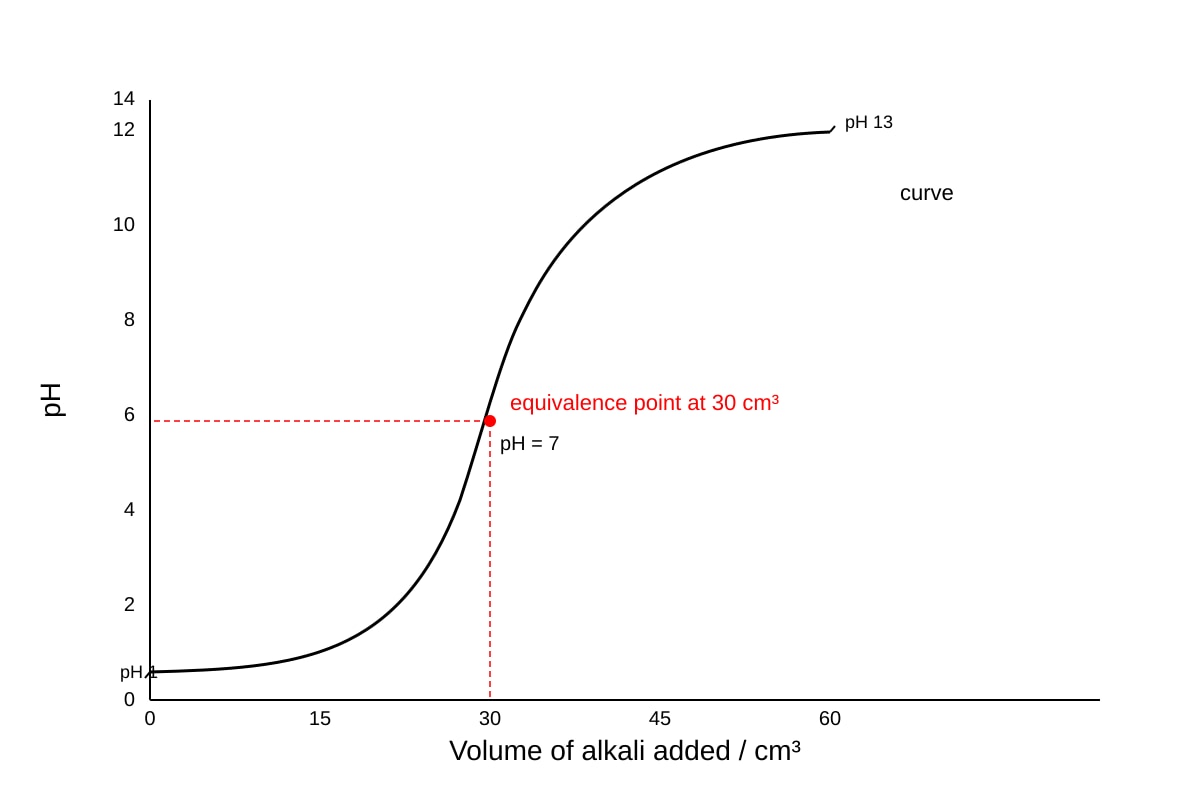
Generated graph for Q17.
(a) State the pH at the equivalence point. [1]
(b) Explain why the pH increases rapidly near the equivalence point. [2]
(a) _________
(b) _______________________________________________________
18. A sample of impure calcium carbonate (chalk) was reacted with excess hydrochloric acid. The gas produced was collected in a gas syringe.
(a) Name the gas produced. [1]
(b) Write a balanced equation for the reaction between calcium carbonate and hydrochloric acid. [2]
(a) _______________________________________________________
(b) _______________________________________________________
19. A student tested three solutions with red litmus paper and blue litmus paper with the following results:
| Solution | Red litmus | Blue litmus |
|---|
| A | stays red | turns blue |
| B | stays red | stays red |
| C | turns red | stays blue |
Classify each solution A, B, and C as acidic, alkaline, or neutral. [3]
A: _________ B: _________ C: _________
20. A fertiliser factory produces ammonium sulfate by reacting ammonia with sulfuric acid.
(a) Write a balanced equation for this reaction. [2]
(b) State one use of ammonium sulfate. [1]
(a) _______________________________________________________
(b) _______________________________________________________