From Real Exams Quiz
Secondary 3 Chemistry Stoichiometry Moles Quiz
Free Sec 3 Chemistry Stoichiometry Moles quiz, HY3 Exam version, with questions, answers, and O Level-style practice for Singapore students.
These static practice materials are generated from the site's syllabus and paper-generation workflow, with source and model context shown so students and parents can evaluate the material before use.
Questions
Secondary 3 Chemistry Quiz - Stoichiometry Moles
Name: ___________________________
Class: ______________
Date: ______________
Score: _______ / 40
Duration: 60 minutes
Total Marks: 40
Instructions:
- Answer all 20 questions.
- Show all working clearly for calculation questions.
- Use proper units and chemical notation.
- Section A: Short Answer (1 mark each)
- Section B: Structured Calculation (2–3 marks each)
- Section C: Data Interpretation & Reasoning (2–4 marks each)
Section A: Short Answer (Questions 1–5)
1. Define the mole in terms of the number of particles. [1]
2. What is the unit used to express the amount of substance in chemistry? [1]
3. State the formula linking number of moles (n), mass (m), and molar mass (Mr). [1]
4. What volume does 1 mole of any gas occupy at room temperature and pressure (r.t.p.)? [1]
5. Write the unit for concentration of a solution in mol/dm³ as a formula symbol. [1]
Section B: Structured Calculation (Questions 6–10)
6. Calculate the number of moles in 8.0 g of oxygen gas, O2. (Relative atomic mass: O = 16) [2]
7. Calculate the mass of 0.50 mol of sodium chloride, NaCl. (Na = 23, Cl = 35.5) [2]
8. A solution contains 0.20 mol of hydrochloric acid in 500 cm³ of solution. Calculate its concentration in mol/dm³. [2]
9. Calculate the volume of carbon dioxide gas, CO2, at r.t.p. produced from 0.10 mol of CO2. (Molar gas volume at r.t.p. = 24 dm³) [2]
10. 4.0 g of magnesium, Mg, reacts completely with hydrochloric acid. Calculate the volume of hydrogen gas produced at r.t.p.
Reaction: Mg+2HCl→MgCl2+H2
(Mg = 24, molar gas volume = 24 dm³ at r.t.p.) [3]
Section C: Data Interpretation & Reasoning (Questions 11–20)
11. A student burns 3.0 g of carbon in oxygen.
C+O2→CO2 (C = 12, O = 16)
Calculate the mass of CO2 formed. [3]
12. 10.0 g of calcium carbonate, CaCO3, decomposes on heating:
CaCO3→CaO+CO2 (Ca = 40, C = 12, O = 16)
Calculate the mass of CaO produced. [3]
13. A titration uses 25.0 cm³ of 0.100 mol/dm³ sodium hydroxide, NaOH, neutralised by hydrochloric acid, HCl.
NaOH+HCl→NaCl+H2O
Calculate the number of moles of NaOH used. [2]
14. Using your answer from Q13, calculate the number of moles of HCl needed for complete neutralisation. [1]
15. If 20.0 cm³ of HCl solution from Q14 neutralised the NaOH, calculate the concentration of HCl in mol/dm³. [2]
16. The equation shows the reaction of iron with sulphur:
Fe+S→FeS (Fe = 56, S = 32)
Calculate the maximum mass of FeS produced from 2.8 g of Fe and excess S. [3]
17. A sample of hydrated copper(II) sulphate, CuSO4⋅xH2O, has mass 2.50 g before heating and 1.60 g after heating to remove water.
(Cu = 64, S = 32, O = 16, H = 1)
(a) Calculate the mass of water lost. [1]
(b) Calculate the number of moles of CuSO4 in the anhydrous solid. [2]
(c) Calculate the value of x. [2]
18. The table shows results from an experiment reacting zinc with hydrochloric acid:
| Trial | Volume of H2 collected (cm³) |
|---|---|
| 1 | 82 |
| 2 | 84 |
| 3 | 83 |
| 4 | 95 |
(a) Identify the concordant results. [1]
(b) Calculate the average volume of H2 from concordant results. [2]
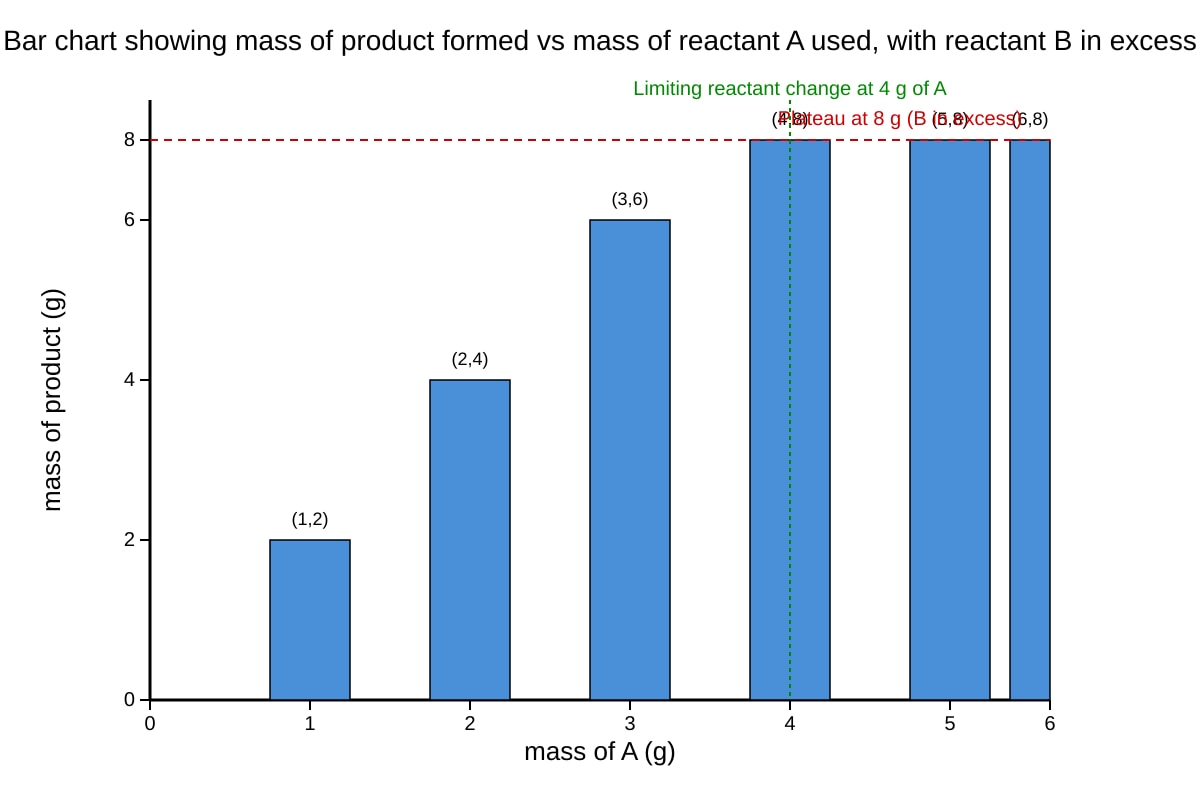
19.

Generated graph for Q19.
Using the graph, state the mass of A that is just enough to react with the fixed amount of B. Explain your answer. [2]
20. A student calculated the percentage yield of a reaction as follows:
Theoretical mass of product = 5.0 g
Actual mass obtained = 3.5 g
Calculate the percentage yield and give one reason why it is less than 100%. [3]
Answers
Secondary 3 Chemistry Quiz - Stoichiometry Moles: Answer Key
Total Marks: 40
Topic: Stoichiometry & Moles
Section A: Short Answer
1. [1] The mole is the amount of substance that contains 6.02×10²³ particles (Avogadro’s constant).
Teaching note: A “particle” may be an atom, molecule, or ion. The mole is the chemist’s counting unit, like “dozen” but much larger.
2. [1] mole (symbol: mol)
Teaching note: Amount of substance is measured in moles, not grams or litres.
3. [1] n=Mrm
Teaching note: n = moles, m = mass in g, Mr = relative formula/molecular mass in g/mol.
4. [1] 24 dm³ (or 24000 cm³)
Teaching note: At r.t.p. (room temperature and pressure), one mole of any gas occupies the same volume: 24 dm³.
5. [1] mol/dm³ (or M)
Teaching note: Concentration c=Vn where V is in dm³.
Section B: Structured Calculation
6. [2]
Mr(O2)=16×2=32
n=Mrm=328.0=0.25 mol
Marks: 1 for Mr, 1 for correct moles.
Common mistake: Using O = 16 as Mr instead of O2 = 32.
7. [2]
Mr(NaCl)=23+35.5=58.5
m=n×Mr=0.50×58.5=29.25 g
Marks: 1 for Mr, 1 for mass.
Note: Answer 29.3 g (3 s.f.) also accepted.
8. [2]
V=500 cm3=0.500 dm3
c=Vn=0.5000.20=0.40 mol/dm³
Marks: 1 for conversion, 1 for concentration.
Common mistake: Forgetting to divide cm³ by 1000.
9. [2]
Vgas=n×24=0.10×24=2.4 dm³
Marks: 1 for method, 1 for answer with unit.
10. [3]
Mr(Mg)=24
n(Mg)=244.0=0.1667 mol
From equation, 1 mol Mg → 1 mol H2, so n(H2)=0.1667 mol
V(H2)=0.1667×24=4.0 dm³
Marks: 1 mole Mg, 1 stoichiometry, 1 volume.
Note: 4.0 dm³ exact from 4.0/24 × 24.
Section C: Data Interpretation & Reasoning
11. [3]
Mr(CO2)=12+16×2=44
n(C)=123.0=0.25 mol
1 mol C → 1 mol CO2, so n(CO2)=0.25 mol
m(CO2)=0.25×44=11.0 g
Marks: 1 Mr, 1 moles C, 1 mass CO2.
12. [3]
Mr(CaCO3)=40+12+48=100
n(CaCO3)=10010.0=0.100 mol
1:1 ratio → n(CaO)=0.100 mol
Mr(CaO)=40+16=56
m(CaO)=0.100×56=5.6 g
Marks: 1 Mr & moles, 1 ratio, 1 mass CaO.
13. [2]
V=25.0 cm3=0.0250 dm3
n=c×V=0.100×0.0250=0.00250 mol
Marks: 1 conversion, 1 moles.
14. [1]
From equation 1:1, n(HCl)=0.00250 mol.
15. [2]
V(HCl)=20.0 cm3=0.0200 dm3
c=Vn=0.02000.00250=0.125 mol/dm³
Marks: 1 conversion, 1 concentration.
16. [3]
n(Fe)=562.8=0.050 mol
1:1 → n(FeS)=0.050 mol
Mr(FeS)=56+32=88
m=0.050×88=4.4 g
Marks: 1 moles Fe, 1 moles FeS, 1 mass.
17. [5 total]
(a) [1] Mass water = 2.50 – 1.60 = 0.90 g
(b) [2] Mr(CuSO4)=64+32+64=160
n(CuSO4)=1601.60=0.0100 mol
(c) [2] Mr(H2O)=18
n(H2O)=180.90=0.050 mol
x=0.01000.050=5
Teaching note: x is ratio of water moles to salt moles.
18. [3 total]
(a) [1] Concordant: Trial 1 (82), 2 (84), 3 (83) — within 0.1? Actually within 2 cm³; in schools often <0.2 dm³ = 2 cm³ acceptable. Trial 4 is outlier.
(b) [2] Average = 382+84+83=83 cm³
Marks: 1 identify, 2 average.
19. [2]
Mass of A just enough = 4 g.
Explanation: Graph shows linear increase up to 4 g of A then plateau; this is the stoichiometric point where B becomes limiting.
Marks: 1 value, 1 reason.
20. [3]
% yield = 5.03.5×100=70%
Reason: incomplete reaction / side reactions / loss during transfer.
Marks: 2 for calculation, 1 for valid reason.
Free quiz and exam paper access
Enter your details to view this paper
Your access is remembered on this device.