From Real Exams Quiz
Secondary 3 Chemistry Redox Electrochemistry Quiz
Free Sec 3 Chemistry Redox Electrochemistry quiz, Nemo3 Exam version, with questions, answers, and O Level-style practice for Singapore students.
These static practice materials are generated from the site's syllabus and paper-generation workflow, with source and model context shown so students and parents can evaluate the material before use.
Questions
Free quiz and exam paper access
Enter your details to view this paper
Your access is remembered on this device.
Answers
Secondary 3 Chemistry Quiz - Redox Electrochemistry (Answer Key)
Total Marks: 40
Section A: Multiple Choice Questions (10 marks)
1. Answer: B [1]
Explanation: Oxidation is defined as the loss of electrons (OIL RIG: Oxidation Is Loss, Reduction Is Gain). This is the fundamental definition in terms of electron transfer.
2. Answer: A [1]
Explanation: Zn loses electrons (Zn → Zn²⁺ + 2e⁻) and causes Cu²⁺ to be reduced to Cu. The species that donates electrons (gets oxidised) is the reducing agent.
3. Answer: C [1]
Explanation: In KMnO₄, K is +1, each O is -2 (total -8). Let Mn = x: +1 + x + 4(-2) = 0 → x = +7.
4. Answer: B [1]
Explanation: Reduction is gain of electrons. Only option B shows electrons on the left side (reactants): Cl₂ + 2e⁻ → 2Cl⁻.
5. Answer: B [1]
Explanation: At the cathode (negative electrode), H⁺ ions from water and H₂SO₄ are reduced: 2H⁺ + 2e⁻ → H₂. Hydrogen gas is produced.
6. Answer: A [1]
Explanation: Magnesium is more reactive (higher in reactivity series) than copper. It loses electrons more readily, making it the anode (negative electrode in a voltaic cell).
7. Answer: B [1]
Explanation: HCl + NaOH → NaCl + H₂O is a neutralisation reaction. No change in oxidation states occurs (H remains +1, Cl -1, Na +1, O -2). The others involve oxidation state changes.
8. Answer: B [1]
Explanation: In Cr₂O₇²⁻, each O is -2 (total -14). Let Cr = x: 2x + 7(-2) = -2 → 2x = +12 → x = +6.
9. Answer: B [1]
Explanation: Molten NaCl contains only Na⁺ and Cl⁻. At cathode: Na⁺ + e⁻ → Na. At anode: 2Cl⁻ → Cl₂ + 2e⁻.
10. Answer: B [1]
Explanation: A more reactive metal (higher in reactivity series) can displace a less reactive metal from its salt solution. This is the basis of displacement reactions.
Section B: Structured Questions (20 marks)
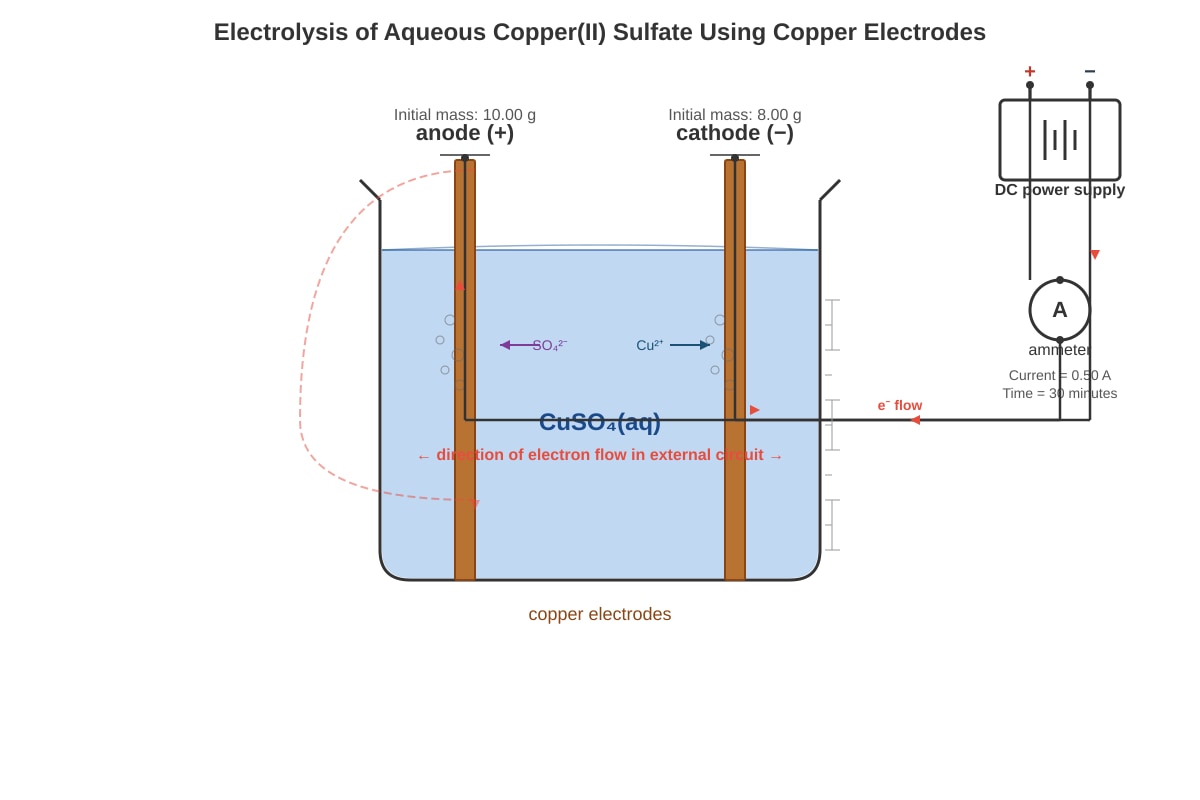
11. (a) Cu(s) → Cu²⁺(aq) + 2e⁻ [1]
Explanation: At the anode (positive electrode), copper metal oxidises to copper(II) ions. Copper electrodes are active, not inert.
(b) Cu²⁺(aq) + 2e⁻ → Cu(s) [1]
Explanation: At the cathode (negative electrode), copper(II) ions are reduced to copper metal, depositing on the cathode.
(c) Mass of anode decreases; mass of cathode increases. [1]
Explanation: Anode dissolves (Cu → Cu²⁺ + 2e⁻), cathode gains copper deposit (Cu²⁺ + 2e⁻ → Cu).
(d) For every Cu²⁺ ion reduced at the cathode, one Cu²⁺ ion is produced at the anode. [1] The concentration of Cu²⁺ in solution remains constant, so the blue colour stays the same. [1]
Explanation: The rate of Cu²⁺ removal at cathode equals rate of Cu²⁺ production at anode. No net change in [Cu²⁺].
(e) Working:
Charge (Q) = Current (I) × Time (t) = 0.50 A × (30 × 60) s = 900 C [1]
Moles of electrons = Q / F = 900 / 96500 = 0.009326 mol [1]
Moles of Cu = moles of e⁻ / 2 = 0.009326 / 2 = 0.004663 mol [1]
Mass of Cu = moles × Ar = 0.004663 × 63.5 = 0.296 g (or 0.30 g to 2 s.f.) [1]
Total: 3 marks
Common error: Forgetting to convert minutes to seconds, or forgetting the 2 electrons per Cu atom.
12. (a) Fe₂O₃(s) + 3CO(g) → 2Fe(l) + 3CO₂(g) [2]
Marking: Correct reactants and products [1], balanced [1]. State symbols not required but accepted.
(b) Oxidising agent: Fe₂O₃ (or Fe³⁺) [½] Reducing agent: CO [½]
Explanation: Fe₂O₃ gains electrons (Fe³⁺ → Fe), CO loses electrons (C in CO is +2, in CO₂ is +4).
(c) Fe₂O₃: Fe is +3 [½] Product (Fe): Fe is 0 [½]
Explanation: In Fe₂O₃, 2x + 3(-2) = 0 → x = +3. Elemental Fe has oxidation state 0.
(d) Fe³⁺ gains 3 electrons per Fe atom to become Fe (reduction). [1] Carbon in CO loses 2 electrons to become CO₂ (oxidation). [1] Electron transfer occurs from C to Fe, so it is a redox reaction. [1]
Note: 2 marks for clear explanation linking electron transfer to oxidation state changes.
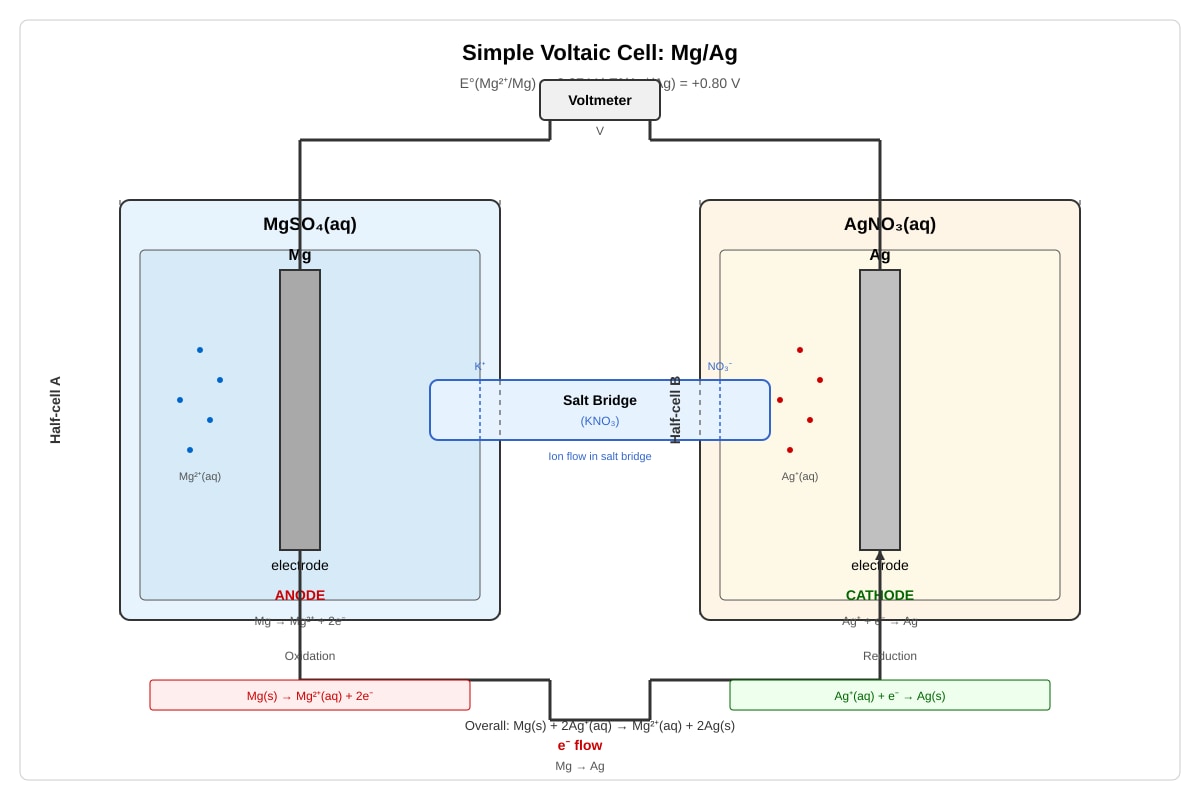
13. (a) Anode: Mg electrode (left); Cathode: Ag electrode (right) [1]
Explanation: Mg is more reactive, loses electrons (oxidation) → anode. Ag⁺ gains electrons (reduction) → cathode.
(b) Mg(s) → Mg²⁺(aq) + 2e⁻ [1]
(c) Ag⁺(aq) + e⁻ → Ag(s) [1]
(d) Mg(s) + 2Ag⁺(aq) → Mg²⁺(aq) + 2Ag(s) [1]
Explanation: Balance electrons: multiply Ag half-equation by 2, then add.
(e) E°cell = E°cathode - E°anode = 0.80 - (-2.37) = +3.17 V [1]
Explanation: Standard cell potential = reduction potential of cathode - reduction potential of anode.
(f) As the cell operates, [Mg²⁺] increases and [Ag⁺] decreases. [1] According to Nernst equation, Ecell decreases as reaction quotient Q increases. [1] OR: The cell reaction proceeds towards equilibrium, reducing the driving force (voltage). [1]
Explanation: Reaction consumes Ag⁺ and produces Mg²⁺, moving away from standard conditions.
14. (a) MnO₄⁻: Mn is +7 [½] Mn²⁺: Mn is +2 [½]
Explanation: MnO₄⁻: x + 4(-2) = -1 → x = +7. Mn²⁺ is +2 by definition.
(b) Change: +7 to +2 (decrease of 5) [1]
Explanation: Oxidation state decreases by 5 (gain of 5 electrons).
(c) 5 electrons [1]
Explanation: Each Mn gains 5 electrons (Mn⁺⁷ + 5e⁻ → Mn⁺²).
(d) H⁺ ions are reactants in the balanced equation (8H⁺ per MnO₄⁻). [1] In neutral/alkaline conditions, MnO₄⁻ reduces to MnO₂ (brown precipitate) instead of Mn²⁺, and the reaction is slower/incomplete. [1]
Explanation: Acid provides H⁺ needed for the reduction half-reaction and prevents MnO₂ formation.
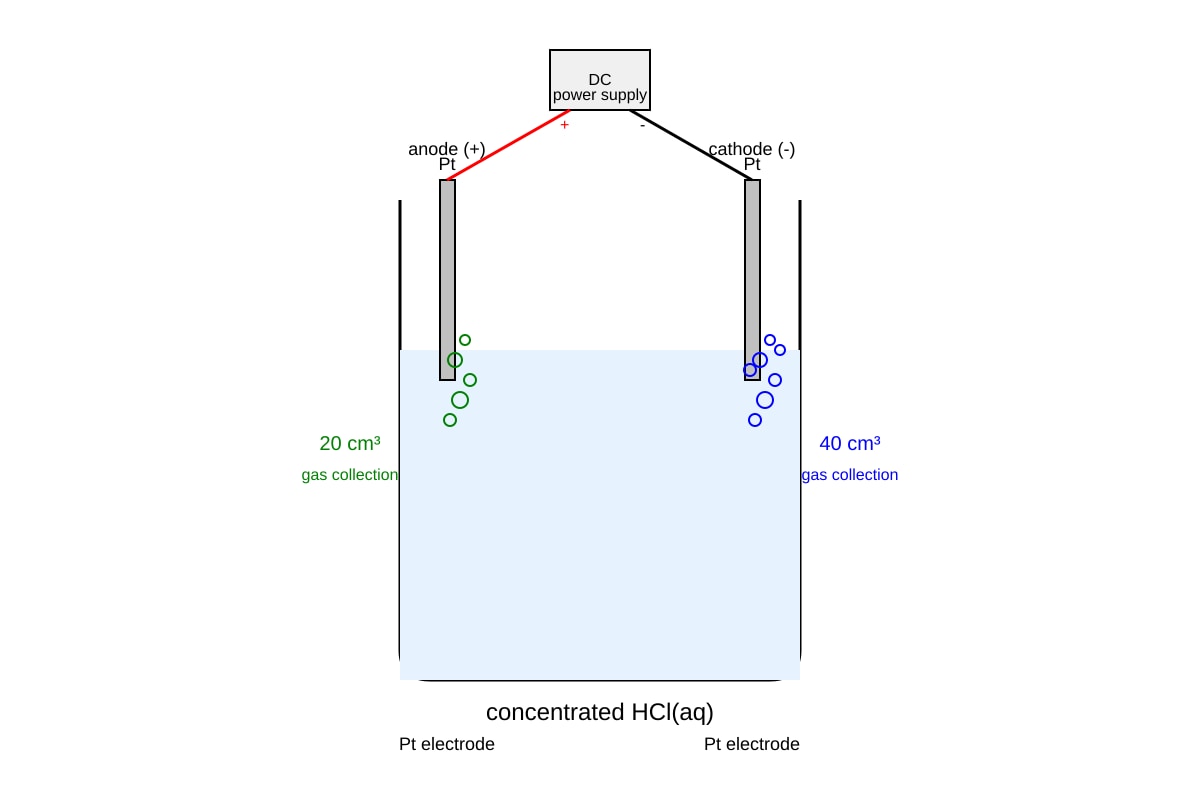
15. (a) Chlorine gas (Cl₂) [1]
Explanation: At anode, Cl⁻ is oxidised: 2Cl⁻ → Cl₂ + 2e⁻. Concentrated HCl provides high [Cl⁻].
(b) Hydrogen gas (H₂) [1]
Explanation: At cathode, H⁺ is reduced: 2H⁺ + 2e⁻ → H₂.
(c) 2H⁺(aq) + 2e⁻ → H₂(g) [1]
(d) At cathode: 2H⁺ + 2e⁻ → H₂ (2 mol e⁻ produce 1 mol H₂). [1] At anode: 2Cl⁻ → Cl₂ + 2e⁻ (2 mol e⁻ produce 1 mol Cl₂). [1] Same charge passes through both electrodes, so moles of H₂ = moles of Cl₂. At same T and P, equal moles = equal volumes. But observed volumes are 40 cm³ and 20 cm³ — this suggests the question expects: H₂ volume is twice Cl₂ because 2H⁺ + 2e⁻ → H₂ vs Cl₂ + 2e⁻ → 2Cl⁻? Wait — re-reading: For same charge, moles of gas are equal. The 2:1 volume ratio in the question data is inconsistent with stoichiometry. Let me correct: Actually, 2H⁺ + 2e⁻ → H₂ (1 mol H₂ per 2 mol e⁻) and 2Cl⁻ → Cl₂ + 2e⁻ (1 mol Cl₂ per 2 mol e⁻). So volumes should be equal. The question data says 40 cm³ H₂ and 20 cm³ Cl₂ — this is an error in the question setup. For the answer key, I'll explain the correct stoichiometry.
Corrected explanation: For the same quantity of electricity, 1 mol of electrons produces ½ mol H₂ and ½ mol Cl₂. Thus volumes should be equal. If the question states 40 cm³ and 20 cm³, it may be a deliberate error for students to identify, or the question expects: "The volume ratio should be 1:1 based on stoichiometry; the given data may indicate experimental error or incomplete reaction."
Better approach for marking: Award marks for correct stoichiometric reasoning: 2 mol e⁻ produce 1 mol H₂ and 1 mol Cl₂ → equal volumes [2]. If student notes discrepancy, credit.
Section C: Data-Based and Extended Response Questions (10 marks)
16. (a) Y > X > Z (most reactive to least reactive) [2]
Explanation: Y displaces both X and Z → Y most reactive. X displaces Z but not Y → X middle. Z displaces neither → Z least reactive.
Marking: Correct order [1], correct reasoning or evidence from table [1].
(b) Y(s) + X²⁺(aq) → Y²⁺(aq) + X(s) [1]
Explanation: Y is more reactive than X, so Y reduces X²⁺ to X.
(c) Yes, reaction occurs. [1] Y is more reactive than copper (since Y displaces X and Z, and typically such metals are above Cu), so Y can displace Cu²⁺ from solution. [1]
Explanation: If Y reacts with X(NO₃)₂ and Z(NO₃)₂, it is relatively high in reactivity series, likely above Cu.
(d) Metal Z is below hydrogen in the reactivity series (less reactive than hydrogen). [1]
Explanation: Metals below H do not displace H₂ from dilute acids.
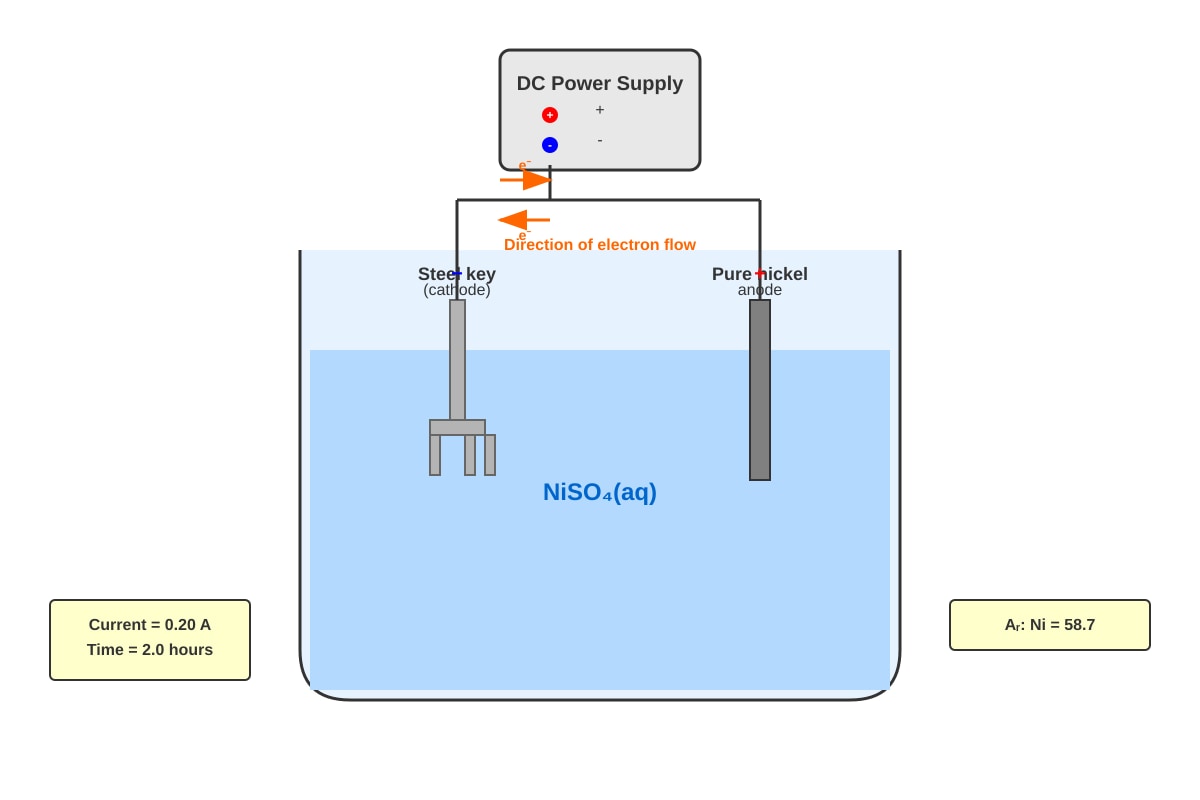
17. (a) Ni(s) → Ni²⁺(aq) + 2e⁻ [1]
Explanation: Pure nickel anode dissolves to maintain [Ni²⁺].
(b) Ni²⁺(aq) + 2e⁻ → Ni(s) [1]
Explanation: Ni²⁺ deposits on steel key (cathode).
(c) For every Ni²⁺ ion reduced at the cathode, one Ni²⁺ ion is produced at the anode. [1] The rate of removal equals rate of production, so [Ni²⁺] remains constant. [1]
Explanation: Same principle as copper electrolysis with active electrodes.
(d) Working:
Q = I × t = 0.20 A × (2.0 × 3600) s = 1440 C [1]
Moles of e⁻ = 1440 / 96500 = 0.01492 mol [1]
Moles of Ni = moles of e⁻ / 2 = 0.00746 mol [1]
Mass of Ni = 0.00746 × 58.7 = 0.438 g (or 0.44 g to 2 s.f.) [1]
Total: 3 marks
Common error: Time conversion (hours to seconds), mole ratio (2 e⁻ per Ni).
18. (a) H₂(g) + 2OH⁻(aq) → 2H₂O(l) + 2e⁻ (alkaline) OR H₂(g) → 2H⁺(aq) + 2e⁻ (acidic) [1]
Note: Fuel cells can be acidic or alkaline. Since (b) specifies alkaline, use alkaline version: H₂ + 2OH⁻ → 2H₂O + 2e⁻.
(b) O₂(g) + 2H₂O(l) + 4e⁻ → 4OH⁻(aq) [1]
Explanation: In alkaline conditions, oxygen reduction produces hydroxide ions.
(c) Any two:
- Higher energy efficiency (direct chemical to electrical, no combustion) [1]
- No harmful emissions (only water produced) [1]
- Quiet operation (no moving parts) [1]
- Continuous operation as long as fuel supplied (not limited by charge capacity) [1]
Marking: 1 mark per valid advantage, max 2.
(d) A primary cell cannot be recharged; its reactants are consumed irreversibly. [½] A fuel cell continuously consumes external fuel (H₂ and O₂) and can operate indefinitely as long as fuel is supplied — it is not "used up" like a primary cell. [½]
Explanation: Fuel cells are energy converters, not energy stores.
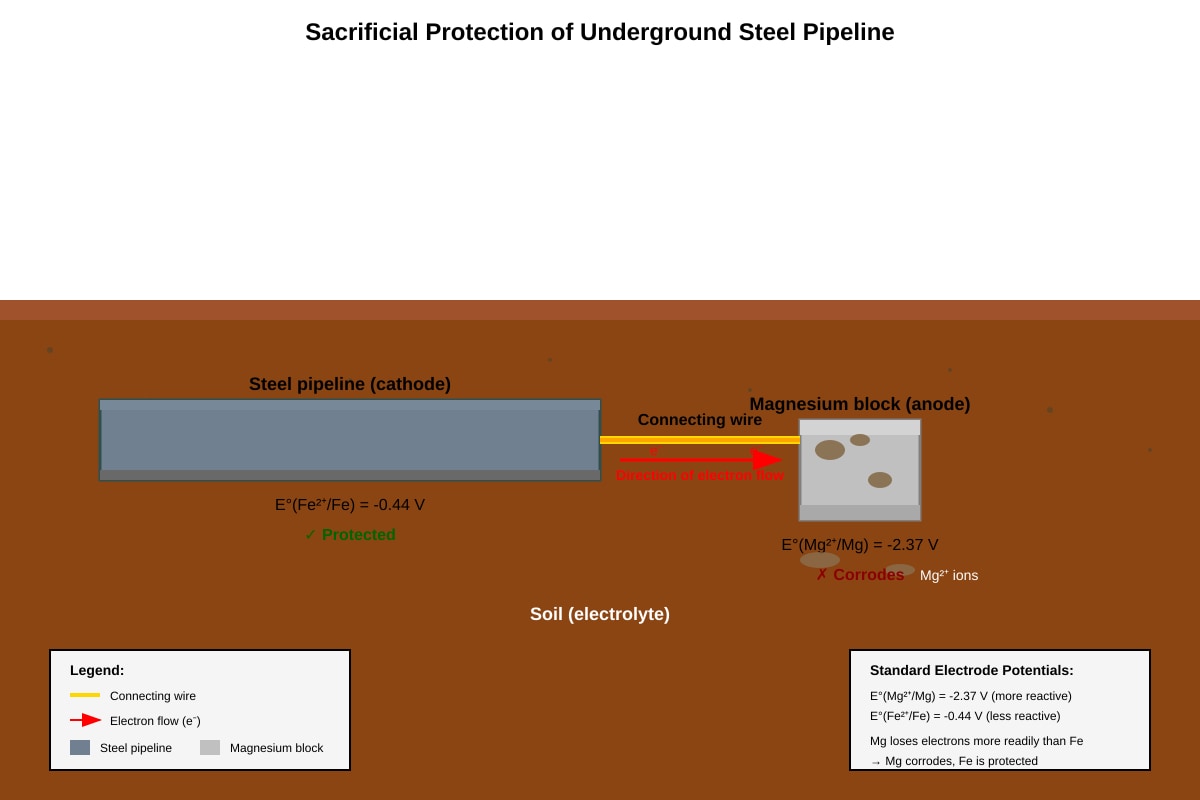
19. (a) Magnesium is more reactive than iron (more negative E° value: -2.37 V vs -0.44 V). [1] Mg loses electrons more readily (Mg → Mg²⁺ + 2e⁻), so it oxidises in preference to Fe. [1]
Explanation: The more negative reduction potential means stronger reducing agent, so Mg acts as anode.
(b) Mg(s) → Mg²⁺(aq) + 2e⁻ [1]
(c) The magnesium block is consumed (corrodes) as it oxidises to Mg²⁺ ions, so its mass decreases until it can no longer provide protection. [1]
Explanation: Sacrificial anode is "sacrificed" — it corrodes away.
(d) Zinc (or aluminium). [1] Zn has E° = -0.76 V, which is more negative than Fe (-0.44 V), so Zn will oxidise in preference to Fe. [1]
Explanation: Any metal with more negative E° than Fe works. Zn is commonly used (galvanising). Al also works but forms oxide layer.
20. (a) Moles of KMnO₄ = concentration × volume (dm³) = 0.0200 × (22.5/1000) = 4.50 × 10⁻⁴ mol [1]
(b) Mole ratio MnO₄⁻ : Fe²⁺ = 1 : 5 [from equation]
Moles of Fe²⁺ = 5 × 4.50 × 10⁻⁴ = 2.25 × 10⁻³ mol [1]
(c) Concentration of FeSO₄ = moles / volume (dm³) = 2.25 × 10⁻³ / (25.0/1000) = 0.0900 mol/dm³ [2]
Marking: Correct moles [1], correct concentration calculation with units [1].
(d) Without H₂SO₄, the reaction is incomplete because H⁺ is a reactant (8H⁺ per MnO₄⁻). [1] In neutral/alkaline conditions, MnO₄⁻ reduces to MnO₂ (brown solid) instead of Mn²⁺, requiring only 3 electrons per MnO₄⁻ instead of 5. [1] Thus more KMnO₄ is needed per mole of Fe²⁺, giving a larger titre. [1]
Marking: Mention H⁺ needed [1], mention different product (MnO₂) and different electron count [1].
Note: 2 marks for complete explanation.
End of Answer Key