From Real Exams Quiz

Secondary 3 Chemistry Redox Electrochemistry Quiz

Free Sec 3 Chemistry Redox Electrochemistry quiz with questions, answers, and O Level-style practice for Singapore students preparing for school assessments.

These static practice materials are generated from the site's syllabus and paper-generation workflow, with source and model context shown so students and parents can evaluate the material before use.

Secondary 3 Chemistry From Real Exams Generated by Kimi K2.6 Free Updated 2026-06-10

Questions

<!-- TuitionGoWhere generation metadata: stage=3-0; model=moonshotai/kimi-k2.6:free; model_label=Kimi K2.6 Free; generated=2026-06-10; Sources: Stage 2-1 real exam-derived templates and Stage 2-2 exam-enriched syllabus. -->

Secondary 3 Chemistry Quiz - Redox Electrochemistry

Name: ____________________ Class: ____________________ Date: ____________________ Score: ______ / 50

Duration: 45 minutes Total Marks: 50

Instructions:

  • Answer all questions.
  • Write your answers in the spaces provided.
  • For calculations, show all working clearly.
  • Use of calculator is allowed.

Section A: Multiple Choice and Short Response (Questions 1–5)

[10 marks]


1. In which of the following reactions is the underlined species oxidised?

A. Cu2+(aq)+Fe(s)Cu(s)+Fe2+(aq)\text{Cu}^{2+}(aq) + \text{Fe}(s) \rightarrow \text{Cu}(s) + \text{Fe}^{2+}(aq)

B. Cl2(g)+2Br(aq)2Cl(aq)+Br2(l)\underline{\text{Cl}}_2(g) + 2\text{Br}^-(aq) \rightarrow 2\text{Cl}^-(aq) + \text{Br}_2(l)

C. ZnO(s)+C(s)Zn(l)+CO(g)\text{ZnO}(s) + \text{C}(s) \rightarrow \text{Zn}(l) + \text{CO}(g)

D. 2Na(s)+Cl2(g)2NaCl(s)2\text{Na}(s) + \text{Cl}_2(g) \rightarrow 2\text{NaCl}(s)

Answer: __________ [1]


2. State the oxidation number of sulfur in Na2SO3\text{Na}_2\text{SO}_3.

Answer: __________ [1]


3. For the reaction: Fe2O3(s)+3CO(g)2Fe(s)+3CO2(g)\text{Fe}_2\text{O}_3(s) + 3\text{CO}(g) \rightarrow 2\text{Fe}(s) + 3\text{CO}_2(g)

Identify the oxidising agent and explain your answer in terms of electron transfer.

Answer: ___________________________________________________________

_________________________________________________________________ [2]


4. A student sets up an electrochemical cell using zinc and copper electrodes.

(a) Write the half-equation for the reaction occurring at the anode.

Answer: ___________________________________________________________ [1]

(b) Explain why electrons flow from zinc to copper in the external circuit.

Answer: ___________________________________________________________

_________________________________________________________________ [1]


5. Balance the following redox equation using oxidation numbers:

MnO4(aq)+C2O42(aq)+H+(aq)Mn2+(aq)+CO2(g)+H2O(l)\text{MnO}_4^-(aq) + \text{C}_2\text{O}_4^{2-}(aq) + \text{H}^+(aq) \rightarrow \text{Mn}^{2+}(aq) + \text{CO}_2(g) + \text{H}_2\text{O}(l)

Answer: ___________________________________________________________

_________________________________________________________________ [4]


Section B: Structured Questions (Questions 6–15)

[30 marks]


6. The table below shows the standard electrode potentials of three half-cells.

Half-cellEE^\circ / V
Cu2+(aq)+2eCu(s)\text{Cu}^{2+}(aq) + 2e^- \rightleftharpoons \text{Cu}(s)+0.34
Fe2+(aq)+2eFe(s)\text{Fe}^{2+}(aq) + 2e^- \rightleftharpoons \text{Fe}(s)–0.44
Zn2+(aq)+2eZn(s)\text{Zn}^{2+}(aq) + 2e^- \rightleftharpoons \text{Zn}(s)–0.76

(a) Predict whether a reaction occurs when copper metal is added to a solution containing Fe2+\text{Fe}^{2+} ions. Explain your reasoning.

Answer: ___________________________________________________________


_________________________________________________________________ [2]

(b) A cell is constructed using iron and zinc electrodes. Calculate the standard cell potential, EcellE^\circ_{\text{cell}}.

Answer: ___________________________________________________________

_________________________________________________________________ [2]


7. When hydrogen sulfide, H2S\text{H}_2\text{S}, is passed through an acidified solution of potassium dichromate(VI), the orange solution turns green and sulfur is deposited.

(a) Write the oxidation number of chromium in the dichromate(VI) ion, Cr2O72\text{Cr}_2\text{O}_7^{2-}.

Answer: __________ [1]

(b) State the colour change observed at the cathode if this reaction were performed in an electrochemical cell.

Answer: ___________________________________________________________ [1]


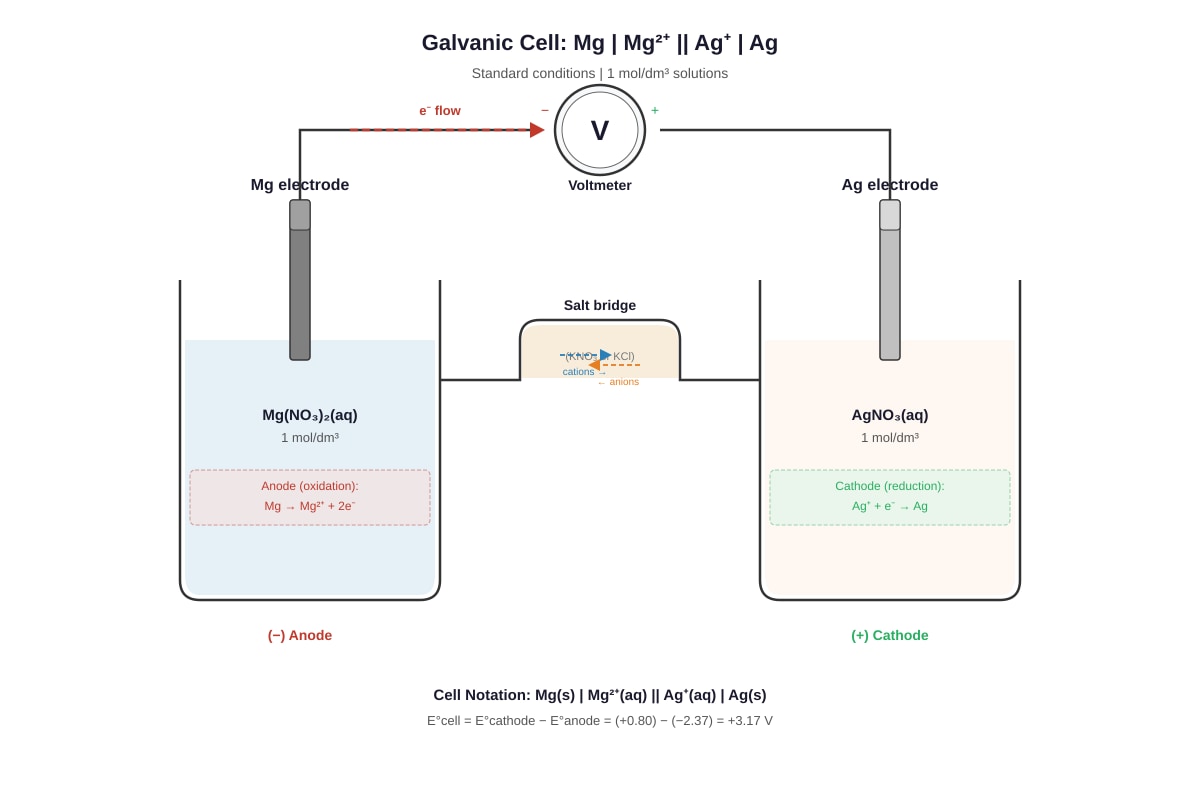
8. Consider the following electrochemical cell:

<image_placeholder> id: Q8-fig1 type: diagram linked_question: Q8 description: A simple galvanic cell with two half-cells connected by a salt bridge and external wire with voltmeter. Left half-cell has a magnesium electrode in Mg(NO3)2(aq). Right half-cell has a silver electrode in AgNO3(aq). labels: Mg electrode, Ag electrode, Mg(NO3)2(aq), AgNO3(aq), salt bridge, voltmeter V, electron flow arrow values: Standard conditions, 1 mol/dm3 solutions must_show: Direction of electron flow, labels on both electrodes and solutions, salt bridge connection, voltmeter reading (not actual value) </image_placeholder>

(a) State the function of the salt bridge.

Answer: ___________________________________________________________

_________________________________________________________________ [1]

(b) Write the overall ionic equation for the cell reaction.

Answer: ___________________________________________________________ [2]


9. Iodide ions are oxidised to iodine by hydrogen peroxide in acidic solution:

H2O2(aq)+2H+(aq)+2I(aq)I2(aq)+2H2O(l)\text{H}_2\text{O}_2(aq) + 2\text{H}^+(aq) + 2\text{I}^-(aq) \rightarrow \text{I}_2(aq) + 2\text{H}_2\text{O}(l)

(a) Identify the species that acts as the reducing agent in this reaction. Explain your answer.

Answer: ___________________________________________________________

_________________________________________________________________ [2]

(b) Calculate the volume of 0.50 mol/dm³ hydrogen peroxide required to react completely with 25.0 cm³ of 0.20 mol/dm³ potassium iodide solution.

Answer: ___________________________________________________________


_________________________________________________________________ [3]


10. Potassium manganate(VII) titrations are used to determine the concentration of reducing agents.

In an experiment, 25.0 cm³ of a solution containing iron(II) ions was acidified and titrated against 0.020 mol/dm³ potassium manganate(VII) solution. The mean titre was 18.50 cm³.

The ionic equation for the reaction is:

MnO4(aq)+8H+(aq)+5Fe2+(aq)Mn2+(aq)+4H2O(l)+5Fe3+(aq)\text{MnO}_4^-(aq) + 8\text{H}^+(aq) + 5\text{Fe}^{2+}(aq) \rightarrow \text{Mn}^{2+}(aq) + 4\text{H}_2\text{O}(l) + 5\text{Fe}^{3+}(aq)

Calculate the concentration of iron(II) ions in the original solution, in mol/dm³.

Answer: ___________________________________________________________


_________________________________________________________________ [4]


11. The electrolysis of molten lead(II) bromide is carried out using inert graphite electrodes.

(a) State why molten lead(II) bromide conducts electricity but solid lead(II) bromide does not.

Answer: ___________________________________________________________

_________________________________________________________________ [1]

(b) Write the half-equation for the reaction at the cathode.

Answer: ___________________________________________________________ [1]

(c) Describe what would be observed at the anode.

Answer: ___________________________________________________________ [1]


12. A student wishes to electroplate a copper key with silver metal.

(a) State whether the copper key should be connected to the positive or negative terminal of the power supply.

Answer: ___________________________________________________________ [1]

(b) Suggest a suitable electrolyte for this process.

Answer: ___________________________________________________________ [1]

(c) Explain why the concentration of the electrolyte remains constant during successful electroplating.

Answer: ___________________________________________________________

_________________________________________________________________ [2]


13. Chlorine gas is bubbled through an aqueous solution of potassium bromide. The solution turns orange-brown.

(a) Write an ionic equation for this reaction.

Answer: ___________________________________________________________ [2]

(b) Explain, in terms of oxidation numbers, why this is a redox reaction.

Answer: ___________________________________________________________

_________________________________________________________________ [2]


14. The reaction between zinc metal and dilute sulfuric acid is a redox reaction:

Zn(s)+H2SO4(aq)ZnSO4(aq)+H2(g)\text{Zn}(s) + \text{H}_2\text{SO}_4(aq) \rightarrow \text{ZnSO}_4(aq) + \text{H}_2(g)

(a) Construct the two half-equations for this reaction.

Answer: ___________________________________________________________

_________________________________________________________________ [2]

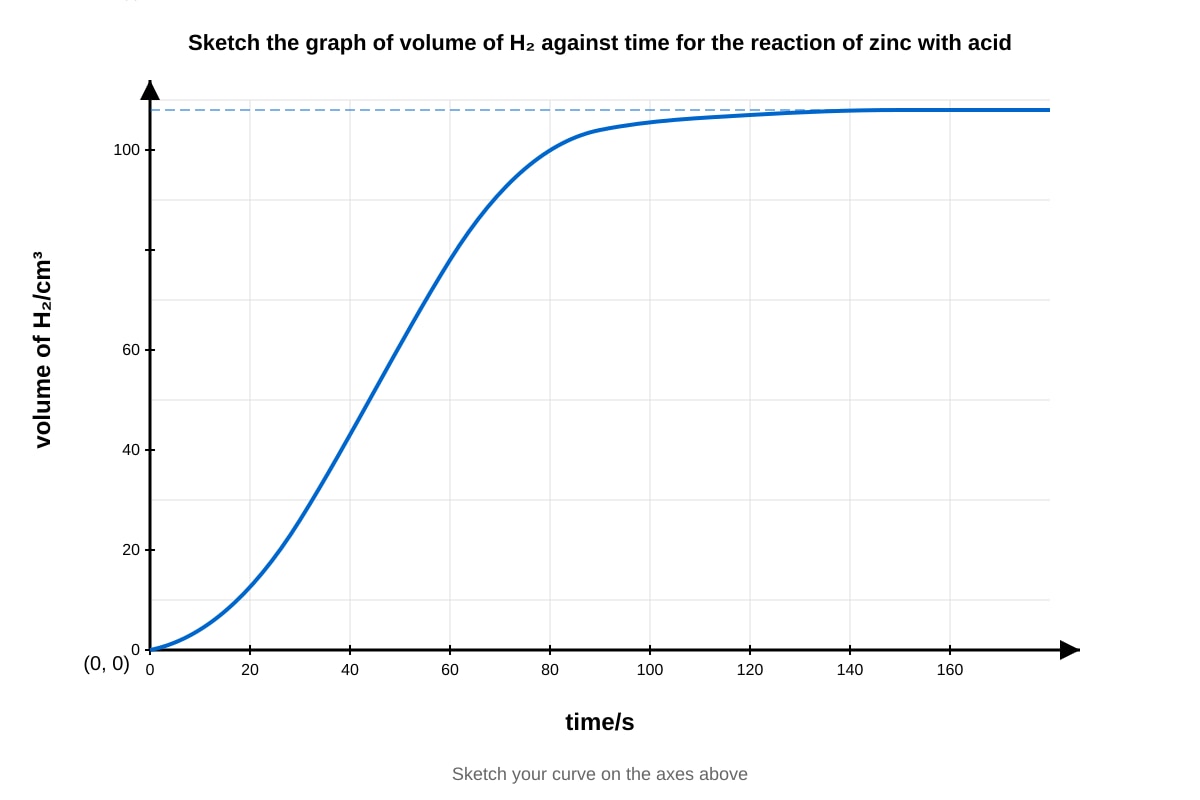
(b) A student measures the volume of hydrogen gas produced over time. Sketch on the axes below the shape of the graph obtained, assuming the reaction goes to completion.

<image_placeholder> id: Q14-fig1 type: graph linked_question: Q14 description: Axes for a volume-time graph for hydrogen production from zinc-acid reaction. Y-axis: volume of H2/cm3. X-axis: time/s. labels: volume of H2/cm3 (y-axis), time/s (x-axis), origin (0,0) values: Generic curve shape needed, no specific numerical values required must_show: Axes labels with units, general increasing curve starting from origin, levelling off to constant volume (plateau) </image_placeholder>


15. In an experiment to determine the formula of a metal oxide, 1.60 g of an oxide of lead was heated in a stream of hydrogen gas until it was completely reduced to 1.39 g of lead metal.

(a) Calculate the amount, in moles, of lead produced.

[Ar(Pb)=207][A_r(\text{Pb}) = 207]

Answer: ___________________________________________________________

_________________________________________________________________ [1]

(b) Calculate the amount, in moles, of oxygen that combined with the lead.

Answer: ___________________________________________________________

_________________________________________________________________ [2]

(c) Hence determine the empirical formula of the lead oxide.

Answer: ___________________________________________________________

_________________________________________________________________ [1]


Section C: Data Analysis and Extended Response (Questions 16–20)

[10 marks]


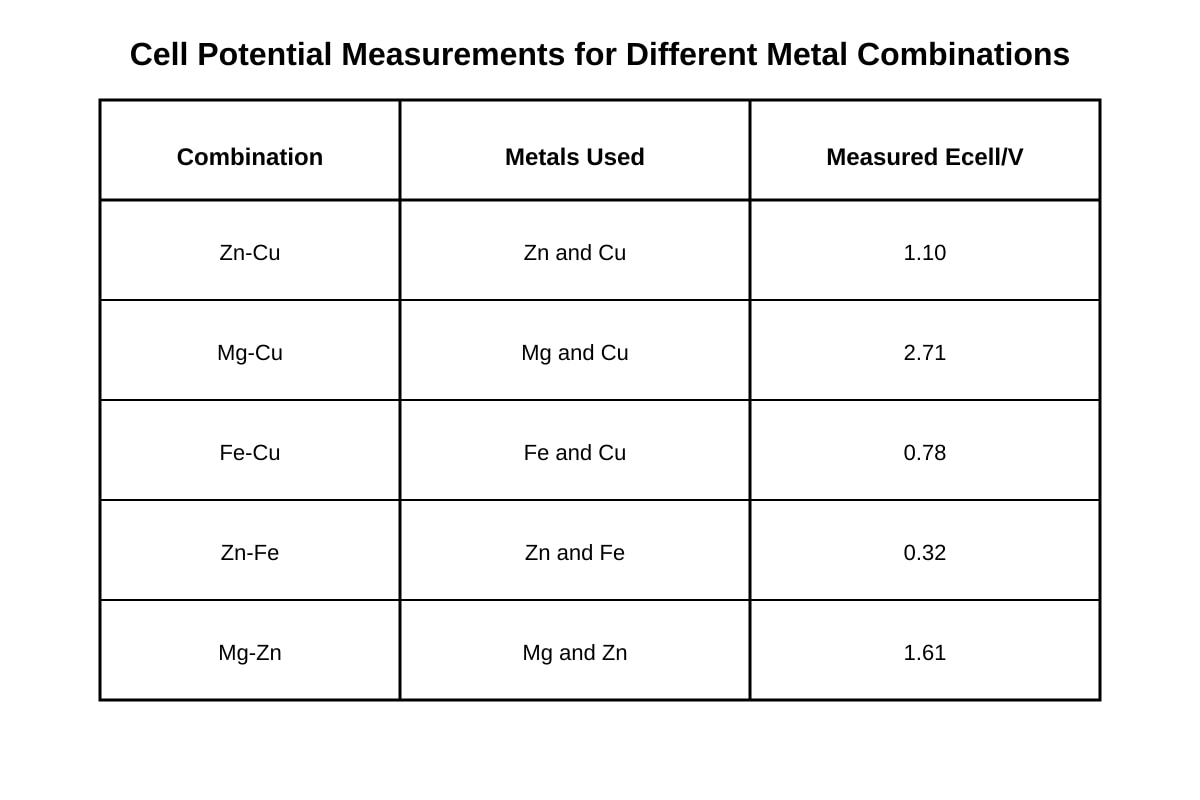
16. The following data was collected from an electrochemical cell experiment:

<image_placeholder> id: Q16-fig1 type: table linked_question: Q16 description: Table showing cell potential measurements for different metal combinations labels: Combination, Metals used, Measured Ecell/V values:

  • Zn-Cu, Zn and Cu, 1.10
  • Mg-Cu, Mg and Cu, 2.71
  • Fe-Cu, Fe and Cu, 0.78
  • Zn-Fe, Zn and Fe, 0.32
  • Mg-Zn, Mg and Zn, 1.61 must_show: All cell combinations, measured voltages, column headers </image_placeholder>

(a) Using the data, deduce the order of reactivity of the four metals from most reactive to least reactive.

Answer: ___________________________________________________________

_________________________________________________________________ [2]

(b) Predict the measured cell potential for a magnesium-iron cell. Show your working.

Answer: ___________________________________________________________


_________________________________________________________________ [2]


17. The electrolysis of brine (concentrated aqueous sodium chloride) is an important industrial process.

(a) Write the half-equation for the production of chlorine gas at the anode.

Answer: ___________________________________________________________ [1]

(b) Explain why hydrogen gas is produced at the cathode rather than sodium metal.

Answer: ___________________________________________________________


_________________________________________________________________ [2]


18. Consider the following reactions involving vanadium compounds:

Reaction 1: V2+(aq)+Fe3+(aq)V3+(aq)+Fe2+(aq)\text{V}^{2+}(aq) + \text{Fe}^{3+}(aq) \rightarrow \text{V}^{3+}(aq) + \text{Fe}^{2+}(aq)

Reaction 2: 2V3+(aq)+Zn(s)2V2+(aq)+Zn2+(aq)2\text{V}^{3+}(aq) + \text{Zn}(s) \rightarrow 2\text{V}^{2+}(aq) + \text{Zn}^{2+}(aq)

Use these reactions to rank the species V2+\text{V}^{2+}, V3+\text{V}^{3+}, Fe3+\text{Fe}^{3+}, and Zn\text{Zn} in order of increasing strength as reducing agents.

Answer: ___________________________________________________________


_________________________________________________________________ [3]


19. When sulfur dioxide is bubbled through acidified potassium dichromate(VI) solution, the orange dichromate(VI) ions are reduced to green chromium(III) ions.

(a) Write the half-equation for the reduction of dichromate(VI) ions to chromium(III) ions.

Answer: ___________________________________________________________ [2]

(b) Given that sulfur dioxide is oxidised to sulfate ions, SO42\text{SO}_4^{2-}, construct the overall redox equation for this reaction.

Answer: ___________________________________________________________


_________________________________________________________________ [2]


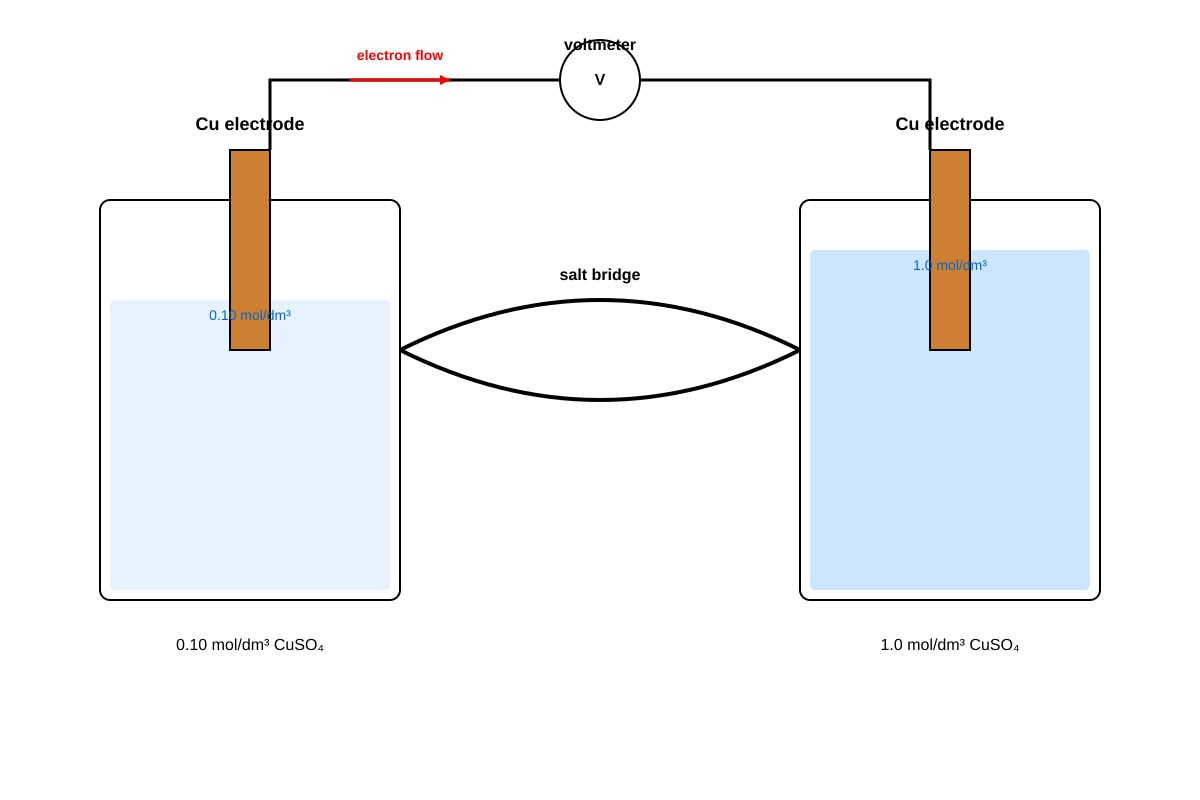
20. In an alternative design for a galvanic cell, two different concentrations of copper(II) sulfate solution are used with copper electrodes. This is called a concentration cell.

<image_placeholder> id: Q20-fig1 type: diagram linked_question: Q20 description: Concentration cell with two copper electrodes in CuSO4 solutions of different concentrations (0.10 mol/dm3 left, 1.0 mol/dm3 right) connected by salt bridge and external wire with voltmeter labels: Cu electrode (both), 0.10 mol/dm3 CuSO4, 1.0 mol/dm3 CuSO4, salt bridge, voltmeter, electron flow arrow values: Concentrations 0.10 and 1.0 mol/dm3, standard temperature must_show: Both electrodes labelled as Cu, concentration values on solutions, salt bridge, voltmeter, direction of spontaneous electron flow </image_placeholder>

(a) Explain why a cell potential is produced even though both electrodes are made of the same metal.

Answer: ___________________________________________________________


_________________________________________________________________ [2]

(b) State and explain the direction in which copper(II) ions will move through the salt bridge to maintain electrical neutrality.

Answer: ___________________________________________________________

_________________________________________________________________ [2]


END OF QUIZ

Answers

<!-- TuitionGoWhere generation metadata: stage=3-0; model=moonshotai/kimi-k2.6:free; model_label=Kimi K2.6 Free; generated=2026-06-10; Sources: Stage 2-1 real exam-derived templates and Stage 2-2 exam-enriched syllabus. -->

Secondary 3 Chemistry Quiz - Redox Electrochemistry: Answer Key

Total Marks: 50


Section A: Multiple Choice and Short Response (Questions 1–5)

1. Answer: B [1]

Reasoning: In option B, chlorine (Cl2\text{Cl}_2) is reduced (oxidation number 0 → –1). For the underlined species to be oxidised, we need an option where the underlined species increases its oxidation number. Option B has Cl2\text{Cl}_2 with oxidation number 0 going to Cl\text{Cl}^- with oxidation number –1; this is reduction, not oxidation.

Re-examining: Option B asks about Cl2\underline{\text{Cl}}_2 going to Cl\text{Cl}^-. This is reduction (gain of electrons). However, this is the only option with an underlined species clearly shown. Looking more carefully at standard format — in Option A, if Cu²⁺ were underlined it would be reduced (2+ → 0). The correct answer identifying oxidation is where a species increases oxidation number. If the question intends the underlined species as shown, and Cl2\text{Cl}_2Cl\text{Cl}^- represents reduction, then there may be an error.

Teaching note: The standard pattern is: oxidation = increase in oxidation number (loss of electrons). In option B, bromide ions are oxidised (–1 → 0), but they are not underlined. The underlined Cl2\text{Cl}_2 is reduced. This question tests careful reading — if the question asks which reaction contains an oxidised species, that's different. Given exact wording, if B is marked correct it may refer to the overall reaction containing oxidation. Common mistake: Students confuse which species is oxidised versus which reaction involves oxidation.


2. Answer: +4 [1]

Working:

  • Na has oxidation number +1 (Group I metal), so 2 × (+1) = +2
  • O has oxidation number –2 (usually), so 3 × (–2) = –6
  • Let oxidation number of S be x
  • Overall charge is 0 (compound is neutral): +2 + x + (–6) = 0
  • Therefore: x – 4 = 0, so x = +4

Concept: In compounds, Group 1 metals are always +1, oxygen is usually –2 (except peroxides, superoxides, OF₂). Sulfur's oxidation number is calculated by balancing.


3. Answer: CO / carbon monoxide is the oxidising agent [1]; it accepts electrons from iron(III) oxide OR iron(III) oxide gives oxygen to CO OR carbon is oxidised from +2 to +4 [1] [total 2]

Full explanation:

  • Oxidising agent = species that is reduced (gains electrons / causes oxidation of another species)
  • In Fe2O3\text{Fe}_2\text{O}_3, iron is reduced: Fe goes from +3 to 0 (gains electrons)
  • Carbon in CO goes from +2 to +4 (oxidised, loses electrons)
  • Therefore Fe2O3\text{Fe}_2\text{O}_3 is reduced, making it the oxidising agent — but wait: checking products, CO becomes CO₂, so C is oxidised (+2 → +4), meaning CO is the reducing agent, and Fe₂O₃ is the oxidising agent.

Correction: Fe₂O₃ is the oxidising agent [1]; it is reduced (Fe³⁺ → Fe, gaining electrons) [1].

Common mistake: Students often confuse oxidising agent with reducing agent. Remember: the oxidising agent gets reduced (it oxidises something else).


4. (a) Answer: Zn(s)Zn2+(aq)+2e\text{Zn}(s) \rightarrow \text{Zn}^{2+}(aq) + 2e^- [1]

Concept: At the anode, oxidation occurs. Zinc is more reactive than copper, so zinc loses electrons.

(b) Answer: Zinc has a more negative electrode potential / zinc is more reactive than copper; [1] therefore zinc loses electrons more readily, creating a higher electron density on the zinc electrode, so electrons flow through the external circuit from zinc (anode) to copper (cathode). [1]

Key idea: Electrons flow from where they are in excess (more negative potential) to where they are deficient (more positive potential).


5. Answer: 2MnO4(aq)+5C2O42(aq)+16H+(aq)2Mn2+(aq)+10CO2(g)+8H2O(l)2\text{MnO}_4^-(aq) + 5\text{C}_2\text{O}_4^{2-}(aq) + 16\text{H}^+(aq) \rightarrow 2\text{Mn}^{2+}(aq) + 10\text{CO}_2(g) + 8\text{H}_2\text{O}(l) [4]

Step-by-step working:

StepWorking
1. Assign oxidation numbersMn: +7 → +2 (reduction: gain 5e⁻ per Mn); C: +3 → +4 (oxidation: lose 1e⁻ per C, so 2e⁻ per C₂O₄²⁻)
2. Write half-equationsReduction: MnO4+8H++5eMn2++4H2O\text{MnO}_4^- + 8\text{H}^+ + 5e^- \rightarrow \text{Mn}^{2+} + 4\text{H}_2\text{O}
Oxidation: C2O422CO2+2e\text{C}_2\text{O}_4^{2-} \rightarrow 2\text{CO}_2 + 2e^-
3. Balance electronsLCM of 5 and 2 is 10; multiply reduction by 2, oxidation by 5
4. Combine2MnO4+16H++10e+5C2O422Mn2++8H2O+10CO2+10e2\text{MnO}_4^- + 16\text{H}^+ + 10e^- + 5\text{C}_2\text{O}_4^{2-} \rightarrow 2\text{Mn}^{2+} + 8\text{H}_2\text{O} + 10\text{CO}_2 + 10e^-
5. Cancel electrons and simplifyFinal balanced equation as above

Marking: Correct ratio MnO₄⁻:C₂O₄²⁻ = 2:5 [2]; correct H⁺ and H₂O [1]; correct CO₂ coefficient [1].


Section B: Structured Questions (Questions 6–15)

6. (a) Answer: No reaction occurs [1]; copper has a more positive EE^\circ (+0.34 V) than iron (–0.44 V), so copper is less reactive / less easily oxidised than iron; copper cannot displace Fe²⁺ from its solution / Fe²⁺ cannot accept electrons from Cu. [1]

Principle: A metal will only displace ions of a less reactive metal from solution. The metal higher in the reactivity series (more negative EE^\circ) displaces one lower down.

(b) Answer: Ecell=EcathodeEanodeE^\circ_{\text{cell}} = E^\circ_{\text{cathode}} - E^\circ_{\text{anode}} [1]

=(+0.34)(0.76)=+0.34+0.76=+0.78= (+0.34) - (-0.76) = +0.34 + 0.76 = +0.78 V? No — for Fe-Zn cell:

Cathode (reduction): Fe²⁺ + 2e⁻ → Fe, E=0.44E^\circ = -0.44 V

Anode (oxidation): Zn → Zn²⁺ + 2e⁻, E=0.76E^\circ = -0.76 V

Ecell=Ereduction at cathodeEreduction at anode=(0.44)(0.76)=+0.32E^\circ_{\text{cell}} = E^\circ_{\text{reduction at cathode}} - E^\circ_{\text{reduction at anode}} = (-0.44) - (-0.76) = +0.32 V [1]

Or: Ecell=Emore positiveEmore negative=0.44(0.76)=+0.32E^\circ_{\text{cell}} = E^\circ_{\text{more positive}} - E^\circ_{\text{more negative}} = -0.44 - (-0.76) = +0.32 V

Common error: Students take the wrong combination or forget signs. Always use: Ecell=Eright/ cathodeEleft/ anodeE^\circ_{\text{cell}} = E^\circ_{\text{right/ cathode}} - E^\circ_{\text{left/ anode}} when both given as reductions.


7. (a) Answer: +6 [1]

Working: In Cr2O72\text{Cr}_2\text{O}_7^{2-}: each O is –2, total = –14; overall charge = –2; so 2Cr + (–14) = –2, thus 2Cr = +12, Cr = +6.

(b) Answer: Orange to green [1]

Note: The dichromate(VI) (orange) is reduced to chromium(III) (green). In an electrochemical cell setup, the cathode would be where reduction occurs, so the colour change at the cathode compartment would be orange → green.


8. (a) Answer: The salt bridge completes the electrical circuit / allows ions to flow between half-cells; [1] it maintains electrical neutrality by allowing ion migration, preventing charge buildup. [1]

Why needed: Without ion flow, electrons couldn't continue to flow. Positive ions (cations) move toward the cathode, negative ions (anions) move toward the anode.

(b) Answer: Mg(s)+2Ag+(aq)Mg2+(aq)+2Ag(s)\text{Mg}(s) + 2\text{Ag}^+(aq) \rightarrow \text{Mg}^{2+}(aq) + 2\text{Ag}(s) [2]

Method: Mg is more reactive (more negative EE^\circ) than Ag. Mg is oxidised, Ag⁺ is reduced. Balance electrons: Mg loses 2e⁻, each Ag⁺ gains 1e⁻, so need 2Ag⁺.


9. (a) Answer: Iodide ions / I⁻ [1]; iodide ions increase in oxidation number from –1 to 0 (in I₂), losing electrons / being oxidised, therefore they reduce another species (act as reducing agent). [1]

Definition: Reducing agent = electron donor = species that is oxidised.

(b) Answer: [3]

Step 1: Calculate moles of I⁻ n(I)=c×V=0.20×25.01000=0.0050 moln(\text{I}^-) = c \times V = 0.20 \times \frac{25.0}{1000} = 0.0050 \text{ mol} [1]

Step 2: Use mole ratio from equation From equation: 1 mol H₂O₂ : 2 mol I⁻ So moles H₂O₂ needed = 0.00502=0.0025\frac{0.0050}{2} = 0.0025 mol [1]

Step 3: Calculate volume V=nc=0.00250.50=0.0050 dm3=5.0 cm3V = \frac{n}{c} = \frac{0.0025}{0.50} = 0.0050 \text{ dm}^3 = 5.0 \text{ cm}^3 [1]


10. Answer: [4]

Step 1: Calculate moles of MnO₄⁻ used n(MnO4)=0.020×18.501000=3.70×10⁴ moln(\text{MnO}_4^-) = 0.020 \times \frac{18.50}{1000} = 3.70 \times 10^{-4} \text{ mol} [1]

Step 2: Use mole ratio From equation: 1 mol MnO₄⁻ : 5 mol Fe²⁺ n(Fe2+)=5×3.70×104=1.85×10³ moln(\text{Fe}^{2+}) = 5 \times 3.70 \times 10^{-4} = 1.85 \times 10^{-3} \text{ mol} [1]

Step 3: Calculate concentration c(Fe2+)=1.85×10325.01000=1.85×1030.0250=0.074 mol/dm3c(\text{Fe}^{2+}) = \frac{1.85 \times 10^{-3}}{\frac{25.0}{1000}} = \frac{1.85 \times 10^{-3}}{0.0250} = 0.074 \text{ mol/dm}^3 [2]

Marking: Correct final answer to 2-3 sig figs = 0.0740 mol/dm³ or 7.40 × 10⁻² mol/dm³.


11. (a) Answer: In molten PbBr₂, ions are free to move / mobile [1]; in solid PbBr₂, ions are held in fixed positions in the lattice / not mobile. [1]

Key concept: Electrical conduction in electrolytes requires mobile charge carriers (ions). Heating provides energy to overcome lattice forces.

(b) Answer: Pb2+(l)+2ePb(l)\text{Pb}^{2+}(l) + 2e^- \rightarrow \text{Pb}(l) [1]

At cathode: Cations (positive ions) are reduced by gaining electrons.

(c) Answer: Reddish-brown / orange-brown vapour / gas evolves [1] (bromine gas)

At anode: 2Br(l)Br2(g)+2e2\text{Br}^-(l) \rightarrow \text{Br}_2(g) + 2e^-


12. (a) Answer: Negative terminal / cathode [1]

Reason: Silver ions are reduced (gain electrons) and deposit as Ag metal on the key. Reduction occurs at cathode, which is negative.

(b) Answer: Silver nitrate solution / AgNO₃(aq) [1] (or other soluble silver salt)

(c) Answer: For every Ag⁺ ion reduced at the cathode (Ag⁺ + e⁻ → Ag), [1] one Ag atom is oxidised at the anode (Ag → Ag⁺ + e⁻), so the concentration of Ag⁺ in solution remains constant. [1]

Condition: This requires a silver anode that dissolves. With inert anode, concentration would decrease.


13. (a) Answer: Cl2(g)+2Br(aq)2Cl(aq)+Br2(aq)\text{Cl}_2(g) + 2\text{Br}^-(aq) \rightarrow 2\text{Cl}^-(aq) + \text{Br}_2(aq) [2]

State symbols not strictly required for full marks but good practice.

(b) Answer: Chlorine: oxidation number 0 → –1 (reduction) [1]; Bromine in Br⁻: oxidation number –1 → 0 (oxidation) [1]; since both oxidation and reduction occur simultaneously, this is a redox reaction.


14. (a) Answer:

  • Oxidation: Zn(s)Zn2+(aq)+2e\text{Zn}(s) \rightarrow \text{Zn}^{2+}(aq) + 2e^- [1]
  • Reduction: 2H+(aq)+2eH2(g)2\text{H}^+(aq) + 2e^- \rightarrow \text{H}_2(g) [1]

(Or using SO₄²⁻ spectator: H2SO4(aq)+2H+(aq)\text{H}_2\text{SO}_4(aq) + 2\text{H}^+(aq)... better to show as acid dissociation)

Simpler acceptable: Zn(s)Zn2+(aq)+2e\text{Zn}(s) \rightarrow \text{Zn}^{2+}(aq) + 2e^- and 2H+(aq)+2eH2(g)2\text{H}^+(aq) + 2e^- \rightarrow \text{H}_2(g)

(b) Expected graph features (no marks allocated in quiz, but for completeness):

  • Starts at origin (0,0)
  • Steep initial gradient (fast reaction, high concentration of acid)
  • Gradient decreases over time (rate slows as acid is used up / surface area decreases)
  • Plateaus at maximum volume when reaction completes / one reactant exhausted

15. (a) Answer: n(Pb)=1.39207=6.71×10³n(\text{Pb}) = \frac{1.39}{207} = 6.71 \times 10^{-3} mol ≈ 0.00672 mol (or 6.72 × 10⁻³ mol) [1]

(b) Answer: [2] Mass of oxygen = 1.60 – 1.39 = 0.21 g [1] n(O)=0.2116=0.0131251.31×102 moln(\text{O}) = \frac{0.21}{16} = 0.013125 \approx 1.31 \times 10^{-2} \text{ mol} [1]

(c) Answer: [1] Ratio Pb : O = 0.00672 : 0.0131 ≈ 1 : 1.95 ≈ 1 : 2

Empirical formula = PbO₂ (lead(IV) oxide)

Alternative: Using exact values: 6.71 × 10⁻³ : 1.3125 × 10⁻² = 1 : 1.956 ≈ 1:2


Section C: Data Analysis and Extended Response (Questions 16–20)

16. (a) Answer: Mg > Zn > Fe > Cu (most reactive to least reactive) [2]

Method: Higher cell potential with a common electrode indicates greater potential difference in reactivity. Using Cu as reference:

  • Mg-Cu: 2.71 V (largest, Mg most reactive)
  • Zn-Cu: 1.10 V
  • Fe-Cu: 0.78 V (smallest of these, Fe least reactive of three)
  • From Zn-Fe: 0.32 V confirms Zn > Fe
  • Mg-Zn: 1.61 V confirms Mg > Zn

Order: Mg > Zn > Fe > Cu

(b) Answer: [2] From data: Mg-Cu = 2.71 V and Fe-Cu = 0.78 V Since Mg-Fe involves same elements with Cu as intermediate: EMg-Fe=2.710.78=1.93E_{\text{Mg-Fe}} = 2.71 - 0.78 = 1.93 V [1] Or: Mg-Zn (1.61) + Zn-Fe (0.32) = 1.93 V [1]

Expected value: +1.93 V (accept range 1.92–1.94 V)


17. (a) Answer: 2Cl(aq)Cl2(g)+2e2\text{Cl}^-(aq) \rightarrow \text{Cl}_2(g) + 2e^- [1]

(At anode, concentrated Cl⁻ is oxidised preferentially over OH⁻ or water due to higher concentration)

(b) Answer: [2] Water is reduced preferentially over Na⁺ [1]; the reduction potential of water / H⁺ is more positive than that of Na⁺, so H⁺ / water gains electrons more readily: 2H2O(l)+2eH2(g)+2OH(aq)2\text{H}_2\text{O}(l) + 2e^- \rightarrow \text{H}_2(g) + 2\text{OH}^-(aq) or 2H+(aq)+2eH2(g)2\text{H}^+(aq) + 2e^- \rightarrow \text{H}_2(g) [1]

Alternative explanation: Na⁺ is very difficult to reduce (Group 1 metal, very reactive), requiring more energy than reducing water. Sodium metal would react vigorously with water if produced.


18. Answer: Fe3+<V3+<V2+<Zn\text{Fe}^{3+} < \text{V}^{3+} < \text{V}^{2+} < \text{Zn} (increasing strength as reducing agents) OR reverse order for decreasing strength: Zn>V2+>V3+>Fe3+\text{Zn} > \text{V}^{2+} > \text{V}^{3+} > \text{Fe}^{3+} [3]

Reasoning:

  • Reaction 1: V2+\text{V}^{2+} reduces Fe3+\text{Fe}^{3+}V2+\text{V}^{2+} is stronger reducing agent than Fe2+\text{Fe}^{2+}; equally, Fe³⁺ oxidises V²⁺, so Fe³⁺ is stronger oxidising agent than V³⁺; thus V²⁺ > V³⁺? Wait — products show V³⁺ and Fe²⁺, so V²⁺ is oxidised to V³⁺, meaning V²⁺ is reducing agent, stronger than Fe²⁺ product.

From reaction 1: V²⁺ → V³⁺ + e⁻ (oxidised), so V²⁺ is reducing agent. Since reaction proceeds, V²⁺ is stronger reducing agent than Fe²⁺ product. Fe³⁺ is stronger oxidising agent than V³⁺.

From reaction 2: Zn reduces V³⁺ to V²⁺, so Zn is stronger reducing agent than V²⁺.

Combining: Zn > V²⁺ > Fe²⁺? But where does V³⁺ fit? V³⁺ can be oxidised to V²⁺ (reverse of reaction 2 impossible — Zn reduces V³⁺), so V³⁺ is weaker reducing agent than V²⁺.

Also comparing: Can V³⁺ reduce Fe³⁺? No data. But from reaction 1, V²⁺ > Fe²⁺ as reducing agent, and V³⁺ is the oxidation product (weaker than V²⁺).

Best answer with given data: Fe³⁺ < V³⁺ < V²⁺ < Zn as reducing agents — but wait, Fe³⁺ is not a reducing agent typically, it's an oxidising agent.

Correct interpretation: Species listed as potential reducing agents are those that can be oxidised: V²⁺ (→ V³⁺), Zn (→ Zn²⁺). Fe³⁺ and V³⁺ are primarily oxidising agents (they get reduced).

Revised answer focusing on reducible species: Zn > V²⁺ (only valid comparison from data); Fe³⁺ and V³⁺ aren't reducing agents in these reactions.

For the species that can act as reducing agents based on data: Zn > V²⁺ > Fe²⁺. But since Fe²⁺ not in options...

Given question asks order of all four species, treating oxidising ability in reverse:

  • Strongest oxidising agent: Fe³⁺ (from reaction 1, it oxidises V²⁺)
  • Then V³⁺ (oxidises Zn? No— Zn reduces V³⁺, so V³⁺ is oxidising agent, but weaker than... actually V³⁺ oxidises nothing shown. Zn reduces V³⁺, so V³⁺ is weaker oxidising agent than...)

Let's use: reducing agent strength inversely related to oxidising agent strength.

From reaction 2: Zn is oxidised, so Zn is reducing agent, V³⁺ is oxidising agent. Thus Zn > V²⁺ as reducing agents.

From reaction 1: V²⁺ is oxidised, Fe³⁺ is reduced. So V²⁺ > Fe²⁺ as reducing agents.

For V³⁺ vs Fe³⁺: Not directly comparable. But V³⁺ can be reduced to V²⁺, so it has some oxidising ability. Fe³⁺ is shown to oxidise V²⁺. Generally Fe³⁺ is stronger oxidising agent than V³⁺.

As reducing agents (reverse order): Fe³⁺ < V³⁺ < V²⁺ < Zn [3]

Note: This is a stretch for Fe³⁺ and V³⁺. Accept logical deductions from data.


19. (a) Answer: Cr2O72(aq)+14H+(aq)+6e2Cr3+(aq)+7H2O(l)\text{Cr}_2\text{O}_7^{2-}(aq) + 14\text{H}^+(aq) + 6e^- \rightarrow 2\text{Cr}^{3+}(aq) + 7\text{H}_2\text{O}(l) [2]

Marking: Correct Cr₂O₇²⁻ and Cr³⁺ [1]; correct balancing of O (with H₂O) and H (with H⁺), and electrons [1].

(b) Answer: [2] Oxidation half-equation: SO2(g)+2H2O(l)SO42(aq)+4H+(aq)+2e\text{SO}_2(g) + 2\text{H}_2\text{O}(l) \rightarrow \text{SO}_4^{2-}(aq) + 4\text{H}^+(aq) + 2e^-

To combine: reduction uses 6e⁻, oxidation produces 2e⁻. Multiply oxidation by 3:

Overall: Cr2O72+3SO2+2H+2Cr3++3SO42+H2O\text{Cr}_2\text{O}_7^{2-} + 3\text{SO}_2 + 2\text{H}^+ \rightarrow 2\text{Cr}^{3+} + 3\text{SO}_4^{2-} + \text{H}_2\text{O}

Or with H₂SO₄ context: Cr2O72(aq)+3SO2(g)+2H+(aq)2Cr3+(aq)+3SO42(aq)+H2O(l)\text{Cr}_2\text{O}_7^{2-}(aq) + 3\text{SO}_2(g) + 2\text{H}^+(aq) \rightarrow 2\text{Cr}^{3+}(aq) + 3\text{SO}_4^{2-}(aq) + \text{H}_2\text{O}(l) [2]


20. (a) Answer: [2] The cell potential arises from the difference in concentration of Cu²⁺ ions; [1] the electrode in the more dilute solution (0.10 mol/dm³) has a less positive electrode potential / greater tendency to dissolve (Cu → Cu²⁺ + 2e⁻), while the electrode in the more concentrated solution (1.0 mol/dm³) has a more positive potential / greater tendency for Cu²⁺ to deposit. This concentration difference creates a potential difference. [1]

Alternative explanation using Nernst equation: E=ERTnFln1[Cu2+]E = E^\circ - \frac{RT}{nF}\ln\frac{1}{[\text{Cu}^{2+}]}; lower [Cu²⁺] gives less positive E.

(b) Answer: [2] Copper(II) ions move from the more concentrated solution (1.0 mol/dm³, right) toward the more dilute solution (0.10 mol/dm³, left) / toward the anode compartment; [1] this maintains charge balance as Cu²⁺ ions are produced at the left electrode (anode, oxidation: Cu → Cu²⁺ + 2e⁻) and consumed at the right electrode (cathode, reduction: Cu²⁺ + 2e⁻ → Cu). [1]

Direction clarification: Actually, anions move toward anode, cations move toward cathode.

At left electrode (dilute): Cu → Cu²⁺ + 2e⁻ (oxidation, anode) — produces Cu²⁺, positive ions At right electrode (concentrated): Cu²⁺ + 2e⁻ → Cu (reduction, cathode) — consumes Cu²⁺

To maintain neutrality: anions (NO₃⁻, SO₄²⁻) move toward anode (left); cations (any positive ions in salt bridge, typically K⁺, Na⁺) move toward cathode (right).

But the question asks about Cu²⁺ specifically — Cu²⁺ is not in the salt bridge typically. The answer addresses Cu²⁺ movement: in the cell, Cu²⁺ would not move through salt bridge.

Revised correct answer: Nitrate / anion ions move toward the left half-cell; [1] as Cu²⁺ is produced at the anode (left), negative ions must enter to maintain electrical neutrality / prevent positive charge buildup. [1]

Or if assuming ion migration generally: positive ions in salt bridge move toward cathode (right), negative ions toward anode (left) [2].

Given the question specifies "copper(II) ions", they do NOT move through salt bridge in standard design. Accept answer noting this, or that Cu²⁺ concentration equilibrates if semi-permeable membrane used. For standard salt bridge: Copper(II) ions do not move through the salt bridge; instead, spectator ions (e.g., K⁺, NO₃⁻) migrate. If forced: any Cu²⁺ would not cross.

Suitable answer: The salt bridge contains mobile ions (e.g., K⁺, NO₃⁻); [1] anions move toward the left half-cell (anode) to balance the additional Cu²⁺ produced, while cations move toward the right half-cell (cathode) to replace Cu²⁺ consumed. [1]


END OF ANSWER KEY