From Real Exams Quiz
Secondary 3 Chemistry Redox Electrochemistry Quiz
Free Sec 3 Chemistry Redox Electrochemistry quiz, HY3 Exam version, with questions, answers, and O Level-style practice for Singapore students.
These static practice materials are generated from the site's syllabus and paper-generation workflow, with source and model context shown so students and parents can evaluate the material before use.
Questions
Secondary 3 Chemistry Quiz - Redox Electrochemistry
Name: ___________________________
Class: ___________
Date: ____________
Score: _______ / 40
Duration: 60 minutes
Total Marks: 40
Instructions: Answer all 20 questions. Section A is short answer, Section B is structured response, Section C is data and calculation. Show your working where required. Use proper chemical notation.
Section A: Short Answer (Questions 1–5)
1. State the term used to describe a reaction where both reduction and oxidation occur at the same time. [1]
2. In the reaction Zn+Cu2+→Zn2++Cu, identify the species that is oxidised. [1]
3. Write the oxidation state of manganese in KMnO4. [1]
4. Name the type of cell that converts chemical energy into electrical energy using a redox reaction. [1]
5. State the direction of electron flow in a simple galvanic cell: from the ___________ electrode to the ___________ electrode. [1]
Section B: Structured Response (Questions 6–15)
6. (a) Define oxidation in terms of electrons. [1]
(b) Define reduction in terms of electrons. [1]
(c) State the acronym used to remember the loss and gain of electrons. [1]
7. Consider the half-equations:
Fe2+→Fe3++e−
Cl2+2e−→2Cl−
(a) Which species is reduced? [1]
(b) Write the overall redox equation. [2]
8. A student places a strip of magnesium in copper(II) sulphate solution.
(a) State what is observed on the magnesium strip. [1]
(b) Write the ionic equation for the reaction. [2]
(c) Identify the oxidising agent. [1]
9. (a) State two requirements for a standard hydrogen electrode. [2]
(b) Explain why the hydrogen electrode is used as a reference. [1]
10. The reactivity series places metals in order of their tendency to lose electrons.
(a) Which of zinc or silver is the better reducing agent? [1]
(b) Give a reason based on electron loss. [1]
(c) Write a half-equation for the better reducing agent. [1]
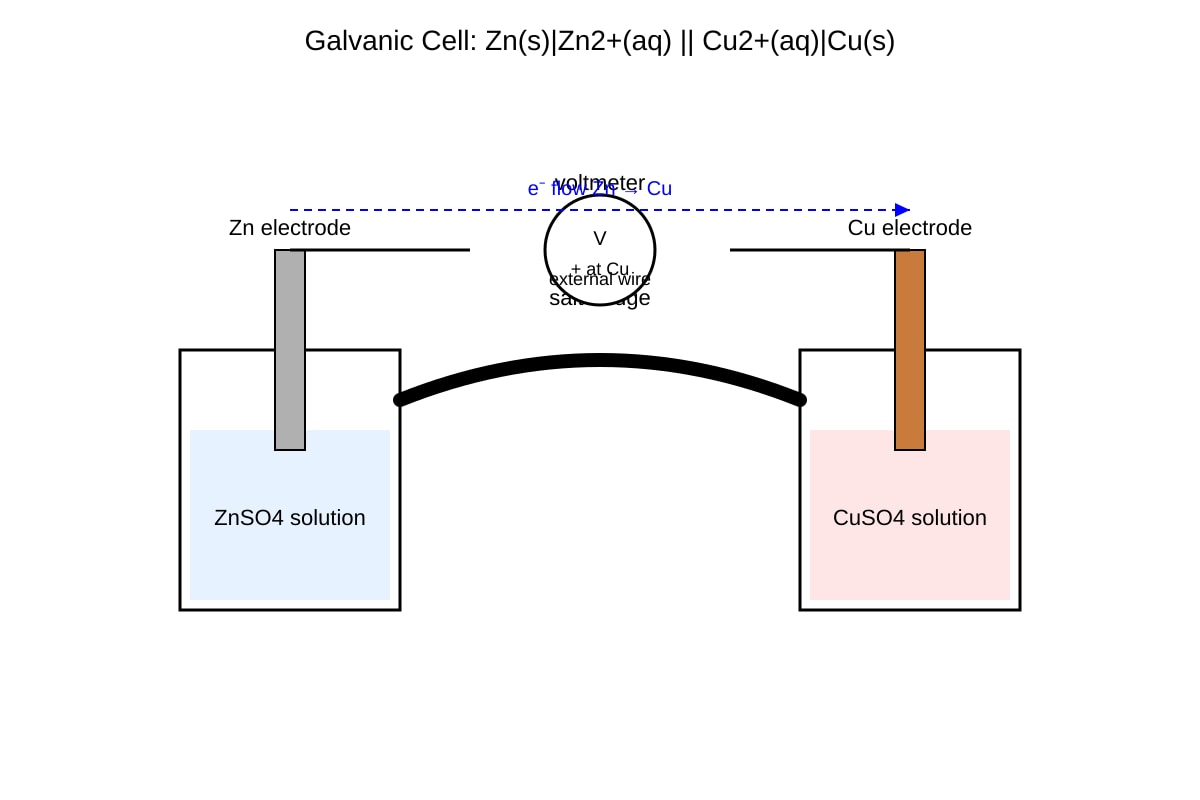
11.

Generated diagram for Q11.
Using the diagram above:
(a) Label the anode and cathode. [2]
(b) State the direction of electron flow. [1]
(c) Write the half-equation at the anode. [1]
12. (a) What is meant by an oxidising agent? [1]
(b) Give one example of a common oxidising agent in the lab. [1]
(c) Explain how it causes another species to be oxidised. [1]
13. Electrolysis of molten lead(II) bromide is carried out.
(a) Write the half-equation at the cathode. [1]
(b) Write the half-equation at the anode. [1]
(c) State the product at the anode and a test for it. [2]
14. (a) State the colour change of acidified potassium manganate(VII) when it acts as an oxidising agent. [1]
(b) Write the reduced form of MnO4− in acidic condition. [1]
(c) State the oxidation state change of Mn. [1]
15. A redox reaction occurs: 2I−+Br2→I2+2Br−
(a) Identify the reducing agent. [1]
(b) State the oxidation state change of iodine. [1]
(c) Explain why bromine is the oxidising agent. [1]
Section C: Data and Calculation (Questions 16–20)
16. A galvanic cell is set up with Mg2+/Mg and Fe2+/Fe.
Standard electrode potentials:
Mg2++2e−⇌Mg E∘=−2.37 V
Fe2++2e−⇌Fe E∘=−0.44 V
(a) Calculate the cell potential. [2]
(b) Write the overall cell reaction. [2]
17. In a titration, 25.0 cm3 of 0.020 mol dm−3 KMnO4 reacts with Fe2+ solution.
Reaction: MnO4−+5Fe2++8H+→Mn2++5Fe3++4H2O
(a) Calculate moles of MnO4− used. [2]
(b) Calculate moles of Fe2+ oxidised. [2]
18.

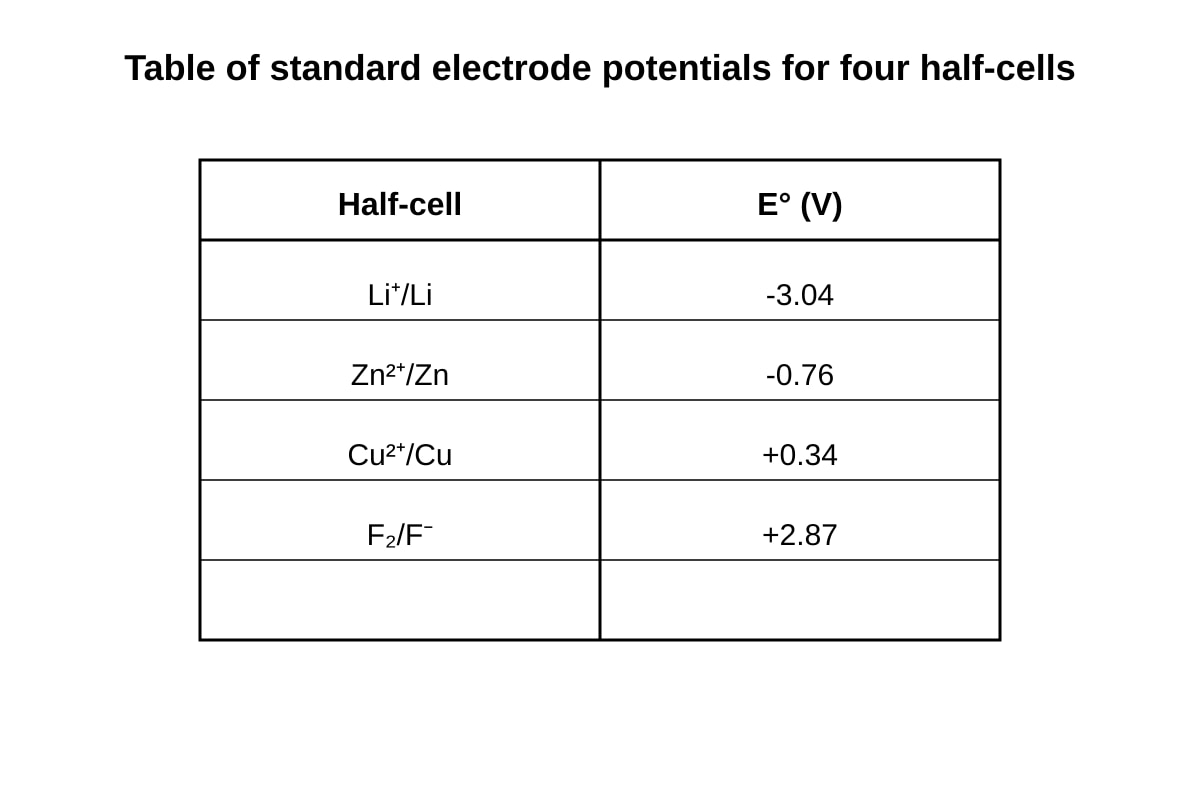
Generated table for Q18.
Using the table:
(a) Which species is the strongest reducing agent? [1]
(b) Write the cell notation for the cell with highest voltage using two of these. [2]
(c) Calculate that maximum cell potential. [1]
19. Electrolysis of aqueous copper(II) sulphate using inert electrodes.
(a) State the product at the cathode and write its half-equation. [2]
(b) State the product at the anode and explain. [2]
20. A sample of 1.00 g of zinc is placed in excess copper(II) sulphate.
Zn+Cu2+→Zn2++Cu
Relative atomic masses: Zn = 65.4, Cu = 63.5
(a) Calculate moles of Zn reacted. [2]
(b) Calculate mass of Cu deposited. [2]
Answers
Secondary 3 Chemistry Quiz - Redox Electrochemistry: Answer Key
Total Marks: 40
Teaching notes are provided for each question.
Section A
1. [1] Redox (or reduction-oxidation)
Teaching: A redox reaction is one where reduction and oxidation happen simultaneously. "Redox" is the combined term.
2. [1] Zn (zinc atom)
Teaching: Zn loses electrons to become Zn2+ (oxidation). The species oxidised is the one that loses electrons.
3. [1] +7
Teaching: K is +1, O is -2 (×4 = -8). For neutral KMnO4: +1 + x - 8 = 0 → x = +7.
4. [1] Galvanic cell (or electrochemical cell / voltaic cell)
Teaching: A galvanic cell uses spontaneous redox to produce electricity.
5. [1] from the anode (negative) to the cathode (positive)
Teaching: Electrons flow from the electrode where oxidation occurs (anode, negative) to where reduction occurs (cathode, positive).
Section B
6. [3]
(a) [1] Oxidation is loss of electrons.
(b) [1] Reduction is gain of electrons.
(c) [1] OIL RIG (Oxidation Is Loss, Reduction Is Gain).
Teaching: Electron transfer defines redox at Sec 3 level.
7. [3]
(a) [1] Cl2 (it gains electrons to become Cl−).
(b) [2] 2Fe2++Cl2→2Fe3++2Cl−
Teaching: Multiply Fe half-equation by 2 to balance electrons; add with Cl half-equation.
8. [4]
(a) [1] Reddish-brown copper metal deposits on Mg strip.
(b) [2] Mg+Cu2+→Mg2++Cu
(c) [1] Cu2+ (it gains electrons, gets reduced).
Teaching: Mg is more reactive, displaces Cu²⁺.
9. [3]
(a) [2] Hydrogen gas at 1 atm, H+ at 1 mol dm−3, 25∘C, Pt electrode. (any two)
(b) [1] It is assigned a potential of 0.00 V as standard reference.
Teaching: SHE defines the zero point for measuring other potentials.
10. [3]
(a) [1] Zinc
(b) [1] Zn loses electrons more readily than Ag.
(c) [1] Zn→Zn2++2e−
Teaching: Better reducing agent = easier to oxidise = more negative E∘.
11. [4]
(a) [2] Anode = Zn electrode (left), Cathode = Cu electrode (right).
(b) [1] From Zn to Cu (left to right).
(c) [1] Zn→Zn2++2e−
Teaching: Diagram must show Zn oxidised; electrons leave Zn through wire to Cu.
12. [3]
(a) [1] Species that accepts electrons / causes oxidation of another.
(b) [1] Acidified KMnO4 (or Cl2, etc.)
(c) [1] It gains electrons from the other species, oxidising it.
Teaching: Oxidising agent itself is reduced.
13. [4]
(a) [1] Pb2++2e−→Pb
(b) [1] 2Br−→Br2+2e−
(c) [2] Bromine; test with starch-iodide paper turns blue-black, or vapour is red-brown.
Teaching: Molten salt electrolysis: cations to cathode, anions to anode.
14. [3]
(a) [1] Purple to colourless.
(b) [1] Mn2+
(c) [1] +7 to +2.
Teaching: In acid, manganate(VII) reduced from Mn(VII) to Mn(II).
15. [3]
(a) [1] I− (iodide ion)
(b) [1] -1 to 0.
(c) [1] Br2 gains electrons to become Br−, oxidising I−.
Teaching: Reducing agent is oxidised; oxidising agent is reduced.
Section C
16. [4]
(a) [2] Ecell∘=Ecathode∘−Eanode∘=(−0.44)−(−2.37)=+1.93 V
(b) [2] Mg+Fe2+→Mg2++Fe
Teaching: More negative electrode is anode (Mg). Cell potential positive for spontaneous.
17. [4]
(a) [2] n=c×V=0.020×(25.0/1000)=5.00×10−4 mol
(b) [2] From equation 1:5 ratio → 5×5.00×10−4=2.50×10⁻³ mol Fe2+
Teaching: Convert cm³ to dm³ by ÷1000 before using n=cV.
18. [4]
(a) [1] Li (most negative E∘ = strongest reducer)
(b) [2] Li∣Li+∣∣F2,F−∣Pt (or Li∣Li+∣∣F2∣F− with Pt)
(c) [1] 2.87−(−3.04)=5.91 V
Teaching: Max voltage from most negative and most positive couples.
19. [4]
(a) [2] Cu at cathode: Cu2++2e−→Cu
(b) [2] O2 at anode: 4OH−→O2+2H2O+4e− (water oxidised, not sulphate).
Teaching: With inert electrodes in aqueous CuSO₄, Cu²⁺ reduced preferentially; OH⁻ oxidised at anode.
20. [4]
(a) [2] nZn=1.00/65.4=0.0153 mol
(b) [2] 1:1 ratio → mCu=0.0153×63.5=0.971 g
Teaching: Mole ratio from equation is 1:1; use m=n×Mr.
Free quiz and exam paper access
Enter your details to view this paper
Your access is remembered on this device.