From Real Exams Quiz
Secondary 3 Chemistry Periodic Table Quiz
Free Sec 3 Chemistry Periodic Table quiz, Kimi2.6 Exam version, with questions, answers, and O Level-style practice for Singapore students.
These static practice materials are generated from the site's syllabus and paper-generation workflow, with source and model context shown so students and parents can evaluate the material before use.
Questions
Free quiz and exam paper access
Enter your details to view this paper
Your access is remembered on this device.
Answers
Secondary 3 Chemistry Quiz Answers - Periodic Table
Total Marks: 60
Section A: Multiple Choice
1. Answer: B [2 marks]
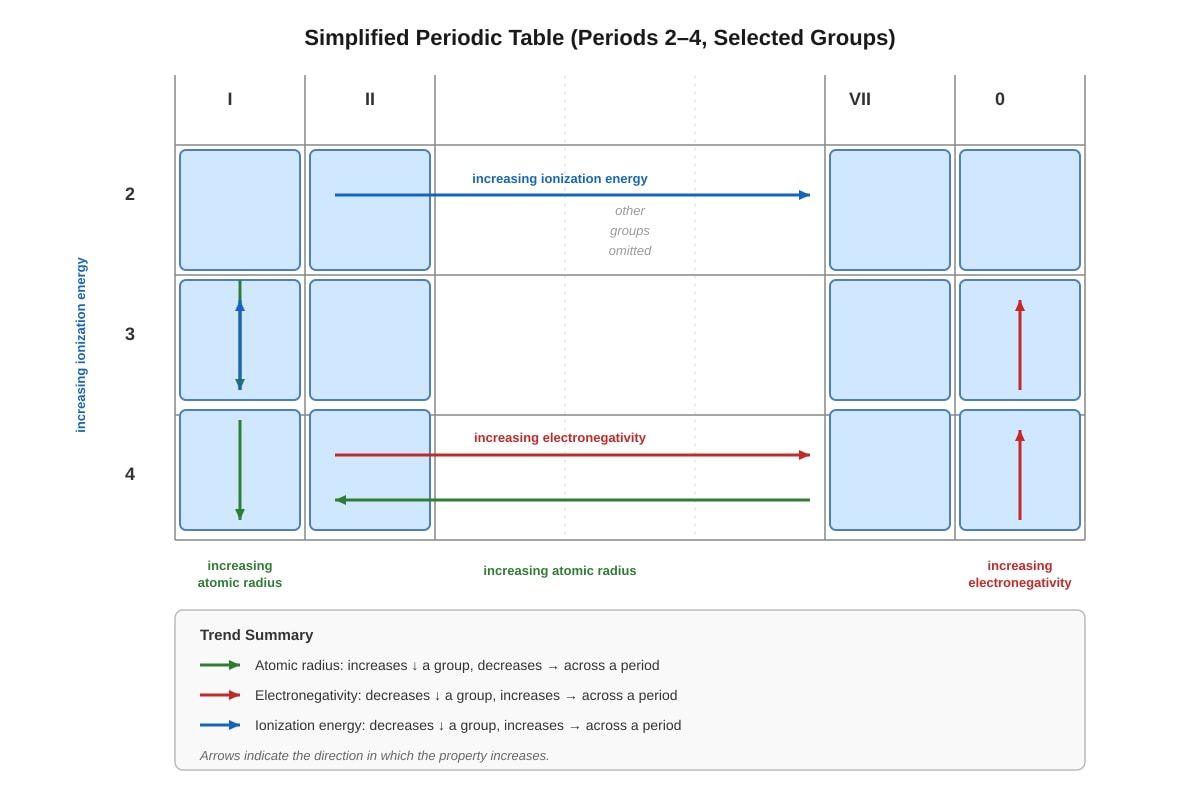
- Correct: Electronegativity increases across a period from left to right due to increasing nuclear charge with the same shielding, so electrons are attracted more strongly.
- Why A is wrong: Atomic radius increases down a group (more electron shells), not decreases. This statement has the trend direction backwards for the justification.
- Why C is wrong: Ionization energy increases across a period (general trend), not decreases.
- Why D is wrong: Group 0 elements have the highest ionization energies in their periods due to stable full outer shell; they are very unreactive.
2. Answer: B [2 marks]
- Correct: Period 3 means 3 electron shells; Group III means 3 valence electrons.
- Why A is wrong: Group III metals form 3+ cations (lose 3 electrons), not 3– anions.
- Why C is wrong: Group III elements are metals (aluminium), not non-metals with giant covalent structures.
- Why D is wrong: Aluminium is less reactive than sodium; reactivity of metals decreases across a period.
3. Answer: B [2 marks]
- Correct: Q has high melting point, good conductivity, high density, and does not react with water — characteristic properties of a transition metal (like iron).
- Why A is wrong: P is too light and reacts vigorously with water — alkali metal.
- Why C is wrong: R has very low melting point (-7°C) and density — not a metal.
- Why D is wrong: S is non-conductive and doesn't react with water — non-metal (like iodine).
4. Answer: A [2 marks]
- Correct: Greatest ionic character comes from the largest electronegativity difference. Li (0.98) to F (3.98) gives difference ≈ 3.0; this is the largest gap among options using Pauling scale values. Also, smaller ions mean stronger ionic bonding character.
- Working: Electronegativity differences: Li-F ≈ 3.0, Na-Cl ≈ 2.2, K-Br ≈ 2.0, Mg-O ≈ 2.3. Lithium fluoride has the greatest difference.
5. Answer: C [2 marks]
- Correct: Group VII elements (halogens: F₂, Cl₂, Br₂, I₂) exist as simple diatomic molecules with covalent bonding between two atoms.
- Why A is wrong: Group I metals have giant metallic structures.
- Why B is wrong: Group II metals have giant metallic structures.
- Why D is wrong: Group 0 elements exist as monatomic gases (single atoms).
Section B: Short Answer
6. (a) Ionization energy is the energy required to remove one mole of electrons from one mole of gaseous atoms to form one mole of gaseous positive ions. [1]
(b) Potassium has a lower first ionization energy than sodium because:
- Potassium is below sodium in Group I, so it has one more electron shell (4 shells vs 3 shells) [1]
- The outer electron in potassium is further from the nucleus and experiences more shielding, so the attraction between the nucleus and the valence electron is weaker [1]
(c) Mg⁺(g) → Mg²⁺(g) + e⁻ [2]
- Correct equation with Mg⁺ on left and Mg²⁺ + e⁻ on right [1]
- Correct state symbols (all gaseous) [1]
Total: [5]
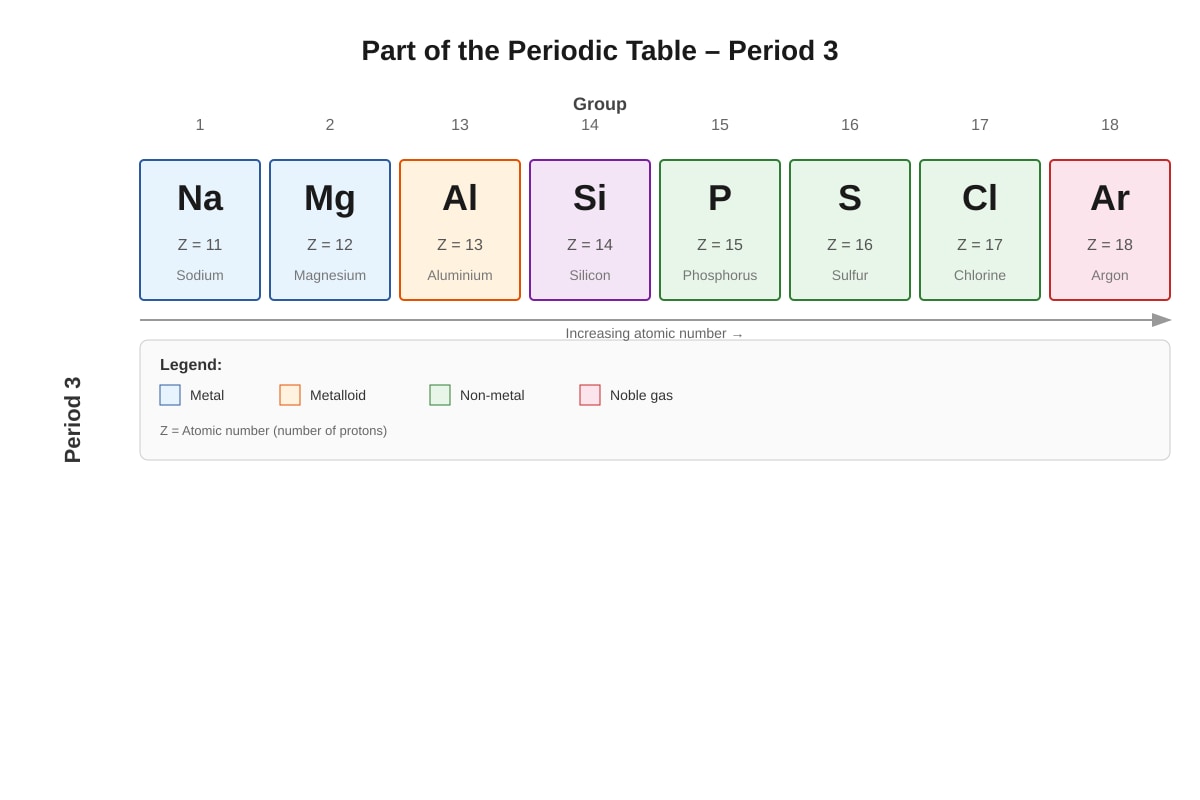
7. (a) Silicon (Si) has the highest melting point in Period 3. [1]
- Silicon has a giant covalent structure where each silicon atom is covalently bonded to four other silicon atoms in a tetrahedral network [1]
- Many strong covalent bonds must be broken to melt silicon, requiring a large amount of energy [1]
(b) Silicon's electrical conductivity is lower than aluminium because:
- Silicon is a semiconductor with a giant covalent structure; it has no free electrons at room temperature (electrons are held in covalent bonds) [1]
- Aluminium is a metal with a giant metallic structure containing a 'sea' of delocalized electrons that are free to move and carry charge [1]
Total: [5]
8. (a) Two physical properties of francium: Any two from:
- Soft, silvery metal [1]
- Low melting point (lower than caesium, ~28°C) [1]
- Low density (higher than caesium due to relativistic effects but still low, ~2 g cm⁻³) [1]
- Good conductor of heat and electricity [1]
(Accept any 2 reasonable predictions based on Group I trends)
(b) 2Fr(s) + 2H₂O(l) → 2FrOH(aq) + H₂(g) [2]
- Correct formulae and balanced [1]
- Correct state symbols [1]
(c) Francium is more reactive than caesium because:
- Francium has one more electron shell than caesium (6 vs 5) [1]
- The outer electron is further from the nucleus with more shielding, so it is lost more easily; weaker attraction between nucleus and valence electron [1]
Total: [6]
9. (a) Astatine is a solid at room temperature. [1]
- Down Group VII, melting/boiling points increase due to stronger intermolecular forces (more electrons, larger electron cloud, stronger instantaneous dipole-induced dipole/London dispersion forces) [1]
(b) At⁻ [1]
(c) No, astatine will not displace bromide ions. [1]
- Reactivity of halogens decreases down the group; astatine is below iodine so is the weakest oxidizing agent/weakest halogen. It cannot oxidize bromide ions to bromine because it is less reactive/less easily reduced than bromine. [1]
Total: [5]
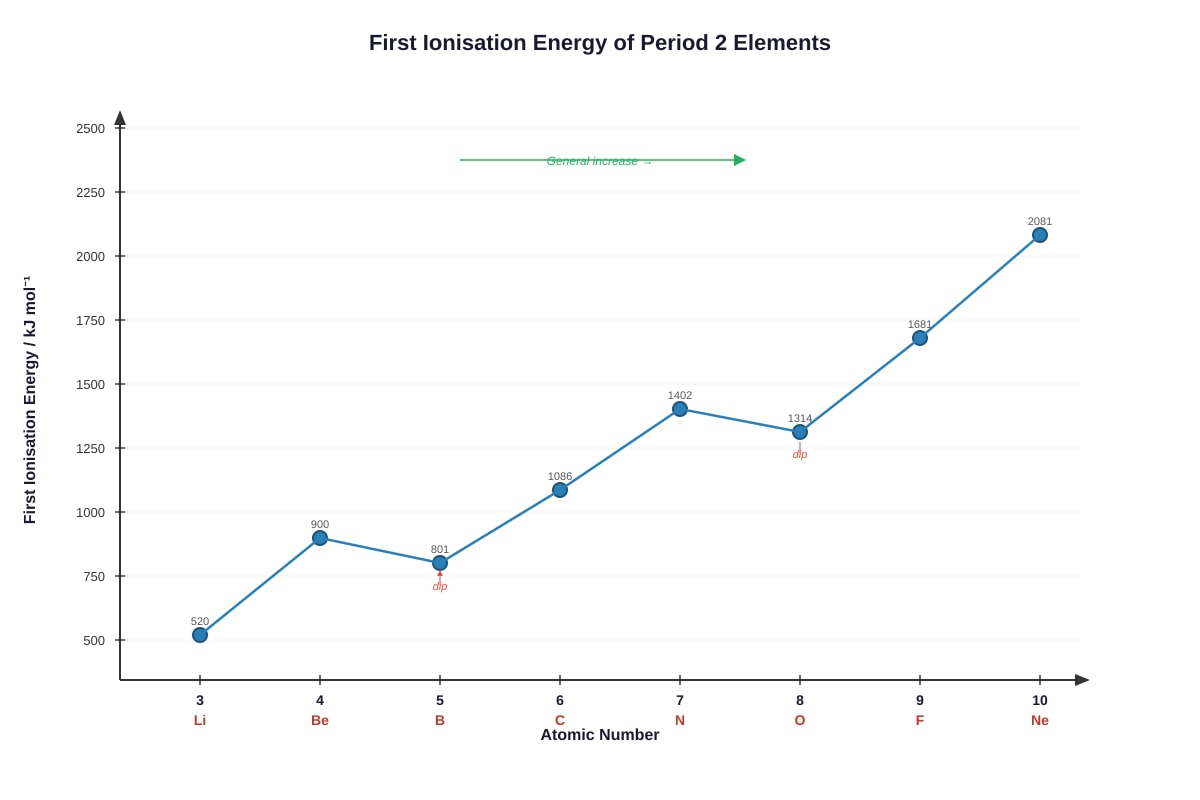
10. (a) General increase across Period 2 because:
- Nuclear charge increases (proton number increases from 3 to 9) [1]
- Electrons are added to the same shell, so shielding remains relatively constant; the increased nuclear pull makes it harder to remove an electron [1]
(b) Boron has a lower first ionization energy than beryllium because:
- Beryllium has a stable full 2s subshell: 1s² 2s² [1]
- Boron's electron configuration is 1s² 2s² 2p¹; the 2p electron is slightly higher in energy and is shielded by the 2s electrons, so it is easier to remove [1]
(c) Neon has the highest first ionization energy because:
- It has the highest nuclear charge in Period 2 (10 protons) [1]
- It has a stable full outer shell (1s² 2s² 2p⁶) — removing an electron would disrupt this stable noble gas configuration, requiring the most energy [1]
Total: [6]
11. (a) Atomic radius increases down Group II because:
- Each successive element has one more occupied electron shell [1]
- The outer electrons are further from the nucleus despite increasing nuclear charge, so the atomic radius increases [1]
(b) Ionic radius of M²⁺ is smaller than atomic radius because:
- The atom loses two electrons to form the 2+ ion, so the outermost shell is removed [1]
- There are fewer electron-electron repulsions, and the remaining electrons are pulled closer to the nucleus by the same nuclear charge [1]
(c) First ionization energy decreases down Group II because:
- The outer electron is further from the nucleus as you go down the group (more electron shells) [1]
- There is more shielding from inner shells, so the nuclear attraction on the valence electron is weaker, making it easier to remove [1]
Total: [6]
12. (a) Boiling point increases down Group VII because:
- The halogens exist as simple diatomic molecules with weak intermolecular forces (instantaneous dipole-induced dipole forces/London dispersion forces) [1]
- Down the group, the number of electrons increases, making the electron cloud more polarizable [1]
- Stronger intermolecular forces require more energy to overcome, so boiling point increases [1]
(b) (i) Cl₂(aq) + 2Br⁻(aq) → 2Cl⁻(aq) + Br₂(aq) [2]
- Correct formulae and products [1]
- Balanced with state symbols [1]
(ii) Chlorine is a stronger oxidizing agent than bromine (or chlorine has a greater tendency to gain electrons/be reduced) [1]
- Chlorine can oxidize bromide ions to bromine by accepting electrons from them; chlorine is more reactive/has a higher standard electrode potential [1]
Total: [7]
Section C: Structured Response
13. (a) Silicon (Si) [1]
(b) Dot-and-cross diagram of SiO₂:
- Central silicon atom with 4 bonding pairs (2 double bonds or 4 single bonds to two oxygen atoms)
- Each oxygen has 2 lone pairs
- All atoms achieve noble gas configuration [2] (Students should show Si with 4 outer electrons, each O with 6, forming two double bonds or showing 4 single bonds in network — either representation acceptable)
(c) TO₂ (SiO₂) has a high melting point because:
- It has a giant covalent structure with strong covalent bonds between silicon and oxygen atoms [1]
- These bonds extend throughout the entire structure in a network; many strong bonds must be broken to melt it, requiring much energy [1]
(d) Pure TO₂ does not conduct electricity because:
- All electrons are involved in covalent bonds; there are no free electrons or mobile ions to carry charge [1]
When heated or doped:
- At higher temperatures, some electrons gain enough energy to break free from bonds and move [1]
- When doped with impurities (e.g., phosphorus or boron), extra electrons or 'holes' are introduced that can move and carry charge, creating an n-type or p-type semiconductor [1]
Total: [8]
14. (a) Elements W and D belong to Group I; elements Y and Z belong to Group VII. [2]
- W (19, K) and D (35 — wait, recheck: W is Z=19, D would need comparison. Actually Y (35) and Z (53) are both halogens (Group VII) with similar outer electron configuration (7 valence electrons), showing pattern of increasing mass and density. W (19) is potassium, X (20) is calcium.
- Correct grouping: Y and Z are in Group VII (both have 7 valence electrons, similar properties — non-metals, diatomic, similar density trends) [1]
- W and X are in Period 4 (consecutive proton numbers), not same group. Actually W (19) and D is not given properly. Looking at pattern: W=K (Group I), X=Ca (Group II), Y=Br (Group VII), Z=I (Group VII).
- Y and Z are in Group VII — both have 7 valence electrons; show trend of increasing density and atomic mass down the group [1]
(b) (i) KY or KBr [1] — Potassium bromide
(ii) Dot-and-cross diagram:
- Potassium loses 1 electron to K⁺
- Bromine gains 1 electron to Br⁻
- Ionic structure with K⁺ and Br⁻ ions shown with correct charges and electron transfer indicated [2]
(iii) The compound conducts electricity when molten or in aqueous solution because:
- In solid state: ions are fixed in lattice, cannot move [1]
- When molten or dissolved: ionic bonds broken, ions are free to move and carry electric charge [1]
Total: [7]
15. (a) Sodium, magnesium, and aluminium all have giant metallic structures [1]
- Positive metal ions arranged in a lattice with delocalized electrons forming a 'sea' [1]
- Increasing number of delocalized electrons per atom: Na (1), Mg (2), Al (3) [1]
- This causes increasing metallic bond strength and therefore increasing electrical conductivity from Na to Mg to Al; more mobile charge carriers per unit volume [1]
(b) Aluminium has a higher melting point than magnesium because:
- Both have giant metallic structures [1]
- Al³⁺ ions have a higher charge than Mg²⁺ ions, and the ionic radius of Al³⁺ is smaller than Mg²⁺ [1]
- This results in stronger electrostatic attraction between the positive ions and the delocalized electrons, requiring more energy to break the metallic bonds [1]
Total: [7]
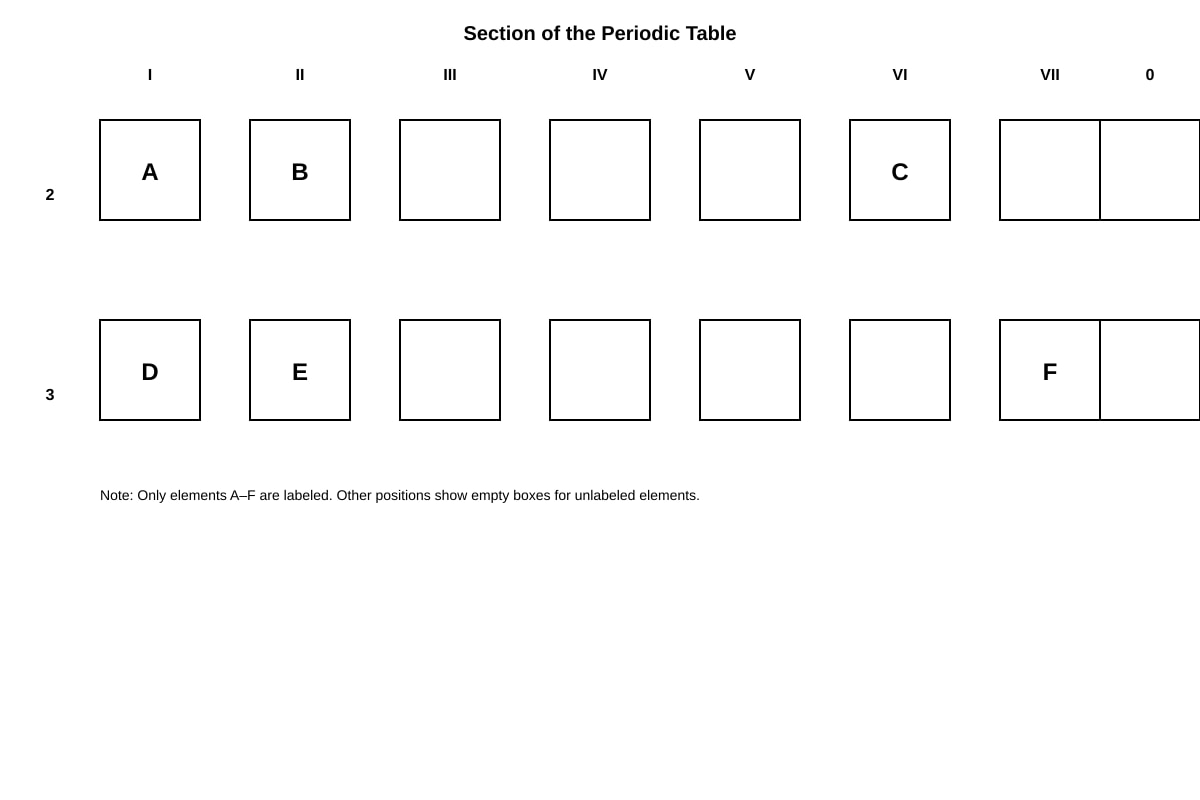
16. (a) Element A (or more precisely, D if in Period 3) — actually A is in Period 2 Group I, D is Period 3 Group I. Element D is the strongest reducing agent. [1]
- It is lowest in Group I shown (Period 3 vs Period 2), with the most electron shells, weakest nuclear attraction on valence electron, so loses electron most readily [1]
(b) BF₂ — B is Group II (Mg), F is Group VII (Cl), so MgCl₂ [1]
(c) F has a smaller atomic radius than C. [1]
- F (Group VII, Period 3) has more protons/greater nuclear charge than C (Group VI, Period 2), and F has its electrons in a higher shell. Actually: C is in Period 2 Group VI (oxygen family), F is in Period 3 Group VII. Need to compare: C=O/S? Actually C is Group VI Period 2. F is Group VII Period 3.
- F is in Period 3 so has an extra electron shell compared to C in Period 2, so F would be LARGER. Wait — let me re-read: C is in Period 2 Group VI, F is in Period 3 Group VII.
- Correction: C (Period 2) has smaller radius than F (Period 3). The increase down a group (extra shell) dominates over the increase across a period. So C has smaller radius than F. [1]
- C is in Period 2 with 2 shells; F is in Period 3 with 3 shells. The additional electron shell in F more than compensates for the increased nuclear charge. [1]
(d) The oxide of A is basic. [1]
- A is a Group I metal (alkali metal). Example equation: Na₂O + H₂O → 2NaOH or 4Na + O₂ → 2Na₂O [1]
Total: [7]
17. (a) 1s² 2s² 2p⁶ 3s² 3p⁶ 3d¹⁰ 4s² 4p¹ or [Ar] 3d¹⁰ 4s² 4p¹ [1]
(b) Ga³⁺ [1]
- Gallium has 3 valence electrons (Group III); it tends to lose these 3 electrons to achieve a stable noble gas configuration (like argon) [1]
(c) Aluminium is more reactive than gallium (with dilute HCl). OR Gallium is slightly more reactive due to d-block contraction — actually Group III trend is complex.
- Standard expected answer: Aluminium appears less reactive due to protective oxide layer; if oxide removed, reactivity should increase down group (opposite to observed for Al).
- More precise: Aluminium has a protective oxide layer that makes it appear unreactive; once this is removed or in certain conditions, gallium may show different behavior. For Sec 3 level: Gallium is more reactive than aluminium as the outer electrons are further from nucleus with more shielding [2]
- However, aluminium's apparent unreactivity is due to its protective oxide coating [1]
Note: This is a challenging question. Accept either trend with valid explanation. Mark for reasoning quality.
Total: [6]
18. (a) Noble gases have low melting and boiling points because:
- They exist as individual atoms with weak intermolecular forces (instantaneous dipole-induced dipole forces/London dispersion forces) between them [1]
- Very little energy is needed to overcome these weak forces [1]
(b) Boiling point increases from He to Xe because:
- The number of electrons increases down the group, making the electron cloud larger and more polarizable [1]
- Stronger instantaneous dipole-induced dipole forces result, requiring more energy to boil [1]
(c) Helium is unreactive/noble gas/inert, while hydrogen is flammable/explosive [1]
- Helium will not burn or react, making it safer for balloons despite being slightly less lifting capacity.
Total: [5]
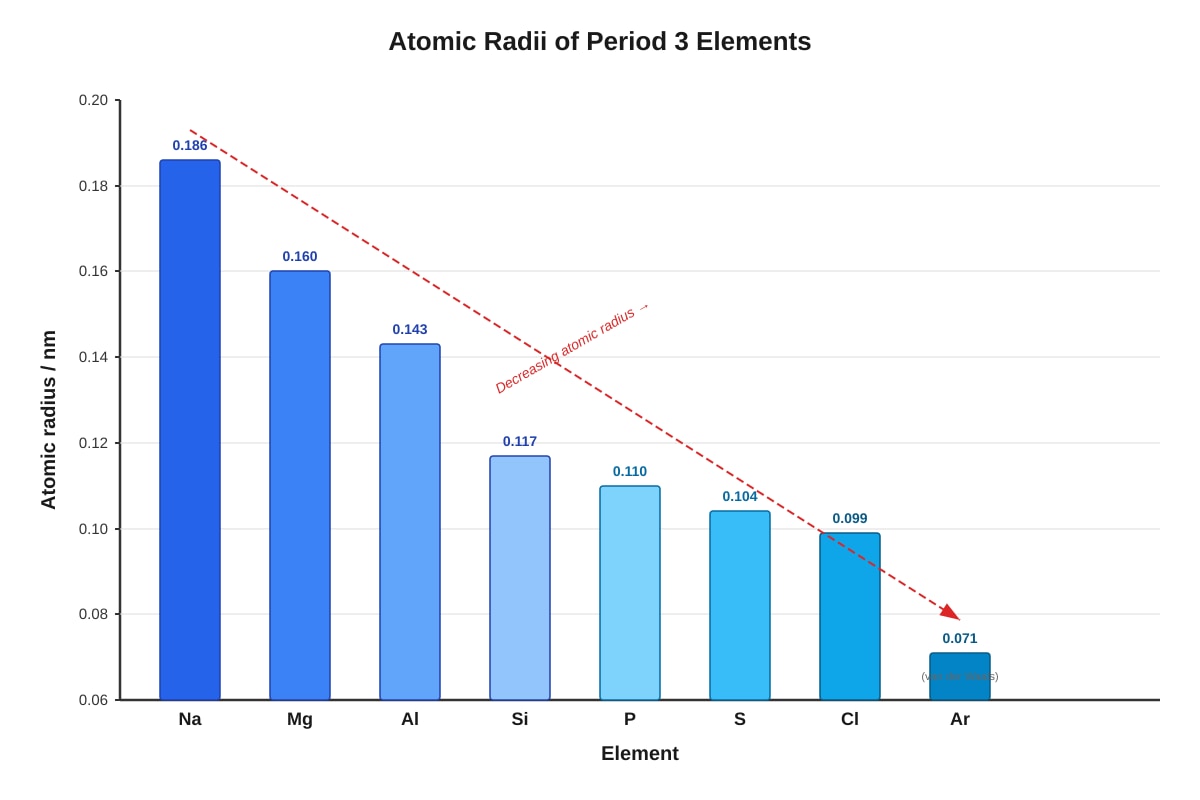
19. (a) Atomic radius decreases across Period 3 because:
- Nuclear charge increases (number of protons increases from 11 to 18) [1]
- Electrons are added to the same principal quantum shell/clectron shell, so shielding is roughly constant [1]
- The increased nuclear attraction pulls the electron cloud closer to the nucleus, making the atom smaller [1]
(b) Na⁺ is smaller than Na because:
- Na loses its outermost (3rd) electron shell to form Na⁺ [1]
- The remaining 2 shells experience greater effective nuclear charge per electron, pulling remaining electrons closer; also fewer electron-electron repulsions [1]
(c) Cl⁻ is larger than Cl because:
- Cl gains an electron to form Cl⁻, increasing electron-electron repulsion [1]
- The extra electron reduces the effective nuclear charge per electron; the electron cloud expands [1]
Total: [7]
20. (a) (i) Scandium atom: 1s² 2s² 2p⁶ 3s² 3p⁶ 3d¹ 4s² or [Ar] 3d¹ 4s² [1] (ii) Sc³⁺ ion: 1s² 2s² 2p⁶ 3s² 3p⁶ or [Ar] [1]
(b) Sc³⁺ is more stable than Sc²⁺ because:
- Sc³⁺ has the electron configuration of argon, a noble gas with a full and stable outer shell [1]
- The 4s² and 3d¹ electrons are all removed, leaving a stable octet in the outer shell (actually full n=2 and n=3 shells, argon configuration) [1]
(c) Two properties different from calcium:
- Scandium forms ions with variable oxidation states / Sc³⁺ is common but other states possible; Ca only forms Ca²⁺ [1]
- Scandium and its compounds are often colored / act as catalysts; calcium compounds are typically white and not catalytic [1]
- Scandium has higher melting point / higher density than calcium [1]
- Scandium forms complexes with ligands more readily [1] (Any 2 valid comparisons)
(d) Percentage by mass of oxygen in Sc₂O₃:
- Relative formula mass of Sc₂O₃ = 2(45) + 3(16) = 90 + 48 = 138 [1]
- Mass of oxygen = 48
- Percentage of oxygen = (48 / 138) × 100% = 34.8% (accept 34.78% or 35%) [1]
Total: [8]