From Real Exams Quiz
Secondary 3 Chemistry Periodic Table Quiz
Free Sec 3 Chemistry Periodic Table quiz, HY3 Exam version, with questions, answers, and O Level-style practice for Singapore students.
These static practice materials are generated from the site's syllabus and paper-generation workflow, with source and model context shown so students and parents can evaluate the material before use.
Questions
Free quiz and exam paper access
Enter your details to view this paper
Your access is remembered on this device.
Answers
Secondary 3 Chemistry Quiz - Periodic Table: Answer Key
Total Marks: 40
Topic: Periodic Table
Section A Answers (Q1–5)
Q1. [2 marks]
Answer: 11 protons.
Teaching note: Proton number = number of protons in the nucleus. Sodium has proton number 11, so it has 11 protons. Common mistake: confusing proton number with nucleon number.
Q2. [2 marks]
Answer: Group 1 (alkali metals).
Teaching note: Group 1 metals are the most reactive metals because they easily lose their single outer electron. Marking: 2 marks for naming Group 1; 1 mark if "alkali metals" only without group.
Q3. [2 marks]
Answer: Neon (Ne).
Teaching note: Group 18 noble gases; neon emits red-orange light in discharge tubes. Common trap: confusing with argon (blue) or helium (yellow).
Q4. [2 marks]
Answer: Atomic radius increases down Group 1.
Teaching note: More electron shells are added down the group, increasing size. Marking: 2 marks for correct trend stated.
Q5. [2 marks]
Answer: Metals.
Teaching note: These are typical metallic properties. 2 marks for "metals"; partial if only some properties listed.
Section B Answers (Q6–15)
Q6. [2 marks]
(a) [1] A period is a horizontal row in the Periodic Table.
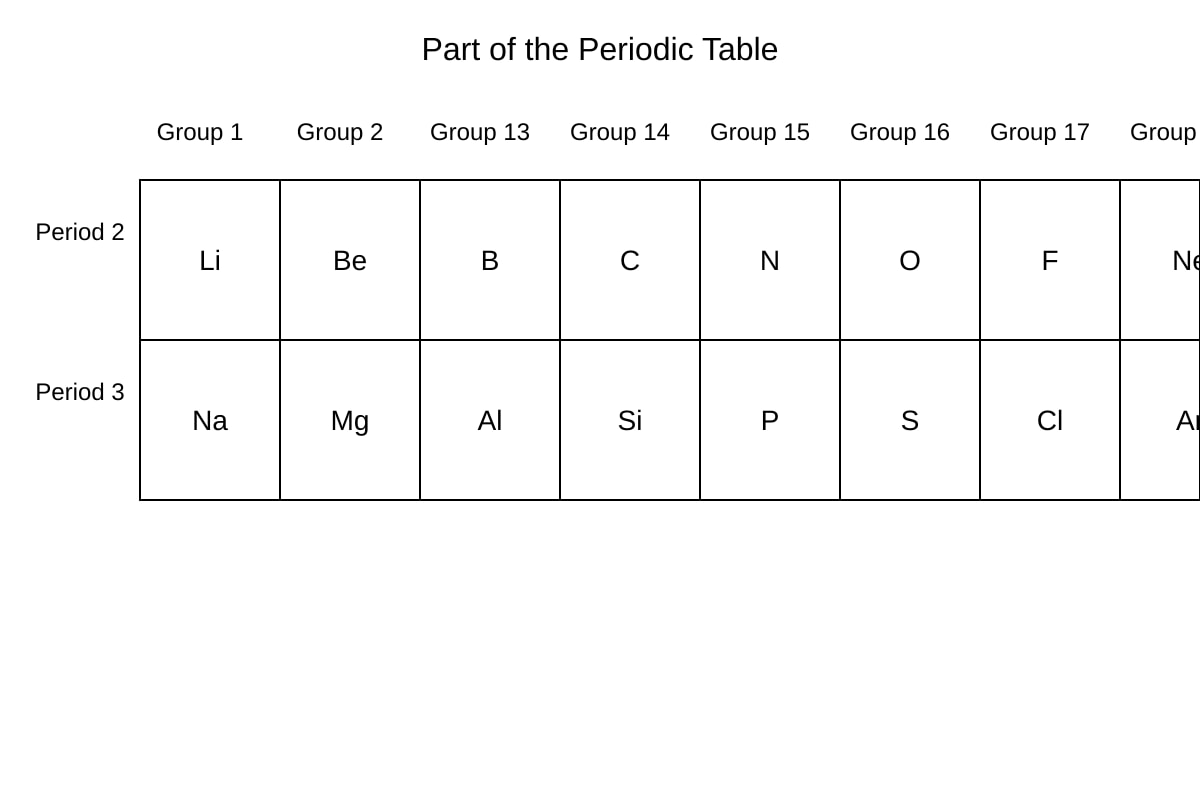
(b) [1] 8 elements (Na, Mg, Al, Si, P, S, Cl, Ar).
Teaching note: Period 3 has 8 elements. Marking: 1 mark each part.
Q7. [2 marks]
Answer: Noble gases have a full outer shell of electrons (octet), so they do not need to gain, lose, or share electrons to become stable.
Teaching note: Unreactivity due to stable electron arrangement. 2 marks: 1 for full shell, 1 for no tendency to react.
Q8. [3 marks]
(a) [2] Group 2, Period 3 (proton number 12 = Mg).
(b) [1] Metal.
Teaching note: Proton number 12 → Mg, in Group 2 (2 outer e⁻), Period 3. Marking: 2 for group & period, 1 for metal.
Q9. [2 marks]
Answer: The number of chloride ions increases from 1 (Group 1) to 2 (Group 2) to 3 (Group 3) as group number increases.
Teaching note: Shows valence/charge trend across period. 2 marks for clear pattern.
Q10. [2 marks]
Answer: Any two: high melting points, hard, high density, form coloured compounds, multiple oxidation states.
Teaching note: Contrast with soft, low-mp Group 1. 1 mark each.
Q11. [3 marks]
Charge: [1] –1.
Explanation: [2] Group 17 elements have 7 outer electrons; they gain 1 electron to achieve a full outer shell, forming X⁻ ion.
Teaching note: 1 mark charge, 2 for electron reasoning.
Q12. [2 marks]
Answer: Cl is larger. Both are Period 3, but Ar is a noble gas with same shells; Cl has fewer protons pulling? Actually Ar has more protons (18 vs 17) so smaller radius. Correct: Cl > Ar? Wait: across period, atomic radius decreases left to right due to increased nuclear charge. So Cl (Z=17) is larger than Ar (Z=18).
Answer: Cl is larger because across a period, increased proton number pulls electrons closer; Ar has 18 protons vs Cl 17, so Ar smaller.
Teaching note: 2 marks for correct choice + reason.
Q13. [2 marks]
Answer: Down Group 1, extra shells shield outer electron; weaker attraction to nucleus, easier to lose → more reactive.
Teaching note: 2 marks for shielding + ease of loss.
Q14. [2 marks]
Answer: Helium – balloons/filling, low density & inert (Group 18). Argon – welding shield gas, inert (Group 18).
Teaching note: 1 mark each use+reason.
Q15. [2 marks]
(a) [1] Neutrons = 14 – 6 = 8.
(b) [1] .
Teaching note: nuclide notation: superscript nucleon, subscript proton.
Section C Answers (Q16–20)
Q16. [2 marks]
Answer: Chlorine (Cl); physical state: gas at room temperature.
Teaching note: From diagram Group 17 Period 3 = Cl; halogen gas. 1 mark each.
Q17. [2 marks]
Answer: Melting point decreases down Group 1 (Li 180 → Na 98 → K 63). Reason: weaker metallic bond due to larger atoms/ more shells.
Teaching note: 1 trend, 1 reason.
Q18. [2 marks]
Answer: Student is incorrect. Atomic radius decreases up Group 17; fluorine is smaller than chlorine because fewer shells.
Teaching note: 1 correct/incorrect, 1 explanation.
Q19. [2 marks]
Answer: Down group, atomic radius increases, outer e⁻ farther from nucleus, less attraction for electron → less reactive (harder to gain e⁻).
Teaching note: 2 marks for radius + attraction link.
Q20. [2 marks]
Answer: Oxide is basic (Group 2 metal oxide), ionic, high melting point, reacts with acid to form salt+water. Any two.
Teaching note: Group 2 → basic ionic oxides. 1 mark each.