From Real Exams Quiz
Secondary 3 Chemistry Periodic Table Quiz
Free Sec 3 Chemistry Periodic Table quiz, DeepSeek Exam version, with questions, answers, and O Level-style practice for Singapore students.
These static practice materials are generated from the site's syllabus and paper-generation workflow, with source and model context shown so students and parents can evaluate the material before use.
Questions
Free quiz and exam paper access
Enter your details to view this paper
Your access is remembered on this device.
Answers
Secondary 3 Chemistry Quiz - Periodic Table — Answer Key
Section A: Short Answer (10 marks)
1. State the name of the Russian scientist who is credited with developing the first widely accepted Periodic Table. [1]
- Answer: Dmitri Mendeleev
- Marking note: Accept "Mendeleev" only. Do not accept "Meyer" or "Newlands."
2. What is meant by the term period in the Periodic Table? [1]
- Answer: A horizontal row of elements in the Periodic Table, arranged in order of increasing proton number.
- Marking note: Accept "horizontal row" or "row of elements." Must convey the idea of a row, not a column.
3. State the proton number of the element that is found in Group 17 and Period 3. [1]
- Answer: 17 (chlorine)
- Marking note: Accept "17" or "chlorine." The proton number is required for the mark.
4. Explain why the noble gases are monatomic. [1]
- Answer: Noble gases have a full valence/outer electron shell (stable octet/duplet configuration), so they do not need to gain, lose, or share electrons to achieve stability. They exist as single atoms.
- Marking note: Must mention "full outer shell" or "stable electronic configuration." Do not accept "they are unreactive" without structural explanation.
5. State the charge of the ion most commonly formed by an element in Group 1. [1]
- Answer: +1 / 1+
- Marking note: Accept "+1" or "1+." Do not accept "1" without charge sign.
Section B: Short Answer (10 marks)
6. What is the relationship between the group number and the number of valence electrons for elements in Groups 1 to 2 and 13 to 18? [1]
- Answer: For Groups 1–2, the group number equals the number of valence electrons. For Groups 13–18, the number of valence electrons equals the group number minus 10.
- Marking note: Accept any clear statement of the relationship. Example: "Group 1 has 1 valence electron, Group 2 has 2, Group 13 has 3, ... Group 18 has 8."
7. Name the element in Period 2 that has the highest electronegativity. [1]
- Answer: Fluorine
- Marking note: Accept "fluorine" only. Do not accept "F" without the name.
8. State whether the atomic radius increases or decreases across a period from left to right. [1]
- Answer: Decreases
- Marking note: Must state "decreases." Do not accept "increases."
9. What is the name given to the elements found in the block between Groups 2 and 13? [1]
- Answer: Transition elements / transition metals
- Marking note: Accept "transition elements" or "transition metals." Do not accept "d-block elements" (O-Level syllabus uses "transition elements").
10. State one physical property that is characteristic of most transition elements. [1]
- Answer: Any one of: high melting point, high density, good conductors of heat/electricity, malleable, ductile, form coloured compounds, have variable oxidation states, act as catalysts.
- Marking note: Accept any one valid physical property. "Form coloured compounds" and "act as catalysts" are acceptable as characteristic properties.
Section C: Structured Questions (12 marks)
11. The table below shows some information about three elements, X, Y, and Z, which are found in the same period of the Periodic Table.
(a) Identify the period in which these elements are found. Explain your answer. [2]
- Answer: Period 3. The elements have proton numbers 11 (sodium), 14 (silicon), and 17 (chlorine), which are all in Period 3.
- Marking scheme: 1 mark for "Period 3"; 1 mark for explanation referencing proton numbers 11–18 corresponding to Period 3, or identifying the elements as Na, Si, Cl.
- Marking note: Accept explanation based on electron configuration: "Element X (11) has electron configuration 2.8.1, so it has 3 electron shells, placing it in Period 3."
(b) Element X is a metal. Explain, in terms of its structure and bonding, why it is a good conductor of electricity. [2]
- Answer: Element X (sodium) has a metallic structure consisting of positive metal ions arranged in a giant lattice, surrounded by a "sea" of delocalised valence electrons. These delocalised electrons are free to move throughout the structure and carry electric charge/current.
- Marking scheme: 1 mark for describing metallic bonding (positive ions in a sea of delocalised electrons); 1 mark for linking delocalised electrons to electrical conductivity.
- Marking note: Must mention "delocalised electrons" or "free-moving electrons." Do not award marks for "ions moving" (ions are fixed in the lattice).
(c) Element Y has a macromolecular structure. Suggest the type of bonding present in element Y. [1]
- Answer: Covalent bonding
- Marking note: Accept "covalent" or "giant covalent." Silicon has a diamond-like giant covalent structure.
(d) Element Z exists as diatomic molecules. Name the type of bonding present in a molecule of Z. [1]
- Answer: Covalent bonding
- Marking note: Accept "covalent" or "simple covalent." Chlorine (Cl₂) has a single covalent bond between the two chlorine atoms.
(e) State the formula of the compound formed when element X reacts with element Z. [1]
- Answer: NaCl / XZ
- Marking note: Accept "NaCl" or "XZ." Sodium (Group 1) forms Na⁺; chlorine (Group 17) forms Cl⁻; compound is NaCl.
12. The elements in Group 1 of the Periodic Table are known as the alkali metals.
(a) Describe the trend in reactivity as Group 1 is descended. [1]
- Answer: Reactivity increases down the group.
- Marking note: Must state "increases." Do not accept "decreases."
(b) Explain this trend in reactivity in terms of atomic structure. [2]
- Answer: As Group 1 is descended, the number of electron shells increases, so the atomic radius increases. The single valence electron is further from the nucleus and more shielded by inner electron shells. The electrostatic attraction between the nucleus and the valence electron decreases, making it easier to lose the valence electron. Therefore, reactivity increases.
- Marking scheme: 1 mark for stating that atomic radius increases / valence electron is further from nucleus / increased shielding; 1 mark for linking this to easier loss of the valence electron / increased reactivity.
- Marking note: Must explain the cause (increased distance/shielding) and the effect (easier electron loss). Do not award full marks for "the electron is easier to lose" without structural explanation.
(c) Lithium reacts with water to form lithium hydroxide and hydrogen gas.
(i) Write a balanced chemical equation, with state symbols, for this reaction. [2]
- Answer: 2Li(s) + 2H₂O(l) → 2LiOH(aq) + H₂(g)
- Marking scheme: 1 mark for correct formulae; 1 mark for correct state symbols and balancing.
- Marking note: Accept LiOH as (aq) or (s). Deduct 1 mark if equation is not balanced. Deduct 1 mark if state symbols are missing or incorrect.
(ii) Describe one observation that would be made during this reaction. [1]
- Answer: Any one of: lithium moves around on the water surface; effervescence/fizzing/bubbles of gas; lithium dissolves/disappears; the solution becomes warm; a colourless solution is formed.
- Marking note: Accept any one valid observation. Do not accept "lithium melts" (lithium does not melt during this reaction, unlike sodium and potassium). Do not accept "flame" or "explosion" (lithium does not ignite).
(d) Suggest why rubidium is stored under oil, whereas lithium can be stored in a sealed container without oil. [1]
- Answer: Rubidium is more reactive than lithium. It reacts vigorously with oxygen and water vapour in the air, so it must be stored under oil to prevent contact with air. Lithium is less reactive and reacts more slowly with air, so a sealed container provides sufficient protection.
- Marking note: Must convey that rubidium is more reactive and requires greater protection. Accept "rubidium is more reactive" as sufficient.
13. The halogens are found in Group 17 of the Periodic Table.
(a) State the colour and physical state of chlorine at room temperature and pressure. [2]
- Answer: Colour: greenish-yellow / yellow-green; Physical state: gas
- Marking scheme: 1 mark for correct colour; 1 mark for correct physical state.
- Marking note: Accept "pale green" or "greenish-yellow." Do not accept "green" alone. Accept "gas" or "gaseous."
(b) Describe the trend in reactivity as Group 17 is descended. [1]
- Answer: Reactivity decreases down the group.
- Marking note: Must state "decreases." Do not accept "increases."
(c) Chlorine gas is bubbled through a colourless solution of potassium iodide.
(i) State the colour change that would be observed. [1]
- Answer: The solution turns from colourless to brown / reddish-brown / yellow-brown.
- Marking note: Accept "brown solution formed" or "turns brown." Iodine is displaced, giving a brown colour in aqueous solution.
(ii) Write the ionic equation for the reaction that occurs. [1]
- Answer: Cl₂(g) + 2I⁻(aq) → 2Cl⁻(aq) + I₂(aq)
- Marking note: Accept equation with state symbols or without. Must be balanced. Accept I₂ as (s) or (aq).
14. The graph below shows the melting points of the elements in Period 3 of the Periodic Table.
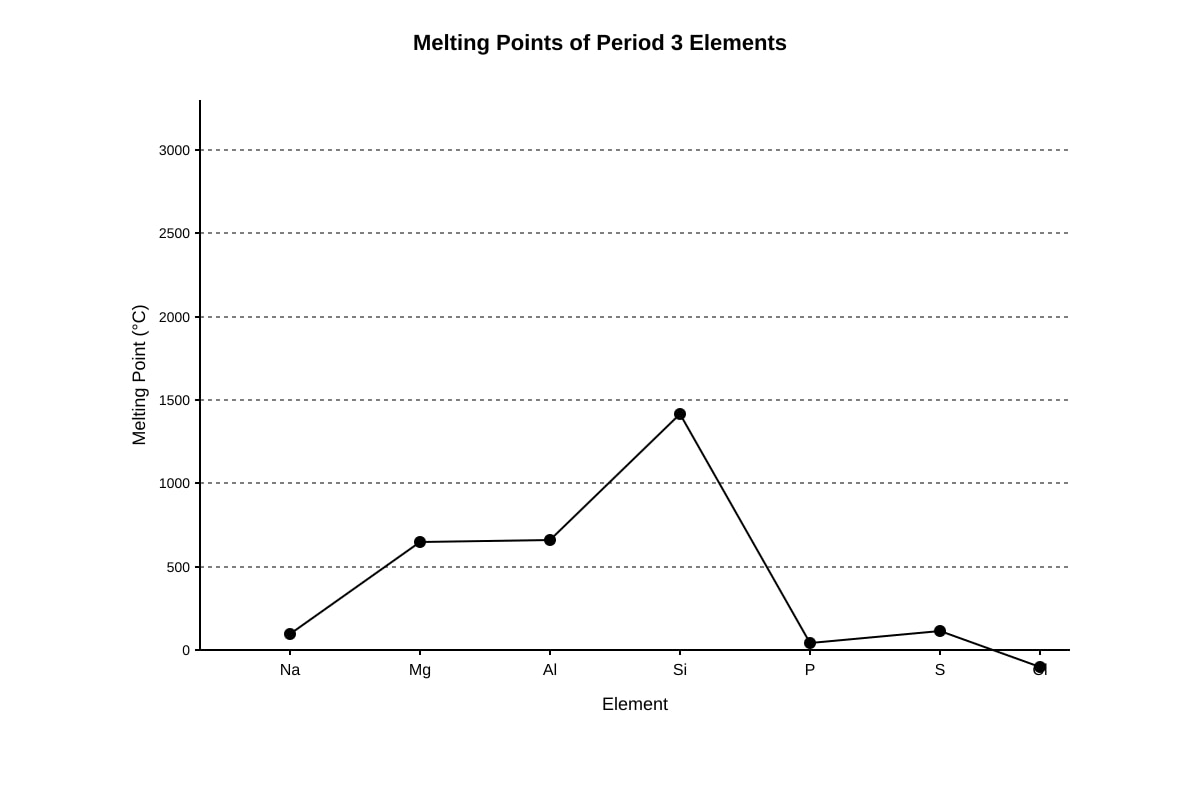
Generated graph for this question.
(a) Identify the element with the highest melting point in Period 3. [1]
- Answer: Silicon
- Marking note: Accept "Si" or "silicon."
(b) Explain why silicon has a very high melting point. [2]
- Answer: Silicon has a giant covalent / macromolecular structure. A large amount of energy is required to break the many strong covalent bonds between silicon atoms throughout the structure.
- Marking scheme: 1 mark for stating giant covalent/macromolecular structure; 1 mark for linking strong covalent bonds to high energy requirement.
- Marking note: Must mention "giant covalent" or "macromolecular" and "strong covalent bonds."
(c) Explain why argon has a very low melting point. [2]
- Answer: Argon exists as individual atoms (monatomic). The forces of attraction between argon atoms are weak intermolecular forces / van der Waals' forces. Very little energy is required to overcome these weak forces, resulting in a low melting point.
- Marking scheme: 1 mark for stating argon is monatomic with weak intermolecular forces; 1 mark for linking weak forces to low energy requirement.
- Marking note: Must mention "weak intermolecular forces" or "weak van der Waals' forces." Do not accept "weak bonds between atoms" (argon has no chemical bonds between atoms).
15. A student carried out an experiment to investigate the reactivity of three metals: copper, magnesium, and zinc. The student added each metal to a solution of dilute hydrochloric acid and recorded the observations.
(a) Arrange the three metals in order of increasing reactivity. [1]
- Answer: Copper, zinc, magnesium (or Cu < Zn < Mg)
- Marking note: Must be in correct order from least to most reactive.
(b) Write a balanced chemical equation, with state symbols, for the reaction between magnesium and dilute hydrochloric acid. [2]
- Answer: Mg(s) + 2HCl(aq) → MgCl₂(aq) + H₂(g)
- Marking scheme: 1 mark for correct formulae; 1 mark for correct state symbols and balancing.
- Marking note: Deduct 1 mark if equation is not balanced. Deduct 1 mark if state symbols are missing or incorrect.
(c) Explain why copper does not react with dilute hydrochloric acid. [1]
- Answer: Copper is less reactive than hydrogen / copper is below hydrogen in the reactivity series, so it cannot displace hydrogen from the acid.
- Marking note: Must reference the reactivity series or the inability to displace hydrogen.
(d) The student also tested the reaction of zinc with copper(II) sulfate solution. State the expected observation and write the ionic equation for the reaction. [2]
- Answer: Observation: The blue solution fades/becomes colourless and a reddish-brown/pink solid deposits on the zinc. (Accept any one clear observation.) Ionic equation: Zn(s) + Cu²⁺(aq) → Zn²⁺(aq) + Cu(s)
- Marking scheme: 1 mark for correct observation; 1 mark for correct ionic equation.
- Marking note: Accept "brown solid" or "pink solid" for copper. Ionic equation must be balanced and include charges.
Section D: Data-Based and Application Questions (8 marks)
16. The transition elements are a block of metals found in the middle of the Periodic Table.
(a) State one use of a transition element or its compound as a catalyst, naming the transition element involved. [1]
- Answer: Any one of: Iron in the Haber process (manufacture of ammonia); Vanadium(V) oxide in the Contact process (manufacture of sulfuric acid); Nickel in hydrogenation of alkenes; Manganese(IV) oxide in decomposition of hydrogen peroxide.
- Marking note: Must name both the transition element and its catalytic use. Accept any valid example.
(b) Explain why transition elements are able to form ions with different charges, using iron as an example. [1]
- Answer: Transition elements can lose different numbers of electrons from their d-subshell / can use electrons from both the 4s and 3d subshells. Iron can form Fe²⁺ by losing two 4s electrons, or Fe³⁺ by losing two 4s electrons and one 3d electron.
- Marking note: Accept explanation based on variable electron loss. Must mention iron forming Fe²⁺ and Fe³⁺.
17. Element Q has the electronic configuration 2.8.8.1.
(a) Identify the group and period of element Q in the Periodic Table. [2]
- Answer: Group: 1; Period: 4
- Marking scheme: 1 mark for correct group; 1 mark for correct period.
- Marking note: Element Q is potassium (K). Group 1 because it has 1 valence electron. Period 4 because it has 4 electron shells.
(b) Predict whether element Q would react more or less vigorously with water compared to sodium. Explain your answer. [2]
- Answer: Element Q (potassium) would react more vigorously with water than sodium. Potassium has more electron shells than sodium, so its atomic radius is larger. The valence electron is further from the nucleus and more shielded, so it is lost more easily, making potassium more reactive.
- Marking scheme: 1 mark for "more vigorously"; 1 mark for explanation in terms of atomic size/shielding and easier electron loss.
- Marking note: Must compare to sodium and explain using atomic structure.
18. The table below shows the atomic radii of some elements in Period 2.
(a) Describe the general trend in atomic radius across Period 2. [1]
- Answer: The atomic radius generally decreases across the period from lithium to fluorine. (Neon is an exception.)
- Marking note: Accept "decreases from left to right" or "decreases across the period."
(b) Explain why the atomic radius decreases across the period. [2]
- Answer: Across a period, the number of protons in the nucleus increases, so the nuclear charge increases. Electrons are added to the same outer shell, so the shielding effect remains approximately constant. The increased nuclear charge attracts the outer electrons more strongly, pulling them closer to the nucleus and decreasing the atomic radius.
- Marking scheme: 1 mark for increasing nuclear charge with constant shielding; 1 mark for stronger attraction pulling electrons closer.
- Marking note: Must mention increasing nuclear charge and constant/similar shielding.
(c) Suggest why neon has a larger atomic radius than fluorine, despite the general trend. [1]
- Answer: Neon has a full outer shell (octet). The atomic radius of neon is measured as the van der Waals' radius (distance between non-bonded atoms), which is larger than the covalent radius used for fluorine. / In neon, there is increased electron-electron repulsion in the completely filled outer shell.
- Marking note: Accept explanation based on van der Waals' radius vs covalent radius, or electron-electron repulsion.
19. Astatine (At) is a rare element found below iodine in Group 17 of the Periodic Table.
(a) Predict the physical state of astatine at room temperature and pressure. [1]
- Answer: Solid
- Marking note: Accept "solid." Down Group 17, state changes from gas (F₂, Cl₂) to liquid (Br₂) to solid (I₂, At₂).
(b) Predict whether astatine will be more or less reactive than iodine. Explain your answer in terms of atomic structure. [2]
- Answer: Astatine will be less reactive than iodine. As Group 17 is descended, the number of electron shells increases, so the atomic radius increases. The outer shell is further from the nucleus and more shielded, so the attraction for an incoming electron is weaker, making it less reactive.
- Marking scheme: 1 mark for "less reactive"; 1 mark for explanation in terms of increased atomic size/shielding and weaker attraction for electrons.
- Marking note: Must compare to iodine and explain using atomic structure.
(c) Write a balanced chemical equation for the reaction between sodium and astatine. [1]
- Answer: 2Na + At₂ → 2NaAt
- Marking note: Accept balanced equation with correct formula for sodium astatide (NaAt). State symbols not required but accept 2Na(s) + At₂(s) → 2NaAt(s).
20. A student is given an unknown element E that is a shiny solid at room temperature, conducts electricity, and reacts slowly with cold water to produce hydrogen gas and an alkaline solution. Element E is in Period 4.
(a) Identify the group of element E. [1]
- Answer: Group 2
- Marking note: Accept "Group 2" or "Group II." The description matches an alkaline earth metal (reacts with water to form alkaline solution and H₂, but slowly).
(b) Suggest the identity of element E. [1]
- Answer: Calcium
- Marking note: Accept "calcium" or "Ca." Period 4, Group 2 element is calcium.
(c) Write a balanced chemical equation, with state symbols, for the reaction of element E with water. [2]
- Answer: Ca(s) + 2H₂O(l) → Ca(OH)₂(aq) + H₂(g)
- Marking scheme: 1 mark for correct formulae; 1 mark for correct state symbols and balancing.
- Marking note: Accept Ca(OH)₂ as (aq) or (s). Deduct 1 mark if equation is not balanced. Deduct 1 mark if state symbols are missing or incorrect.
END OF ANSWER KEY