From Real Exams Quiz
Secondary 3 Chemistry Organic Chemistry Quiz
Free Sec 3 Chemistry Organic Chemistry quiz, Kimi2.6 Exam version, with questions, answers, and O Level-style practice for Singapore students.
These static practice materials are generated from the site's syllabus and paper-generation workflow, with source and model context shown so students and parents can evaluate the material before use.
Questions
Free quiz and exam paper access
Enter your details to view this paper
Your access is remembered on this device.
Answers
Secondary 3 Chemistry Quiz - Organic Chemistry: ANSWER KEY
Total Marks: 40
Section A: Multiple Choice and Short Response
1. CₙH₂ₙ₊₂ [2]
Teaching note: Alkanes are saturated hydrocarbons containing only single C–C bonds. The general formula shows that for every carbon atom, there are two hydrogen atoms plus two extra. Common error: confusing with alkene formula CₙH₂ₙ.
2.
Image pending generation: diagram for Q2.
Or in condensed structural form: CH₃CH₂CH₂CH₃ [2]
Teaching note: Butane has four carbon atoms in a continuous chain. Each carbon forms four bonds. The end carbons each bond to three hydrogens; the middle carbons each bond to two hydrogens.
3. Hydroxyl group (–OH) / alcohol functional group [2]
Teaching note: The –OH group is characteristic of alcohols. The compound CH₃CH₂OH is ethanol, a primary alcohol. Common error: confusing "hydroxyl" with "hydroxide" (which refers to the OH⁻ ion).
4. C₃H₆ + 4½ O₂ → 3 CO₂ + 3 H₂O
Or (doubled): 2C₃H₆ + 9O₂ → 6CO₂ + 6H₂O [2]
Teaching note: For complete combustion, balance C first (3 CO₂), then H (3 H₂O, giving 6 H atoms, matches C₃H₆). Then count O atoms on right: 6 + 3 = 9 oxygen atoms, needing 9/2 = 4½ O₂ molecules. Multiply through by 2 to avoid fractions.
Marking: 1 mark for correct coefficients (accept 4½ or equivalent whole number equation); 1 mark for all products correct.
5. Alkenes contain a carbon–carbon double bond (C=C) [1], which is a region of high electron density that can react with electrophiles/undergo addition reactions [1]. Alkanes contain only strong, non-polar C–C and C–H single bonds that are difficult to break. [2]
Teaching note: The π bond in C=C is weaker than σ bonds and exposed above and below the molecular plane, making it susceptible to attack. This explains why alkenes undergo addition reactions readily while alkanes require harsh conditions for substitution.
6. Orange/brown to colourless (decolourised) [2]
Teaching note: Bromine water (orange-brown) adds across the C=C double bond in ethene to form colourless 1,2-dibromoethane. This is the standard test for unsaturation. Common error: saying "clear" instead of "colourless"—water itself is clear, so this is ambiguous.
7. Ethene (C₂H₄) / an alkene [2]
Teaching note: This is dehydration of ethanol. Concentrated H₂SO₄ acts as a dehydrating agent at 170°C, removing H₂O from ethanol to form ethene. At 140°C, the product would be diethyl ether (CH₃CH₂OCH₂CH₃)—temperature is crucial.
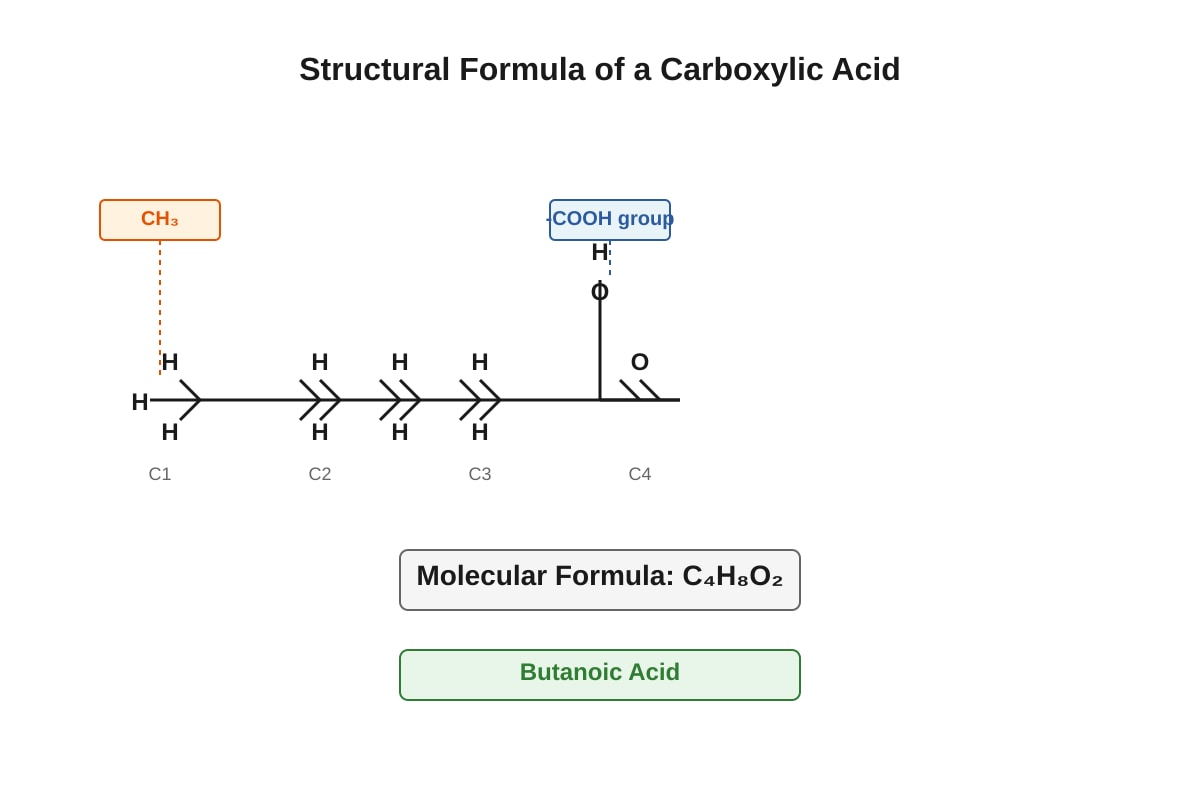
8. (a) Butanoic acid [1]
(b) Neutralisation / acid–base reaction [1]
Teaching note: The structure shows four carbons with a terminal –COOH group: CH₃CH₂CH₂COOH. Carboxylic acids react with carbonates to produce CO₂ gas, salt, and water—this is a neutralisation reaction. Common error: naming as "butyric acid" (historical but not IUPAC).
9. (a)
Image pending generation: diagram for Q9.
Or: −CH₂−CH₂− with brackets and n subscript [1]
(b) All carbon–carbon bonds in poly(ethene) are single bonds (it is saturated) [1]; no C=C double bonds remain after polymerisation.
Teaching note: During addition polymerisation, the π bond of ethene breaks to form two new σ bonds with neighboring units, leaving only saturated C–C single bonds throughout the polymer chain.
10. Add bromine water to each compound separately [1]. Hexene (alkene) will decolorise the orange bromine water rapidly at room temperature [0.5]; hexane (alkane) will not decolorise bromine water (or only slowly in presence of UV light) [0.5]. [2]
Teaching note: Alternative tests: add acidified KMnO₄ (purple to colourless/brown with alkenes); or burn sample—alkenes produce more sooty flame due to higher carbon:hydrogen ratio.
Section B: Structured Response
11. (a) Q / C₂H₄ / ethene [1]
(b) R and S / ethanol and ethanoic acid / C₂H₅OH and CH₃COOH [1]
(c) C₂H₅OH + CH₃COOH ⇌ CH₃COOC₂H₅ + H₂O [1]
Teaching note: (c) Esterification is reversible. Concentrated sulfuric acid is catalyst and dehydrating agent. The ester formed is ethyl ethanoate, which has a fruity smell. Equilibrium arrow (⇌) is essential for full credit.
12. (a) Different boiling points (or different volatilities / different sizes of molecules) [1]
(b) Diesel / fuel for heavy vehicles / heating oil [1]
(c) Smaller molecules have weaker intermolecular forces (or London dispersion forces) [0.5], so they boil at lower temperatures [0.5] and can travel further up the column before condensing [0.5—tie to collection point]. [1]
Teaching note: Fractional distillation separates by boiling point. Heavier hydrocarbons (longer chains) condense at higher temperatures (lower in column); lighter ones remain gaseous longer and condense higher up.
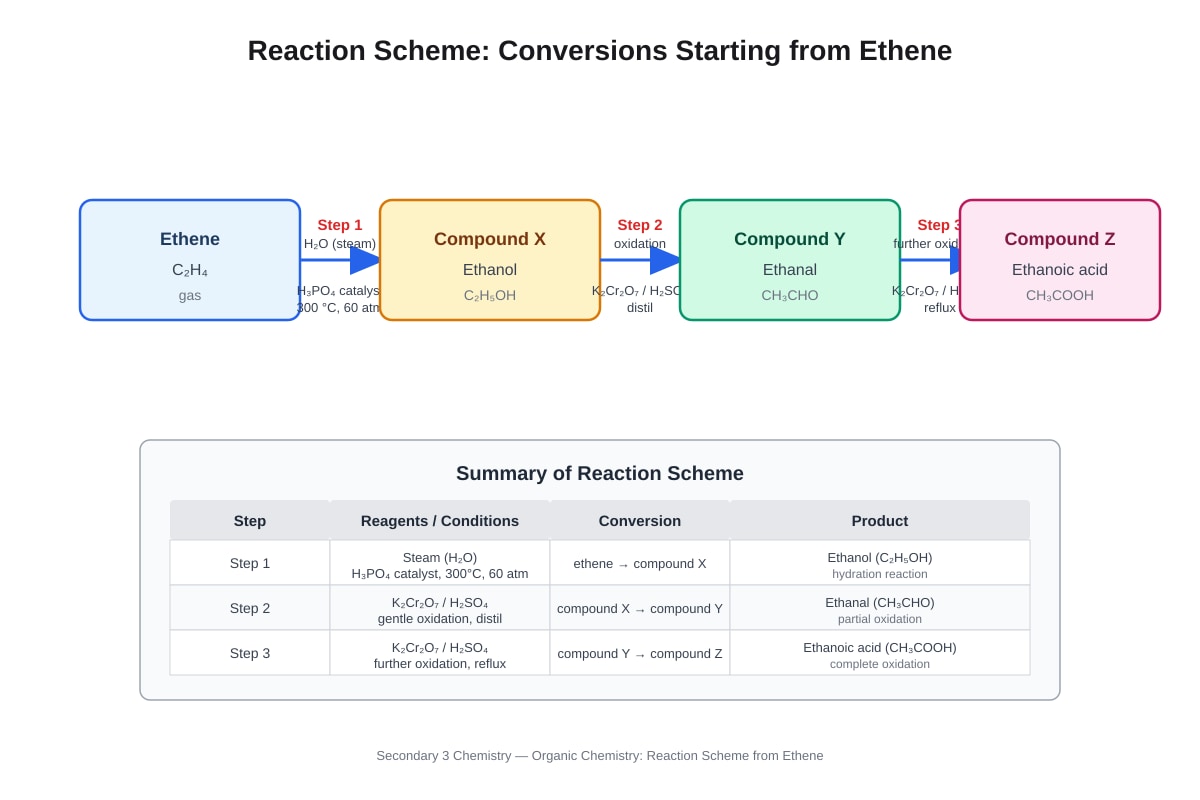
13. (a) Compound X: Ethanol [1]
Reagents and conditions: Steam (H₂O) and phosphoric acid catalyst (or H₃PO₄) at 300°C and 60–70 atm [1]
(b) Compound Y: Ethanal [1]
Teaching note: Step 1 is hydration of ethene—industrial method for ethanol production. Step 2 is partial oxidation of ethanol (with potassium dichromate(VI) in dilute sulfuric acid, distilled immediately). Step 3 further oxidises ethanal to ethanoic acid. Common error: naming Y as "ethanol" or confusing aldehyde with ketone.
14. (a) Any two from:
- Carbon monoxide (CO) poisoning—toxic, odorless, binds to hemoglobin [1]
- Soot (carbon particles) causing respiratory problems / smog / global dimming [1]
- Unburnt hydrocarbons contributing to photochemical smog [1]
(b) Catalytic converters contain platinum/palladium/rhodium [0.5] which catalyse the oxidation of CO to CO₂ and reduction of NOₓ to N₂ [0.5]. [1]
Teaching note: 2CO + 2NO → 2CO₂ + N₂ is the key reaction. Catalytic converters require high temperatures to function (hence placement close to engine) and are poisoned by lead compounds.
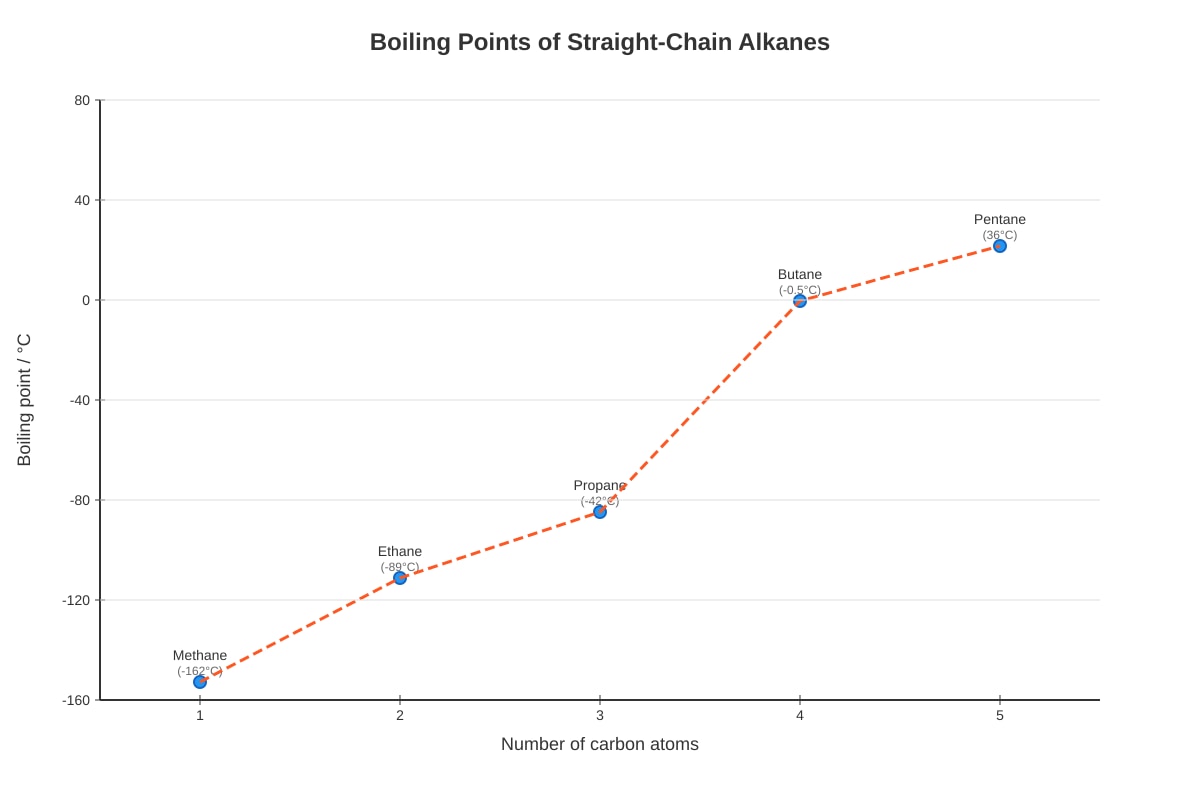
15. (a) Boiling point increases as the number of carbon atoms increases (positive correlation / upward trend) [1]
(b) As number of carbon atoms increases:
- Molecular size / electron cloud / surface area increases [0.5]
- London dispersion forces / van der Waals forces between molecules become stronger [1]
- More energy is required to overcome these stronger intermolecular forces [0.5] [2]
Teaching note: Alkanes are non-polar; only London dispersion forces operate. These scale with surface area and number of electrons. Covalent bonds within molecules are NOT broken during boiling—this is a common misconception.
16. (a) Any one from: renewable resource / biodegradable / lower carbon footprint / sustainable / reduces dependence on fossil fuels [1]
(b) Hydrolysis [1] using sodium hydroxide (NaOH) or potassium hydroxide (KOH) [0.5] and heat [0.5]. [2]
Teaching note: This produces glycerol and fatty acid salts (soap) with NaOH, or glycerol and methyl esters (biodiesel) with methanol and acid/base catalyst. The question specifies biodiesel, so methanol with acid/base catalyst is also acceptable for full marks.
Section C: Extended Response
17.
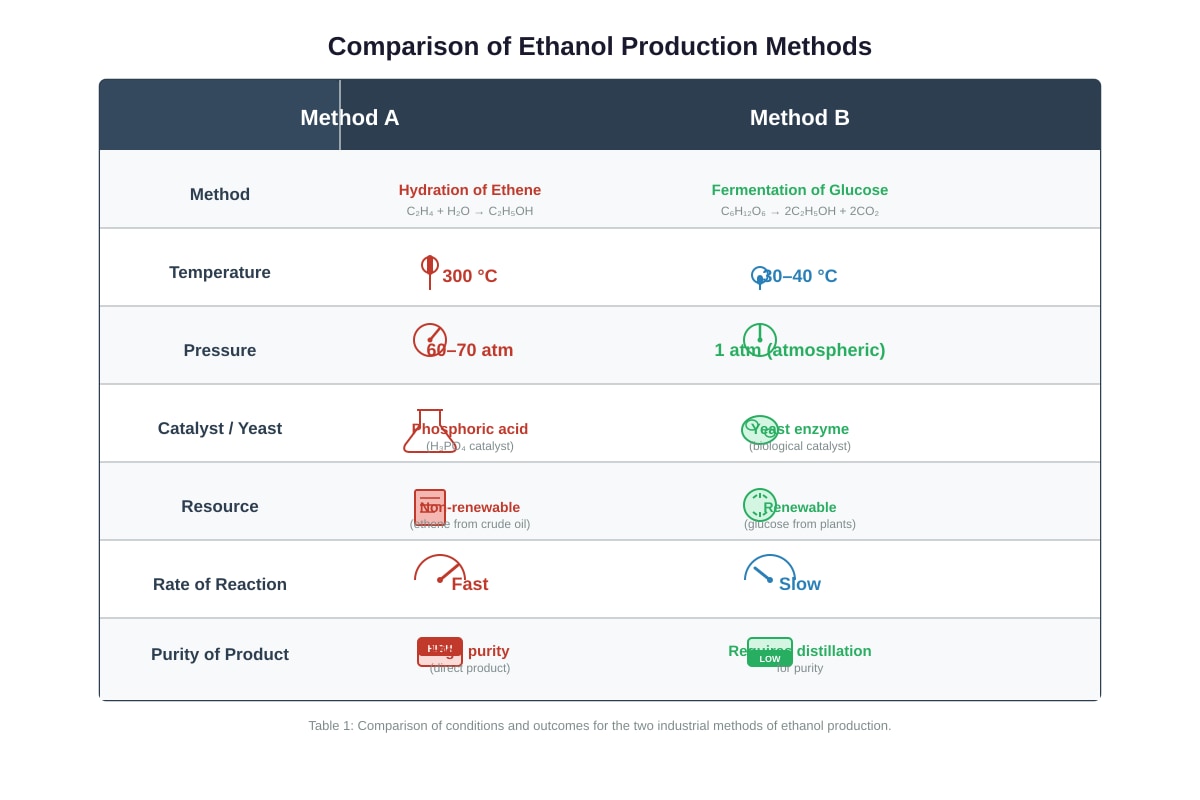
| Aspect | Method A (Hydration) | Method B (Fermentation) | Marks |
|---|---|---|---|
| Temperature | High temperature (~300°C) required | Low temperature (~30–40°C) sufficient | 1 |
| Pressure | High pressure (60–70 atm) needed | Atmospheric pressure only | 1 |
| Catalyst | Phosphoric acid catalyst | Yeast (enzyme/biological catalyst) | — |
| Renewable resource | Ethene from crude oil—non-renewable | Glucose from plants—renewable | 1 |
| Rate of reaction | Fast / continuous production | Slow / requires several days | 1 |
| Purity | High purity ethanol obtained directly | Mixture with water; requires distillation to concentrate | 1 |
Maximum 4 marks—award best four points from:
- Method A needs high temperature and high pressure; Method B uses moderate temperature and atmospheric pressure ✓
- Method A uses non-renewable crude oil resource; Method B uses renewable plant material ✓
- Method A is faster / gives rapid production; Method B is slower / takes days ✓
- Method A gives higher purity product directly; Method B gives dilute aqueous ethanol requiring further purification ✓
Teaching note: Industrial preference varies: Method A suits large-scale continuous production with petroleum feedstock; Method B suits countries with agricultural surplus seeking sustainability. Neither method is "better" absolutely—context matters.
18. (a) Isomers are compounds with the same molecular formula [1] but different structural formulae / different arrangements of atoms [1]. [2]
(b)
Image pending generation: diagram for Q18.
Or: CH₂=CHCH₂CH₂CH₃ [2]
Teaching note: "Pent-1-ene" specifies the double bond starts at carbon 1. The "1" is essential in IUPAC naming to distinguish from pent-2-ene. In displayed formula, all bonds must be shown. Common error: drawing C₅H₁₂ instead of C₅H₁₀, or placing double bond in wrong position.
19. (a) Esterification (or condensation) [1]
(b) Concentrated sulfuric acid [1] as catalyst; heat under reflux (or warm gently) [1]. [2]
(c) To prevent loss of volatile reactants/products [0.5] and allow gentle heating for extended time to reach equilibrium position [0.5]. Simple distillation would remove the volatile ethanol and ester before reaction completes. [1]
Teaching note: Reflux condenses vapours back into the reaction flask. The esterification equilibrium is slow and never completes; industrially, distillation removes ester to shift equilibrium right (Le Chatelier), but in school preparation, reflux ensures maximum yield from limited reagents.
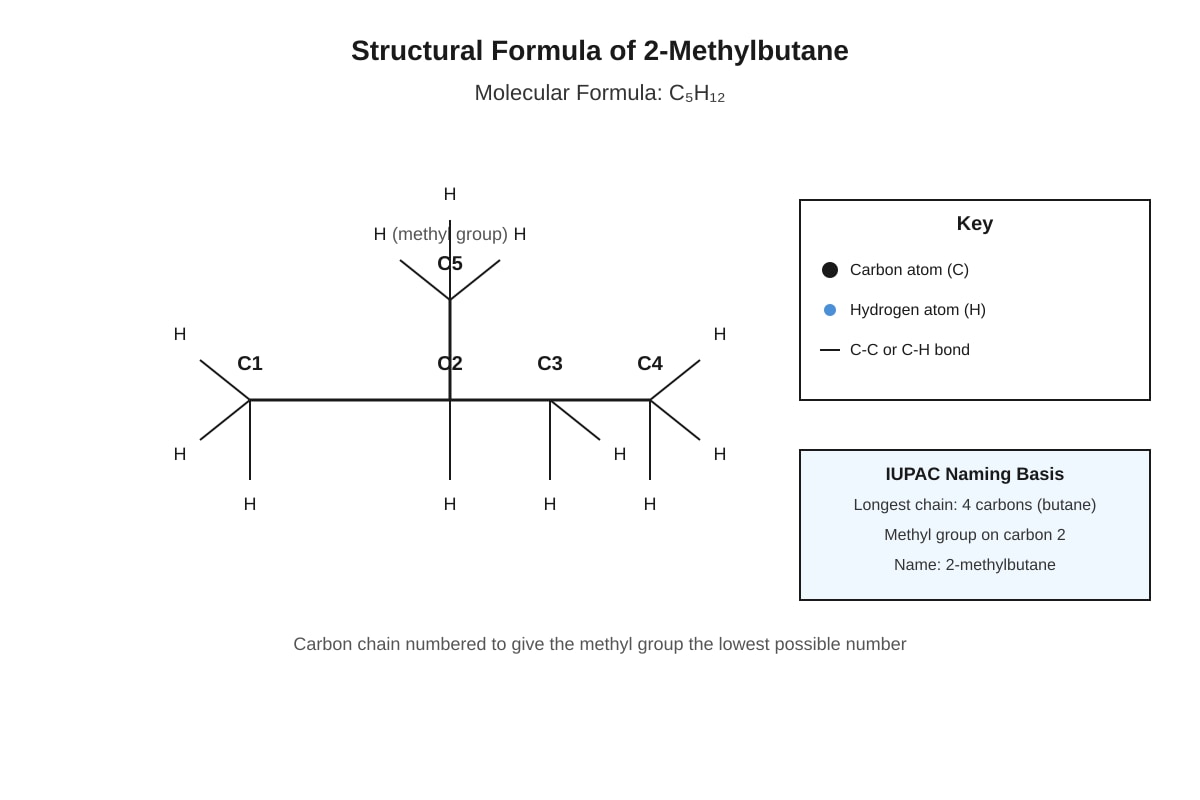
20. (a) 2-methylbutane [2]
Breakdown: Longest chain = butane (4 carbons) [1]; methyl substituent on carbon-2 [1]. Common error: "3-methylbutane" (wrong numbering—must give lowest locant to substituent) or "isopentane" (non-systematic).
(b) C₅H₁₂ + 8O₂ → 5CO₂ + 6H₂O [2]
Teaching note: Method: C₅H₁₂ has 5 C → 5CO₂; 12 H → 6H₂O. O atoms on right: 10 + 6 = 16, so need 8O₂. Check: 8 × 2 = 16 O atoms ✓.
Marking: 1 mark for correct formulas of reactants and products; 1 mark for correctly balanced equation.
END OF ANSWER KEY