From Real Exams Quiz
Secondary 3 Chemistry Atomic Structure Bonding Quiz
Free Sec 3 Chemistry Atomic Structure Bonding quiz, Nemo3 Exam version, with questions, answers, and O Level-style practice for Singapore students.
These static practice materials are generated from the site's syllabus and paper-generation workflow, with source and model context shown so students and parents can evaluate the material before use.
Questions
Free quiz and exam paper access
Enter your details to view this paper
Your access is remembered on this device.
Answers
Secondary 3 Chemistry Quiz - Atomic Structure Bonding (Answer Key)
Total Marks: 40
Section A: Multiple Choice Questions (10 marks)
1. D — F⁻ has 9 protons and 10 electrons (2.8), same as Ne (2.8). Na⁺ and Mg²⁺ also have 10 electrons, but F⁻ is the only anion listed. All three are isoelectronic with Ne. [1]
2. A — Electronic configuration 2.8.5 means 3 electron shells (Period 3) and 5 valence electrons (Group V). [1]
3. B — Mg atom: 2.8.2. Mg²⁺ loses 2 electrons from outer shell → 2.8. [1]
4. B — Y has 7 valence electrons (Group VII), forms Y⁻. Ca (Group II) forms Ca²⁺. Formula: CaY₂. [1]
5. C — NH₄Cl: NH₄⁺ has covalent bonds (N-H, one dative) and ionic bond between NH₄⁺ and Cl⁻. [1]
6. C — Substance R (3550 °C) matches diamond (giant covalent). P and S are low (simple molecular). Q (801 °C) is ionic (NaCl). [1]
7. B — Isotopes: same protons, different neutrons. Same electronic configuration → similar chemical properties. [1]
8. A — 12 protons = Mg. 10 electrons = 2+ charge. Mg²⁺. [1]
9. C — O (Group VI) and S (Group VI) both have 6 valence electrons. [1]
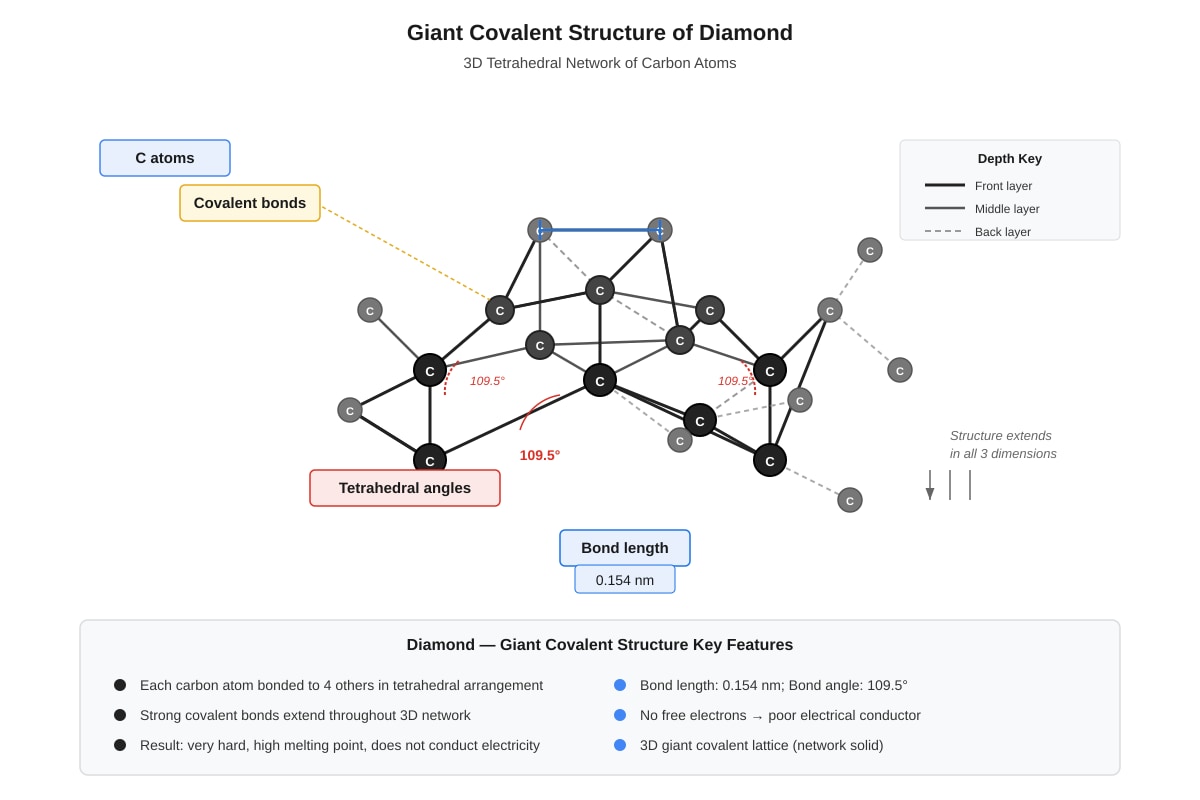
10. C — Diamond: giant covalent, each C bonded to 4 others tetrahedrally → very hard, very high melting point. [1]
Section B: Short Answer Questions (15 marks)
11. [3 marks — 1 mark per fully correct row]
| Particle | Proton Number | Nucleon Number | Number of Protons | Number of Neutrons | Number of Electrons | Electronic Configuration |
|---|---|---|---|---|---|---|
| ²³Na | 11 | 23 | 11 | 12 | 11 | 2.8.1 |
| ²⁴Mg²⁺ | 12 | 24 | 12 | 12 | 10 | 2.8 |
| ¹⁶O²⁻ | 8 | 16 | 8 | 8 | 10 | 2.8 |
Marking notes:
- ²³Na: protons = 11, neutrons = 23-11 = 12, electrons = 11 (neutral), config = 2.8.1
- ²⁴Mg²⁺: protons = 12, neutrons = 24-12 = 12, electrons = 12-2 = 10, config = 2.8
- ¹⁶O²⁻: protons = 8, neutrons = 16-8 = 8, electrons = 8+2 = 10, config = 2.8
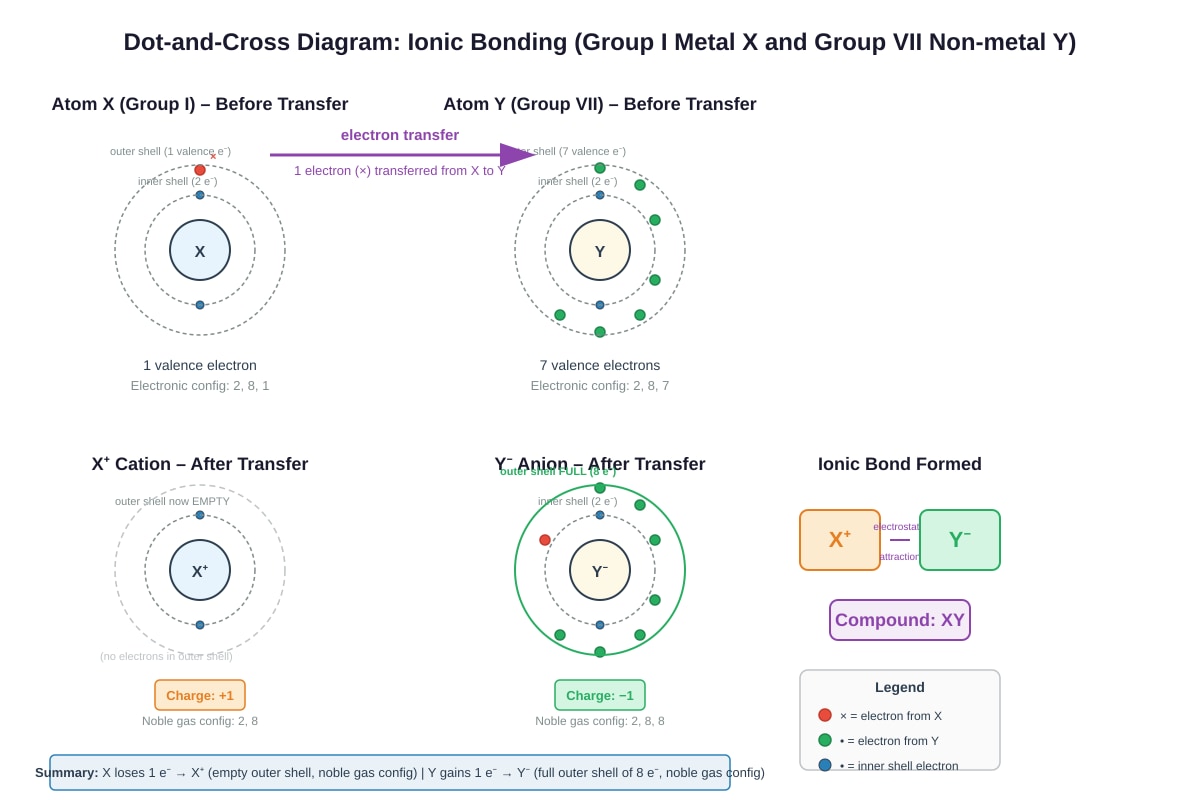
12. (a) Ionic bonding / Electrovalent bonding [1]
(b) X (Group I) loses 1 valence electron to form X⁺ with stable noble gas configuration. Y (Group VII) gains 1 electron to form Y⁻ with stable noble gas configuration. The electrostatic attraction between oppositely charged ions forms the ionic bond. [2]
- 1 mark: X loses electron, Y gains electron
- 1 mark: Both achieve noble gas configuration / electrostatic attraction
(c) Solid state: Does not conduct electricity (ions fixed in lattice). Aqueous solution: Conducts electricity (ions mobile and free to move). [2]
- 1 mark: Correct conductivity for both states
- 1 mark: Correct explanation (mobile ions in solution, fixed in solid)
13. [2 marks]
   O = C = O
  (4)   (4)  (4)
Dot-and-cross diagram showing:
- Carbon: 4 valence electrons (●)
- Each oxygen: 6 valence electrons (×)
- Two double bonds (C=O), each with 2 shared pairs
- Each atom achieves octet (8 electrons in outer shell)
Marking:
- 1 mark: Correct sharing (two double bonds, 4 shared pairs total)
- 1 mark: Correct outer shell electrons (C: 8, each O: 8)
14. (a) Silicon dioxide has a giant covalent structure. Each silicon atom is covalently bonded to four oxygen atoms in a tetrahedral arrangement. Each oxygen atom is bonded to two silicon atoms. The network extends in three dimensions with strong Si-O covalent bonds throughout. [2]
- 1 mark: Giant covalent / tetrahedral / each Si bonded to 4 O
- 1 mark: 3D network / strong covalent bonds throughout
(b) Very high melting point because all atoms are held by strong covalent bonds in a giant 3D network. A large amount of energy is energy is needed to overcome these strong covalent bonds throughout the structure. [2]
- 1 mark: Strong covalent bonds / giant structure
- 1 mark: Large energy needed to break bonds
15. [4 marks — 1 mark each]
- Substance A: Giant ionic structure (high MP, conducts when molten/aq, soluble) — e.g., NaCl
- Substance B: Simple molecular structure (low MP, no conductivity, molecular) — e.g., ethanol
- Substance C: Giant covalent structure (very high MP, no conductivity, insoluble) — e.g., SiO₂/diamond
- Substance D: Giant metallic structure (high MP, conducts in solid and molten, insoluble) — e.g., Fe, Cu
Marking notes: Accept "ionic lattice", "molecular covalent", "macromolecular", "metallic lattice" etc.
Section C: Structured Questions (15 marks)
16. (a) Isotopes are atoms of the same element with the same number of protons but different numbers of neutrons (different nucleon numbers). [1]
(b) Relative atomic mass = (35 × 75 + 37 × 25) / 100 = (2625 + 925) / 100 = 3550 / 100 = 35.5 [2]
- 1 mark: Correct formula/working
- 1 mark: Correct answer (35.5) to 1 d.p.
(c) Chemical properties depend on electronic configuration. Isotopes have the same number of protons and electrons, hence same electronic configuration. [1]
17. (a) 2Mg(s) + O₂(g) → 2MgO(s) [1]
- 1 mark: Correct formulae, balancing, and state symbols
(b) [3 marks]
Mg: 2.8.2        O: 2.6
Mg loses 2e⁻ → Mg²⁺ (2.8)
O gains 2e⁻ → O²⁻ (2.8)

Dot-and-cross:
  ××     ●●
×  Mg  ×  →  [Mg]²⁺  [O]²⁻
  ××     ●●
Description: Mg (●) transfers 2 electrons to O (×). Mg²⁺ has 2.8 config, O²⁻ has 2.8 config. Ionic lattice forms.
Marking:
- 1 mark: Correct electron transfer (Mg loses 2, O gains 2)
- 1 mark: Correct resulting ions with noble gas configurations
- 1 mark: Charges shown correctly (Mg²⁺, O²⁻)
(c) MgO has a giant ionic lattice structure with strong electrostatic forces of attraction between Mg²⁺ and O²⁻ ions. High charge density (2+ and 2-) leads to very strong ionic bonds. Large amount of energy needed to overcome these forces. [2]
- 1 mark: Giant ionic lattice / strong electrostatic forces
- 1 mark: High charge (2+/2-) → strong attraction / high energy needed
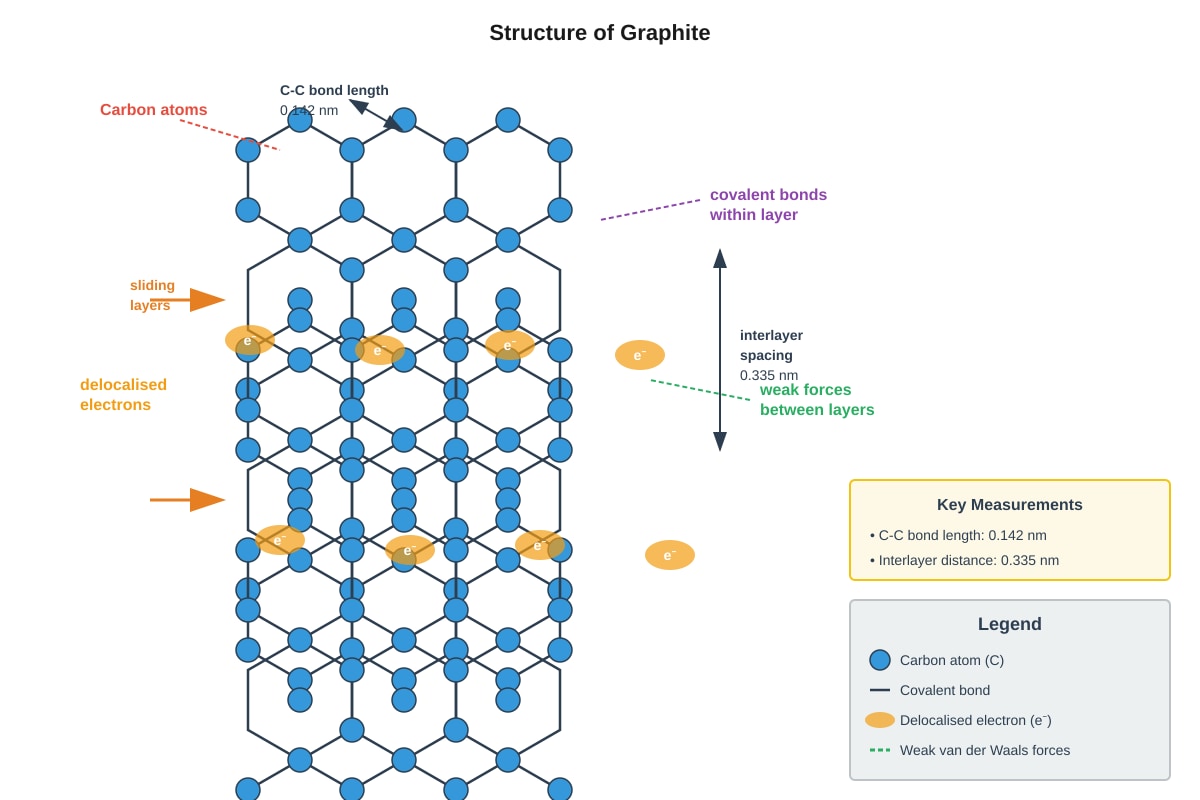
18. (a) Similarity: Both have covalent bonds between carbon atoms. Difference: Diamond has 3D tetrahedral network (each C bonded to 4 others); graphite has layered structure (each C bonded to 3 others in hexagonal layers with delocalised electrons). [2]
- 1 mark: Valid similarity (covalent C-C bonds)
- 1 mark: Valid difference (3D vs layered, 4 vs 3 bonds, delocalised electrons)
(b) Graphite: Each carbon bonded to 3 others, leaving 1 delocalised electron per carbon. These delocalised electrons are mobile between layers and can carry charge. Diamond: Each carbon bonded to 4 others, all 4 electrons used in covalent bonds, no free electrons/mobile charge carriers. [2]
- 1 mark: Graphite has delocalised/mobile electrons
- 1 mark: Diamond has no free electrons / all electrons in bonds
(c) Weak van der Waals forces between layers allow layers to slide over each other easily. [1]
19. (a) [3 marks]
    H
    |
H → N → H
    |
    H
Ammonium ion NH₄⁺:
- N (5 valence electrons) shares 3 electrons with 3 H atoms (3 normal covalent bonds)
- 4th H⁺ (no electrons) accepts a lone pair from N → dative covalent bond (arrow from N to H)
- N has formal charge +1, overall ion charge +1
- All 4 N-H bonds equivalent
Marking:
- 1 mark: 3 normal covalent bonds + 1 dative bond shown with arrow
- 1 mark: Correct electron distribution (N: 8 electrons, each H: 2 electrons)
- 1 mark: Correct charge (+1 on ion)
(b) Solid state: Ions (NH₄⁺ and Cl⁻) fixed in lattice, cannot move. Aqueous: Ions dissociate and are mobile, free to move and carry charge. [2]
- 1 mark: Solid — ions fixed
- 1 mark: Aqueous — ions mobile/dissociated
20. (a) [3 marks — 1 each]
- X: Giant metallic structure (shiny, high MP, conducts solid/molten, insoluble)
- Y: Giant ionic structure (crystalline, high MP, conducts molten/aq only, soluble)
- Z: Simple molecular structure (gas at room temp, very low MP, no conductivity, slightly soluble)
(b) Mobile ions (NH₄⁺ and Cl⁻ / cations and anions) [1]
(c) In metals, atoms are arranged in layers of positive ions in a sea of delocalised electrons. When force is applied, layers of ions can slide over each other without breaking the metallic bonds because the delocalised electrons hold the structure together non-directionally. [2]
- 1 mark: Layers of cations / sea of delocalised electrons
- 1 mark: Layers slide / non-directional bonding / bonds not broken
End of Answer Key