From Real Exams Quiz
Secondary 3 Chemistry Atomic Structure Bonding Quiz
Free Sec 3 Chemistry Atomic Structure Bonding quiz, Kimi2.6 Exam version, with questions, answers, and O Level-style practice for Singapore students.
These static practice materials are generated from the site's syllabus and paper-generation workflow, with source and model context shown so students and parents can evaluate the material before use.
Questions
Free quiz and exam paper access
Enter your details to view this paper
Your access is remembered on this device.
Answers
Secondary 3 Chemistry Quiz - Atomic Structure Bonding: Answer Key
Total Marks: 40
Section A: Multiple Choice
1. B — neutron [1]
Teaching note: Protons have a relative mass of 1 and charge +1. Neutrons have a relative mass of approximately 1 and charge 0. Electrons have negligible mass (~1/1840) and charge –1. Ions are charged atoms/species, not subatomic particles.
Common mistake: Confusing neutron with proton — remember "neutron = neutral" (no charge).
2. B — 16 [1]
Working: Number of neutrons = mass number – atomic number = 31 – 15 = 16.
Teaching note: The atomic number (proton number) determines the element's identity. The mass number is the total of protons + neutrons. Electrons are not included in mass number as their mass is negligible.
3. C — oxygen [1]
Teaching note: Oxygen is in Group VI and has 6 outer electrons. It gains 2 electrons to achieve a stable octet (noble gas configuration), forming O²⁻. Sodium (Group I) forms Na⁺; magnesium (Group II) forms Mg²⁺; aluminium (Group III) forms Al³⁺.
4. C — the formation of oppositely charged ions [1]
Teaching note: Ionic bonding involves complete transfer of electrons from metal to non-metal. The metal becomes a positive ion (cation) and the non-metal becomes a negative ion (anion). Electrostatic attraction between these oppositely charges ions holds the giant ionic lattice together. Option A and B describe covalent bonding; D describes metallic bonding.
5. C — diamond, C [1]
Teaching note: Diamond consists of carbon atoms joined by strong covalent bonds in a tetrahedral arrangement extending in three dimensions — a giant covalent/macromolecular structure. Chlorine (A) is simple molecular; sodium chloride (B) is giant ionic; copper (D) is metallic.
Section B: Short Answer
6. Isotopes are atoms of the same element / same proton number / same atomic number [1] that have different numbers of neutrons / different mass number / different nucleon number [1].
Teaching note: Isotopes have the same chemical properties (same electron configuration) but different physical properties (different mass). Examples include carbon-12 and carbon-14, or chlorine-35 and chlorine-37.
Common mistake: Saying "different number of protons" — this would be a different element entirely.
7. Relative atomic mass = (75 × 35 + 25 × 37) / 100 [1] = (2625 + 925) / 100 = 3550 / 100 = 35.5 [1]
Working shown:
- Contribution from Cl-35: 0.75 × 35 = 26.25
- Contribution from Cl-37: 0.25 × 37 = 9.25
- Total: 26.25 + 9.25 = 35.5
Teaching note: The relative atomic mass is a weighted average. It is always closer to the more abundant isotope. Chlorine's RAM of 35.5 explains why it doesn't appear to be a whole number — it's not that individual atoms have half-neutrons, but the average of mixed isotopes.
Common mistake: Forgetting to divide by 100, or simply averaging 35 and 37 to get 36 without weighting.
8.
| Particle | Relative charge | Relative mass | Location in atom |
|---|---|---|---|
| proton | +1 | 1 | nucleus |
| neutron | 0 | 1 | nucleus |
| electron | –1 | negligible / ~1/1840 | orbiting nucleus / shells / energy levels |
[1 mark per correct row, maximum 3]
Teaching note: Protons and neutrons are found in the nucleus and make up nearly all the atom's mass. Electrons occupy energy levels/shells around the nucleus. The nuclear model (Rutherford-Bohr) replaced the "plum pudding" model when scattering experiments showed atoms have a small, dense, positive center.
9. Sodium has electronic configuration 2.8.1 [1]. It readily loses its single outer electron to achieve a stable octet (noble gas configuration, same as neon) [1]. Removing a second electron would require removing an electron from a stable, inner, filled shell (2.8), which requires much more energy / is energetically unfavorable [1].
Teaching note: Ionisation energy increases dramatically for removing an electron from an inner shell. Group I metals form 1+ ions, Group II form 2+, Group III form 3+. The energy cost of removing core electrons far exceeds any energetic benefit from achieving a "higher" noble gas configuration.
Common mistake: Thinking Na²⁺ is more stable because it has 10 electrons like neon — but the remaining 10 electrons in a sodium atom are arranged 2.8, and the 8 are in a lower energy level that is much harder to disrupt.
10. Property: high melting point / high boiling point / solid at room temperature / brittle / conduct electricity when molten or in aqueous solution / do not conduct when solid (any one) [1]
Explanation: Ionic compounds consist of a giant lattice of oppositely charged ions [1] held together by strong electrostatic forces of attraction between positive and negative ions [1]. These strong forces require much energy to overcome, giving high melting points. Ions are fixed in position in the solid, so cannot move and conduct electricity; when molten or dissolved, ions are free to move and carry charge.
Teaching note: The electrostatic force strength depends on ion charge and ionic radius (Coulomb's law in simplified form). Higher charges and smaller radii give stronger forces and higher melting points — compare NaCl (801°C) with MgO (2852°C).
Common mistake: Saying "ions are delocalized" — this describes metallic bonding, not ionic bonding. In ionic compounds, ions are fixed in position in the lattice.
Section C: Structured Response
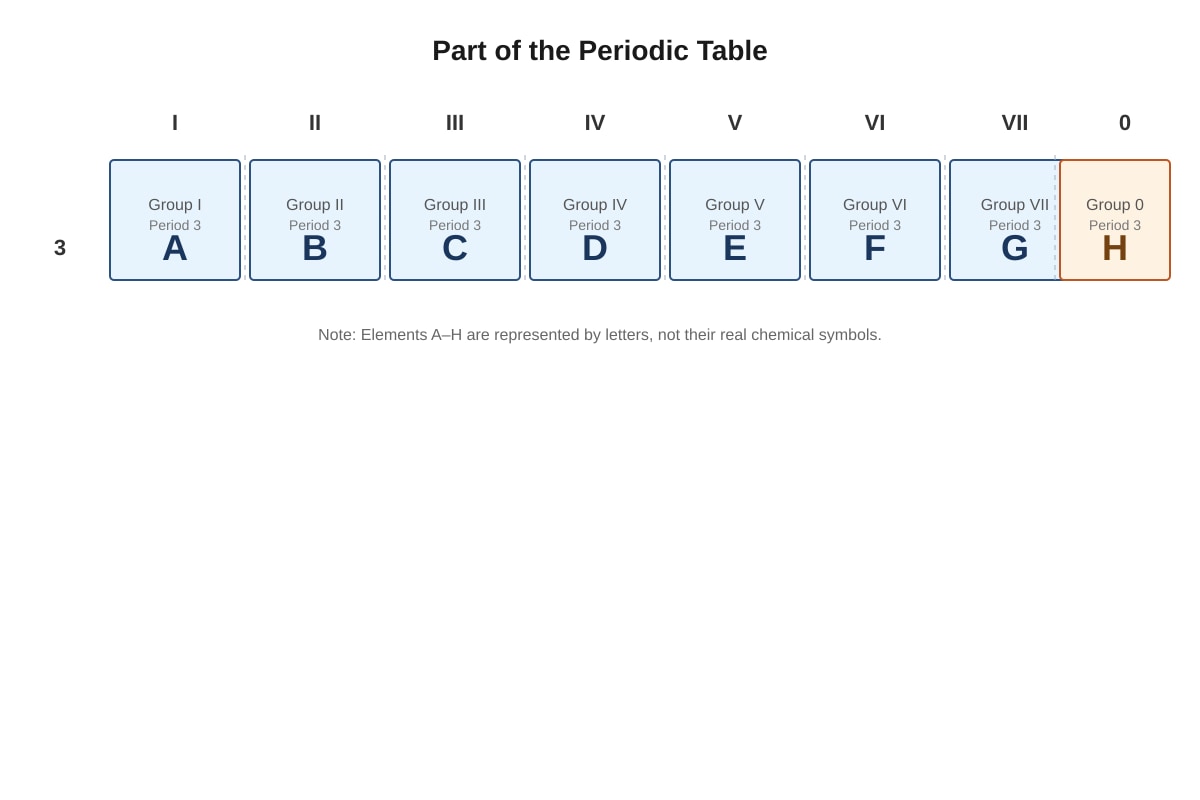
11. (a) G [1] — Group VII element (halogen) gains one electron to form 1– ion.
(b) 2.8.2 [1] — Group II, Period 3: 2 electrons in first shell, 8 in second, 2 in third.
(c) Atomic radius of A is larger than G [1]. Going across a period from left to right, the nuclear charge / number of protons increases [1], while the number of occupied electron shells remains the same [1]. The increased nuclear charge pulls the electron shells closer to the nucleus, decreasing atomic radius [1]. [3]
Teaching note: This is a key periodic trend. Across Period 3: Na (186 pm) → Cl (99 pm). The increased proton count strengthens the effective nuclear charge experienced by the valence electrons, contracting the electron cloud. Shielding from inner electrons remains roughly constant across a period.
12. (a) 2Mg(s) + O₂(g) → 2MgO(s) [1 for correct formulae, 1 for balancing and state symbols]
(b)
- Magnesium atom: should show 2 outer electrons (crosses) [1]
- Oxygen atom: should show 6 outer electrons (dots) [1]
- Transfer shown: 2 crosses move from Mg to O, resulting in Mg²⁺ (no outer electrons) and O²⁻ (full octet, 8 electrons including 2 crosses) [1]
Teaching note: For ionic compounds, always show the electron transfer — arrows can help but aren't essential. The final ions must have full outer shells. Mg²⁺ should have empty outer shell (2.8); O²⁻ should have full shell (2.8).
(c) Magnesium oxide has a giant ionic structure / lattice of Mg²⁺ and O²⁻ ions [1] held together by strong electrostatic forces between oppositely charged ions [1]. A large amount of energy is needed to overcome these strong forces, giving a high melting point [1].
Marking note: Must mention "ionic lattice/structure" and "strong electrostatic forces" or "strong ionic bonds" for full marks. Simply saying "strong bonds" is insufficient — specify the type.
13. (a) Q [1]. High melting point and does not conduct when solid but conducts when molten/aqueous are characteristic properties of ionic compounds [1].
(b) R has a giant covalent / macromolecular structure [1] with many strong covalent bonds between atoms [1]. These strong bonds require a lot of energy to break, making R very hard / able to withstand mechanical stress in cutting applications [1].
Teaching note: R is likely diamond (or silica, SiO₂). The tetrahedral network of strong C–C covalent bonds makes diamond the hardest natural substance. Each carbon is bonded to four others in a rigid 3D structure.
(c) S has metallic bonding / giant metallic structure [1] with positive ions/cations in a "sea" of delocalized electrons [1]. The delocalized electrons can move freely, enabling electrical conductivity in all states.
Teaching note: S is copper (or any metal). The metallic bond strength increases with more delocalized electrons and smaller ionic radius, explaining why transition metals like copper have high melting points and good conductivity.
14. (a) Nitrogen should show 5 outer electrons (dots), each hydrogen 1 electron (crosses) [1]. Three pairs of electrons are shared between N and each H, with one lone pair remaining on nitrogen [1].
(b) Bond angle is approximately 107° [1]. Ammonia has 4 regions of electron density around nitrogen (3 bonding pairs, 1 lone pair) [1]. According to electron pair repulsion theory, electron pairs repel to positions of minimum repulsion; a tetrahedral arrangement is adopted [1]. The lone pair repels more strongly than bonding pairs, compressing the angle slightly from the ideal tetrahedral 109.5° to ~107° [1].
Teaching note: The VSEPR (Valence Shell Electron Pair Repulsion) theory is fundamental for predicting molecular shapes. Lone pair-lone pair repulsion > lone pair-bonding pair repulsion > bonding pair-bonding pair repulsion. This is why NH₃ (107°) has a smaller angle than CH₄ (109.5°) and H₂O (104.5°) is even smaller (2 lone pairs).
15. (a) 2.8.3 [1]
(b) Aluminium has metallic bonding with delocalized electrons [1] that are free to move throughout the structure and carry electric charge when a potential difference is applied [1].
(c) Aluminium ions have charge 3+ (Al³⁺) [1] and oxide ions have charge 2– (O²⁻). To balance charges: 2 × 3+ = 6+ and 3 × 2– = 6–, giving neutral compound Al₂O₃ [1].
Teaching note: The crossover method (swapping charges as subscripts) works but understanding the charge balance is crucial. Criss-cross: Al³⁺ and O²⁻ → Al₂O₃. Always check: 2(+3) + 3(–2) = 0.
16. (a) Na(g) → Na⁺(g) + e⁻ [1 for species, 1 for state symbols — must be (g)]
Teaching note: State symbols are essential. The electron is often written as e⁻ without a state symbol, or with (g). Full accepted form: Na(g) → Na⁺(g) + e⁻.
(b) Sodium (2.8.1) has its outer electron in the 3rd shell, further from the nucleus [1] with more shielding from inner shell electrons [1] compared to magnesium (2.8.2). The outer electron in sodium experiences less effective nuclear charge / is less strongly attracted to the nucleus [1], so less energy is needed to remove it. Additionally, magnesium's outer electron is paired in a 3s orbital, which would be slightly stabilized, but the main factors are distance and shielding.
Teaching note: Across Period 3, ionisation energy generally increases due to increasing nuclear charge with similar shielding. The slight dip at aluminium (3p¹) and the larger dip from Mg to Al (not asked here) are due to sub-level effects. Na (496 kJ/mol) vs Mg (738 kJ/mol) — the significant difference is due to Na's extra shell factor: actually same shell, but Na's outer electron is 3s¹ vs Mg's 3s² — both are n=3. Correction: Actually Na and Mg are both Period 3, n=3. The key difference is: Mg has more protons (12 vs 11), but also the electron being removed from Mg is from a 3s orbital that is slightly more penetrating? No — actually for first IE, the general increase is due to increasing nuclear charge. The detailed explanation: Na has 11 protons, Mg has 12. Both have n=3 valence electrons. The increase from Na to Mg is mainly due to increased nuclear charge with similar shielding.
Revised better answer: Sodium has a lower nuclear charge / fewer protons (11 vs 12) [1]. The outer electron in sodium is in a 3s orbital with similar shielding to magnesium, but experiences less attraction to the nucleus due to lower nuclear charge [1]. There is also less effective nuclear charge holding the outer electron in sodium [1].
17. (a) Carbon should show 4 outer electrons, each oxygen 6. Two double bonds formed with two shared pairs between C and each O [1]. The remaining electrons on each oxygen form two lone pairs, giving carbon no lone pairs and each oxygen two lone pairs [1]. Linear arrangement around carbon.
(b) Carbon dioxide has simple molecular structure [1] with weak intermolecular forces / van der Waals forces between discrete CO₂ molecules [1]. Little energy needed to overcome these weak forces, so CO₂ is a gas at room temperature. Silicon dioxide has a giant covalent / macromolecular structure [1] with many strong Si–O covalent bonds forming a network solid [1]. A large amount of energy is needed to break these strong covalent bonds throughout the structure, giving SiO₂ a very high melting point / making it a solid [1].
Teaching note: This comparison is classic for understanding structure-property relationships. CO₂ (sublimation point –78°C) vs SiO₂ (melting point ~1710°C). The dramatic difference arises from bonding type, not element position. Silicon cannot form stable Si=O double bonds like carbon does with C=O; instead it forms single bonds to four oxygens in a network, with each oxygen bridging two silicons.
18. (a) Atomic radius increases down the group [1].
(b) Going down Group I, each successive element has one more occupied electron shell / energy level [1]. The outer electron is further from the nucleus [1] and there is increased shielding from additional inner shells [1], reducing the effective nuclear charge experienced by the valence electron and increasing atomic radius.
Teaching note: Down a group, the periodic trend reverses from across a period. Increased shielding and distance outweigh the increased nuclear charge. Li (152 pm) → Na (186 pm) → K (227 pm) → Rb (248 pm) → Cs (265 pm).
19. (a) 18 [1]
(b) Chlorine has electronic configuration 2.8.7 [1] — it needs one more electron to achieve a stable octet / noble gas configuration (like argon, 2.8.8) [1]. Gaining one electron is energetically favorable / requires less energy than losing seven electrons.
(c) The chloride ion has one more electron than the chlorine atom [1]. This increases electron-electron repulsion in the valence shell and the electron cloud expands / the added electron goes into the existing shell without additional nuclear charge to counteract it [1].
Teaching note: For isoelectronic species, size decreases with increasing nuclear charge. Cl⁻, Ar, K⁺, Ca²⁺ all have 18 electrons but Cl⁻ is largest (17 protons) and Ca²⁺ smallest (20 protons).
20. (a) Relative atomic mass is the average mass of naturally occurring atoms of an element [1] compared to 1/12 of the mass of a carbon-12 atom / on a scale where carbon-12 has a mass of exactly 12 [1].
Teaching note: The carbon-12 standard is used because it gives whole numbers close to actual nuclear particle counts. The unified atomic mass unit (u) is 1.661 × 10⁻²⁷ kg.
(b) Relative atomic mass = (1 × 10 + 4 × 11) / (1 + 4) [1] = (10 + 44) / 5 [1] = 54 / 5 = 10.8 [1]
Working shown clearly:
- Total parts = 1 + 4 = 5
- Contribution from B-10: (1/5) × 10 = 2.0
- Contribution from B-11: (4/5) × 11 = 8.8
- Average: 2.0 + 8.8 = 10.8
Teaching note: Boron's RAM of 10.8 appears on the Periodic Table. This weighted average explains non-integer atomic masses commonly seen. The more abundant isotope (B-11 at 80%) dominates the average.
END OF ANSWER KEY