Secondary 3 Chemistry Quiz - Atomic Structure Bonding
Name: ___________________________
Class: _________
Date: ____________
Score: _______ / 40
Duration: 50 minutes
Total Marks: 40
Instructions:
- Answer all 20 questions.
- Section A: Multiple-choice style short responses (1 mark each).
- Section B: Structured short answers (1–3 marks each).
- Section C: Data and diagram interpretation (2–3 marks each).
- Write your answers clearly in the spaces provided.
Section A (Questions 1–5, 1 mark each)
1. What is the relative charge of a neutron?
2. Which sub-atomic particle is found in the nucleus together with protons?
3. An atom of sodium has proton number 11 and nucleon number 23. How many neutrons does it have?
4. Which type of bonding is formed when electrons are transferred from a metal to a non-metal?
5. What term describes atoms of the same element with different numbers of neutrons?
Section B (Questions 6–15)
6. (a) Define the proton number of an element. [1]
(b) An atom has 17 protons and 18 neutrons. State its nuclide notation. [1]
7. Draw a dot-and-cross diagram to show the formation of magnesium oxide (MgO) from Mg and O atoms. Show only the outer shell electrons. [3]
8. Explain why ionic compounds such as sodium chloride have high melting points. [2]
9. A sample of chlorine has two isotopes: 35Cl (75%) and 37Cl (25%). Calculate the relative atomic mass of chlorine. [2]
10. State the type of bonding present in each of the following: [3]
(a) Oxygen gas (O2) ________________
(b) Copper metal ________________
(c) Potassium bromide ________________
11. Describe how a covalent bond is formed between two hydrogen atoms. [2]
12. Explain, in terms of structure and bonding, why diamond is very hard. [2]
13. Give the number of protons, neutrons, and electrons in an ion of Al3+ (proton number 13, nucleon number 27). [3]
Protons: ______ Neutrons: ______ Electrons: ______
14. Why does solid sodium chloride not conduct electricity, but molten sodium chloride does? [2]
15. Compare the electrical conductivity of graphite and diamond. Explain your answer. [3]
Section C (Questions 16–20)
16. The diagram below shows the arrangement of particles in a substance.
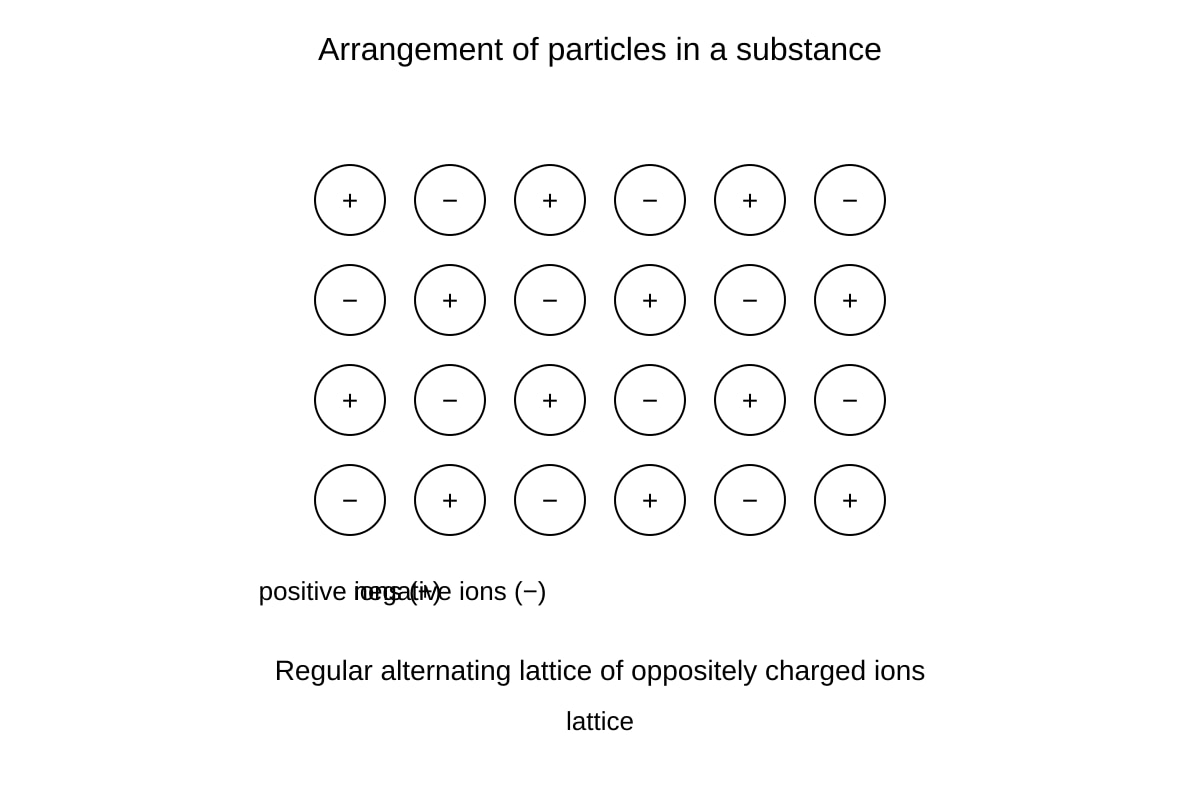
Generated diagram for Q16.
(a) Name the type of bonding shown. [1]
(b) Explain why this substance conducts electricity only when molten or dissolved. [2]
17. The table shows melting points of four substances.
| Substance | Melting point (°C) |
|---|
| P (CH4) | −182 |
| Q (MgO) | 2852 |
| R (Si) | 1414 |
| S (Cu) | 1085 |
(a) Which substance is most likely to be ionic? Give a reason. [2]
(b) Which substance is simple molecular? Give a reason. [1]
18. Use the periodic table positions to state the formula of the compound formed between calcium (Group 2) and fluorine (Group 17). Show your working using electron transfer. [3]
19. The diagram shows a model of a giant covalent structure.
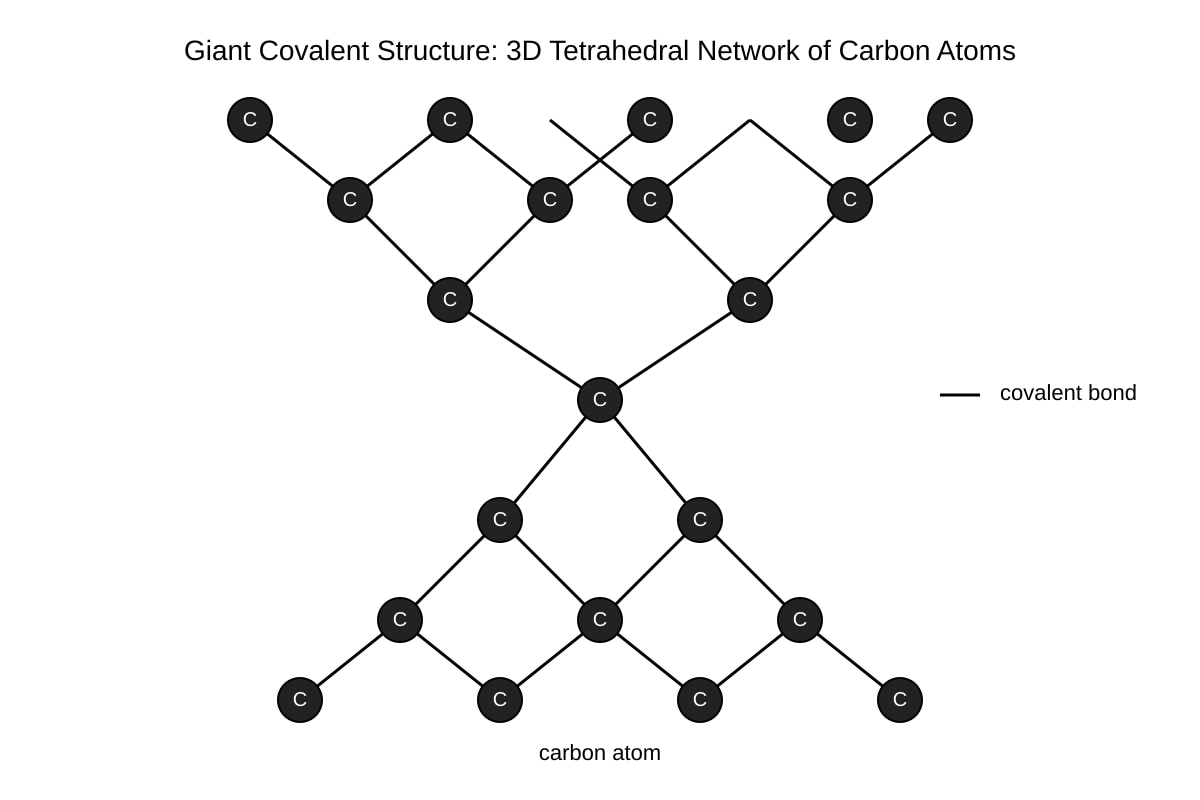
Generated diagram for Q19.
(a) Name the structure shown. [1]
(b) State two physical properties of this substance. [2]
20. An atom X has electron arrangement 2,8,7.
(a) To which group does X belong? [1]
(b) Draw the dot-and-cross diagram for the molecule formed between X and hydrogen. [2]
</stage3_quiz_answers_md>
Secondary 3 Chemistry Quiz - Atomic Structure Bonding (Answers)
Total Marks: 40
Section A
1. 0
Teaching note: Neutrons have no charge (relative charge 0). Protons are +1, electrons −1.
2. Neutron
Teaching note: Nucleus contains protons (positive) and neutrons (neutral).
3. 12
Working: Neutrons = nucleon number − proton number = 23 − 11 = 12.
4. Ionic bonding
Teaching note: Metal loses electrons, non-metal gains; electrostatic attraction forms ionic bond.
5. Isotopes
Teaching note: Same proton number, different neutron number.
Section B
6. (a) [1] Number of protons in the nucleus of an atom.
(b) [1] 1735Cl (since 17 p, 18 n → nucleon = 35).
7. [3]
Mg: ×× (2 outer e) → Mg2+; O: ×× (6 outer e) + 2 from Mg → O2− with 8 e.
Mark: 1 for Mg losing 2e, 1 for O gaining 2e, 1 for correct charges shown.
8. [2] Ionic compounds have strong electrostatic forces between oppositely charged ions / giant lattice; large energy needed to overcome → high melting point. (1 mark each point)
9. [2]
RAM = (35×0.75) + (37×0.25) = 26.25 + 9.25 = 35.5.
Working shown = 1, answer 35.5 = 1.
10. [3] (a) Covalent, (b) Metallic, (c) Ionic. (1 each)
11. [2] Two hydrogen atoms each share one electron / overlap orbitals; pair of shared electrons attracts both nuclei (1 each).
12. [2] Diamond has giant covalent network / each C bonded to 4 C by strong covalent bonds in 3D; hard because bonds must break (1 each).
13. [3] Protons 13, Neutrons 27−13=14, Electrons 13−3=10. (1 each)
14. [2] Solid: ions fixed, no mobile charge carriers; molten: ions free to move and carry current (1 each).
15. [3] Graphite conducts, diamond does not. Graphite has delocalised electrons between layers; diamond all electrons localized in covalent bonds (1 for compare, 2 for explanation).
Section C
16. (a) [1] Ionic bonding.
(b) [2] Ions fixed in solid (no mobile charge); molten/dissolved ions free to move carrying charge (1 each).
17. (a) [2] Q (MgO); very high mp suggests ionic giant lattice (1 id, 1 reason).
(b) [1] P; very low mp suggests weak intermolecular forces / simple molecular.
18. [3] Ca loses 2e → Ca2+; 2 F each gain 1e → 2F−; formula CaF2. (1+1+1)
19. (a) [1] Diamond.
(b) [2] Hard, high melting point (or non-conducting). (1 each)
20. (a) [1] Group 17.
(b) [2] H× + ×X (7 e) → H:X with 1 shared pair; X has 3 lone pairs. (1 formation, 1 diagram)
</stage3_quiz_answers_md>
<stage3_quiz_md>
Secondary 3 Chemistry Quiz - Atomic Structure Bonding
Name: ___________________________
Class: _________
Date: ____________
Score: _______ / 40
Duration: 50 minutes
Total Marks: 40
Instructions:
- Answer all 20 questions.
- Section A: Multiple-choice style short responses (1 mark each).
- Section B: Structured short answers (1–3 marks each).
- Section C: Data and diagram interpretation (2–3 marks each).
- Write your answers clearly in the spaces provided.
Section A (Questions 1–5, 1 mark each)
1. What is the relative charge of a neutron?
2. Which sub-atomic particle is found in the nucleus together with protons?
3. An atom of sodium has proton number 11 and nucleon number 23. How many neutrons does it have?
4. Which type of bonding is formed when electrons are transferred from a metal to a non-metal?
5. What term describes atoms of the same element with different numbers of neutrons?
Section B (Questions 6–15)
6. (a) Define the proton number of an element. [1]
(b) An atom has 17 protons and 18 neutrons. State its nuclide notation. [1]
7. Draw a dot-and-cross diagram to show the formation of magnesium oxide (MgO) from Mg and O atoms. Show only the outer shell electrons. [3]
8. Explain why ionic compounds such as sodium chloride have high melting points. [2]
9. A sample of chlorine has two isotopes: 35Cl (75%) and 37Cl (25%). Calculate the relative atomic mass of chlorine. [2]
10. State the type of bonding present in each of the following: [3]
(a) Oxygen gas (O2) ________________
(b) Copper metal ________________
(c) Potassium bromide ________________
11. Describe how a covalent bond is formed between two hydrogen atoms. [2]
12. Explain, in terms of structure and bonding, why diamond is very hard. [2]
13. Give the number of protons, neutrons, and electrons in an ion of Al3+ (proton number 13, nucleon number 27). [3]
Protons: ______ Neutrons: ______ Electrons: ______
14. Why does solid sodium chloride not conduct electricity, but molten sodium chloride does? [2]
15. Compare the electrical conductivity of graphite and diamond. Explain your answer. [3]
Section C (Questions 16–20)
16. The diagram below shows the arrangement of particles in a substance.
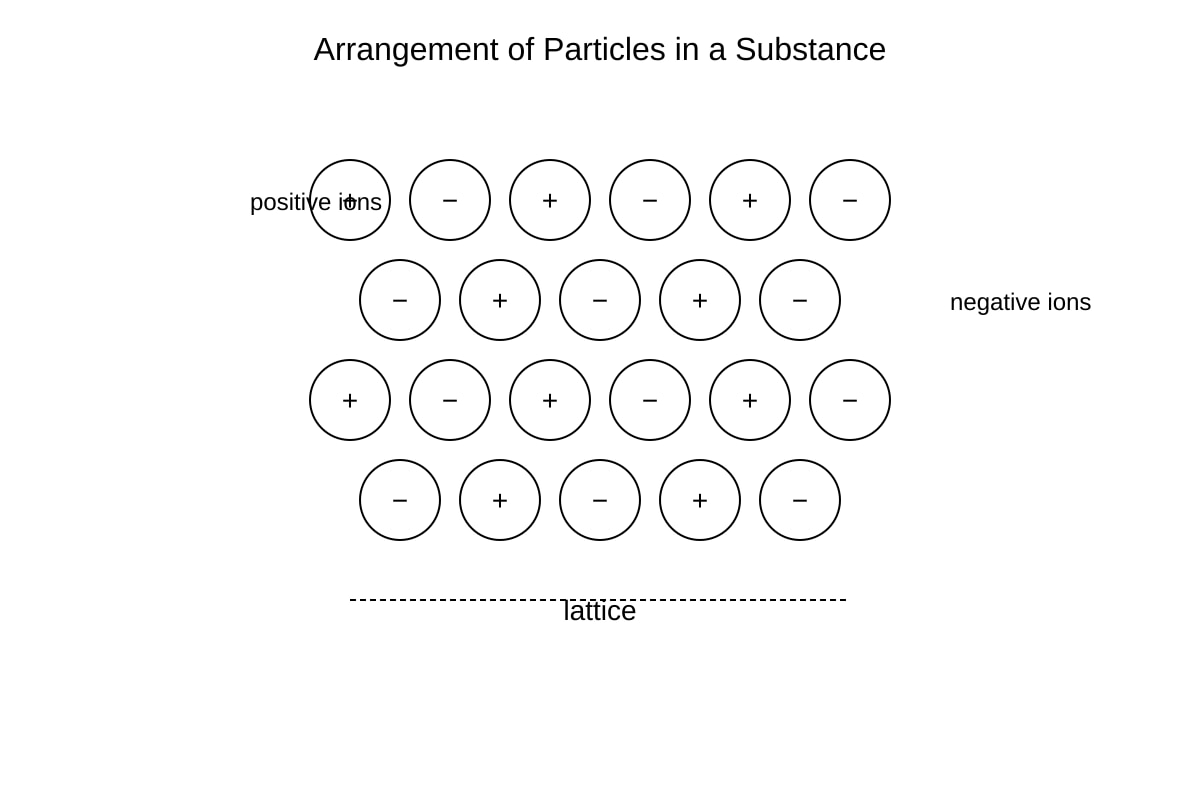
Generated diagram for Q16.
(a) Name the type of bonding shown. [1]
(b) Explain why this substance conducts electricity only when molten or dissolved. [2]
17. The table shows melting points of four substances.
| Substance | Melting point (°C) |
|---|
| P (CH4) | −182 |
| Q (MgO) | 2852 |
| R (Si) | 1414 |
| S (Cu) | 1085 |
(a) Which substance is most likely to be ionic? Give a reason. [2]
(b) Which substance is simple molecular? Give a reason. [1]
18. Use the periodic table positions to state the formula of the compound formed between calcium (Group 2) and fluorine (Group 17). Show your working using electron transfer. [3]
19. The diagram shows a model of a giant covalent structure.
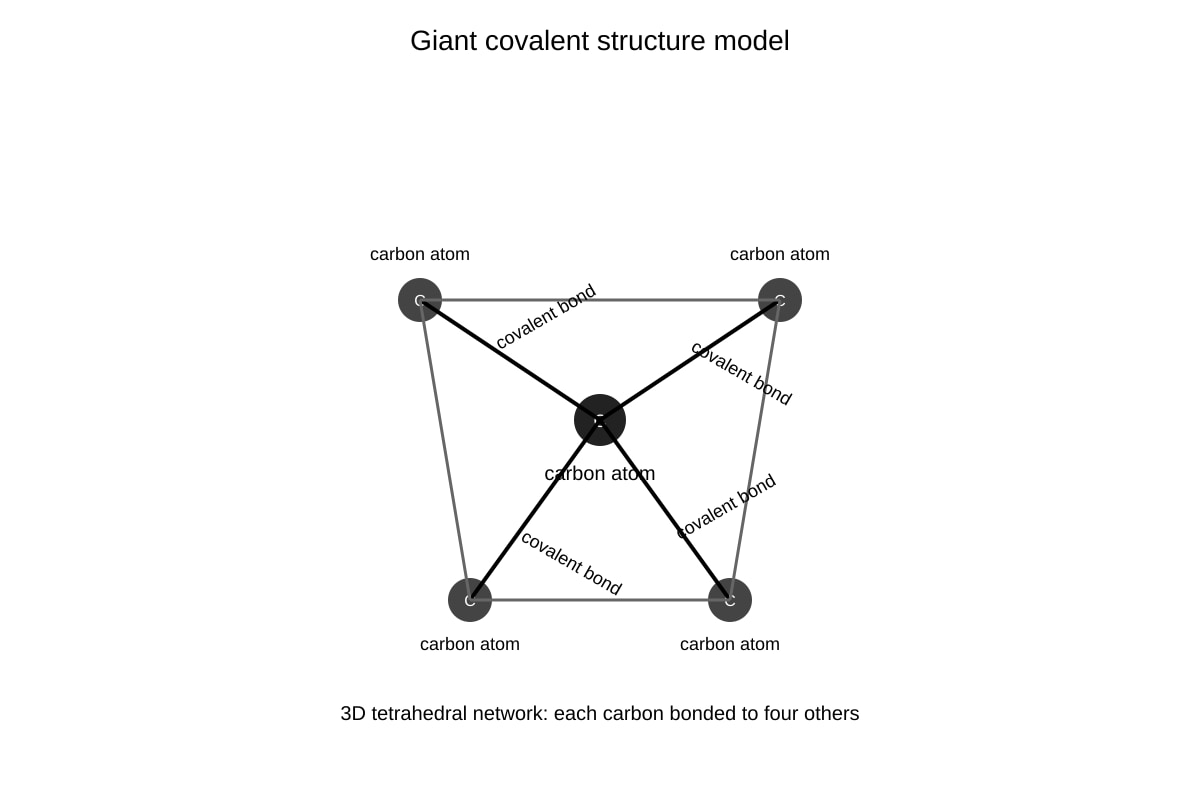
Generated diagram for Q19.
(a) Name the structure shown. [1]
(b) State two physical properties of this substance. [2]
20. An atom X has electron arrangement 2,8,7.
(a) To which group does X belong? [1]
(b) Draw the dot-and-cross diagram for the molecule formed between X and hydrogen. [2]