From Real Exams Quiz
Secondary 3 Chemistry Atomic Structure Bonding Quiz
Free Sec 3 Chemistry Atomic Structure Bonding quiz, DeepSeek Exam version, with questions, answers, and O Level-style practice for Singapore students.
These static practice materials are generated from the site's syllabus and paper-generation workflow, with source and model context shown so students and parents can evaluate the material before use.
Questions
Free quiz and exam paper access
Enter your details to view this paper
Your access is remembered on this device.
Answers
Secondary 3 Chemistry Quiz - Atomic Structure Bonding - ANSWER KEY
Total Marks: 40
Section A: Short Answer (10 marks)
1. What is meant by the term monatomic? [1]
- Answer: Monatomic means consisting of a single atom per particle / existing as individual atoms.
- Marking: Award 1 mark for correct definition. Accept "single atom" or "one atom per molecule/particle."
2. State the relative charge and relative mass of a proton. [2]
- Answer:
- Relative charge: +1
- Relative mass: 1
- Marking: 1 mark for each correct answer.
3. An atom of element X has 17 protons and 18 neutrons. Write the nuclide notation for this atom. [1]
- Answer: ³⁵₁₇Cl (or ³⁵₁₇X)
- Marking: Award 1 mark for correct nuclide notation with mass number 35 and atomic number 17.
4. Define the term isotopes. [1]
- Answer: Isotopes are atoms of the same element with the same number of protons but different numbers of neutrons / same atomic number but different mass numbers.
- Marking: Award 1 mark for correct definition including reference to same element and different neutron numbers.
5. State the number of valence electrons in an atom of phosphorus (atomic number 15). [1]
- Answer: 5
- Marking: Award 1 mark for correct answer. Electronic configuration is 2,8,5; valence electrons = 5.
Section B: Diagram and Data Interpretation (10 marks)
6. Draw the electronic structure of a neon atom, showing the arrangement of electrons in shells. [1]
- Answer: Diagram showing nucleus with 2 electrons in first shell and 8 electrons in second shell.
- Marking: Award 1 mark for correct electron arrangement (2,8).
7. What is the charge on a sulfide ion, S²⁻? Explain how this ion is formed from a sulfur atom. [2]
- Answer:
- Charge: 2– (negative two)
- Explanation: A sulfur atom gains two electrons to achieve a full outer shell / stable octet configuration.
- Marking: 1 mark for correct charge; 1 mark for explanation involving gain of two electrons.
8. State the atom in chlorofluorocarbons (CFCs) that is responsible for depleting the ozone layer. [1]
- Answer: Chlorine (Cl)
- Marking: Award 1 mark for chlorine/Cl.
9. The table below shows the melting points of four substances.
| Substance | Melting Point (°C) |
|---|---|
| W | 801 |
| X | –95 |
| Y | 3550 |
| Z | 660 |
(a) Which substance is most likely to be a simple molecular compound? Explain your answer. [2]
- Answer: Substance X. Simple molecular compounds have low melting points because they are held together by weak intermolecular forces / van der Waals forces which require little energy to overcome.
- Marking: 1 mark for identifying X; 1 mark for explanation linking low melting point to weak intermolecular forces.
(b) Substance Y has a giant covalent structure. Explain why it has a very high melting point. [2]
- Answer: In a giant covalent structure, all atoms are held together by strong covalent bonds throughout the entire structure. A large amount of energy is required to break these strong covalent bonds, resulting in a very high melting point.
- Marking: 1 mark for identifying strong covalent bonds throughout structure; 1 mark for linking to large energy requirement.
10. Draw the 'dot and cross' diagram to show the bonding in a molecule of tetrachloromethane, CCl₄. Show only the valence electrons. Use • for carbon electrons and × for chlorine electrons. [2]
- Answer: Diagram showing carbon atom at centre with four chlorine atoms around it. Carbon has 4 valence electrons (•), each chlorine has 7 valence electrons (×). Four shared pairs (•×) between carbon and each chlorine, with three lone pairs (××) on each chlorine atom.
- Marking: 1 mark for correct arrangement (C central, 4 Cl around) and correct electron count; 1 mark for correct dot/cross notation.
Section C: Structured Response (10 marks)
11. The diagram below represents the structure of sodium chloride.
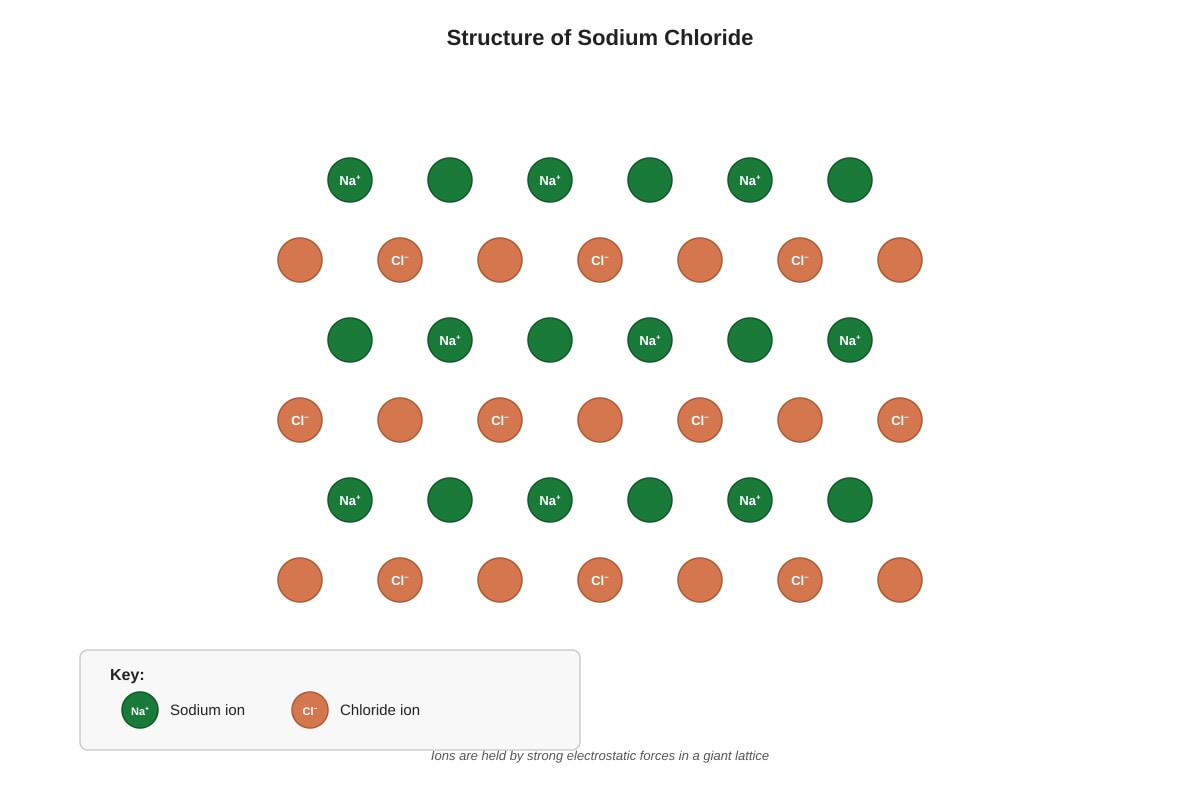
Generated diagram for this question.
(a) Name the type of structure shown. [1]
- Answer: Giant ionic lattice / giant ionic structure
- Marking: Award 1 mark for correct answer.
(b) Explain why sodium chloride conducts electricity when molten but not when solid. [2]
- Answer: In the solid state, the Na⁺ and Cl⁻ ions are held in fixed positions in the lattice and cannot move, so no electrical conductivity. When molten, the ions are free to move and can carry electric current.
- Marking: 1 mark for explaining ions are fixed in solid; 1 mark for explaining ions are mobile in molten state.
12. The mass spectrum of element Q shows two peaks at m/z 63 and m/z 65. The peak at m/z 63 has a relative abundance of 69% and the peak at m/z 65 has a relative abundance of 31%.
(a) State the relative mass of the most abundant isotope of element Q. [1]
- Answer: 63
- Marking: Award 1 mark for 63.
(b) Calculate the relative atomic mass of element Q. Show your working. [1]
- Answer: Aᵣ = (63 × 69 + 65 × 31) ÷ 100 = (4347 + 2015) ÷ 100 = 6362 ÷ 100 = 63.62 ≈ 63.6
- Marking: Award 1 mark for correct answer with working shown. Accept 63.6 or 63.62.
13. Sodium bromide (NaBr) has a melting point of 747 °C, while tetrabromomethane (CBr₄) has a melting point of 91 °C.
Explain, in terms of structure and bonding, why sodium bromide has a much higher melting point than tetrabromomethane. [3]
- Answer: Sodium bromide has a giant ionic lattice structure with strong electrostatic forces of attraction between Na⁺ and Br⁻ ions throughout the lattice. A large amount of energy is required to overcome these strong forces. Tetrabromomethane has a simple molecular structure with discrete CBr₄ molecules held together by weak intermolecular forces / van der Waals forces. Only a small amount of energy is required to overcome these weak forces.
- Marking: 1 mark for identifying NaBr as giant ionic with strong electrostatic forces; 1 mark for identifying CBr₄ as simple molecular with weak intermolecular forces; 1 mark for linking energy requirements to melting point difference.
14. Magnesium oxide (MgO) and sodium chloride (NaCl) are both ionic compounds.
(a) Write the formula of the ions present in magnesium oxide. [1]
- Answer: Mg²⁺ and O²⁻
- Marking: Award 1 mark for both correct ions.
(b) Explain why magnesium oxide has a higher lattice energy than sodium chloride. Refer to the charges of the ions in your answer. [1]
- Answer: The ions in MgO (Mg²⁺ and O²⁻) have higher charges than the ions in NaCl (Na⁺ and Cl⁻). The electrostatic forces of attraction between ions with higher charges are stronger, so more energy is required to separate the ions / lattice energy is higher.
- Marking: 1 mark for identifying higher charges in MgO and linking to stronger electrostatic attraction and higher lattice energy.
15. The electronic configuration of an atom of element R is 2,8,2.
(a) Identify element R. [1]
- Answer: Magnesium (Mg)
- Marking: Award 1 mark for magnesium/Mg.
Section D: Extended Response (10 marks)
16. State the group and period of element R (from question 15) in the Periodic Table. [2]
- Answer:
- Group: 2 (or II)
- Period: 3
- Marking: 1 mark for each correct answer.
17. Predict whether element R would form an ionic or covalent compound with chlorine. Explain your answer. [2]
- Answer: Ionic compound. Magnesium is a metal that loses its 2 valence electrons to form Mg²⁺ ions, while chlorine is a non-metal that gains electrons to form Cl⁻ ions. The electrostatic attraction between Mg²⁺ and Cl⁻ ions forms an ionic bond.
- Marking: 1 mark for predicting ionic; 1 mark for explanation involving electron transfer and ion formation.
18. Graphite and diamond are both allotropes of carbon.
(a) Describe the structure of graphite. [2]
- Answer: Graphite has a layered structure. Each carbon atom is covalently bonded to three other carbon atoms, forming hexagonal rings in flat sheets. The layers are held together by weak intermolecular forces / van der Waals forces.
- Marking: 1 mark for describing layered structure and carbon bonded to three others; 1 mark for identifying weak forces between layers.
(b) Explain why graphite can conduct electricity but diamond cannot. [2]
- Answer: In graphite, each carbon atom uses only three of its four valence electrons for covalent bonding, leaving one delocalised electron per carbon atom. These delocalised electrons are free to move and carry electric current. In diamond, all four valence electrons are used in covalent bonds, so there are no delocalised electrons / no free charge carriers.
- Marking: 1 mark for explaining delocalised electrons in graphite; 1 mark for explaining all electrons are localised in diamond.
19. The table below shows information about three particles.
| Particle | Number of protons | Number of neutrons | Number of electrons |
|---|---|---|---|
| A | 9 | 10 | 10 |
| B | 12 | 12 | 10 |
| C | 17 | 18 | 18 |
(a) Identify which particle is a negative ion. Explain your answer. [1]
- Answer: Particle A and Particle C are negative ions. They have more electrons than protons, giving them an overall negative charge.
- Marking: Award 1 mark for identifying A and C as negative ions with correct explanation.
(b) Identify which particle is a positive ion. Explain your answer. [1]
- Answer: Particle B is a positive ion. It has fewer electrons (10) than protons (12), giving it an overall positive charge.
- Marking: Award 1 mark for identifying B as positive ion with correct explanation.
20. Particle A and particle C are both negative ions. Explain why particle C has a larger ionic radius than particle A. [2]
- Answer: Particle C (chloride ion, Cl⁻) has more electron shells (3 shells) than particle A (fluoride ion, F⁻) which has only 2 electron shells. The increased number of electron shells results in a larger ionic radius. Additionally, the increased nuclear charge in C is outweighed by the increased electron-electron repulsion and shielding.
- Marking: 1 mark for identifying difference in number of electron shells; 1 mark for linking to larger radius.
END OF ANSWER KEY