From Real Exams Quiz
Secondary 3 Chemistry Acids Bases Salts Quiz
Free Sec 3 Chemistry Acids Bases Salts quiz, Nemo3 Exam version, with questions, answers, and O Level-style practice for Singapore students.
These static practice materials are generated from the site's syllabus and paper-generation workflow, with source and model context shown so students and parents can evaluate the material before use.
Questions
Secondary 3 Chemistry Quiz - Acids Bases Salts
Name: ___________________________
Class: ___________________________
Date: ___________________________
Score: _____ / 40
Duration: 45 minutes
Total Marks: 40
Instructions:
- Answer all questions in the spaces provided.
- Show all working for calculation questions.
- For chemical equations, include state symbols where appropriate.
- The Periodic Table is provided on the last page.
Section A: Multiple Choice Questions (10 marks)
Questions 1 to 10 carry 1 mark each. Choose the correct answer and write its letter (A, B, C, or D) in the box provided.
-
Which solid compound is added to soil to increase the pH?
A. Ammonium sulfate
B. Calcium oxide
C. Sodium chloride
D. Sulfur dioxide
Answer: ☐ -
A student adds dilute hydrochloric acid to solid sodium carbonate. Which gas is produced?
A. Hydrogen
B. Oxygen
C. Carbon dioxide
D. Chlorine
Answer: ☐ -
The pH of a solution is 2. What is the concentration of H⁺ ions in mol/dm³?
A. 0.01
B. 0.1
C. 1
D. 10
Answer: ☐ -
Which of the following oxides is amphoteric?
A. Sodium oxide
B. Magnesium oxide
C. Aluminium oxide
D. Carbon dioxide
Answer: ☐ -
When aqueous ammonia is added to copper(II) sulfate solution, a light blue precipitate forms. What happens when excess aqueous ammonia is added?
A. The precipitate dissolves to form a deep blue solution
B. The precipitate turns black
C. No change occurs
D. The precipitate dissolves to form a colourless solution
Answer: ☐ -
Which salt can be prepared by titration?
A. Barium sulfate
B. Sodium chloride
C. Lead(II) nitrate
D. Calcium carbonate
Answer: ☐ -
A solution has pH 11. Which indicator would be most suitable for titrating this solution against a strong acid?
A. Methyl orange (pH range 3.1–4.4)
B. Bromothymol blue (pH range 6.0–7.6)
C. Phenolphthalein (pH range 8.2–10.0)
D. Universal indicator (pH range 4–10)
Answer: ☐ -
Which of the following reactions produces a soluble salt?
A. Pb(NO₃)₂(aq) + 2NaCl(aq) → PbCl₂(s) + 2NaNO₃(aq)
B. CuO(s) + H₂SO₄(aq) → CuSO₄(aq) + H₂O(l)
C. BaCl₂(aq) + Na₂SO₄(aq) → BaSO₄(s) + 2NaCl(aq)
D. AgNO₃(aq) + NaCl(aq) → AgCl(s) + NaNO₃(aq)
Answer: ☐ -
What is the ionic equation for the reaction between hydrochloric acid and sodium hydroxide?
A. HCl + NaOH → NaCl + H₂O
B. H⁺ + OH⁻ → H₂O
C. H⁺ + Cl⁻ + Na⁺ + OH⁻ → Na⁺ + Cl⁻ + H₂O
D. 2H⁺ + 2OH⁻ → 2H₂O
Answer: ☐ -
Which statement about strong and weak acids is correct?
A. Strong acids have a higher pH than weak acids of the same concentration
B. Strong acids are fully ionised in aqueous solution
C. Weak acids do not contain hydrogen ions
D. The concentration of an acid determines whether it is strong or weak
Answer: ☐
Section B: Short Answer Questions (15 marks)
Questions 11 to 16 carry the marks shown. Write your answers in the spaces provided.
-
A farmer tests his soil and finds it has a pH of 4.5. He wants to raise the pH to 6.5 for optimal crop growth.
(a) Name a solid compound he could add to the soil. [1]
(b) Write a word equation for the reaction that occurs in the soil. [1]
(c) Explain why adding too much of this compound could be harmful to plants. [1]
-
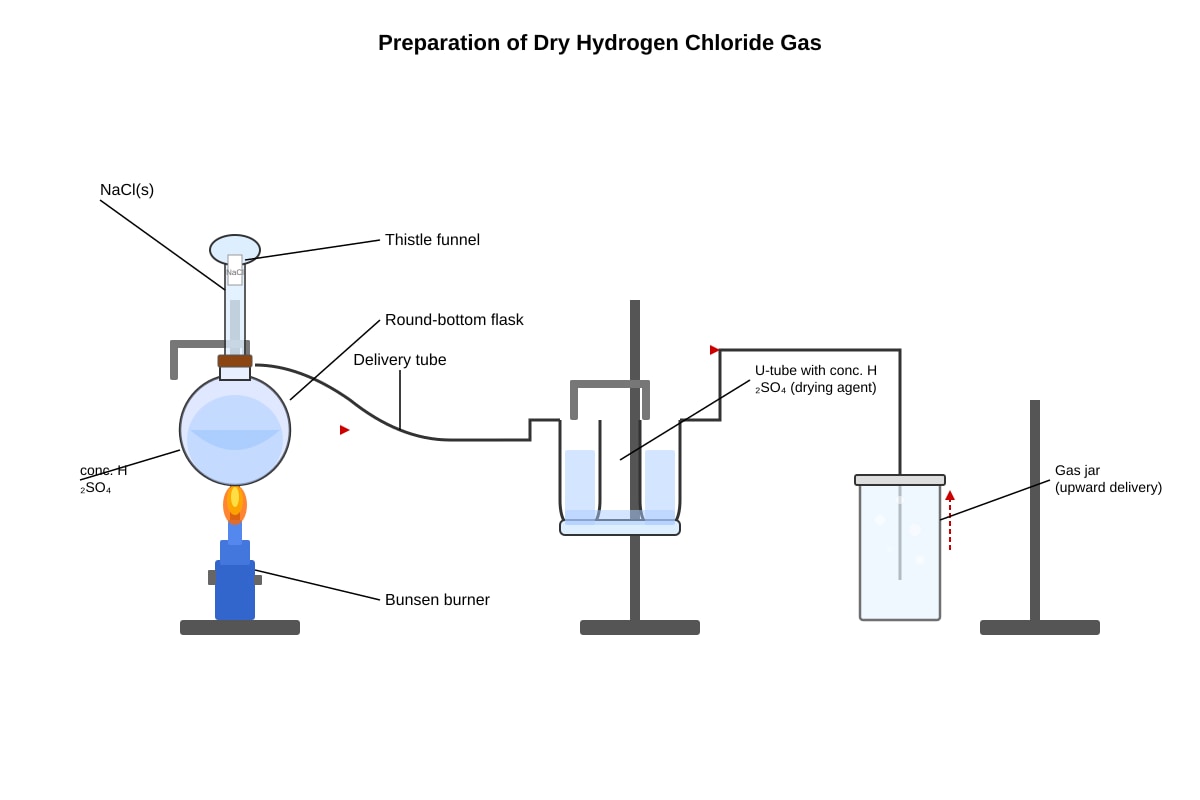
The diagram below shows the apparatus used to prepare a sample of dry hydrogen chloride gas.
<image_placeholder> id: Q12-fig1 type: experimental_setup linked_question: Q12 description: Laboratory setup for preparing dry HCl gas: concentrated sulfuric acid in a round-bottom flask heated with a Bunsen burner, sodium chloride solid added via a thistle funnel, gas passes through a delivery tube into a U-tube containing concentrated sulfuric acid as a drying agent, then collected by upward delivery into a gas jar. labels: Round-bottom flask, Bunsen burner, thistle funnel, NaCl(s), conc. H₂SO₄, delivery tube, U-tube with conc. H₂SO₄ (drying agent), gas jar (upward delivery) values: None must_show: All apparatus correctly connected, drying agent labelled, upward delivery method shown </image_placeholder> (a) Name the solid reactant placed in the flask. [1]
(b) State the purpose of the concentrated sulfuric acid in the U-tube. [1]
(c) Why is the gas collected by upward delivery? [1]
-
A student carries out a titration using 25.0 cm³ of 0.100 mol/dm³ sodium hydroxide solution and dilute hydrochloric acid. The results are shown below.
| Titration | Rough | 1 | 2 | 3 |
|---|---|---|---|---|
| Final burette reading / cm³ | 24.50 | 48.20 | 23.80 | 47.60 |
| Initial burette reading / cm³ | 0.00 | 24.50 | 0.00 | 24.50 |
| Volume of HCl used / cm³ | 24.50 | 23.70 | 23.80 | 23.10 |
(a) Complete the table by calculating the volume of HCl used for each titration. [1]
(b) Identify the two concordant titres and calculate the average volume of HCl used. [1]
_________________________________________________________________________
(c) Calculate the concentration of the hydrochloric acid in mol/dm³. [2]
_________________________________________________________________________
_________________________________________________________________________
14. Zinc oxide is an amphoteric oxide.
(a) Write a balanced chemical equation, with state symbols, for the reaction of zinc oxide with dilute hydrochloric acid. [2]
_________________________________________________________________________
(b) Write a balanced chemical equation, with state symbols, for the reaction of zinc oxide with aqueous sodium hydroxide. [2]
_________________________________________________________________________
-
Describe a laboratory method to prepare a pure, dry sample of copper(II) sulfate crystals starting from copper(II) oxide and dilute sulfuric acid. Your answer should include:
- The steps involved
- How to remove excess reactant
- How to obtain dry crystals [4]
-
The table shows the pH values of four solutions.
| Solution | pH |
|---|---|
| P | 1 |
| Q | 4 |
| R | 7 |
| S | 13 |
(a) Which solution is a strong alkali? [1]
_________________________________________________________________________
(b) Which solution is a weak acid? [1]
_________________________________________________________________________
(c) Solutions P and S are mixed in equal volumes. Predict the pH of the resulting mixture and explain your answer. [2]
_________________________________________________________________________
_________________________________________________________________________
Section C: Structured and Data-Based Questions (15 marks)
Questions 17 to 20 carry the marks shown. Write your answers in the spaces provided.
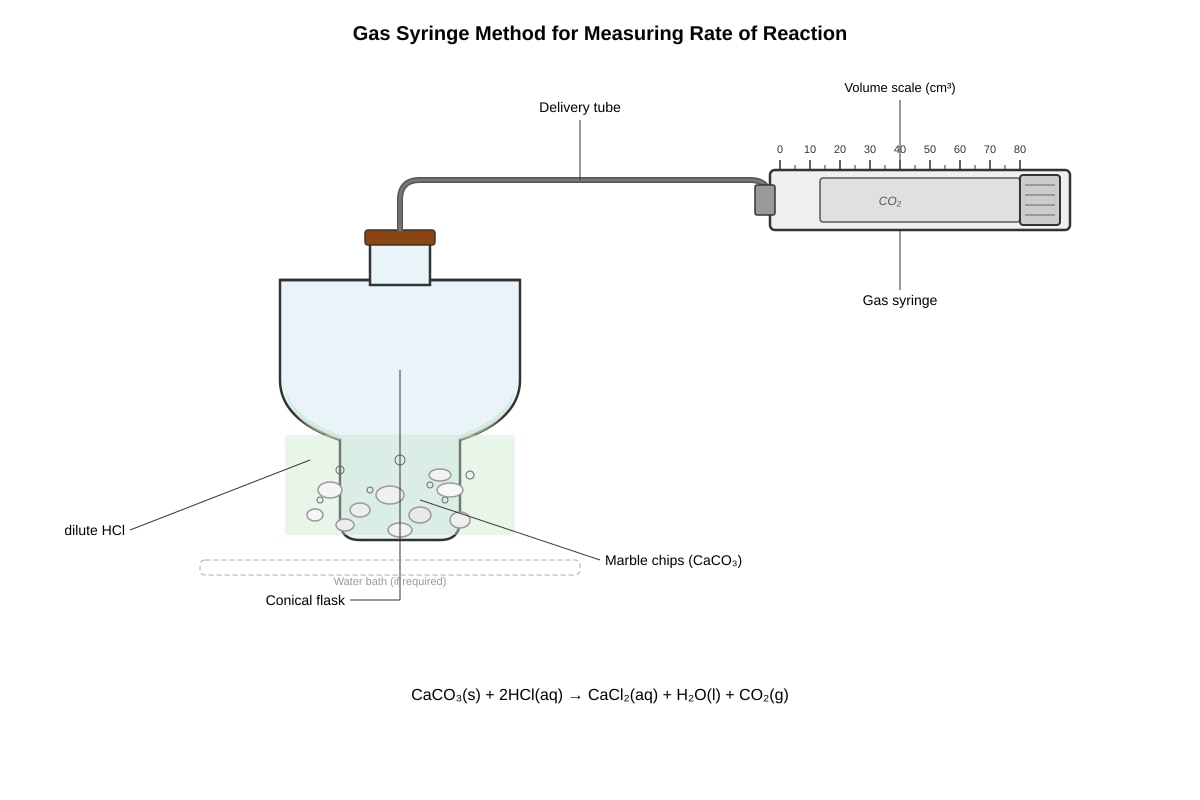
- A student investigates the reaction between marble chips (calcium carbonate) and dilute hydrochloric acid. The apparatus is shown below.
<image_placeholder> id: Q17-fig1 type: experimental_setup linked_question: Q17 description: Gas syringe method for measuring rate of reaction: conical flask containing marble chips and dilute HCl, connected via delivery tube to a gas syringe. The gas syringe measures volume of CO₂ produced over time. labels: Conical flask, marble chips (CaCO₃), dilute HCl, delivery tube, gas syringe, volume scale on gas syringe values: Gas syringe calibrated in cm³ must_show: Gas syringe with volume markings, delivery tube connected to flask, marble chips visible in flask </image_placeholder> The student records the volume of gas collected every 30 seconds. The results are shown in the table.
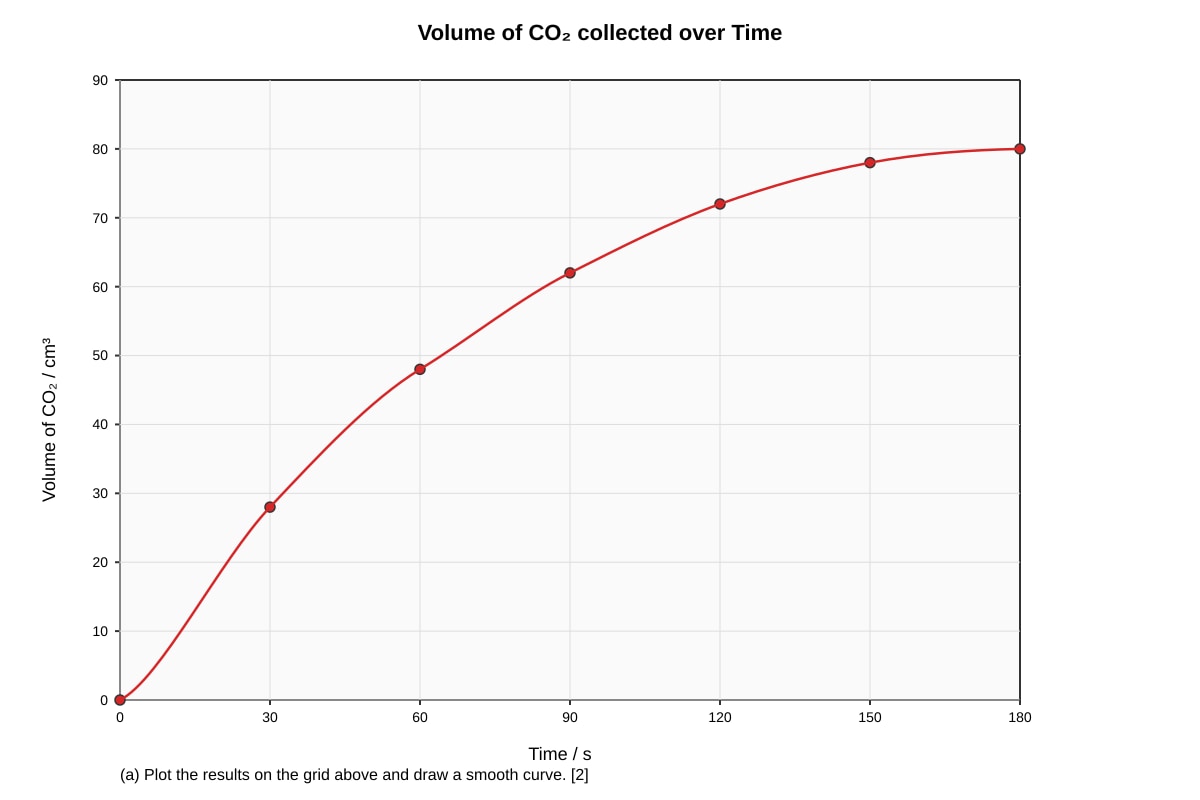
| Time / s | 0 | 30 | 60 | 90 | 120 | 150 | 180 |
|---|---|---|---|---|---|---|---|
| Volume of CO₂ / cm³ | 0 | 28 | 48 | 62 | 72 | 78 | 80 |
(a) Plot the results on the grid below and draw a smooth curve. [2]
<image_placeholder>
id: Q17-fig2
type: graph
linked_question: Q17
description: Blank graph grid for plotting volume of CO₂ vs time. x-axis: Time/s (0 to 180), y-axis: Volume of CO₂/cm³ (0 to 90).
labels: x-axis: Time / s, y-axis: Volume of CO₂ / cm³
values: x-axis scale 0–180 in 30s intervals, y-axis scale 0–90 in 10 cm³ intervals
must_show: Grid with labelled axes and scales, points plotted accurately, smooth curve drawn
</image_placeholder>
(b) Use your graph to determine the rate of reaction at 60 seconds. Show your working on the graph. [2]
_________________________________________________________________________
_________________________________________________________________________
(c) Explain why the rate of reaction decreases with time. [1]
_________________________________________________________________________
(d) The student repeats the experiment using the same mass of marble chips but in powdered form. Sketch the expected curve on the same graph and label it "Powdered". [1]
_________________________________________________________________________
18. Ammonium sulfate, (NH₄)₂SO₄, is a fertiliser produced by the reaction of ammonia with sulfuric acid.
(a) Write the balanced chemical equation for this reaction. [1]
_________________________________________________________________________
(b) A farmer applies 50 kg of ammonium sulfate to a field. Calculate the mass of nitrogen in this sample. (Relative atomic masses: N = 14, H = 1, S = 32, O = 16) [2]
_________________________________________________________________________
_________________________________________________________________________
(c) Ammonia is a weak base. Explain what is meant by a weak base. [1]
_________________________________________________________________________
(d) When ammonium sulfate is heated with sodium hydroxide, ammonia gas is released. Write the ionic equation for this reaction. [2]
_________________________________________________________________________
-
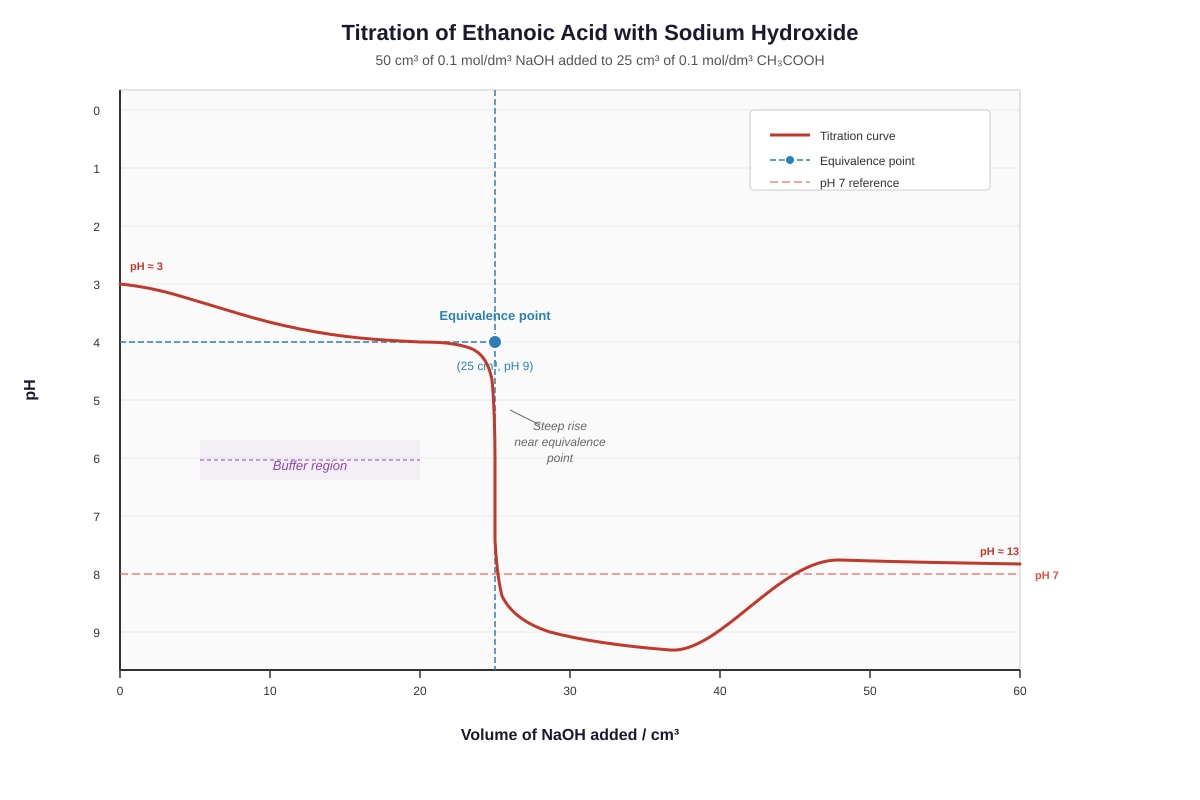
The diagram shows the pH changes when 50 cm³ of 0.1 mol/dm³ sodium hydroxide is added to 25 cm³ of 0.1 mol/dm³ ethanoic acid.
<image_placeholder> id: Q19-fig1 type: graph linked_question: Q19 description: Titration curve for weak acid (ethanoic acid) with strong base (NaOH). x-axis: Volume of NaOH added / cm³ (0 to 60), y-axis: pH (0 to 14). Curve starts at pH ~3, rises slowly, steep rise at equivalence point (25 cm³) to pH ~9, then levels off. labels: x-axis: Volume of NaOH added / cm³, y-axis: pH, equivalence point marked at 25 cm³ values: Initial pH ~3, equivalence point at 25 cm³, pH at equivalence ~9, final pH ~13 must_show: Characteristic weak acid–strong base titration curve shape with buffer region, steep rise at equivalence point, correct equivalence volume </image_placeholder> (a) State the volume of NaOH at the equivalence point. [1]
(b) Explain why the pH at the equivalence point is greater than 7. [2]
(c) Suggest a suitable indicator for this titration and explain your choice. [2]
-
A student is given three unlabelled bottles containing colourless solutions: dilute hydrochloric acid, aqueous sodium hydroxide, and distilled water.
(a) Describe how the student could use red and blue litmus paper to identify each solution. [3]
(b) The student then adds a small piece of magnesium ribbon to each solution. State the observations for each solution. [3]
End of Quiz
Answers
Secondary 3 Chemistry Quiz - Acids Bases Salts (Answer Key)
Total Marks: 40
Section A: Multiple Choice Questions (10 marks)
-
B — Calcium oxide (CaO) is a basic oxide that reacts with acidic soil to neutralise acidity and raise pH. Ammonium sulfate is acidic, sodium chloride is neutral, sulfur dioxide forms acidic solutions.
Mark: 1 -
C — Carbonates react with acids to produce carbon dioxide gas: Na₂CO₃ + 2HCl → 2NaCl + H₂O + CO₂.
Mark: 1 -
A — pH = –log[H⁺], so [H⁺] = 10⁻ᵖᴴ = 10⁻² = 0.01 mol/dm³.
Mark: 1 -
C — Aluminium oxide reacts with both acids and bases (amphoteric). Na₂O and MgO are basic; CO₂ is acidic.
Mark: 1 -
A — Cu²⁺(aq) + 2OH⁻(aq) → Cu(OH)₂(s) (light blue ppt). With excess NH₃: Cu(OH)₂ + 4NH₃ → [Cu(NH₃)₄]²⁺ (deep blue solution).
Mark: 1 -
B — Titration prepares soluble salts from soluble reactants (acid + alkali). BaSO₄, Pb(NO₃)₂, CaCO₃ are insoluble or not made by titration.
Mark: 1 -
C — For strong acid + weak base titration, equivalence point pH < 7. But here the solution is pH 11 (alkaline), so it's a strong base being titrated. Phenolphthalein changes at pH 8.2–10, suitable for strong base + weak acid. Wait — the question says "titrating this solution against a strong acid", so the solution is the alkali. Phenolphthalein is correct for strong base titrations.
Mark: 1 -
B — CuO + H₂SO₄ → CuSO₄(aq) + H₂O. CuSO₄ is soluble. All other options form insoluble precipitates (PbCl₂, BaSO₄, AgCl).
Mark: 1 -
B — Ionic equation shows only reacting ions: H⁺(aq) + OH⁻(aq) → H₂O(l). Spectator ions (Na⁺, Cl⁻) are omitted.
Mark: 1 -
B — Strong acids fully ionise in water (e.g., HCl → H⁺ + Cl⁻). Weak acids partially ionise. pH depends on concentration AND strength.
Mark: 1
Section B: Short Answer Questions (15 marks)
-
(a) Calcium oxide (CaO) / calcium hydroxide Ca(OH)₂ / calcium carbonate (CaCO₃) — Any one. These are basic compounds that neutralise soil acidity.
Mark: 1(b) Calcium oxide + water → calcium hydroxide (then) calcium hydroxide + acid (in soil) → calcium salt + water
OR simply: Base + acid → salt + water
Mark: 1(c) Over-liming raises pH too high (above 7), making essential nutrients (e.g., phosphate, iron, manganese) less available to plants. It can also damage soil structure and microbial activity.
Mark: 1 -
(a) Sodium chloride (NaCl) — Solid reactant with conc. H₂SO₄ to produce HCl gas.
Mark: 1(b) To dry the hydrogen chloride gas — Conc. H₂SO₄ is a drying agent that removes water vapour from the gas.
Mark: 1(c) Hydrogen chloride is denser than air (Mᵣ = 36.5 vs air ≈ 29), so it sinks and is collected by upward delivery.
Mark: 1 -
(a) Volumes: Rough = 24.50, Titration 1 = 23.70, Titration 2 = 23.80, Titration 3 = 23.10 cm³
Mark: 1 (all four correct)(b) Concordant titres: 23.70 and 23.80 cm³ (difference 0.10 cm³).
Average = (23.70 + 23.80) / 2 = 23.75 cm³
Mark: 1(c) Step 1: Moles of NaOH = concentration × volume = 0.100 mol/dm³ × (25.0/1000) dm³ = 0.00250 mol
Step 2: Reaction: NaOH + HCl → NaCl + H₂O, mole ratio 1:1
∴ Moles of HCl = 0.00250 mol
Step 3: Volume of HCl = 23.75 cm³ = 0.02375 dm³
Step 4: Concentration of HCl = moles / volume = 0.00250 / 0.02375 = 0.105 mol/dm³ (3 s.f.)
Marks: 1 for moles NaOH, 1 for final concentration with unit -
(a) ZnO(s) + 2HCl(aq) → ZnCl₂(aq) + H₂O(l)
Marks: 1 for correct formulae and balancing, 1 for state symbols(b) ZnO(s) + 2NaOH(aq) → Na₂ZnO₂(aq) + H₂O(l)
OR ZnO(s) + 2NaOH(aq) + H₂O(l) → Na₂[Zn(OH)₄](aq)
Marks: 1 for correct formulae and balancing, 1 for state symbols
Note: Sodium zincate formula may vary; accept correct stoichiometry. -
Method for preparing copper(II) sulfate crystals:
- Add excess copper(II) oxide to warm dilute sulfuric acid in a beaker and stir until no more reacts (acid is limiting reagent). [1]
- Filter the hot mixture to remove unreacted CuO (residue). Collect filtrate (copper(II) sulfate solution). [1]
- Heat the filtrate to evaporate water until a saturated solution forms (test by dipping a glass rod — crystals form on cooling). [1]
- Allow to cool slowly for crystallisation. Filter to collect crystals, wash with cold distilled water, and dry between filter papers / in a warm oven. [1]
Total: 4 marks
Common errors: Not using excess base, not filtering excess solid, heating to dryness (destroys crystals), not washing/drying crystals.
-
(a) Solution S (pH 13) — Strong alkalis have pH 13–14.
Mark: 1(b) Solution Q (pH 4) — Weak acids have pH 3–6. pH 1 is strong acid; pH 7 neutral; pH 13 strong alkali.
Mark: 1(c) Predicted pH ≈ 7 (neutral).
Explanation: Solution P (pH 1) is a strong acid, Solution S (pH 13) is a strong alkali. Equal volumes of equal concentration (implied by pH difference of 12, but assuming similar molarities for neutralisation) will neutralise to form a neutral salt solution. H⁺ + OH⁻ → H₂O.
Marks: 1 for prediction, 1 for explanation
Section C: Structured and Data-Based Questions (15 marks)
-
(a) Graph plotting:
- Axes labelled with units: x-axis "Time / s", y-axis "Volume of CO₂ / cm³" [1]
- All 7 points plotted accurately (± half a square) [1]
- Smooth curve drawn through points, starting at origin, levelling off at 80 cm³
Marks: 2
(b) Rate at 60 s = gradient of tangent at t = 60 s
Draw tangent at 60 s on graph.
Gradient = Δy / Δx = (volume change) / (time change)
Example: Tangent passes through (30, 20) and (90, 70) → gradient = (70–20)/(90–30) = 50/60 = 0.83 cm³/s
Accept range: 0.75–0.90 cm³/s
Marks: 1 for drawing tangent, 1 for correct calculation with units(c) Rate decreases because the concentration of hydrochloric acid decreases as it is consumed, and the surface area of marble chips decreases as they react. Fewer collisions per unit time.
Mark: 1(d) Sketch: Curve starts at origin, rises more steeply than original, reaches 80 cm³ sooner (e.g., by ~120 s), then levels off at same final volume (same mass of CaCO₃ = same moles CO₂). Labelled "Powdered".
Mark: 1 -
(a) 2NH₃(aq) + H₂SO₄(aq) → (NH₄)₂SO₄(aq)
Mark: 1(b) Mᵣ of (NH₄)₂SO₄ = 2(14+4) + 32 + 4(16) = 36 + 32 + 64 = 132
Mass of N in 1 mole = 28 g
% N = (28/132) × 100% = 21.2%
Mass of N in 50 kg = 50 × (28/132) = 10.6 kg (or 10600 g)
Marks: 1 for Mᵣ / %N calculation, 1 for final mass with unit(c) A weak base is a base that partially ionises / dissociates in water to produce a low concentration of hydroxide ions (OH⁻).
Example: NH₃ + H₂O ⇌ NH₄⁺ + OH⁻ (equilibrium lies to the left).
Mark: 1(d) (NH₄)₂SO₄ + 2NaOH → 2NH₃ + Na₂SO₄ + 2H₂O
Ionic: NH₄⁺(aq) + OH⁻(aq) → NH₃(g) + H₂O(l)
Marks: 1 for correct ions, 1 for balancing and state symbols (NH₃ is gas) -
(a) 25 cm³ — Read from graph at steepest point / equivalence point.
Mark: 1(b) At equivalence point, all ethanoic acid (weak acid) is converted to sodium ethanoate (salt of weak acid + strong base). The ethanoate ion (CH₃COO⁻) undergoes hydrolysis: CH₃COO⁻ + H₂O ⇌ CH₃COOH + OH⁻, producing OH⁻ ions, making the solution alkaline (pH > 7).
Marks: 1 for identifying salt formed, 1 for hydrolysis explanation(c) Phenolphthalein (pH range 8.2–10.0).
Reason: The equivalence point pH is ~9 (alkaline), which falls within phenolphthalein's transition range. Methyl orange (3.1–4.4) would change too early (in buffer region).
Marks: 1 for indicator name, 1 for explanation linking pH range to equivalence point -
(a) Procedure with litmus paper:
- Dip red litmus into each solution. The one that turns blue is NaOH (alkali).
- Dip blue litmus into the remaining two. The one that turns red is HCl (acid).
- The one that causes no colour change to either paper is distilled water (neutral).
Marks: 1 for identifying alkali with red litmus, 1 for identifying acid with blue litmus, 1 for identifying water by no change
(b) Observations with magnesium ribbon:
- HCl: Effervescence / bubbles (H₂ gas), magnesium disappears/dissolves, test tube feels warm (exothermic).
- NaOH: No reaction (no bubbles, magnesium remains, no temperature change).
- Water: No reaction (magnesium does not react with cold water).
Marks: 1 for HCl observation, 1 for NaOH observation, 1 for water observation
End of Answer Key