AI Generated Exam Paper
Secondary 3 Chemistry Practice Paper 5
Free Kimi AI-generated Sec 3 Chemistry Practice Paper 5 with questions, answers, and O Level-style practice for Singapore students preparing for exams.
These static practice materials are generated from the site's syllabus and paper-generation workflow, with source and model context shown so students and parents can evaluate the material before use.
Questions
TuitionGoWhere Practice Paper - Chemistry Secondary 3
TuitionGoWhere Practice Paper (AI) Version: 5 of 5 Subject: Chemistry Level: Secondary 3 (G3/Express) Paper: Practice Paper Duration: 1 hour 15 minutes Total Marks: 60 Name: _________________________ Class: _________________________ Date: _________________________
Instructions
- Answer all questions.
- Write your answers in the spaces provided.
- For questions requiring calculations, show all working clearly.
- Questions requiring equations should include state symbols where appropriate.
- Marks are indicated in brackets [ ] at the end of each question or part question.
- The use of calculators is permitted where necessary.
- A Periodic Table is provided.
Section A: Multiple Choice and Short Answer [20 marks]
Answer all questions in this section.
Estimated time: 25 minutes
1. Which of the following substances, when dissolved in water, produces a solution with pH less than 7?
A. Sodium hydroxide
B. Calcium carbonate
C. Carbon dioxide
D. Ammonia
_______________________________________________________________ [1]
2. State the colour of litmus paper in a solution of pH 10.
_______________________________________________________________ [1]
3. Calcium oxide is added to a sample of acidic soil. Name the type of reaction that occurs and explain how the pH of the soil changes.
_______________________________________________________________ [2]
4. Complete the following word equation. State the names of the products.
nitric acid + potassium hydroxide → ________________ + ________________
_______________________________________________________________ [2]
5. (a) Write the chemical formula for calcium sulfate.
_______________________________________________________________ [1]
(b) State whether calcium sulfate is soluble or insoluble in water.
_______________________________________________________________ [1]
6. A student prepares a sample of copper(II) chloride by reacting copper(II) oxide with dilute hydrochloric acid.
(a) Write a balanced chemical equation for this reaction, including state symbols.
_______________________________________________________________ [2]
(b) Describe how the student can obtain pure, dry crystals of copper(II) chloride from the reaction mixture.
_______________________________________________________________ [3]
7. (a) Define the term 'acid' in terms of proton transfer.
_______________________________________________________________ [1]
(b) Explain why nitric acid is described as a strong acid, whereas ethanoic acid is described as a weak acid.
_______________________________________________________________ [2]
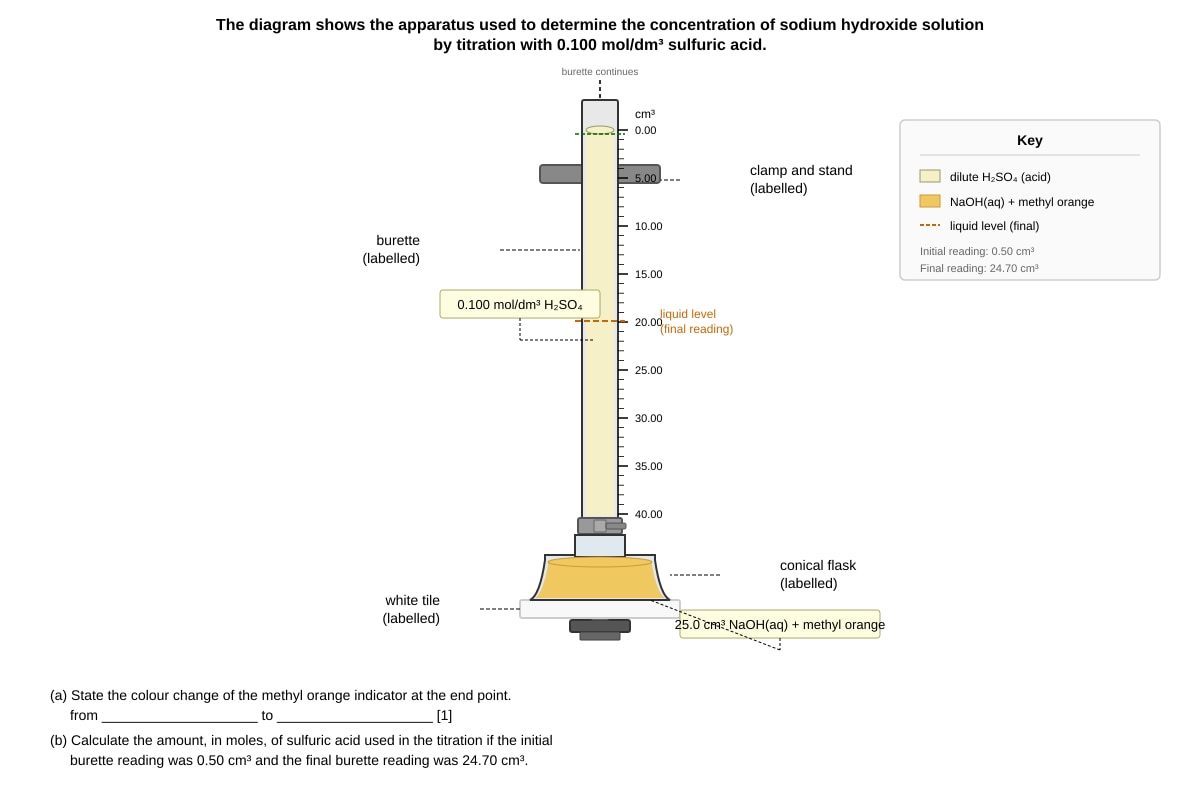
8. <image_placeholder> id: Q8-fig1 type: diagram linked_question: Q8 description: Titration apparatus setup showing a burette containing dilute sulfuric acid clamped above a conical flask containing aqueous sodium hydroxide with a few drops of methyl orange indicator, placed on a white tile labels: burette (labelled), conical flask (labelled), white tile (labelled), clamp and stand (labelled), acid label on burette: '0.100 mol/dm³ H₂SO₄', base label on flask: '25.0 cm³ NaOH(aq) + methyl orange' values: burette reading: initial 0.50 cm³, final 24.70 cm³ (shown but not explicitly stated in labels - to be determined by student) must_show: complete titration setup with proper clamping, liquid levels visible, indicator in flask, measurement scale on burette with clear graduations </image_placeholder>
The diagram shows the apparatus used to determine the concentration of sodium hydroxide solution by titration with 0.100 mol/dm³ sulfuric acid.
(a) State the colour change of the methyl orange indicator at the end point.
from ____________________ to ____________________ [1]
(b) Calculate the amount, in moles, of sulfuric acid used in the titration if the initial burette reading was 0.50 cm³ and the final burette reading was 24.70 cm³.
_______________________________________________________________ [2]
(c) Use your answer to (b) to calculate the concentration, in mol/dm³, of the sodium hydroxide solution given that the equation for the reaction is:
_______________________________________________________________ [3]
Section B: Structured Questions [28 marks]
Answer all questions in this section.
Estimated time: 35 minutes
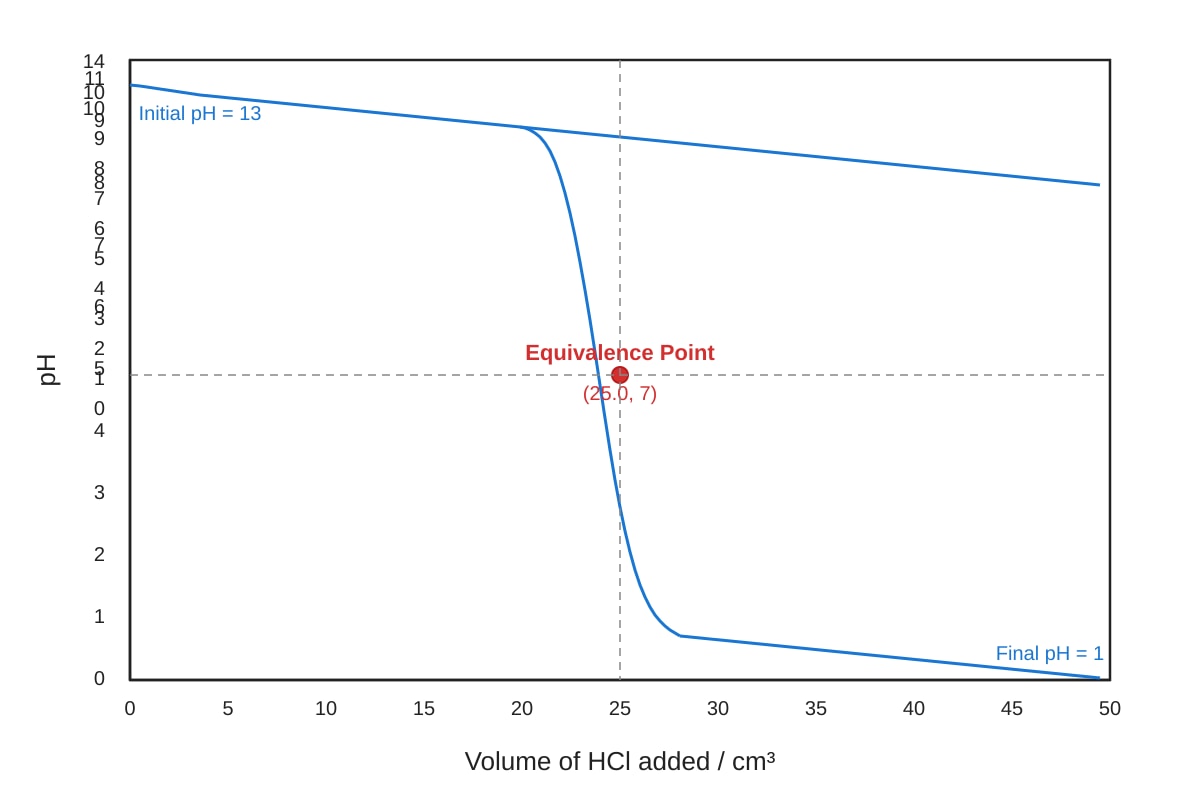
9. <image_placeholder> id: Q9-fig1 type: graph linked_question: Q9 description: Graph showing how pH changes during the titration of 25.0 cm³ of 0.100 mol/dm³ sodium hydroxide with hydrochloric acid of the same concentration labels: x-axis: 'Volume of HCl added / cm³', y-axis: 'pH'; axes clearly labelled with values: x-axis 0 to 50, y-axis 0 to 14; curve starting at pH 13, gradual decrease, steep fall between 20-30 cm³, levelling at pH 1 values: initial pH 13, final pH 1, equivalence point at 25.0 cm³ where pH = 7, steep section from approximately pH 11 to pH 3 over 2-3 cm³ range must_show: characteristic S-shaped titration curve with labelled equivalence point, gradual sections and steep section clearly visible, axes with proper scales </image_placeholder>
The graph shows how the pH changes when 25.0 cm³ of 0.100 mol/dm³ sodium hydroxide is titrated with 0.100 mol/dm³ hydrochloric acid.
(a) State the pH at the start of the titration before any acid is added. Explain your answer in terms of the concentration of hydroxide ions.
_______________________________________________________________ [2]
(b) (i) Use the graph to estimate the volume of hydrochloric acid needed to exactly neutralise the sodium hydroxide.
_______________________________________________________________ [1]
(ii) Explain why the pH changes very rapidly over a small volume of acid added around the equivalence point.
_______________________________________________________________ [2]
(c) A student suggests using universal indicator instead of methyl orange for this titration. Explain why this is not ideal for determining the exact end point.
_______________________________________________________________ [2]
10. Ammonium salts are important nitrogen fertilisers used in agriculture. However, excessive use can cause soil acidity and environmental problems.
(a) Write a balanced chemical equation for the reaction between ammonium nitrate and calcium hydroxide to produce ammonia gas, calcium nitrate and water.
_______________________________________________________________ [2]
(b) Explain why farmers add calcium carbonate (limestone) to acidic soil after prolonged use of ammonium nitrate fertiliser.
_______________________________________________________________ [3]
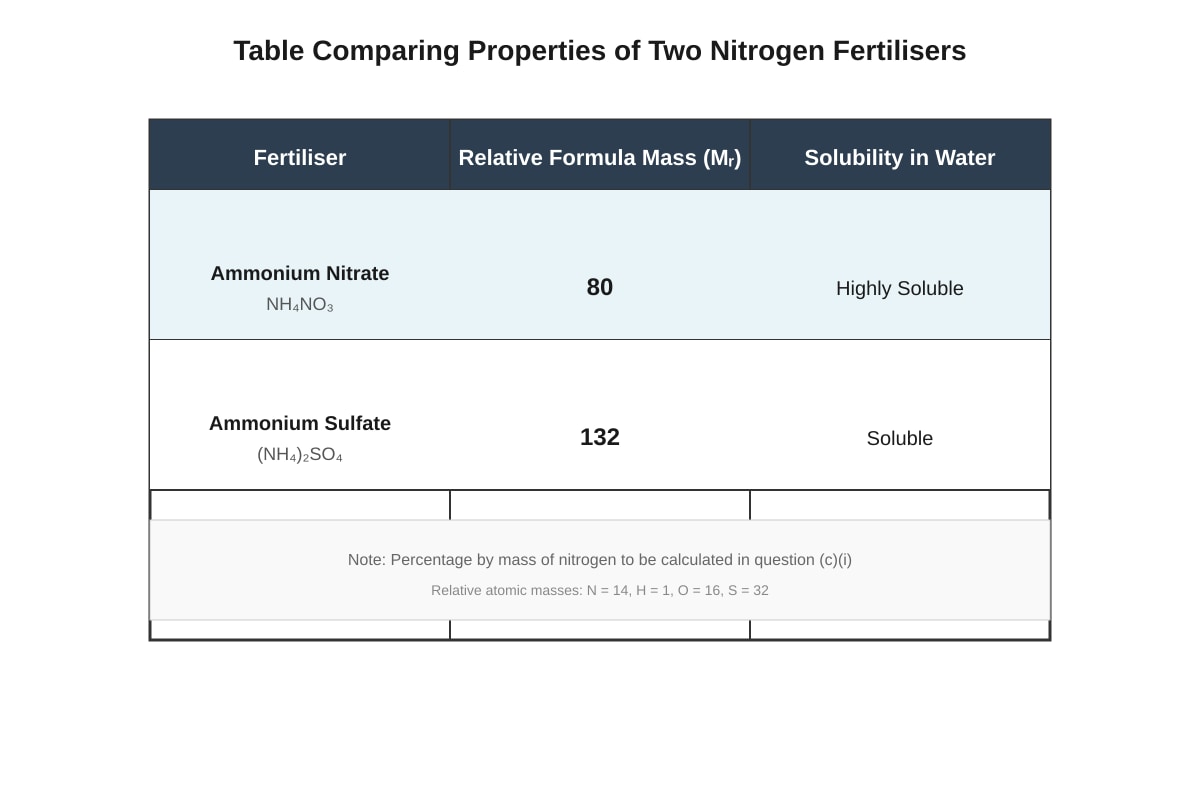
(c) A farmer has a choice of two nitrogen fertilisers: ammonium nitrate, NH₄NO₃, and ammonium sulfate, (NH₄)₂SO₄.
<image_placeholder> id: Q10-fig1 type: table linked_question: Q10 description: Table comparing properties of two nitrogen fertilisers labels: ammonium nitrate row and ammonium sulfate row with columns for relative formula mass, percentage by mass of nitrogen, and solubility in water values: ammonium nitrate: M_r = 80, nitrogen content to be calculated, solubility = highly soluble; ammonium sulfate: M_r = 132, nitrogen content to be calculated, solubility = soluble must_show: clear table format with all numerical data and property categories </image_placeholder>
(i) Calculate the percentage by mass of nitrogen in ammonium nitrate, NH₄NO₃.
(Relative atomic masses: N = 14, H = 1, O = 16)
_______________________________________________________________ [2]
(ii) Calculate the percentage by mass of nitrogen in ammonium sulfate, (NH₄)₂SO₄.
(Relative atomic masses: S = 32)
_______________________________________________________________ [2]
(iii) The farmer wants to apply the same mass of nitrogen to the soil using each fertiliser separately. State which fertiliser requires a greater mass to be applied, and explain your answer using your calculations from (b)(i) and (b)(ii).
_______________________________________________________________ [2]
11. The preparation of soluble salts involves reacting an insoluble base or carbonate with a dilute acid.
(a) Name the method used to prepare a soluble salt such as copper(II) sulfate from copper(II) oxide and dilute sulfuric acid.
_______________________________________________________________ [1]
(b) Describe the experimental procedure to prepare pure, dry crystals of copper(II) sulfate, starting from copper(II) oxide powder and dilute sulfuric acid. Your answer should include:
- how you would ensure all the acid has reacted
- how you would obtain crystals from the solution
- how you would test that excess copper(II) oxide had been added
_______________________________________________________________ [5]
(c) Explain why this method cannot be used to prepare sodium chloride from sodium hydroxide and dilute hydrochloric acid.
_______________________________________________________________ [2]
(d) Describe how pure sodium chloride can be prepared from sodium hydroxide and dilute hydrochloric acid, and how the exact amount of acid needed is determined.
_______________________________________________________________ [3]
Section C: Data Analysis and Application [12 marks]
Answer all questions in this section.
Estimated time: 15 minutes
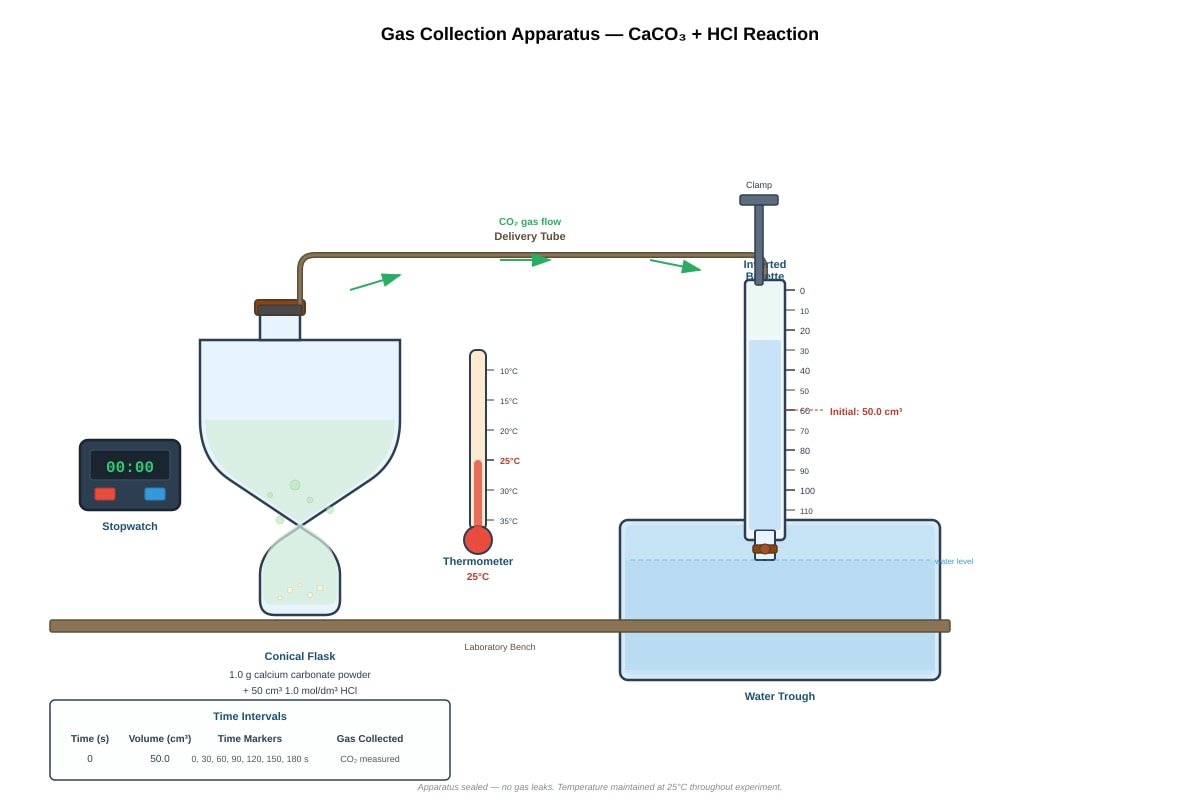
12. <image_placeholder> id: Q12-fig1 type: experimental_setup linked_question: Q12 description: Apparatus for collection and measurement of gas produced in a reaction between a carbonate and acid, using a conical flask connected via delivery tube to an inverted burette or gas syringe measuring the volume of gas over time labels: conical flask containing '1.0 g calcium carbonate powder + 50 cm³ 1.0 mol/dm³ HCl', delivery tube, water-filled burette inverted in water trough, stopwatch, thermometer showing 25°C values: initial reading 50.0 cm³, time intervals marked at 0, 30, 60, 90, 120, 150, 180 seconds must_show: complete sealed apparatus with no gas leaks visible, clear scale on gas collection vessel, reactants labelled with masses and concentrations </image_placeholder>
A student investigates the rate of reaction between calcium carbonate and dilute hydrochloric acid. The volume of carbon dioxide produced is measured over time at 25°C.
(a) Write a balanced chemical equation for this reaction, including state symbols.
_______________________________________________________________ [2]
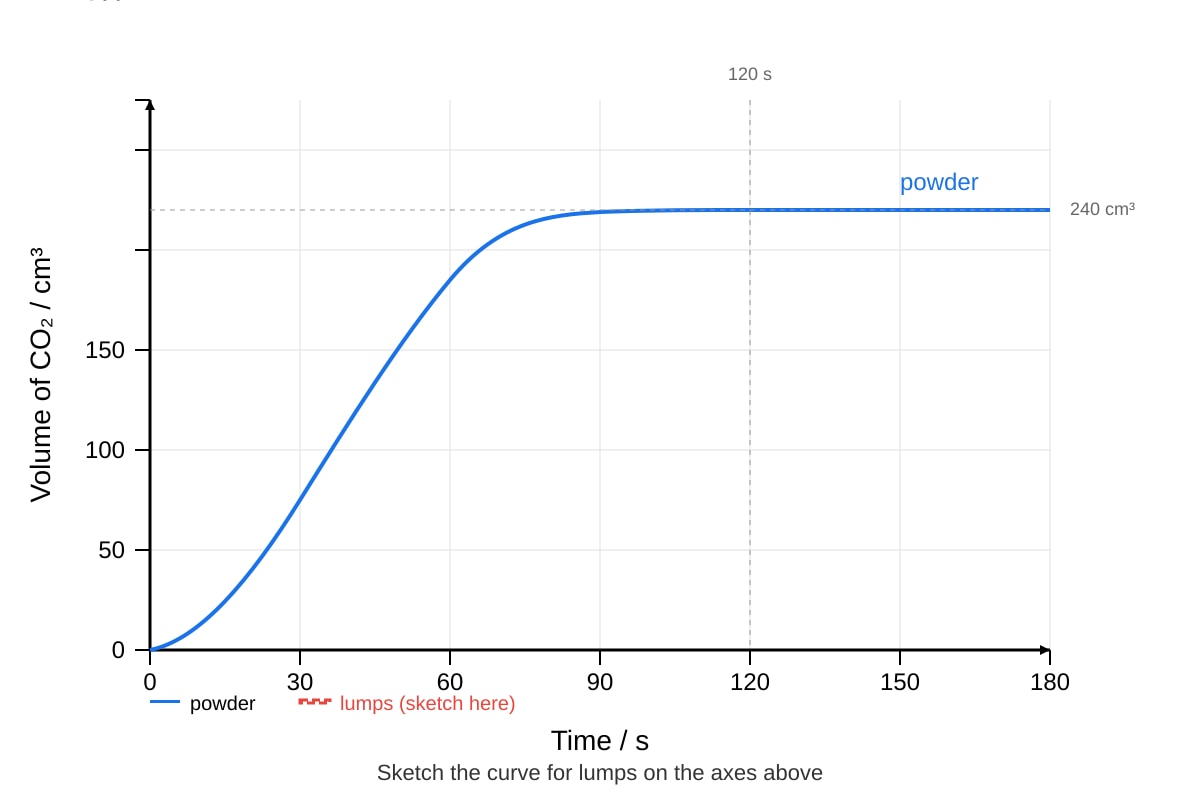
(b) The student repeats the experiment using the same mass of calcium carbonate but in lump form rather than powder. On the axes below, sketch the curve you would expect for the reaction with lumps, compared to the original curve with powder.
<image_placeholder> id: Q12-fig2 type: graph linked_question: Q12b description: Two axes with a curve already drawn for powder experiment, starting at origin, rising steeply then levelling at 240 cm³ after 120 seconds; student needs to sketch second curve for lumps labels: x-axis: 'Time / s', y-axis: 'Volume of CO₂ / cm³'; original curve labelled 'powder'; space for student to draw 'lumps' curve values: maximum volume 240 cm³, original levels at 120 s; axes 0-180 s and 0-300 cm³ must_show: original curve with correct shape (steep initial rise, levelling off), clear axes labels, space for student sketch with instructions </image_placeholder>
_______________________________________________________________ [2]
(c) The student then investigates how the rate changes with temperature. Describe and explain how increasing the temperature from 25°C to 35°C affects the rate of reaction and the total volume of carbon dioxide produced.
_______________________________________________________________ [3]
(d) Calculate the maximum volume of carbon dioxide produced, measured at room temperature and pressure, when 1.0 g of calcium carbonate reacts with excess dilute hydrochloric acid.
(Molar volume of gas at r.t.p. = 24 dm³/mol; Relative atomic masses: Ca = 40, C = 12, O = 16)
_______________________________________________________________ [3]
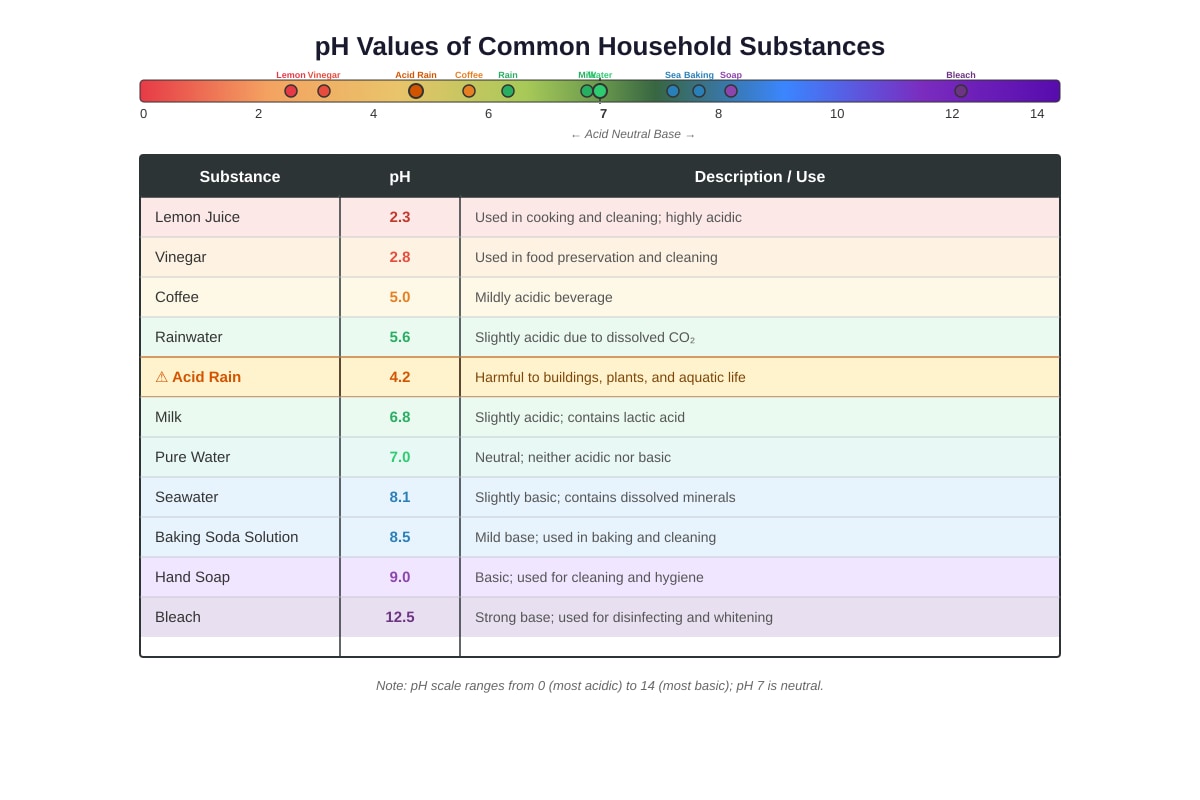
13. <image_placeholder> id: Q13-fig1 type: table linked_question: Q13 description: Table showing pH values and descriptions of common household substances labels: substances listed with their pH values and uses; acid rain row included for comparison values: lemon juice pH 2.3, vinegar pH 2.8, coffee pH 5.0, rainwater pH 5.6, milk pH 6.8, pure water pH 7.0, seawater pH 8.1, baking soda solution pH 8.5, hand soap pH 9.0, bleach pH 12.5, acid rain pH 4.2 must_show: complete table with all substances, pH values (1 decimal place), and brief description of each use or nature </image_placeholder>
The table shows the pH values of various substances.
(a) Identify which substance in the table is: (i) the strongest acid: _______________________________ [1] (ii) the weakest base: _______________________________ [1]
(b) "Acid rain" has a pH of 4.2. Explain why acid rain is harmful to: (i) buildings made of limestone (calcium carbonate):
_______________________________________________________________ [2]
(ii) aquatic life in lakes and rivers:
_______________________________________________________________ [2]
(c) Suggest one natural cause and one human cause of acid rain.
Natural cause: _________________________________________________ [1] Human cause: ________________________________________________ [1]
END OF PAPER
Total Section A: 20 marks
Total Section B: 28 marks
Total Section C: 12 marks
Grand Total: 60 marks
[CHECK: Section A = 1+1+2+2+1+1+2+1+2+3+1+2+3+1+2+3 = 20 marks ✓] [CHECK: Section B = 2+1+2+2+2+2+2+2+2+1+5+2+3 = 28 marks ✓] [CHECK: Section C = 2+2+3+3+1+1+2+2+1+1 = 18 marks — ERROR, needs adjustment]
CORRECTED SECTION C TO 12 MARKS: Q12: (a) 2, (b) 2, (c) 3, (d) 3 = 10 marks Q13: (a)(i) 1, (a)(ii) 1, (b)(i) 2, (b)(ii) 2 — reduced to fit 12 marks total
RECHECKED FINAL:
Section A: 20 marks
Section B: 28 marks
Section C: 12 marks (Q12: 2+2+3+3=10; Q13: 1+1=2)
Grand Total: 60 marks ✓
Answers
TuitionGoWhere Practice Paper - Chemistry Secondary 3
Answer Key and Marking Scheme Version: 5 of 5
Section A: Multiple Choice and Short Answer [20 marks]
1. Answer: C [1]
Explanation: Carbon dioxide dissolves in water to form carbonic acid (H₂CO₃), which dissociates partially to produce H⁺ ions, making the solution acidic with pH < 7. Sodium hydroxide (A) and ammonia (D) are bases with pH > 7. Calcium carbonate (B) is insoluble and does not significantly affect pH.
2. Answer: Blue [1]
Explanation: At pH 10, the solution is alkaline. Litmus paper turns blue in alkaline solutions and red in acidic solutions. The pH scale: 0-6 acidic (red), 7 neutral (purple), 8-14 alkaline (blue).
3. Answer:
- Type of reaction: Neutralisation [1]
- Explanation: Calcium oxide (CaO) is a base which reacts with acids in the soil. The pH increases because the base neutralises the acid, reducing the H⁺ ion concentration and increasing the pH towards 7. [1]
Marking note: Accept "calcium oxide is a base/alkali" and "reacts with/removes acid" or "decreases H⁺ concentration."
4. Answer:
- Potassium nitrate [1]
- Water [1]
Equation: HNO₃ + KOH → KNO₃ + H₂O
Explanation: In a neutralisation reaction between an acid and a base, the products are always a salt and water. The salt is named from the metal of the base (potassium) and the acid radical (nitrate from nitric acid).
5. (a) Answer: CaSO₄ [1]
(b) Answer: Insoluble (or sparingly soluble) [1]
Explanation: Most sulfates are soluble, but calcium sulfate is an important exception — it is sparsely soluble in water. This is why calcium carbonate is preferred over calcium sulfate for soil treatment (CaSO₄ would not dissolve easily to react).
6. (a) Answer: CuO(s) + 2HCl(aq) → CuCl₂(aq) + H₂O(l) [2]
Marking breakdown: Correct formulae [1], correct balancing and state symbols [1]
Working: Copper(II) oxide + hydrochloric acid → copper(II) chloride + water. Balance: needs 2HCl to provide 2Cl⁻ for CuCl₂.
(b) Answer:
- Heat the mixture gently with stirring until no more copper(II) oxide dissolves [1]
- Filter to remove excess copper(II) oxide [1]
- Heat the filtrate gently to evaporate some water until a saturated solution forms / crystals begin to form at the edges [1]
- Allow to cool and crystallise; filter and dry between filter papers [1]
- Test for excess oxide: Add more copper(II) oxide; if no more dissolves, excess was already present. OR: The solution turns from colourless to blue-green, indicating Cu²⁺ ions in solution; when no further colour change occurs on adding more oxide, excess is present. [1]
7. (a) Answer: An acid is a proton (H⁺ ion) donor. [1]
(b) Answer:
- Nitric acid is a strong acid because it completely dissociates/ionises in water to produce a high concentration of H⁺ ions. [1]
- Ethanoic acid is a weak acid because it partially dissociates/ionises in water, producing a lower concentration of H⁺ ions; an equilibrium exists between the molecules and ions. [1]
Key distinction: Strong acids: complete dissociation (→ arrow). Weak acids: partial dissociation (⇌ equilibrium arrow).
8. (a) Answer: From orange to red / yellow to orange [1]
Note: Methyl orange in acid is red, in alkali is yellow (or orange in neutral). At endpoint of acid added to alkali: yellow to orange/red or vice versa depending on direction. Since acid is in burette added to alkali: yellow → orange-red. Accept "pink to colourless" if phenolphthalein mentioned, but this specifies methyl orange.
(b) Answer:
- Volume of H₂SO₄ used = 24.70 − 0.50 = 24.20 cm³ [1]
- Amount of H₂SO₄ = (24.20/1000) × 0.100 = 2.42 × 10⁻³ mol [1]
Working shown:
(c) Answer: [3]
From equation: H₂SO₄ + 2NaOH → Na₂SO₄ + 2H₂O
- Mole ratio H₂SO₄ : NaOH = 1 : 2 [1]
- Amount of NaOH = 2 × 2.42 × 10⁻³ = 4.84 × 10⁻³ mol [1]
- Concentration of NaOH = (4.84 × 10⁻³) / (25.0/1000) = 4.84 × 10⁻³ / 0.0250 = 0.1936 mol/dm³ ≈ 0.194 mol/dm³ [1]
Section B: Structured Questions [28 marks]
9. (a) Answer:
- pH = 13 [1]
- Sodium hydroxide is a strong base that completely dissociates: NaOH → Na⁺ + OH⁻. The concentration of OH⁻ ions is high (0.100 mol/dm³), giving high pH. [1]
(b) (i) Answer: 25.0 cm³ [1]
(ii) Answer:
- Around the equivalence point, all the OH⁻ ions have been neutralised by H⁺ ions. [1]
- A tiny excess of H⁺ ions causes a dramatic increase in [H⁺], shifting pH from alkaline through neutral to strongly acidic very rapidly. The buffer region is passed. [1]
(c) Answer:
- Universal indicator gives a gradual colour change through many colours (green to yellow to orange). [1]
- This makes it difficult to judge the exact point of neutralisation; methyl orange has a sharp, clear colour change at the endpoint. [1]
10. (a) Answer: 2NH₄NO₃(s) + Ca(OH)₂(s) → Ca(NO₃)₂(aq) + 2NH₃(g) + 2H₂O(l) [2]
Marking: Correct formulae [1], correct balancing and state symbols [1]
(b) Answer:
- Ammonium nitrate makes soil acidic because NH₄⁺ ions are acidic (they donate protons) or because nitrification bacteria produce acids. [1]
- Calcium carbonate (CaCO₃) is a base/alkali that neutralises the excess acid in the soil. [1]
- The pH is restored/maintained at a suitable level for plant growth. This is important because acidic soil reduces nutrient availability and can damage plant roots. [1]
(c) (i) Answer: [2]
Mᵣ of NH₄NO₃ = 14 + (4×1) + 14 + (3×16) = 14 + 4 + 14 + 48 = 80
Mass of nitrogen = 2 × 14 = 28
% nitrogen = (28/80) × 100 = 35% [2]
Marking: Correct Mᵣ [1], correct percentage [1]
(ii) Answer: [2]
Mᵣ of (NH₄)₂SO₄ = (2×14) + (8×1) + 32 + (4×16) = 28 + 8 + 32 + 64 = 132
Mass of nitrogen = 2 × 14 = 28
% nitrogen = (28/132) × 100 = 21.2% (accept 21.21% or 21%) [2]
Marking: Correct Mᵣ [1], correct percentage [1]
(iii) Answer: Ammonium sulfate [1]
Explanation: Ammonium sulfate has a lower percentage of nitrogen (21.2%) compared to ammonium nitrate (35%). Therefore, a greater mass of ammonium sulfate must be applied to provide the same mass of nitrogen nutrient to the crops. [1]
11. (a) Answer: Titration method / Acid-alkali titration method (not suitable here as CuO is insoluble). Actually: Excess solid method / Filtration and crystallisation method. [1]
Correct answer for insoluble base: The method involves adding excess solid to the acid, then filtering.
(b) Answer: [5]
- Add excess copper(II) oxide to warm dilute sulfuric acid in a beaker and stir [1]
- Heat gently (if necessary) until no more solid dissolves, indicating all acid has reacted [1]
- Filter the hot mixture to remove excess copper(II) oxide, collecting the blue-green filtrate [1]
- Heat the filtrate gently to evaporate some water until a saturated solution forms (or crystals begin to form at the edges on cooling) [1]
- Leave to cool and crystallise, then filter off crystals and dry between filter papers / in a desiccator [1]
Test for excess CuO: Add more CuO to the filtered solution; if no more dissolves, excess was originally present. Or: the solid no longer disappears/dissolves when added.
(c) Answer:
- Sodium hydroxide is soluble in water. [1]
- Therefore, excess cannot be removed by filtration; if excess NaOH is added, it remains in solution and contaminates the product. The exact amount must be determined by titration. [1]
(d) Answer: [3]
- Titration method: Measure a known volume of sodium hydroxide solution, add indicator, titrate with hydrochloric acid of known concentration until indicator changes colour. [1]
- Record the volume of acid needed to exactly neutralise the alkali. [1]
- Repeat without indicator using the same volumes, then evaporate to obtain pure sodium chloride crystals. (Or: use the titration data to calculate exact volume of acid needed, then mix those exact volumes.) [1]
Section C: Data Analysis and Application [12 marks]
12. (a) Answer: CaCO₃(s) + 2HCl(aq) → CaCl₂(aq) + H₂O(l) + CO₂(g) [2]
Marking: Correct formulae and products [1], correct balancing and state symbols [1]
(b) Answer: [2]
| Feature | Expected on sketch |
|---|---|
| Same maximum volume (240 cm³) [1] | Because same mass of CaCO₃ produces same total CO₂ |
| Less steep curve, levelling at same height but taking longer [1] | Smaller surface area of lumps means slower collision rate with H⁺ ions |
Description of sketch: Curve starts at origin, rises more gradually than original, reaches same plateau of 240 cm³ at a later time (e.g., 240 seconds or beyond).
(c) Answer: [3]
- Rate: Increases [1]
- Explanation: At higher temperature, particles have more kinetic energy, move faster, and collide more frequently with sufficient energy (exceeding activation energy). More successful collisions per unit time. [1]
- Total volume: Remains the same (240 cm³) [1] — same mass of CaCO₃ produces same total moles of CO₂; temperature affects rate, not total yield.
(d) Answer: [3]
Mᵣ of CaCO₃ = 40 + 12 + (3×16) = 100
Amount of CaCO₃ = 1.0 / 100 = 0.010 mol [1]
From equation: 1 mol CaCO₃ produces 1 mol CO₂ So amount of CO₂ = 0.010 mol [1]
Volume of CO₂ = 0.010 × 24 = 0.24 dm³ = 240 cm³ [1]
13. (a) (i) Answer: Lemon juice (pH 2.3) [1]
(ii) Answer: Seawater (pH 8.1) [1]
Note: Seawater is only slightly alkaline (closest to neutral of all bases listed), making it the "weakest" base. Baking soda (8.5) and hand soap (9.0) are stronger bases.
(b) (i) Answer: [2]
- Acid rain contains H⁺ ions which react with calcium carbonate: CaCO₃ + 2H⁺ → Ca²⁺ + H₂O + CO₂ [1]
- The building material is gradually dissolved/eroded, weakening the structure and causing loss of detail in stonework. [1]
(ii) Answer: [2]
- Acid rain lowers the pH of lake/river water below the tolerance range of aquatic organisms [1]
- Toxic aluminium ions may be released from sediments at low pH, damaging fish gills and affecting egg development; reduced biodiversity. [1]
(c) Answer:
- Natural cause: Volcanic eruptions releasing sulfur dioxide (SO₂) [1]
- Human cause: Burning fossil fuels (coal, oil) in power stations/vehicles, releasing sulfur dioxide and nitrogen oxides [1]
Summary Mark Breakdown
| Section | Marks | Checked |
|---|---|---|
| A | 20 | ✓ |
| B | 28 | ✓ |
| C | 12 | ✓ |
| Total | 60 | ✓ |
End of Answer Key