AI Generated Exam Paper
Secondary 3 Chemistry Practice Paper 5
Free Sec 3 Chemistry Practice Paper 5, HY3 AI version, with questions, answers, and O Level-style practice for Singapore students.
These static practice materials are generated from the site's syllabus and paper-generation workflow, with source and model context shown so students and parents can evaluate the material before use.
Questions
TuitionGoWhere Practice Paper - Chemistry Secondary 3
TuitionGoWhere Practice Paper (AI) — Version 5
Subject: Chemistry
Level: Secondary 3
Paper: Practice Paper (Topic: Acids, Bases & Salts)
Duration: 45 minutes
Total Marks: 40
Name:
Class:
Date:
Instructions
- Answer all questions in the spaces provided.
- Use a pen with blue or black ink.
- Show all working clearly for calculation questions.
- State units where required.
- This practice paper is generated from syllabus-first templates and is not an official examination paper.
Section A: Multiple Choice and Short Answer (Questions 1–8) [8 marks]
-
Which solid compound is added to acidic soil to increase its pH? [1]
-
State the name of the salt formed when hydrochloric acid reacts with potassium hydroxide. [1]
-
A solution has pH = 3. State whether it is acidic, neutral, or alkaline. [1]
-
Name two compounds that react together to form an ammonium salt. [1]
-
Give the formula of the ion that makes a solution acidic. [1]
-
State the colour of litmus paper in a solution of pH 9. [1]
-
Write the chemical formula of calcium hydroxide. [1]
-
Name the type of reaction that occurs between an acid and a base. [1]
Section B: Structured Questions (Questions 9–14) [18 marks]
-
A student adds nitric acid to sodium hydroxide until neutral. (a) Write a balanced equation with state symbols. [2] (b) Name the salt formed. [1]
-
Describe how you would prepare pure dry crystals of zinc sulfate starting from zinc oxide and sulfuric acid. Include the method name and key steps. [3]
-
A titration was carried out using 25.0 cm³ of hydrochloric acid (concentration 0.100 mol/dm³) with sodium hydroxide. (a) Calculate the number of moles of HCl used. [2] (b) Write the equation and state the mole ratio of HCl to NaOH. [1]
-
The table shows pH values of four household substances.
Substance pH Vinegar 3 Milk 6 Soap 10 Water 7 (a) Which is most acidic? [1] (b) Which is alkaline? [1] (c) Arrange from most acidic to most alkaline. [1] -
Explain why aluminum hydroxide is described as amphoteric. Include one reaction with acid and one with alkali. [3]
-
A student prepared copper(II) chloride by adding excess copper(II) carbonate to hydrochloric acid. (a) Write the equation for the reaction. [2] (b) Describe how to obtain pure dry crystals. [2]
Section C: Calculation and Interpretation (Questions 15–20) [14 marks]
-
20.0 cm³ of 0.200 mol/dm³ sulfuric acid is neutralised by sodium hydroxide. Equation: H₂SO₄ + 2NaOH → Na₂SO₄ + 2H₂O Calculate the moles of NaOH required. [3]
-
A titration gave these volumes of NaOH needed to neutralise 25.0 cm³ of acid: Trial 1 (rough): 24.8 cm³ Trial 2: 23.1 cm³ Trial 3: 23.3 cm³ Trial 4: 23.2 cm³ Calculate the average volume of NaOH from concordant results. [2]
-
The pH of a solution changes from 2 to 5 after adding base. (a) Does the H⁺ concentration increase or decrease? [1] (b) By what factor does the H⁺ concentration change? [2]
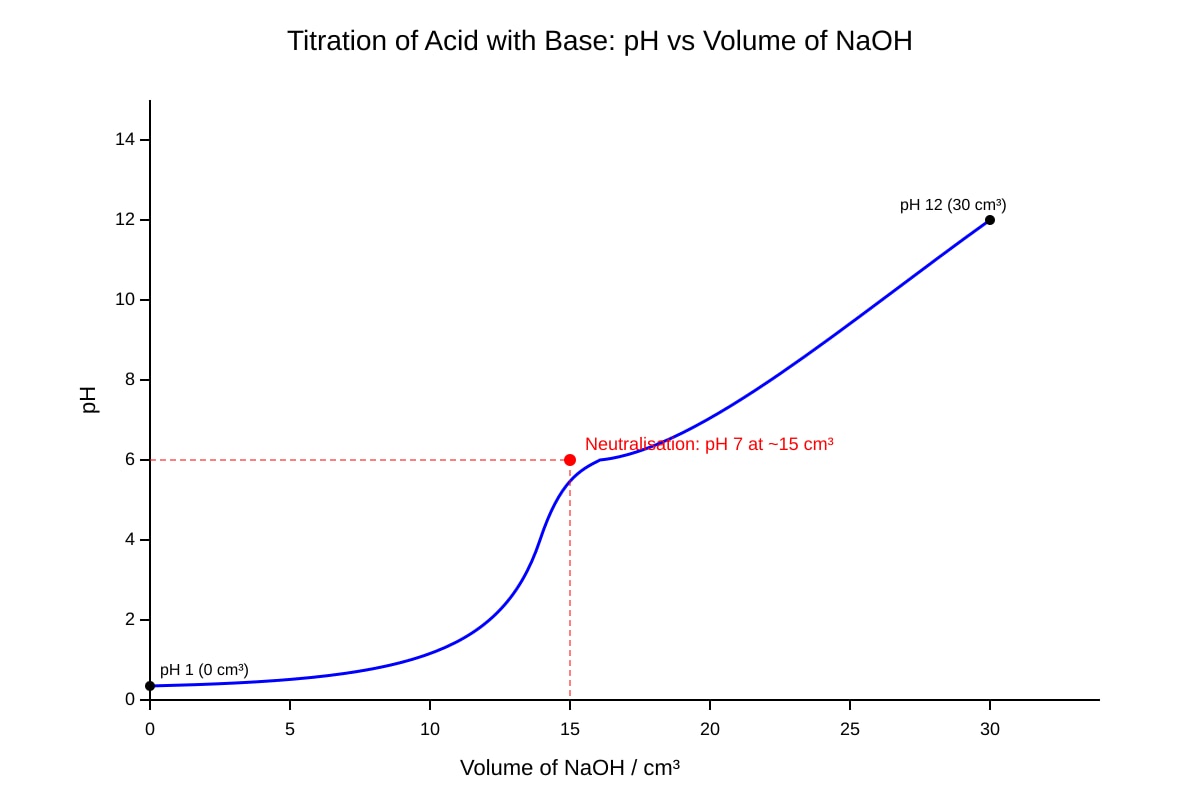
Image pending generation: graph for Q18.
Using the graph, state the volume of base at neutralisation. [1]
19. Calculate the mass of sodium chloride formed when 0.050 mol of HCl reacts with excess NaOH. (Relative atomic masses: Na = 23, Cl = 35.5) [3]
- A fertilizer contains ammonium nitrate. Explain why it is not suitable to use with alkaline soil, using a chemical equation. [3]
Answers
TuitionGoWhere Practice Paper — Answer Key (Version 5)
Subject: Chemistry
Level: Secondary 3
Topic: Acids, Bases & Salts
Total Marks: 40
Section A (8 marks)
-
Calcium oxide / calcium hydroxide / calcium carbonate [1]
Teaching note: Bases increase pH. Common soil amendments are CaO, Ca(OH)₂, CaCO₃. Avoid naming neutral salts like NaCl. -
Potassium chloride [1]
KOH + HCl → KCl + H₂O. Salt = metal from base + non-metal from acid. -
Acidic [1]
pH < 7 is acidic. -
Ammonia (NH₃) and an acid (e.g. HCl) [1]
Ammonium salts form from NH₃ + acid. -
H⁺ [1]
Hydrogen ion causes acidity. -
Blue [1]
Litmus is blue in alkaline (pH > 7). -
Ca(OH)₂ [1]
-
Neutralisation [1]
Section B (18 marks)
-
(a) HNO₃(aq) + NaOH(aq) → NaNO₃(aq) + H₂O(l) [2: 1 eq, 1 states]
(b) Sodium nitrate [1] -
Method: Direct combination / neutralisation [1]
Steps: (1) Add excess ZnO to dilute H₂SO₄, warm until no more dissolves [1]; (2) Filter off excess ZnO [0.5]; (3) Evaporate filtrate and cool to crystallise, dry crystals [0.5]. Total [3] -
(a) n = c × V = 0.100 × (25.0/1000) = 0.00250 mol [2: 1 formula, 1 answer]
(b) HCl + NaOH → NaCl + H₂O; ratio 1:1 [1] -
(a) Vinegar [1] (b) Soap [1] (c) Vinegar, Milk, Water, Soap [1]
-
Amphoteric means reacts with both acids and alkalis [1].
With acid: Al(OH)₃ + 3HCl → AlCl₃ + 3H₂O [1]
With alkali: Al(OH)₃ + NaOH → NaAlO₂ + 2H₂O (or Na[Al(OH)₄]) [1] -
(a) CuCO₃ + 2HCl → CuCl₂ + CO₂ + H₂O [2]
(b) Filter, evaporate filtrate to crystallisation, cool, filter crystals, dry [2]
Section C (14 marks)
-
n(H₂SO₄) = 0.200 × 0.0200 = 0.00400 mol [1]
Ratio H₂SO₄:NaOH = 1:2 [1]
n(NaOH) = 0.00800 mol [1] Total [3] -
Concordant: 23.1, 23.3, 23.2 (exclude rough 24.8) [1]
Avg = (23.1+23.3+23.2)/3 = 23.2 cm³ [1] -
(a) Decrease [1] (b) pH rise by 3 = 10⁻³ factor, so ×1/1000 or divide by 1000 [2]
-
From graph, neutralisation at 15 cm³ [1] (point where pH = 7).
-
HCl + NaOH → NaCl + H₂O (1:1) [1]
n(NaCl) = 0.050 mol [1]
M(NaCl) = 23+35.5 = 58.5 g/mol; mass = 0.050 × 58.5 = 2.925 g [1] -
Alkaline soil contains OH⁻ which reacts with NH₄⁺ releasing NH₃ gas, reducing fertilizer value [1].
Equation: NH₄NO₃ + OH⁻ → NH₃ + NO₃⁻ + H₂O (or with NaOH) [2]
Free quiz and exam paper access
Enter your details to view this paper
Your access is remembered on this device.