AI Generated Exam Paper
Secondary 3 Chemistry Practice Paper 4
Free Sec 3 Chemistry Practice Paper 4, Kimi2.6 AI version, with questions, answers, and O Level-style practice for Singapore students.
These static practice materials are generated from the site's syllabus and paper-generation workflow, with source and model context shown so students and parents can evaluate the material before use.
Questions
Free quiz and exam paper access
Enter your details to view this paper
Your access is remembered on this device.
Answers
TuitionGoWhere Practice Paper - Chemistry Secondary 3: Answer Key (Version 4)
Total Marks: 80
Section A: Multiple Choice [10 marks]
| Question | Answer | Explanation |
|---|---|---|
| 1 | B | H⁺(aq) is the common ion in all acids. OH⁻ indicates bases; Cl⁻ and Na⁺ are spectator ions. |
| 2 | C | HCl is strong (fully ionised) so [H⁺] = [acid]. 0.001 mol/dm³ → pH = -log(0.001) = 3. Each 10× dilution increases pH by 1. |
| 3 | C | NaOH is a strong alkali (caustic soda)—too corrosive for internal use. Others are weak bases safe in antacids. |
| 4 | B | Excess insoluble base ensures all acid reacts; unreacted base is filtered off. Prevents acid contamination of product. |
| 5 | C | Carbonate + acid → salt + water + carbon dioxide. A is metal + acid; B is metal oxide + acid; D is neutralisation. |
| 6 | A | KNO₃ is soluble—titration (acid + alkali) gives pure soluble salt. B would need filtration but product is soluble. C gives no precipitate. D is not a preparative method. |
| 7 | D | [H⁺] = 10⁻⁹ mol/dm³, so pH = 9. This is alkaline (pH > 7). Note: 10⁻⁹ is less than 10⁻⁷ (neutral). |
| 8 | B | AgCl is insoluble (white precipitate). All other combinations produce soluble products. |
| 9 | B | Forward reaction is exothermic; higher T would shift equilibrium left (Le Chatelier), reducing yield. Catalyst + compromise T balances rate and yield. |
| 10 | B | Weak alkali = partially ionised. A describes insoluble base; C is neutral; D is false—all bases react with acids. |
Section A Total: 10 marks
Section B: Short Answer and Structured Questions [30 marks]
11 (a) An acid is a substance that donates protons (H⁺ ions) or produces H⁺ ions in aqueous solution. [1]
(b) An alkali is a soluble base that produces hydroxide ions (OH⁻) in aqueous solution. [1]
(c) Neutralisation is the reaction between an acid and a base to produce salt and water only. [1]
Teaching note: Brønsted-Lowry definitions preferred at O-Level. Arrhenius definitions acceptable. Neutralisation must mention salt + water as products.
12
| Reactant 1 | Reactant 2 | Product(s) | Type of reaction |
|---|---|---|---|
| (completed) | |||
| Copper(II) oxide | Sulfuric acid | Copper(II) sulfate + Water | Metal oxide + Acid |
| Sodium carbonate | Nitric acid | Sodium nitrate + Water + Carbon dioxide | Carbonate + Acid |
| Magnesium | Ethanoic acid | Magnesium ethanoate + Hydrogen | Metal + Acid |
[4 marks: 1 mark per correct row for products and type]
13 (a) [2: 1 forbalanced equation, 1 for state symbols]
(b) Heating increases the rate of reaction / provides activation energy / increases kinetic energy of particles, leading to more successful collisions per unit time. [1]
(c) Excess/unreacted copper(II) oxide (insoluble solid) is removed. [1]
(d) Evaporating to dryness would cause: [1]
- Spitting/decomposition of the salt / loss of water of crystallisation / formation of powder rather than crystals
Evaporating to crystallisation point then cooling allows slow, ordered crystal formation, giving regular crystals with correct water of crystallisation. [1]
14 (a) pH 7 [1] (at 25°C; water is neutral)
(b) pH = -log[H⁺], so [H⁺] = 10^(-pH) = 10^(-2.5) = 3.16 × 10⁻³ mol/dm³ (accept 3.2 × 10⁻³) [2 marks: 1 for correct method, 1 for answer]
(c) HCl is a strong acid and fully ionised, giving high [H⁺] and low pH. [1]
Ethanoic acid is a weak acid and partially ionised (equilibrium lies to left), giving lower [H⁺] for same concentration and hence higher pH. [1]
15 (a) [2: 1 for formulae, 1 for balancing and state symbols]
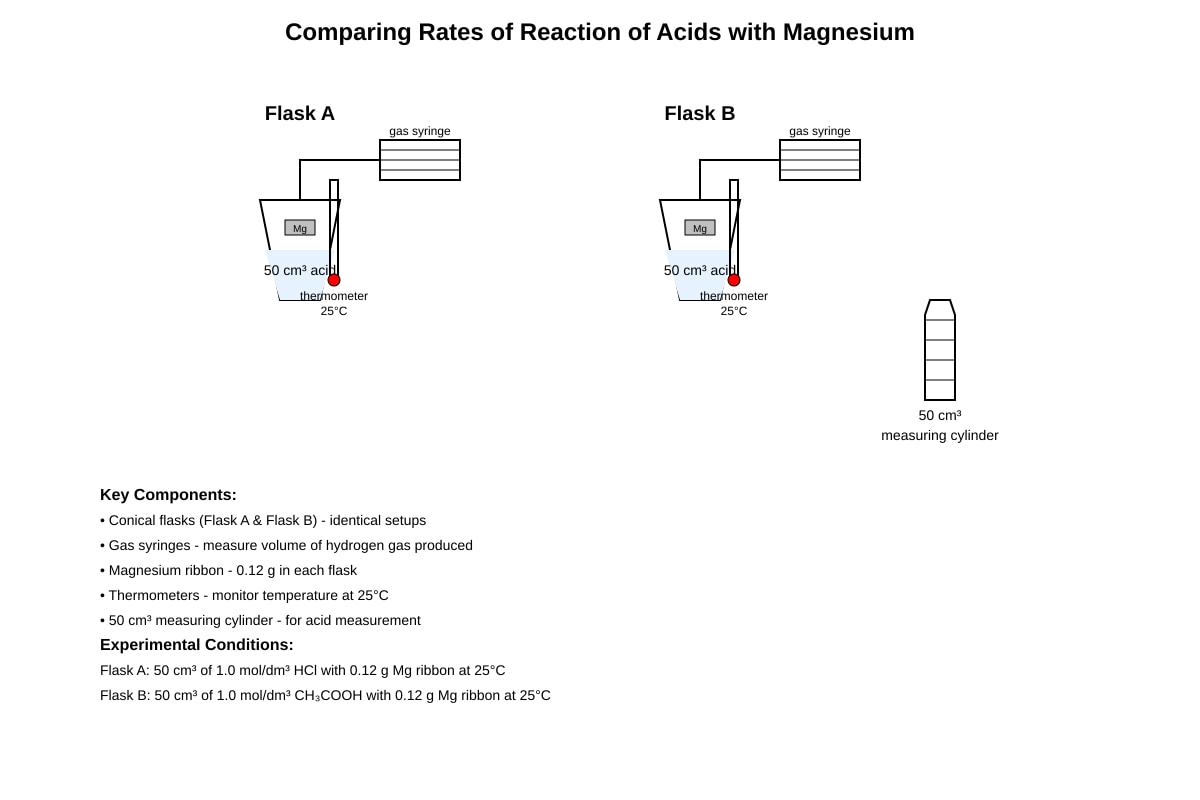
(b) Both acids have same concentration, but HCl is a strong acid (fully dissociated into H⁺ and Cl⁻ ions). [1]
Ethanoic acid is a weak acid (partially dissociated, CH₃COOH ⇌ CH₃COO⁻ + H⁺, equilibrium to left). [1]
Therefore HCl has higher [H⁺] at same concentration, leading to more frequent successful collisions with Mg and faster rate. [1]
(c) Any two from: temperature; mass/amount of magnesium; surface area of magnesium; total volume of acid; same diameter gas syringe [2]
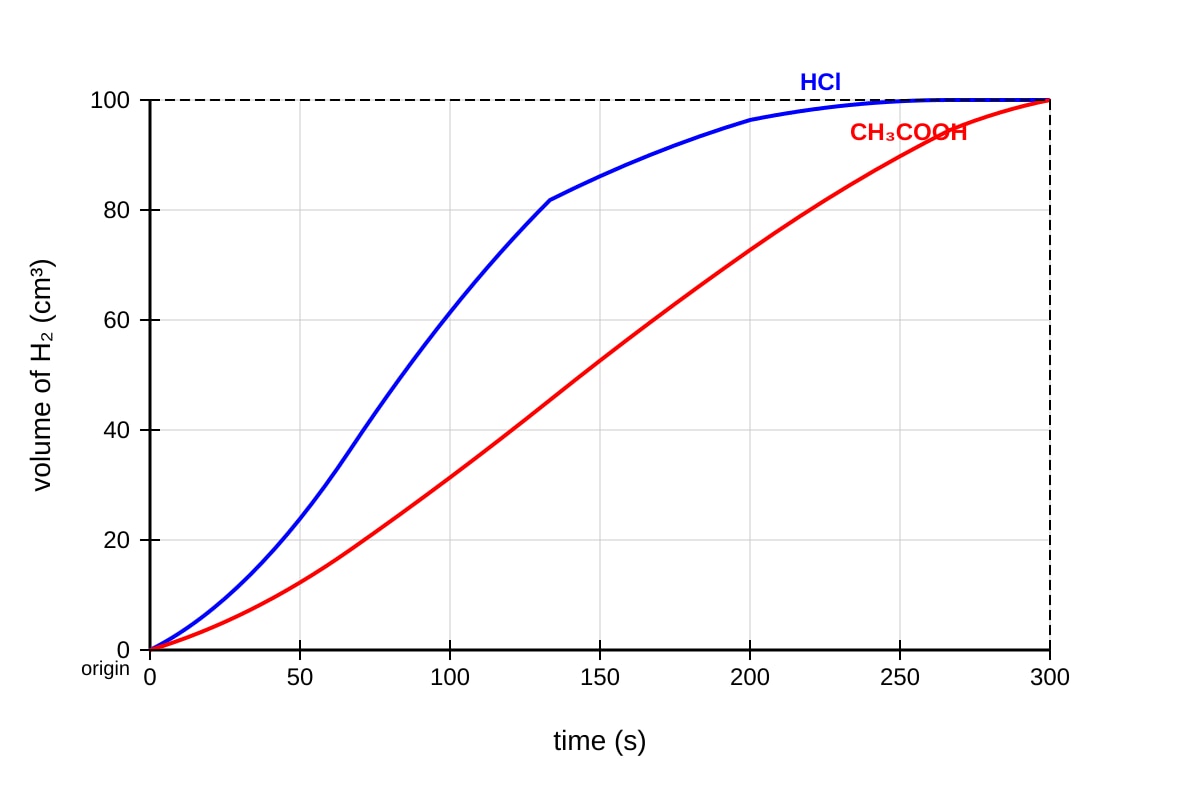
(d) Expected features for graph:
Image pending generation: graph for Q15.
Marking: [3]
- Both curves start at origin, both show increase then level off [1]
- HCl curve clearly steeper than CH₃COOH curve [1]
- Both reach same maximum volume (final amount H₂ same because same Mg used, stoichiometric excess of acid) [1]
16 (a) [2: 1 formulae/charges, 1 state symbols]
(b) Barium sulfate is insoluble in water (Ksp very low ≈ 1 × 10⁻¹⁰). [1]
Therefore negligible Ba²⁺ ions dissolve to be absorbed into bloodstream; the solid passes through digestive system unchanged. [1]
(c) Barium sulfate is insoluble; titration requires soluble reactants that react completely in solution to give soluble products for accurate end-point determination. [1]
17 (a) Temperature: 450°C (accept 400-500°C); Pressure: 200 atm (accept 150-250 atm) [2]
(b) Lower temperature would favour the exothermic forward reaction (higher yield by Le Chatelier), but the rate would be too slow at low temperature for economic production. [1]
450°C is a compromise giving reasonable yield with acceptable rate, aided by catalyst. [1]
(c) Unreacted N₂ and H₂ are recycled back into the reactor to improve overall yield and reduce raw material costs. [1]
Section C: Data Analysis and Extended Response [25 marks]
18 (a)
| Titration | 1 (rough) | 2 | 3 |
|---|---|---|---|
| Final | 26.50 | 24.80 | 25.10 |
| Initial | 1.20 | 0.50 | 1.00 |
| Volume used (cm³) | 25.30 | 24.30 | 24.10 |
[2 marks: all three correct; 1 mark if two correct]
(b) Titration 1 is rough and accepted as approximate; check concordance of 2 and 3: difference = 0.20 cm³ (within 0.20 cm³, both concordant). [1]
Mean = (24.30 + 24.10) / 2 = 24.20 cm³ [1]
If using all three: (25.30 + 24.30 + 24.10)/3 = 24.57 cm³ — accept with valid reasoning, but exclude rough titration by standard practice.
(c) Moles of H₂SO₄ = 0.200 × (24.20/1000) = 0.00484 mol [1]
(d) From equation: mole ratio H₂SO₄ : KOH = 1 : 2 [1]
Moles of KOH = 2 × 0.00484 = 0.00968 mol [1]
Concentration of KOH = 0.00968 / (25.0/1000) = 0.387 mol/dm³ (accept 0.39 or 0.3872) [1]
19 (a) Tall chimneys disperse pollutants higher into the atmosphere where winds carry them further. [1] SO₂ remains in air longer, reacting with water/oxidising to form H₂SO₄ over greater distances rather than depositing locally. [1]
(b)(i) (sulfurous acid) [1]
(b)(ii) or [1]
(Alternative: SO₃ + H₂O → H₂SO₄, but must show oxidation step)
(c) Any two: [2]
- Flue gas desulfurisation (limestone scrubbing: CaCO₃ or Ca(OH)₂ to absorb SO₂)
- Use low-sulfur fuels
- Catalytic converters / alternative energy sources (nuclear, renewables, hydro)
- Fluidised bed combustion to capture sulfur during burning
(d) pH difference = 6.5 − 4.5 = 2 units [1]
[H⁺] ratio = 10² = 100 times greater (or 10^(6.5-4.5) = 10²) [1]
20 (a) Preparation of lead(II) iodide:
Reactants: Lead(II) nitrate solution and potassium iodide solution (or any soluble lead(II) salt and soluble iodide) [1]
Apparatus: Beaker, glass rod, filter funnel, filter paper, distilled water, evaporating dish or paper to dry [1]
Method:
- Mix solutions in beaker — yellow precipitate forms immediately: [1]
- Stir with glass rod to ensure complete reaction [1]
- Filter using filter paper in funnel; residue is lead(II) iodide, filtrate contains soluble potassium nitrate [1]
- Wash residue with distilled water to remove soluble potassium nitrate and excess reactants [1]
- Dry precipitate between filter papers or in warm oven (not strong heat—lead(II) iodide is sensitive to light/heat may cause issues; warm drying preferred) [1]
Teaching note: This is a precipitation method for insoluble salts. Lead(II) iodide is distinctive yellow, sparingly soluble in hot water (can be used for recrystallisation test).
(b)
| Method | Advantage | Disadvantage |
|---|---|---|
| 1: Zn + H₂SO₄ | No filtration needed (Zn dissolves completely if excess controlled); hydrogen by-product easily removed | Dangerous — explosive hydrogen gas produced; rate may be vigorous/hard to control; needs safety measures [2] |
| 2: ZnCO₃ + H₂SO₄ | Easy to control — reaction moderate; CO₂ not hazardous in small amounts; excess carbonate visible (bubbles stop when acid consumed) | CO₂ produced needs ventilation; must filter off any undissolved impurity if carbonate impure [2] |
| 3: ZnO + H₂SO₄ | Easy to control, no gas produced; excess oxide easily filtered; clean method | Slightly slower than metal; need to ensure complete reaction by warming [2] |
Accept other valid points. Each method needs distinct advantage and disadvantage.
Section D: Application and Synthesis [15 marks]
21 (a) Carbon dioxide (CO₂) [1] — turns limewater milky (test for CO₂)
(b) Sodium (Na⁺) — yellow-orange flame colour characteristic of sodium [1]
(c) Iodide (I⁻) [2]
Evidence: Yellow precipitate with AgNO₃; insoluble in dilute NH₃ and slightly soluble in concentrated NH₃ is characteristic of silver iodide (AgI). Other yellow silver halide precipitate would be AgBr (cream, soluble in conc NH₃) or AgCl (white, soluble in dilute NH₃). [1 for iodide, 1 for reasoning from observations]
(d) [2: 1 formulae/charges, 1 state symbols]
(e) Confirmatory test for iodide:
- Add acidified silver nitrate to solution of solid (acidified with dilute nitric acid prevents precipitation of other silver salts like Ag₂CO₃) [1]
- Yellow precipitate confirms halide present [1]
- Add concentrated ammonia — AgI is insoluble (distinction from AgCl soluble in dilute NH₃, AgBr soluble in conc NH₃ only); or add chlorine water and organic solvent — iodide liberates iodine (brown in water, purple in organic layer) [1]
22 (a) [2: 1 balanced equation, 1 state symbols]
(Or with H₂SO₄: 3H₂SO₄ + Fe₂O₃ → Fe₂(SO₄)₃ + 3H₂O — but question specifies HCl)
(b)(i) Moles = 0.495 / 98 = 0.00505 mol or 5.05 × 10⁻³ mol (accept 0.005 mol) [1]
(b)(ii) Volume = 330 cm³ = 0.330 dm³ [1]
Concentration = 0.00505 / 0.330 = 0.0153 mol/dm³ (accept 0.015 or 0.0152) [1]
(c)(i) CH₃COO⁻ (ethanoate ion) — this is the conjugate base; some H⁺ also present: CH₃COOH ⇌ CH₃COO⁻ + H⁺ [1]
(c)(ii) Strong acid (HCl): Fully ionised in water, HCl → H⁺ + Cl⁻, equilibrium lies completely to right, high [H⁺]. [1]
Weak acid (CH₃COOH): Partially ionised in water, CH₃COOH ⇌ CH₃COO⁻ + H⁺, equilibrium lies to left, most molecules remain un-ionised, low [H⁺] for same concentration. [1]
Therefore HCl is strong (complete ionisation), ethanoic acid is weak (incomplete ionisation). [1]
23 (a) Sulfur from crude oil/natural gas refining (removing sulfur compounds) or mining of sulfur/Frasch process from underground deposits or metal sulfide ores/metallurgy [1]
(b) Molar mass S = 32 g/mol; SO₂ = 64 g/mol [1]
Moles of S = 100 × 10⁶ × 1000 / 32 = 3.125 × 10⁹ mol (or ratio method: mass SO₂ = mass S × 64/32) [1]
Mass of SO₂ = 100 × (64/32) = 200 tonnes (or 2.0 × 10⁸ g / 200,000 kg) [1]
(Simple ratio: S → SO₂ is 1:1 mass ratio 32:64, so 100 tonnes S → 200 tonnes SO₂)
(c)(i) Without catalyst, rate would be too slow at compromise temperature for economic production. [1]
Vanadium(V) oxide provides alternative pathway with lower activation energy, giving acceptable rate at moderate temperature without excessive energy costs. [1]
(c)(ii) Higher pressure favours side with fewer gas moles — product side has 2 moles vs 3 moles reactants, so forward reaction favoured, increasing SO₃ yield. [1]
Not used industrially because: very high pressures require expensive, thick-walled vessels; [1] greater safety risks; compression costs exceed benefit from marginally improved yield (already good at 1-2 atm with catalyst). [1]
[END OF ANSWER KEY — Total: 80 marks]