AI Generated Exam Paper
Secondary 3 Chemistry Practice Paper 4
Free Sec 3 Chemistry Practice Paper 4, HY3 AI version, with questions, answers, and O Level-style practice for Singapore students.
These static practice materials are generated from the site's syllabus and paper-generation workflow, with source and model context shown so students and parents can evaluate the material before use.
Questions
TuitionGoWhere Practice Paper - Chemistry Secondary 3
TuitionGoWhere Practice Paper (AI) — Version 4 of 5
Subject: Chemistry
Level: Secondary 3
Paper: Practice Paper (Topic: Acids, Bases & Salts)
Duration: 60 minutes
Total Marks: 40
Name: ________________________
Class: ________
Date: ________
Instructions:
- Answer all questions in the spaces provided.
- Use a calculator where necessary.
- Show all working clearly for calculation questions.
- This practice paper is generated from syllabus-first inferred templates. It is NOT derived from official past-year papers.
Section A: Multiple Choice and Short Answer (Questions 1–8) [12 marks]
1. Which solid compound is added to acidic soil to increase its pH? [1]
2. State the name of the salt formed when hydrochloric acid reacts with potassium hydroxide. [1]
3. A solution has a pH of 2. State whether it is acidic, neutral, or alkaline. [1]
4. Which two compounds react together to form an ammonium salt? [1]
5. Give the formula of the ion that makes a solution acidic. [1]
6. Name the method used to prepare copper(II) sulfate crystals from copper(II) oxide and dilute sulfuric acid. [1]
7. State the colour of litmus paper in a solution of pH 9. [1]
8. Write the chemical equation for the reaction between nitric acid and sodium hydroxide. Include state symbols. [1]
Section B: Structured Response (Questions 9–14) [16 marks]
9. A student adds sulfuric acid to sodium hydroxide until neutralisation is complete.
(a) Write a balanced chemical equation for this reaction. [1]
(b) Name the salt formed. [1]
10. Describe how you would prepare pure, dry crystals of zinc sulfate starting from zinc carbonate and dilute sulfuric acid. Include the method name and key steps. [3]
11. The table below shows the pH of four household substances.
| Substance | pH |
|---|---|
| Vinegar | 3 |
| Milk | 6 |
| Soap | 10 |
| Water | 7 |
(a) Which substance is most acidic? [1]
(b) Which substance is alkaline? [1]
(c) Arrange the substances from most acidic to most alkaline. [1]
12. Aluminum oxide is an amphoteric oxide.
(a) State what is meant by "amphoteric". [1]
(b) Write a balanced equation for aluminum oxide reacting with hydrochloric acid. [2]
13. A student performed a titration using 25.0 cm³ of hydrochloric acid (concentration 0.100 mol/dm³) and sodium hydroxide of unknown concentration. The average volume of alkali used was 20.0 cm³.
(a) Calculate the number of moles of HCl used. [2]
(b) Calculate the concentration of the sodium hydroxide solution in mol/dm³. [2]
14. State two differences between a strong acid and a dilute acid. [2]
Section C: Data Interpretation and Extended Reasoning (Questions 15–20) [12 marks]
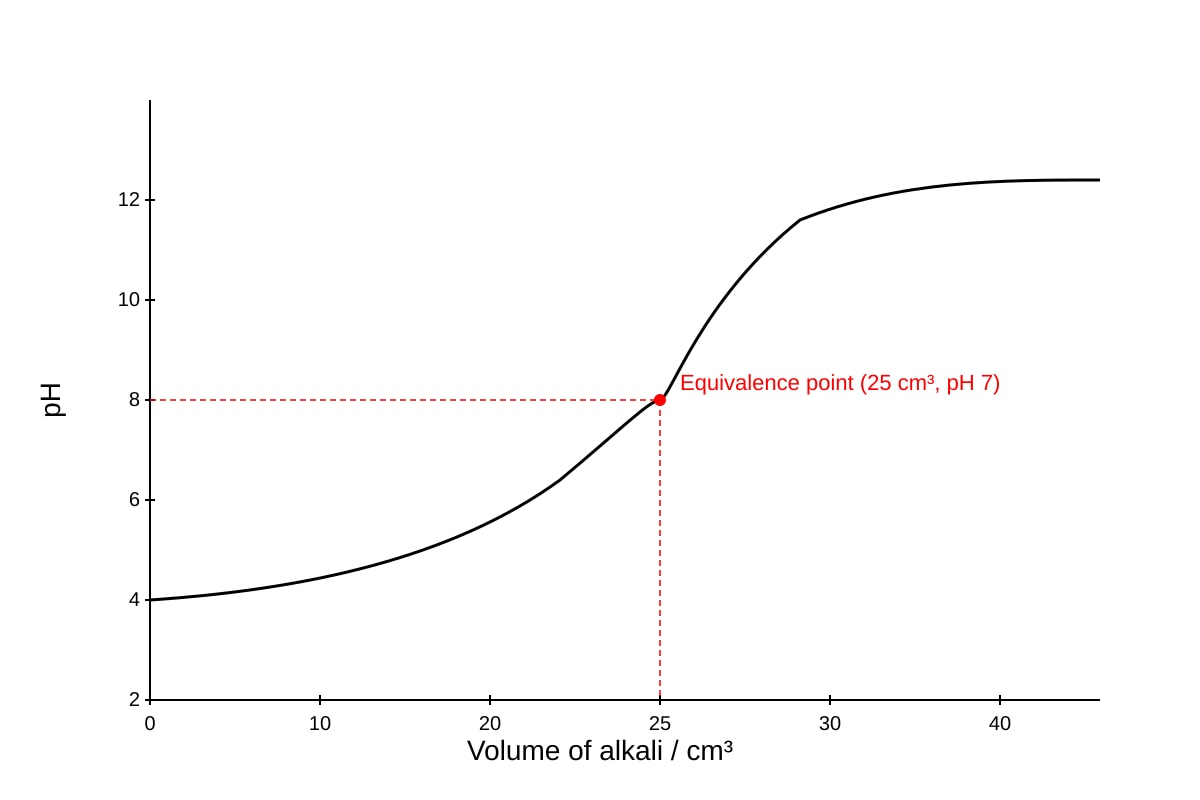
15. The diagram shows a pH curve for the titration of an acid with an alkali.
Image pending generation: graph for Q15.
(a) What is the volume of alkali at the equivalence point? [1]
(b) State the pH at the equivalence point. [1]
16. Explain why magnesium oxide is used to neutralise acidic industrial waste. [2]
17. A farmer adds calcium hydroxide to his fields.
(a) State the effect on soil pH. [1]
(b) Write an equation for calcium hydroxide reacting with nitric acid. [2]
18. The following results were obtained from a titration of acid R with alkali S:
| Trial | Volume of R / cm³ |
|---|---|
| 1 (rough) | 24.8 |
| 2 | 24.2 |
| 3 | 24.3 |
| 4 | 24.2 |
Calculate the average volume of R required for complete neutralisation. [1]
19. State two properties of a salt produced from a strong acid and a strong base. [2]
20. A student says: "Hydrochloric acid is more dangerous than ethanoic acid because it is a stronger acid." Explain whether this statement is always correct. [2]
Answers
TuitionGoWhere Practice Paper - Chemistry Secondary 3 (Answers)
Version 4 of 5 — Answer Key
Total Marks: 40
Section A Answers (12 marks)
1. Calcium oxide (CaO) OR calcium hydroxide (Ca(OH)₂) OR calcium carbonate (CaCO₃). [1]
Teaching note: Acidic soil has pH < 7. To increase pH (make less acidic), a base is added. Common solid soil amendments are calcium compounds. Avoid naming NaCl (neutral salt).
2. Potassium chloride. [1]
Teaching note: HCl + KOH → KCl + H₂O. Salt name comes from metal (potassium) + non-metal from acid (chloride).
3. Acidic. [1]
Teaching note: pH < 7 is acidic; pH = 7 neutral; pH > 7 alkaline.
4. Ammonia (NH₃) and an acid (e.g., HCl). [1]
Teaching note: Ammonium salts form from ammonia (or ammonium hydroxide) + acid. Example: NH₃ + HCl → NH₄Cl.
5. H⁺ (hydrogen ion). [1]
Teaching note: Acids release H⁺ in water.
6. Neutralisation (or direct combination) method. [1]
Teaching note: Insoluble base + acid → salt + water; excess base removed by filtration.
7. Blue. [1]
Teaching note: Litmus is blue in alkaline (pH > 7), red in acidic.
8. HNO₃(aq) + NaOH(aq) → NaNO₃(aq) + H₂O(l). [1]
Teaching note: Acid + alkali → salt + water. State symbols required.
Section B Answers (16 marks)
9. (a) H₂SO₄ + 2NaOH → Na₂SO₄ + 2H₂O [1]
(b) Sodium sulfate [1]
Teaching note: Sulfuric acid is diprotic; needs 2 NaOH per H₂SO₄.
10. Method: Neutralisation. [1] Steps: (1) Add excess zinc carbonate to dilute sulfuric acid, warm until no more effervescence. [1] (2) Filter to remove unreacted solid. [1] (3) Evaporate filtrate and cool to crystallise zinc sulfate.
Marking: 3 marks for method + 3 key steps. Common trap: forgetting excess or filtration.
11. (a) Vinegar (pH 3) [1] (b) Soap (pH 10) [1] (c) Vinegar, milk, water, soap [1]
Teaching note: Lower pH = more acidic.
12. (a) Amphoteric means a substance that reacts with both acids and alkalis. [1]
(b) Al₂O₃ + 6HCl → 2AlCl₃ + 3H₂O [2]
Marking: [1] for correct formulae, [1] for balancing.
13. (a) n(HCl) = c × V = 0.100 × (25.0/1000) = 0.00250 mol [2]
(b) HCl + NaOH → NaCl + H₂O (1:1). n(NaOH) = 0.00250 mol. c = n/V = 0.00250 / (20.0/1000) = 0.125 mol/dm³ [2]
Teaching note: Convert cm³ to dm³ by ÷1000.
14. Strong acid = fully dissociated; dilute acid = low concentration. [2]
Teaching note: Strength ≠ concentration. A strong acid can be dilute.
Section C Answers (12 marks)
15. (a) 25 cm³ [1] (b) pH 7 [1]
Based on placeholder: Equivalence at 25 cm³, pH 7 labelled.
16. MgO is a base; neutralises acid in waste to form harmless salt + water, preventing environmental damage. [2]
Marking: [1] base property, [1] product/safety.
17. (a) Increases pH [1] (b) Ca(OH)₂ + 2HNO₃ → Ca(NO₃)₂ + 2H₂O [2]
Marking: [1] equation, [1] balance.
18. Average = (24.2 + 24.3 + 24.2)/3 = 24.2 cm³ (exclude rough). [1]
Teaching note: Concordant trials only.
19. Neutral pH solution; soluble in water (e.g., NaCl). [2]
20. Not always; strength = dissociation, danger also depends on concentration. Dilute HCl less harmful than concentrated ethanoic. [2]
Marking: [1] strength definition, [1] concentration factor.
Free quiz and exam paper access
Enter your details to view this paper
Your access is remembered on this device.