AI Generated Exam Paper
Secondary 3 Chemistry Practice Paper 3
Free Sec 3 Chemistry Practice Paper 3, Kimi2.6 AI version, with questions, answers, and O Level-style practice for Singapore students.
These static practice materials are generated from the site's syllabus and paper-generation workflow, with source and model context shown so students and parents can evaluate the material before use.
Questions
Free quiz and exam paper access
Enter your details to view this paper
Your access is remembered on this device.
Answers
TuitionGoWhere Practice Paper - Chemistry Secondary 3
Version 3 of 5 — Answer Key and Marking Scheme
Section A: Multiple Choice [10 marks]
1. C — They produce hydrogen ions in aqueous solution
Explanation: An acid is defined as a substance that dissociates in water to produce hydrogen ions (). Option A describes bases (turn red litmus blue), B describes bases/alkalis, and D describes bases which feel soapy. This tests the fundamental definition of acids in terms of ionic theory. [1]
2. C — It contains more hydroxide ions than hydrogen ions
Explanation: pH 9 indicates an alkaline solution. At pH 7, . Above pH 7, . Option A is wrong (pH 7 is neutral), B is wrong (universal indicator is green at pH 7, purple/blue at pH 9), and D describes acids reacting with reactive metals, not alkalis. [1]
3. C — Sodium chloride
Explanation: Direct titration requires both reactants to be soluble and the reaction to have a sharp endpoint. Sodium chloride is soluble and can be made from NaOH + HCl titration. Lead(II) chloride (A) and barium sulfate (B) are insoluble — precipitation methods needed. Copper(II) carbonate (D) is insoluble, so acid + excess base method is used. [1]
4. B — 1 : 2
Explanation: The balanced equation is: . One mole of sulfuric acid provides 2 moles of ions, neutralising 2 moles of which provides 2 moles of . Students often mistakenly choose 1:1 through habit with HCl/NaOH. [1]
5. C — Zinc oxide
Explanation: Zinc oxide is amphoteric — it reacts with both acids and bases. Copper(II) oxide (A) is basic only. Carbon monoxide (B) is neutral. Sulfur dioxide (D) is acidic only. Common exam trap: students confuse amphoteric with neutral oxides. [1]
6. B — Slaked lime (calcium hydroxide)
Explanation: For quick pH increase, calcium hydroxide is preferred because it is more soluble than calcium carbonate, so it reacts faster with soil acids. Limestone (A) is slower-acting. Wood ash (C) varies in composition. Ammonium nitrate (D) is acidic and would lower pH further — a common trap for students who don't read carefully. [1]
7. C — Carbon dioxide
Explanation: Carbonates react with acids to produce CO₂: . The test for CO₂ is limewater turning milky. Students sometimes confuse this with hydrogen from metal-acid reactions. [1]
8. B — A hydrogen ion and a hydroxide ion
Explanation: This ionic equation shows the essential reaction in any strong acid-strong alkali neutralization — the from the acid and from the alkali combine to form water. It is called the "ionic equation" because spectator ions are removed. [1]
9. C — Precipitation (double decomposition)
Explanation: Insoluble salts are prepared by mixing two soluble salts containing the desired ions, causing precipitation. Titration (A) gives soluble salts. Acid + excess insoluble base (B) gives soluble salts. Acid + reactive metal (D) also gives soluble salts. This is a core syllabus distinction. [1]
10. B — Has a pH greater than 7 and contains ions
Explanation: . Ammonia accepts a proton from water, producing hydroxide ions. This makes the solution alkaline (pH > 7). The equilibrium lies to the left (ammonia is a weak base), but sufficient is produced for pH > 7. [1]
Section B: Structured Questions [32 marks]
11. (a) An acid is a substance that dissociates in water to produce hydrogen ions () as the only positive ions. [2]
Marking: Definition mentioning dissociation/produces ions (1 mark); "as the only positive ions" or equivalent emphasis on uniqueness (1 mark). Accept "proton donor" if Bronsted-Lowry definition given, though Arrhenius is expected at Sec 3 level.
Teaching note: The key phrase "as the only positive ion" distinguishes acids from acid salts like which also produce but contain other cations.
(b) • Hydrogen chloride in methylbenzene exists as covalent molecules / does not dissociate [1]
• Therefore there are no free移动 ions (or no mobile ions) to carry charge [1]
• Hydrogen chloride in water ionises/dissociates completely to form and ions [1]
• These free移动 ions allow electrical conduction [1 — implicit in logical answer]
Max 3 marks. Accept "ionise" or "dissociate".
Teaching note: This is a classic Sec 3 distinction. The solvent matters enormously — water's polar nature enables ionisation; non-polar methylbenzene cannot support this. Students often state "no molecules" when they mean "no ions."
(Total: 5 marks)
12. (a) (i) Solution W (pH 2) [1]
Teaching note: Lowest pH = most acidic. The pH scale is logarithmic; pH 2 has 1000× more than pH 5.
(ii) mol/dm³ [2]
Working:
Therefore mol/dm³
mol/dm³ or mol/dm³
Marking: Correct formula or method (1 mark); correct answer with units (1 mark).
Teaching note: At pH 13, is extremely low. The ion product of water: at 25°C, so mol/dm³.
(b) Solution W: red (or orange-red) [1]
Solution Y: blue (or blue-purple/green-blue — accept any blue shade) [1]
Teaching note: Universal indicator colours: red (strong acid), orange (weak acid), yellow (very weak acid), green (neutral), blue (weak alkali), purple (strong alkali). pH 10 is clearly blue.
(c) Solution Z has a higher concentration of hydroxide ions than solution Y. [1]
pH 13 > pH 10, so in Z is greater. Since , pOH of Z = 1, so mol/dm³; pOH of Y = 4, so mol/dm³. Thus Z is 1000 times more concentrated in . [1]
Teaching note: The logarithmic nature means each pH unit represents a 10-fold change in ion concentration. pH 13 has times more than pH 10.
(Total: 7 marks)
13. (a) Amphoteric means the oxide (or hydroxide) reacts with both acids and bases. [1]
Accept: "shows both basic and acidic properties" or "can behave as both an acid and a base."
(b) (i) [2]
Marking: Correct formulae (1 mark); correct balancing and state symbols (1 mark).
(ii) [2]
Or:
Marking: Correct formulae showing zinc complex or zincate (1 mark); correct balancing and state symbols (1 mark). Accept zincate formula or . At Sec 3 level, either is acceptable though tetrahydroxozincate(II) is more modern.
Teaching note: Zinc reacting with alkali produces a complex ion — this is why it's "amphoteric" not just "basic." The equation often confuses students who haven't seen complex ion formation.
(c) Aluminium oxide / Lead(II) oxide / Tin(II) oxide / Tin(IV) oxide [1]
Any correct amphoteric oxide. Common answer: Al₂O₃.
(Total: 6 marks)
14. (a) Any two of: lead(II) nitrate solution AND sodium sulfate solution / potassium sulfate solution / sulfuric acid [2]
Marking: One mark for each correct soluble reactant. Both must be soluble. Common error: suggesting lead metal or insoluble lead compounds.
Teaching note: For precipitation, we need soluble salts containing the target ions: and . Lead(II) nitrate and sodium sulfate are both soluble and safe choices.
(b) [2]
Marking: Correct spectator ions removed (1 mark); correct state symbols showing precipitation (1 mark). The full equation earns 1 mark if ionic equation not given.
Teaching note: Ionic equations show only the participating ions. Spectator ions (, ) are eliminated as they remain in solution unchanged.
(c) • Filter the mixture to separate the insoluble lead(II) sulfate from the solution [1]
• Wash the residue with distilled water to remove soluble impurities / sodium nitrate solution [1]
• Dry the solid between filter papers or in a warm oven [1]
Teaching note: The three key steps are filter-wash-dry. Students often miss washing, which is essential for purity — without it, the product contains sodium nitrate and unreacted reagents. Drying must be gentle as lead(II) sulfate doesn't decompose easily, but excessive heat is still poor practice.
(Total: 7 marks)
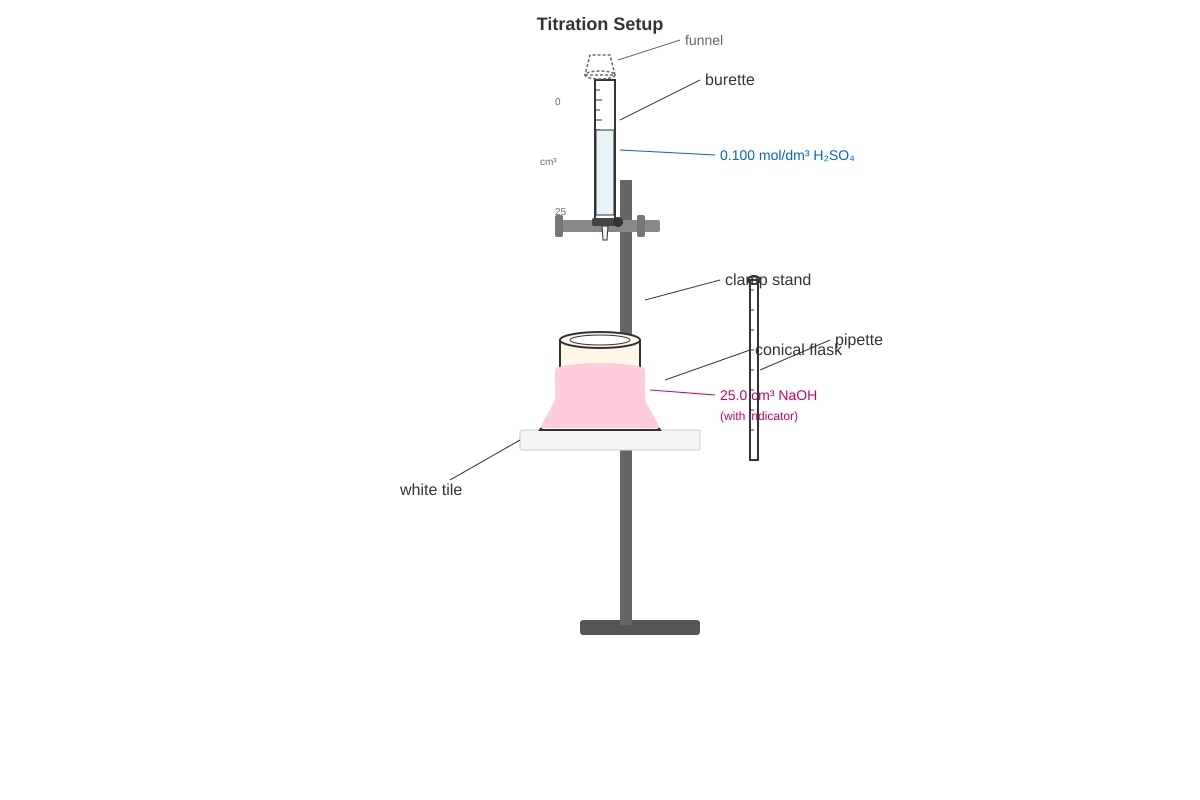
15. (a) Methyl orange / Phenolphthalein / Litmus [1]
Any suitable acid-base indicator. Methyl orange (red in acid, yellow in alkali) or phenolphthalein (colourless in acid, pink in alkali) are standard.
(b) Step 1: Identify concordant results
Titration 1: 23.80 − 0.50 = 23.30 cm³
Titration 2: 24.30 − 1.00 = 23.30 cm³
Titration 3: 23.60 − 0.20 = 23.40 cm³
Concordant results are those within 0.20 cm³ of each other. Titrations 1 and 2 are concordant (both 23.30 cm³). Titration 3 is not concordant (23.40 cm³ differs by 0.10 cm³, just outside typical 0.10 cm³ strict concordance, though some labs accept 0.20 cm³). [1 for identifying correct titre values or noting concordance]
Marking note: If student includes Tit 3, check working. Strictly, 23.30 and 23.30 are concordant; 23.40 may be excluded.
Step 2: Calculate mean
Mean = = 23.30 cm³ [2 — 1 for method, 1 for correct value]
Teaching note: "Rough" is never used in calculating means. Concordance is typically ±0.10 cm³ or ±0.20 cm³. The ability to identify and justify which results to use is a key practical skill.
(c) Step 1: Calculate moles of
Moles = concentration × volume (in dm³)
mol [1]
Step 2: Use mole ratio from equation
Moles of
mol [1]
Step 3: Calculate concentration of NaOH
Concentration =
$= 0.186 mol/dm³ or 0.19 mol/dm³ (to 2 sig figs, matching data) [1]
Marking: Each step 1 mark. Sig figs: accept 0.186, 0.1864, or 0.19. Must show clear working for full credit.
Teaching note: The 1:2 ratio is the critical step where many errors occur. Always write the mole ratio explicitly. Also note that the titre is the dependent variable — the NaOH volume was fixed at 25.0 cm³ by pipette.
(Total: 7 marks)
Section C: Data Analysis and Extended Response [18 marks]
16. (a) A base is defined as a proton acceptor (Bronsted-Lowry) or a substance that neutralises an acid to form a salt and water only. [1]
Calcium carbonate reacts with acids, accepting protons:
Even though it doesn't dissolve in water to produce ions directly, it still neutralises acids and fits the broader definition of a base. [1 for explanation involving reaction with acid]
Teaching note: The Arrhenius definition (produces in water) fails for insoluble bases. The Bronsted-Lowry (proton acceptor) or operational definition (neutralises acids) is needed. This is a key conceptual leap in Sec 3.
(b) [2]
Marking: Correct formulae (1 mark); correct balancing and state symbols (1 mark).
(c)
| Factor | Calcium hydroxide | Calcium carbonate | Assessment |
|---|---|---|---|
| Speed of reaction | Faster — more soluble, so ions readily available to neutralise acid | Slower — insoluble, reacts at surface only; reaction depends on particle size and surface area | Farmer needs quick results: Ca(OH)₂ wins; but CaCO₃ provides longer-term buffering |
| Cost | $95/tonne | $65/tonne — cheaper | CaCO₃ wins on cost |
| Practical factors | Can "over-lime" soil, raising pH too high; stronger alkali, more hazardous to handle | Safer to handle; self-limiting (excess doesn't dissolve, so pH won't rise above ~7 if used carefully); but may need repeated applications | Ca(OH)₂ needs care; CaCO₃ is more forgiving |
Synthesis — best choice depends on urgency and budget: For rapid pH correction before planting, Ca(OH)₂ despite higher cost. For maintenance and long-term pH stability, CaCO₃ is more economical and safer. [5]
Marking (max 5): Speed comparison with reasoning (2 marks); Cost comparison (1 mark); Practical factor with safety/environmental consideration (2 marks). Quality of explanation and clear comparison structure rewarded.
Teaching note: This extended response mirrors O-Level data analysis style. The best answers synthesise rather than list — they make a recommendation justified by the data.
(Total: 9 marks)
17. (a) (i) [2]
Marking: Correct formulae and reversible arrows (1 mark); correct state symbols (1 mark). Must show equilibrium arrows — ammonia is a weak base.
(ii) The solution is alkaline because:
- Ammonia accepts a proton () from water, forming ammonium ions and hydroxide ions [1 for proton acceptance/equilibrium producing ]
- The hydroxide ion concentration exceeds the hydrogen ion concentration (), so pH > 7 [1]
Teaching note: Weak bases establish equilibria. The position lies left — most ammonia remains as molecules — but sufficient is produced to make the solution distinctly alkaline. Students often write irreversible equations for weak bases.
(b) (i) Molar mass of :
g/mol [1 for method]
Mass of nitrogen = g/mol (two N atoms)
Percentage by mass =
[1]
Teaching note: This is a crucial calculation — fertiliser quality is measured by %N. Notice there are TWO nitrogen atoms (one in , one in ). Common error: counting only one nitrogen.
(ii) Ammonium nitrate is the salt of a weak base and a strong acid. [1]
When dissolved in soil moisture, the ammonium ion hydrolyses:
Or more simply: acts as a weak acid, releasing ions into the soil. [1]
This gradually lowers the soil pH / makes the soil more acidic over repeated applications. [1]
Therefore, farmers add calcium carbonate (a base) to neutralise this acidification and maintain suitable soil pH for crop growth.
Teaching note: This is sophisticated Sec 3 chemistry — salt hydrolysis. The cation from a weak base (NH₄⁺) makes the solution acidic. This explains why even "neutral" salts can alter pH. The reasoning connects to preservation of soil chemistry for sustainable agriculture.
(iii) Eutrophication (or algal blooms / water pollution from nitrate runoff) [1]
Explanation: Excess ammonium/nitrate ions dissolve in rainwater and run off into rivers and lakes. These nutrients cause rapid algae growth (algal blooms). When algae die, their decomposition by bacteria depletes dissolved oxygen in the water, killing fish and other aquatic organisms. [1 for mechanistic explanation]
Alternative: Groundwater contamination / nitrate poisoning if focused on drinking water.
Teaching note: Eutrophication is a major environmental issue linked to agricultural practice. The mechanism matters — it's not just "pollution" but a specific biological-oxygen-demand cascade.
(Total: 11 marks)
Mark Summary
| Section | Marks | Details |
|---|---|---|
| A | 10 | 10 × 1 mark |
| B | 32 | Q11: 5; Q12: 7; Q13: 6; Q14: 7; Q15: 7 |
| C | 18 | Q16: 9; Q17: 11 |
| Total | 60 |