AI Generated Exam Paper
Secondary 3 Chemistry Practice Paper 3
Free Sec 3 Chemistry Practice Paper 3, HY3 AI version, with questions, answers, and O Level-style practice for Singapore students.
These static practice materials are generated from the site's syllabus and paper-generation workflow, with source and model context shown so students and parents can evaluate the material before use.
Questions
Free quiz and exam paper access
Enter your details to view this paper
Your access is remembered on this device.
Answers
TuitionGoWhere Practice Paper — Answer Key (Version 3)
Subject: Chemistry
Level: Secondary 3
Topic: Acids, Bases & Salts
Total Marks: 40
Section A (Q1–10) — Marking Scheme
1. [1] Calcium oxide (CaO) / calcium hydroxide (Ca(OH)₂) / calcium carbonate (CaCO₃).
Teaching note: Acidic soil has pH < 7. To increase pH, a base (solid) is added. Common soil amendments are calcium compounds. Avoid naming NaCl (neutral salt).
2. [1] Potassium chloride (KCl).
Teaching note: HCl + KOH → KCl + H₂O. Salt from acid (HCl → chloride) and base (KOH → potassium).
3. [1] Acidic.
Teaching note: pH < 7 is acidic; pH = 7 neutral; pH > 7 alkaline.
4. [1] Ammonia (NH₃) and hydrochloric acid (HCl).
Teaching note: Ammonium salts form from ammonia (or ammonium hydroxide) + acid. NH₃ + HCl → NH₄Cl.
5. [1] H⁺ (hydrogen ion).
Teaching note: Acids release H⁺ in water; this ion causes acidic properties.
6. [1] Blue.
Teaching note: Litmus is red in acid, blue in alkali, purple in neutral.
7. [1] HNO₃(aq) + NaOH(aq) → NaNO₃(aq) + H₂O(l).
Teaching note: Neutralisation: acid + alkali → salt + water. Nitric acid gives nitrate; sodium gives sodium salt.
8. [1] Neutralisation (or direct combination / reaction of acid with insoluble base).
Teaching note: CuO is insoluble base; reacts with acid to form salt + water.
9. [1] B. ZnO.
Teaching note: Amphoteric oxides react with both acids and alkalis. ZnO is amphoteric; CaO and Na₂O are basic; SO₂ is acidic.
10. [1] n = c × V = 0.20 × 0.50 = 0.10 mol.
Teaching note: Use n = cV with V in dm³. Answer: 0.10 mol.
Section B (Q11–15) — Marking Scheme
11. [2]
(a) [1] H₂SO₄(aq) + 2NaOH(aq) → Na₂SO₄(aq) + 2H₂O(l)
(b) [1] Sodium sulfate
Teaching note: Sulfuric acid (diprotic) needs 2 NaOH; salt is sodium sulfate.
12. [3] Method: Reaction of acid with metal. Steps:
- Add zinc to dilute sulfuric acid until no more gas (H₂) evolves (excess Zn removed). [1]
- Filter to remove unreacted zinc. [1]
- Evaporate filtrate and cool to crystallise; dry crystals. [1]
Teaching note: Zn + H₂SO₄ → ZnSO₄ + H₂. Use excess metal for complete reaction, filter, crystallise.
13. [3]
(a) [1] Water
(b) [1] Lemon (2), Vinegar (3), Water (7), Soap (10)
(c) [1] Cleaning / washing (any sensible use of alkali)
Teaching note: Lower pH = more acidic. pH 10 is alkaline, used in soap.
14. [3]
(a) [1] Amphoteric
(b) [2] XO + 2HCl → XCl₂ + H₂O (or with stated X, e.g., ZnO + 2HCl → ZnCl₂ + H₂O)
Teaching note: Amphoteric = reacts with acid and base. Equation must balance.
15. [3]
(a) [1] n(NaOH) = cV = 0.100 × (25.0/1000) = 0.00250 mol
(b) [2] 2NaOH + H₂SO₄ → Na₂SO₄ + 2H₂O; mol H₂SO₄ = 0.00250/2 = 0.00125 mol; c = n/V = 0.00125 / (20.0/1000) = 0.0625 mol/dm³
Teaching note: Convert cm³ to dm³; 1:2 ratio NaOH:H₂SO₄.
Section C (Q16–20) — Marking Scheme
16. [2] Calcium oxide is a base [1]; it reacts with acid in soil to neutralise it, raising pH toward 7 [1].
Teaching note: CaO + 2H⁺ → Ca²⁺ + H₂O (simplified).
17. [2] Add excess CuCO₃ to HNO₃, filter unreacted solid [1]; evaporate filtrate and cool to get Cu(NO₃)₂ crystals, dry [1].
Teaching note: CuCO₃ + 2HNO₃ → Cu(NO₃)₂ + CO₂ + H₂O.
18. [2] Strong acid fully ionises in water; concentrated acid has high moles per dm³ [1]. A weak acid can be concentrated; a strong acid can be dilute [1].
Teaching note: Strength = ionisation; concentration = amount per volume.
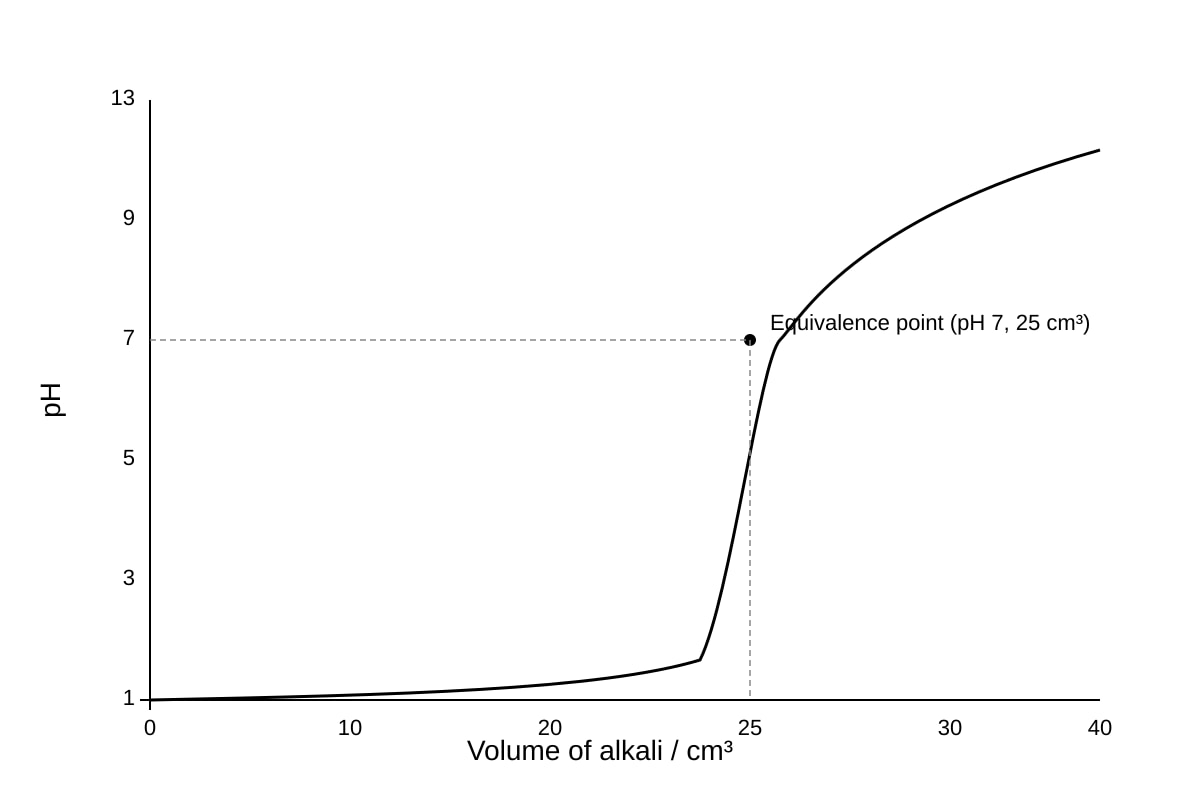
19. [2]
(a) [1] 7
(b) [1] Strong acid (HCl) and strong alkali (NaOH)
Teaching note: Equivalence at pH 7 indicates strong–strong titration; salt NaCl.
20. [2] Add litmus: base turns red litmus blue [1]; or feel slippery / react with acid to form salt+water, not just dissolve [1].
Teaching note: Base shows alkali properties; salt is neutral.