AI Generated Exam Paper
Secondary 3 Chemistry Practice Paper 2
Free Sec 3 Chemistry Practice Paper 2, Kimi2.6 AI version, with questions, answers, and O Level-style practice for Singapore students.
These static practice materials are generated from the site's syllabus and paper-generation workflow, with source and model context shown so students and parents can evaluate the material before use.
Questions
Free quiz and exam paper access
Enter your details to view this paper
Your access is remembered on this device.
Answers
TuitionGoWhere Practice Paper - Chemistry Secondary 3
Answer Key and Marking Scheme — Version 2 of 5
Section A: Multiple Choice and Short Response
Total: 20 marks
1. [1 mark]
Answer: Hydrogen ion / H⁺ / H₃O⁺ (hydronium ion)
Explanation: Acids are substances that produce hydrogen ions (H⁺) when dissolved in water. In aqueous solution, H⁺ ions immediately bond to water molecules to form hydronium ions (H₃O⁺), but H⁺ is the commonly accepted answer at Sec 3 level. The presence of mobile H⁺ ions gives acids their characteristic properties: sour taste, reaction with metals, neutralization of bases, and ability to change indicator colours.
2. [1 mark]
Answer: MgCl₂ / magnesium chloride
Explanation: This is a neutralization reaction between a basic oxide (MgO) and an acid (HCl). The metal from the oxide (Mg²⁺) combines with the non-metal/acid radical from the acid (Cl⁻) to form a salt. The balanced equation is: MgO + 2HCl → MgCl₂ + H₂O. The salt is named by combining the metal name with the acid radical: magnesium chloride.
3. [2 marks total]
(a) [1 mark]
Answer: pH 3–6 (accept: approximately pH 4 or 5; any value in range 3–6)
Explanation: Universal Indicator colours: red (strong acid, pH 0–3), orange (weak acid, pH 3–6), yellow (very weak acid/neutral, pH 6–7), green (neutral, pH 7), blue (weak alkali, pH 8–11), purple (strong alkali, pH 11–14). Orange indicates a weakly acidic solution.
(b) [1 mark]
Answer: Any acceptable weak acid, e.g. diluted lemon juice / vinegar / fizzy drink / orange juice / tomato juice
Explanation: Common household substances with pH in the 3–6 range include vinegar (acetic acid solution, pH ~3), lemon juice (citric acid, pH ~2.5), and carbonated drinks (carbonic acid, pH ~4). The substance must be a genuine weak acid commonly found at home.
4. [2 marks]
Answer: Sodium sulfate + water / Na₂SO₄ + H₂O (1 mark each)
Explanation: This is a neutralization reaction between a carbonate (sodium carbonate) and an acid (sulfuric acid). Carbonates react with acids to produce a salt, water, and carbon dioxide. Note: the word equation as given is incomplete in the question—it should show carbon dioxide as a third product. However, following the pattern of standard neutralization, the salt and water are the essential products. The complete equation would be: sodium carbonate + sulfuric acid → sodium sulfate + water + carbon dioxide. Accept either the neutralization simplification or the complete carbonate-acid reaction.
Marking note: Award 1 mark for sodium sulfate, 1 mark for water. Accept CO₂ as third product if included, but not penalize if omitted given the two blank format.
5. [2 marks]
Answer: Aluminium oxide reacts with both acids and bases (1 mark), producing a salt and water in each case (1 mark)
Explanation: Amphoteric oxides are a special class of metal oxides that show both acidic and basic properties. Unlike basic oxides (e.g. CaO, Na₂O) which only react with acids, and acidic oxides (e.g. CO₂, SO₂) which only react with bases, amphoteric oxides react with both:
- With acid: Al₂O₃ + 6HCl → 2AlCl₃ + 3H₂O
- With base: Al₂O₃ + 2NaOH + 3H₂O → 2Na[Al(OH)₄]
Other amphoteric oxides include zinc oxide and lead(II) oxide.
6. [3 marks]
Answer: (Any three correct steps with sufficient detail)
| Step | Description |
|---|---|
| 1 | Add excess copper(II) oxide to warm dilute sulfuric acid |
| 2 | Stir and heat until reaction is complete; excess oxide remains |
| 3 | Filter to remove excess copper(II) oxide |
| 4 | Heat filtrate to evaporate some water until saturated |
| 5 | Allow to cool so crystals form |
| 6 | Filter crystals, wash with distilled water, dry between filter papers |
Explanation: This is the insoluble base + dilute acid method for preparing soluble salts. Key reasons:
- Excess oxide ensures all acid reacts (the oxide does not dissolve, so excess is easily removed)
- Heating increases reaction rate
- Filtration removes excess solid
- Controlled evaporation + cooling crystallization yields pure crystals (not heating to dryness, which would produce powder)
Marking points: mention of excess oxide (1), filtration to remove excess (1), crystallization by evaporation-cooling (1)—accept equivalent detail.
7. [4 marks total]
(a) [2 marks]
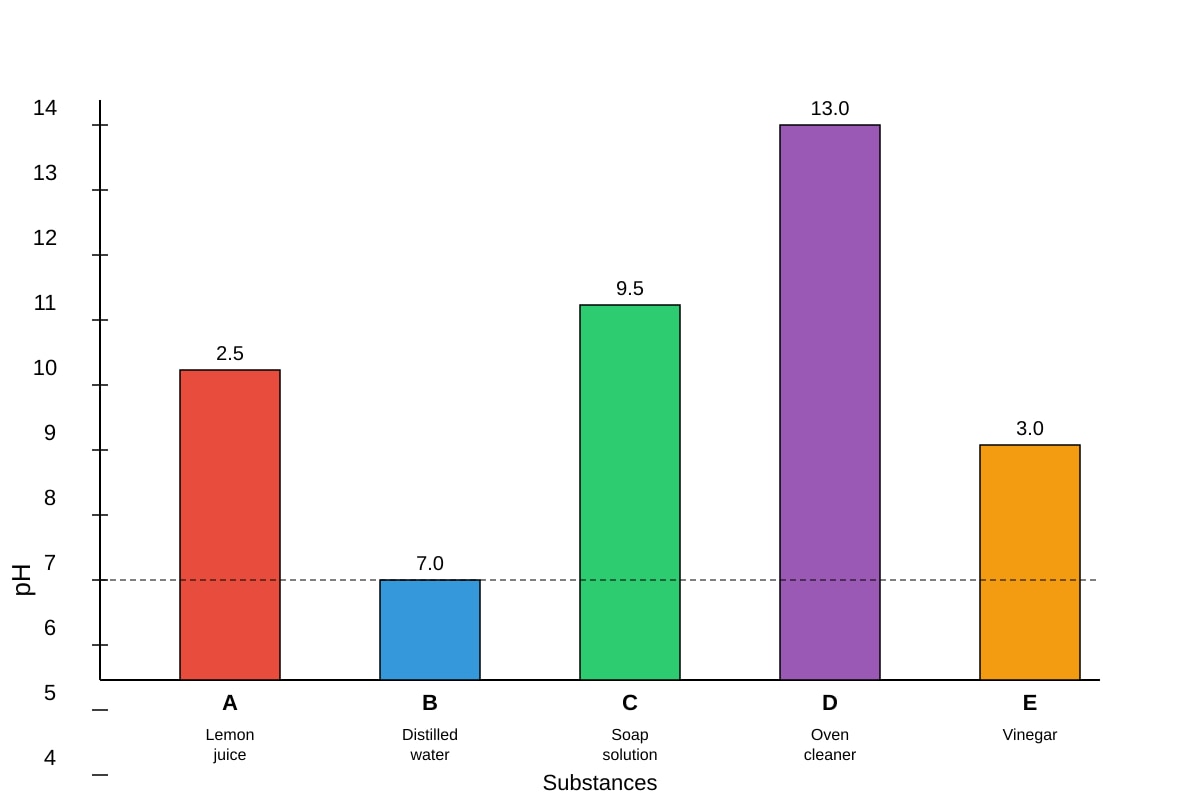
Answer: Substance D (oven cleaner) (1 mark); it has the highest pH / pH 13.0 / strongest alkali (1 mark)
Explanation: The pH scale measures acidity/alkalinity. Acids have pH < 7, neutral pH = 7, alkalis have pH > 7. The higher the pH above 7, the stronger the alkali. Oven cleaner at pH 13.0 has the highest pH value, making it the strongest alkali. Do not accept "strongest acid"—the question asks for strongest alkali/highest pH substance, which is D. Note: if misreading the chart, A and E are acids (low pH), B is neutral, C is weak alkali.
Common error: Students confuse "strongest" with most dangerous—D is strongest alkali; A is strongest acid.
(b) [2 marks]
Answer: [H⁺] = 10⁻¹³ mol/dm³ (or 1 × 10⁻¹³ mol/dm³)
Working:
- pH = −log₁₀[H⁺]
- Therefore [H⁺] = 10⁻ᵖᴴ = 10⁻¹³ mol/dm³
- At pH 13, [H⁺] = 1 × 10⁻¹³ mol/dm³
Explanation: The pH scale is logarithmic; each whole number change represents a tenfold change in [H⁺]. Alternatively, use Kw: [H⁺][OH⁻] = 10⁻¹⁴ at 25°C, so [H⁺] = 10⁻¹⁴/[OH⁻]. At pH 13, pOH = 1, so [OH⁻] = 10⁻¹ and [H⁺] = 10⁻¹³. The extremely low [H⁺] confirms strongly alkaline conditions.
8. [5 marks total]
(a) [2 marks]
Answer: 2NaOH(aq) + H₂SO₄(aq) → Na₂SO₄(aq) + 2H₂O(l)
Marking: Correct formulae (1), correct balancing and state symbols (1)
Explanation: Sodium hydroxide (strong alkali) reacts with sulfuric acid (strong dibasic acid) in a 2:1 mole ratio because H₂SO₄ provides 2 H⁺ ions per molecule. The salt is sodium sulfate (Na₂SO₄), not sodium hydrogen sulfate (NaHSO₄), because neutralization is complete. State symbols: (aq) for aqueous solutions, (l) for water. Water is a liquid, not aqueous, in this context.
(b) [3 marks]
Working:
- Moles of NaOH = (25.0/1000) × 0.100 = 0.00250 mol
- Mole ratio NaOH : H₂SO₄ = 2 : 1
- Moles of H₂SO₄ = 0.00250 ÷ 2 = 0.00125 mol
- Concentration of H₂SO₄ = 0.00125 ÷ (20.0/1000) = 0.0625 mol/dm³
Answer: 0.0625 mol/dm³ (or 6.25 × 10⁻² mol/dm³)
Explanation: This is a standard titration calculation using the mole concept. The key steps: (1) calculate moles of known substance (NaOH), (2) use mole ratio from balanced equation to find moles of unknown (H₂SO₄), (3) convert to concentration using c = n/V. The 2:1 ratio is crucial—many students incorrectly use 1:1. Dibasic acids (H₂SO₄) and diacidic bases react with 2:1 stoichiometry with monobasic/monobasic counterparts.
9. [2 marks]
Answer: Hydrogen chloride in methylbenzene does not ionize / does not form ions / remains as molecules (1 mark); aqueous HCl ionizes completely into H⁺ and Cl⁻ ions that can carry charge (1 mark)
Explanation: Electrical conductivity requires mobile charge carriers (ions or electrons). Covalent molecular substances like HCl(g) or HCl in organic solvents (methylbenzene) exist as intact HCl molecules with no free ions. Only in water does HCl ionize: HCl → H⁺(aq) + Cl⁻(aq). Water's polar nature stabilizes the ions, enabling dissociation. This demonstrates that acidity and electrical conductivity both require aqueous conditions for covalent hydrogen halides.
10. [2 marks]
Answer: A strong acid ionizes completely in water (1 mark); a weak acid ionizes only partially in water / establishes an equilibrium with mostly undissociated molecules (1 mark)
Explanation:
- Strong acids (e.g. HCl, H₂SO₄, HNO₃): 100% ionization → all molecules become ions → high [H⁺] → low pH for given concentration
- Weak acids (e.g. CH₃COOH, citric acid): reversible partial ionization → equilibrium mixture of molecules and ions → lower [H⁺] → higher pH than strong acid of same concentration
The degree of ionization (α) distinguishes them: α ≈ 1 for strong acids, α << 1 for weak acids.
11. [4 marks total]
(a) [1 mark]
Answer: Calcium carbonate / CaCO₃ / calcium oxide / CaO / calcium hydroxide / Ca(OH)₂
Explanation: All are bases that neutralize soil acidity. Calcium carbonate is most common (limestone powder, agricultural lime) because it is cheap, safe to handle, and releases calcium ions beneficial for plant growth.
(b) [2 marks]
Answer (for CaCO₃): CaCO₃ + 2H⁺ → Ca²⁺ + H₂O + CO₂ (or CaCO₃ + H₂SO₄ → CaSO₄ + H₂O + CO₂)
Or (for CaO): CaO + 2H⁺ → Ca²⁺ + H₂O (or CaO + H₂SO₄ → CaSO₄ + H₂O)
Or (for Ca(OH)₂): Ca(OH)₂ + 2H⁺ → Ca²⁺ + 2H₂O
Marking: Correct formulae (1), correct balancing (1)
Explanation: The essential chemistry is acid + base → salt + water. For carbonates, CO₂ is also produced. The ionic equation using H⁺ is acceptable and more general. Remember: soil "acid" is typically weak organic acids or acid rain deposited H₂SO₄/HNO₃.
(c) [1 mark]
Answer: It would make the soil too alkaline / raise pH too much / pH > 7 / damage plants / make soil unsuitable for cabbages
Explanation: Optimal pH varies by crop. Over-liming raises pH excessively, causing nutrient lock-up (especially iron, manganese) and creating alkaline conditions that hinder root function. The goal is pH ≈ 6.5, not maximum alkalinity.
Section B: Structured Questions
Total: 25 marks
12. [7 marks total]
(a)(i) [2 marks]
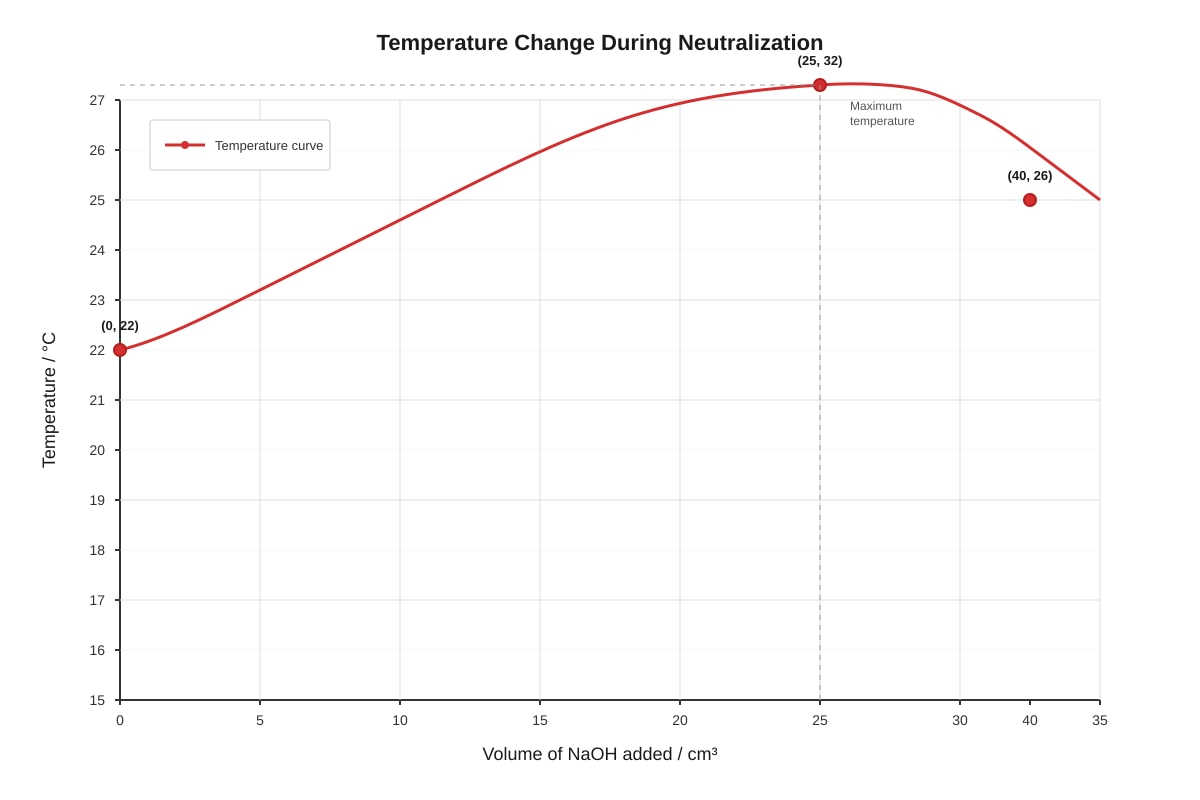
Answer: 25 cm³ (1 mark); this is where the temperature is maximum (1 mark) / equivalence point / all acid has reacted
Explanation: In a thermometric titration, the maximum temperature indicates the equivalence point where stoichiometric amounts of acid and alkali have reacted, releasing maximum heat of neutralization. Before this point, limiting reagent is alkali; after, excess alkali dilutes and cools the mixture. The graph shows clear peak at 25 cm³ NaOH.
(a)(ii) [3 marks]
Working:
- Moles of HCl = (25.0/1000) × 0.200 = 0.00500 mol
- Mole ratio HCl : NaOH = 1 : 1
- Moles of NaOH = 0.00500 mol in 25.0 cm³
- Concentration of NaOH = 0.00500 ÷ (25.0/1000) = 0.200 mol/dm³
Answer: 0.200 mol/dm³
Explanation: Since both are monobasic (HCl) and monoacidic (NaOH), the 1:1 ratio applies. At equivalence: moles acid = moles base. This yields equal concentrations, which is reasonable for a standard thermometric titration using solutions of similar concentration.
(b) [2 marks]
Answer: After equivalence, excess NaOH is added (1 mark); this dilutes the hot solution and absorbs heat / no more reaction occurs so added solution cools the mixture (1 mark)
Explanation: Beyond 25 cm³, no more HCl remains to react, so no further heat is generated. The added NaOH solution (at room temperature, ~22°C) mixes with the hot reaction mixture (32°C), causing thermal dilution—heat distributes into a larger mass, and the average temperature drops. This is a common feature of thermometric titrations.
13. [5 marks total]
(a) [3 marks]
Method: Add magnesium ribbon to each solution (or add sodium carbonate powder)
| Solution | Expected observations |
|---|---|
| Hydrochloric acid (strong) | Rapid effervescence / vigorous bubbling / ribbon dissolves quickly / gas given off faster |
| Ethanoic acid (weak) | Slow effervescence / gentle bubbling / ribbon dissolves slowly |
| Sodium chloride (neutral salt) | No reaction / no bubbling / no change |
Explanation: The key distinction is reaction rate with a reactive metal, reflecting [H⁺] differences: HCl fully ionized (high [H⁺]), CH₃COOH partially ionized (low [H⁺]), NaCl has no H⁺. pH paper would also distinguish (pH 0 for HCl, pH 2.4 for 1.0 M CH₃COOH, pH 7 for NaCl), but this provides less direct evidence of chemical reactivity.
Alternative: Use Na₂CO₃—vigorous fizzing with HCl, slow fizzing with CH₃COOH, no reaction with NaCl.
(b) [2 marks]
Answer: Hydrochloric acid is a strong acid and ionizes completely, giving high [H⁺] and low pH (1 mark); ethanoic acid is a weak acid and ionizes partially, so [H⁺] is lower and pH is higher despite same overall concentration (1 mark)
Explanation: For 1.0 mol/dm³ HCl, [H⁺] = 1.0 mol/dm³, pH = 0. For 1.0 mol/dm³ CH₃COOH, [H⁺] ≈ 0.004 mol/dm³ (Ka ≈ 1.7 × 10⁻⁵), pH ≈ 2.4. The total acid molecules are equal, but only a small fraction of ethanoic acid molecules release H⁺ at equilibrium.
14. [8 marks total]
(a) [3 marks]
| Salt | Method |
|---|---|
| A (PbSO₄) | Precipitation / double decomposition / direct combination of lead(II) nitrate + sulfuric acid (or soluble lead salt + soluble sulfate) |
| B (Na₂SO₄) | Titration / acid + alkali (NaOH + H₂SO₄) / acid + carbonate (Na₂CO₃ + H₂SO₄) |
| C (Cu(NO₃)₂) | Insoluble base + acid / CuO + HNO₃ / CuCO₃ + HNO₃ / excess CuO, filter, crystallize |
Explanation: Method selection depends on solubility rules and reactivity:
- Insoluble salts: Precipitation using double decomposition (mix two soluble salts, filter precipitate)
- Soluble salts from acid + reactive metal/insoluble base/carbonate: React excess solid with acid, filter, crystallize
- Soluble salts from acid + soluble base/carbonate: Titration (no excess, exact reacting quantities)
(b) [2 marks]
Answer: Pb²⁺(aq) + SO₄²⁻(aq) → PbSO₄(s)
Marking: Correct ions with charges (1), correct state symbols and formula (1)
Explanation: Precipitation reactions involve spectator ions (here, if using Pb(NO₃)₂ + Na₂SO₄, Na⁺ and NO₃⁻ are spectators). The net ionic equation shows only the species forming the precipitate. The (s) state symbol is essential—PbSO₄ is insoluble.
(c)(i) [2 marks]
Answer: CuCO₃ + 2HNO₃ → Cu(NO₃)₂ + H₂O + CO₂ (or CuO + 2HNO₃ → Cu(NO₃)₂ + H₂O)
Marking: Correct formulae (1), correct balancing (1)
(c)(ii) [3 marks]
Answer: (Any three of following steps with sufficient detail)
| Step | Description |
|---|---|
| 1 | Add excess copper(II) carbonate to warm dilute nitric acid / add acid to carbonate until no more dissolves |
| 2 | Filter to remove excess copper(II) carbonate |
| 3 | Heat filtrate to concentrate / evaporate some water until saturated point |
| 4 | Allow to cool for crystallization |
| 5 | Filter crystals, wash with distilled water, dry with filter paper |
Explanation: Same method as Q6. Key: excess insoluble reactant ensures complete acid consumption; crystallization by cooling yields pure, well-formed crystals rather than powder from complete evaporation.
15. [5 marks total]
(a) [1 mark]
Answer: Natural gas / methane / hydrogen from steam reforming of natural gas / electrolysis of water
Explanation: The Haber process requires N₂ (from air, liquefaction) and H₂. Industrial H₂ is primarily obtained by steam reforming: CH₄ + H₂O → CO + 3H₂, followed by water-gas shift. Accept any valid industrial H₂ source.
(b) [2 marks]
Answer: 2NH₃ + H₂SO₄ → (NH₄)₂SO₄
Marking: Correct formulae (1), correct balancing (1)
Explanation: Ammonia (weak base) reacts with sulfuric acid (strong acid) to form ammonium sulfate, an important nitrogen fertilizer. The 2:1 ratio reflects ammonia's monobasic nature and sulfuric acid's dibasic nature.
(c) [2 marks]
Answer: Ammonium sulfate is a solid / easy to transport and store / slow-release nitrogen / less volatile / not lost as gas (1 mark); aqueous ammonia is a gas in solution / volatile / unpleasant fumes / difficult to transport / quickly lost to atmosphere (1 mark)
Explanation: Practical agriculture requires stable, storable fertilizers. Aqueous ammonia (NH₃(aq)) contains dissolved NH₃ gas that escapes easily, especially in warm conditions. Solid ammonium salts release NH₄⁺ ions gradually by soil bacterial action (nitrification), providing controlled nutrient release.
16. [7 marks total]
(a) [2 marks]
Answer: ZnO + H₂SO₄ → ZnSO₄ + H₂O
Marking: Correct formulae (1), correct balancing (1)
(b) [3 marks]
Working:
- Moles of H₂SO₄ = (50.0/1000) × 0.500 = 0.0250 mol
- Mole ratio ZnO : H₂SO₄ = 1 : 1
- Moles of ZnO = 0.0250 mol
- Molar mass of ZnO = 65 + 16 = 81 g/mol
- Mass of ZnO = 0.0250 × 81 = 2.025 g ≈ 2.03 g
Answer: 2.03 g (or 2.025 g)
Explanation: Stoichiometry in three stages: (1) moles of known reactant from concentration and volume, (2) mole ratio from equation, (3) mass from moles × molar mass. Zinc is Aᵣ 65 (or 65.4), oxygen is 16; accept 81 or 81.4 g/mol. Excess zinc oxide is used specifically so acid is limiting—this ensures complete reaction and pure product.
(c) [2 marks]
Answer: If excess acid were used (1 mark), the product would be contaminated with sulfuric acid / be acidic / require additional purification steps / crystals would be impure (1 mark)
Explanation: Using excess insoluble base (ZnO) guarantees all acid reacts; excess ZnO is easily removed by filtration as it doesn't dissolve. If excess acid remained, it would co-crystallize or require neutralization, complicating purification. This is a fundamental principle of soluble salt preparation.
Section C: Data Analysis and Extended Response
Total: 15 marks
17. [7 marks total]
(a) [2 marks]
Answer: Adding water dilutes the acid / increases the volume (1 mark); this decreases the concentration of hydrogen ions / [H⁺] decreases, so pH increases (1 mark)
Explanation: pH depends on [H⁺], not total amount of H⁺. Dilution spreads the same number of H⁺ ions over a larger volume. For strong acids, dilution simply reduces [H⁺] proportionally; for weak acids, dilution also shifts equilibrium to produce slightly more ions, but [H⁺] still decreases overall.
(b) [2 marks]
Working:
- Final volume = 10 + 9990 = 10000 cm³ = 10 dm³
- Using c₁V₁ = c₂V₂: 1.0 × (10/1000) = c₂ × (10000/1000)
- 0.010 = c₂ × 10
- c₂ = 0.0010 mol/dm³ = 10⁻³ mol/dm³
- Or by pattern: 10-fold dilution per pH unit, so 10⁴-fold dilution gives 10⁻⁴ original = 10⁻³ mol/dm³? Wait—check: 1.0 → 0.1 → 0.01 → 0.001. Actually pH 0→1→2→3, so factor is 10³. c₂ = 1.0/10³ = 0.001 mol/dm³.
Wait correction: pH 0 to pH 3 is [H⁺] from 1 to 10⁻³, dilution factor 10³.
From table:
- Expt 1: 10 cm³ acid, no water, total 10 cm³, [H⁺] = 1.0, pH 0
- Expt 2: total 100 cm³, dilution 10, [H⁺] = 0.1, pH 1
- Expt 3: total 1000 cm³, dilution 100, [H⁺] = 0.01, pH 2
- Expt 4: total 10000 cm³, dilution 1000, [H⁺] = 0.001, pH 3
So c = 1.0 × 10/10000 = 0.001 = 10⁻³ mol/dm³. Correct.
Answer: 0.0010 mol/dm³ (or 1.0 × 10⁻³ mol/dm³)
(c) [1 mark]
Answer: 99990 cm³ (or 99.99 dm³, or approximately 100 dm³)
Working: Following the pattern: water volumes are 0, 90, 990, 9990... each adds a '9'. For pH 4, dilution factor 10⁴ = 10000, so total volume = 100000 cm³, water added = 100000 − 10 = 99990 cm³.
(d) [2 marks]
Answer: No (1 mark); dilution can only reduce [H⁺] but cannot remove all H⁺ ions / pH will approach 7 but never reach or exceed it / strong acid always has [H⁺] > [OH⁻] (1 mark)
Explanation: Mathematically, infinite dilution would be needed for pH 7. Practically, even at extreme dilution, water autoionization (Kw = 10⁻¹⁴) produces [H⁺] = 10⁻⁷ from water itself. So very dilute strong acid has pH approaching 7 from below, but never reaches neutral. To achieve pH 7, stoichiometric neutralization with a base is required.
18. [7 marks total]
(a)(i) [2 marks]
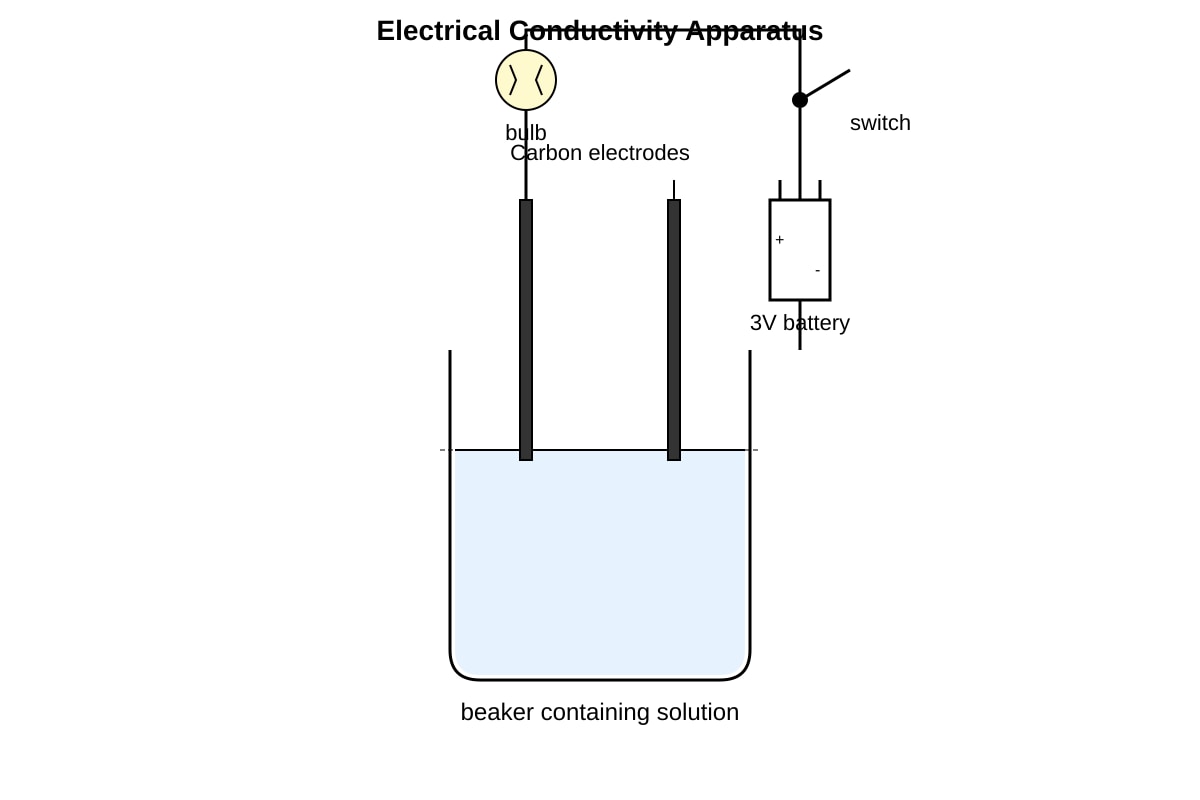
Answer: No / very dim / not light up (1 mark); distilled water has very few ions / essentially no dissolved ionic substances / [H⁺] and [OH⁻] from water autoionization are only 10⁻⁷ mol/dm³, insufficient to carry appreciable current (1 mark)
Explanation: Pure water autoionizes: H₂O ⇌ H⁺ + OH⁻ with [H⁺] = [OH⁻] = 10⁻⁷ mol/dm³. This ion concentration is far too low for detectable conductivity with simple apparatus. In practice, even "distilled" water contains enough dissolved CO₂ to show slight conductivity, but the theoretical expectation is non-conducting.
(a)(ii) [2 marks]
Answer: Yes / bulb lights brightly (1 mark); aqueous NaOH dissociates completely into Na⁺ and OH⁻ ions that are mobile and carry charge through the solution (1 mark)
Explanation: NaOH is a strong base, fully ionized: NaOH → Na⁺ + OH⁻. At 1.0 mol/dm³, high ion concentration provides good conductivity. Both cations (Na⁺) and anions (OH⁻) migrate to oppositely charged electrodes, completing the circuit.
(a)(iii) [2 marks]
Answer: No / very dim / not light up (1 mark); glucose is a covalent molecular compound that does not ionize in water / remains as neutral molecules / no ions to carry charge (1 mark)
Explanation: Glucose (C₆H₁₂O₆) dissolves in water due to hydrogen bonding but does not dissociate into ions. It is a non-electrolyte. The solution contains intact glucose molecules and water molecules—none are charged. This distinguishes molecular solubility from ionic dissociation.
(b) [1 mark]
Answer: Replace bulb with ammeter / light bulb with microammeter / use conductivity meter / measure current quantitatively
Explanation: A bulb is a crude indicator—it only shows whether conductivity exceeds a threshold. An ammeter provides numerical current readings, enabling comparison of relative conductivity. This modification converts the qualitative test to a quantitative measurement.
19. [5 marks total]
(a) [3 marks]
Answer:
- Lower temperature would give higher equilibrium yield (Le Chatelier, exothermic forward reaction) (1 mark)
- BUT rate would be too slow / uneconomically slow at low temperature (1 mark)
- 450°C is a compromise / optimum / gives reasonable rate and acceptable yield with catalyst (1 mark)
Explanation: The contact process exemplifies industrial equilibrium optimization. Thermodynamics favours low T (exothermic) and high P (fewer gas moles on product side). Kinetics favours high T. The catalyst (V₂O₅) accelerates attainment of equilibrium without affecting its position. 450°C with 1-2 atm pressure and V₂O₅ catalyst achieves practical compromise: sufficient SO₃ yield (~99% with recycling) with acceptable production rate.
(b) [2 marks]
Answer: Direct reaction of SO₃ with water is too vigorous / highly exothermic / produces a corrosive acid mist / mist is difficult to condense and causes pollution (1 mark); dissolving in concentrated H₂SO₄ first controls the reaction / produces oleum that can be safely diluted to sulfuric acid (1 mark)
Explanation: SO₃ + H₂O → H₂SO₄ has ΔH ≈ −130 kJ/mol, very exothermic. The rapid reaction vaporizes water, creating fine sulfuric acid droplets (mist) that escape as polluting aerosols and are hard to absorb. The two-step process: SO₃ + H₂SO₄ → H₂S₂O₇ (oleum), then H₂S₂O₇ + H₂O → 2H₂SO₄, is controllable and avoids mist formation.
20. [8 marks total]
(a) [3 marks]
Answer: CaCO₃ + 2H⁺ → Ca²⁺ + H₂O + CO₂ (or CaCO₃ + H₂SO₄ → CaSO₄ + H₂O + CO₂ or with nitric acid)
Explanation:
- Limestone is mainly calcium carbonate (1 mark)
- Acids react with carbonates to form salt + water + carbon dioxide (1 mark)
- The calcium sulfate/calcium nitrate formed may wash away, or the CO₂ evolution physically damages structure (1 mark)
Chemical equation: CaCO₃(s) + H₂SO₄(aq) → CaSO₄(aq/s) + H₂O(l) + CO₂(g)
Note: CaSO₄ is slightly soluble, so damage occurs through both chemical loss and mechanical stress from CO₂ bubbles. This is why acid rain damages limestone buildings and statues.
(b)(i) [3 marks]
Working:
- Molar mass of CaCO₃ = 40 + 12 + (3 × 16) = 100 g/mol
- Moles of CaCO₃ = 10.0 ÷ 100 = 0.100 mol
- CaCO₃ + H₂SO₄ → CaSO₄ + H₂O + CO₂
- Mole ratio CaCO₃ : H₂SO₄ = 1 : 1
- Moles of H₂SO₄ = 0.100 mol
- Volume of H₂SO₄ = 0.100 ÷ 0.100 = 1.00 dm³ = 1000 cm³
Answer: 1.00 dm³ (or 1000 cm³)
Explanation: Standard stoichiometry: mass → moles → mole ratio → volume via c = n/V. Note the 1:1 ratio with carbonate despite H₂SO₄ being dibasic—carbonate is a basic compound (not hydroxide), and one CO₃²⁻ accepts two H⁺ to become H₂O + CO₂, matching one SO₄²⁻. Actually check: CaCO₃ + H₂SO₄ → CaSO₄ + H₂O + CO₂ is balanced as 1:1. Yes: Ca⁺², CO₃⁻² + H₂SO₄ → CaSO₄ + H₂CO₃ → H₂O + CO₂. Correct.
(b)(ii) [2 marks]
Advantage: Calcium carbonate is cheap / readily available / less hazardous to handle / solid easy to store / produces harmless CO₂ / adds calcium nutrient / slower reaction avoids pH shock (1 mark)
Disadvantage: Calcium carbonate is only slightly soluble / reacts slowly / may not act quickly enough to prevent fish death / insoluble residue may cloud water / need large quantity / may not react completely if particle size too large (1 mark)
Explanation: Sodium hydroxide is a strong alkali—cheap, very soluble, fast reaction, but dangerously corrosive and can cause rapid pH overshoot to strongly alkaline, killing fish through alkalosis. Calcium carbonate is gentler, self-buffering (excess doesn't dissolve above pH ~7 if CO₂ present), and adds beneficial Ca²⁺, but reacts slower and may leave sediment.
END OF ANSWER KEY
Paper Total: 60 marks