AI Generated Exam Paper
Secondary 3 Chemistry Practice Paper 2
Free Sec 3 Chemistry Practice Paper 2, HY3 AI version, with questions, answers, and O Level-style practice for Singapore students.
These static practice materials are generated from the site's syllabus and paper-generation workflow, with source and model context shown so students and parents can evaluate the material before use.
Questions
Free quiz and exam paper access
Enter your details to view this paper
Your access is remembered on this device.
Answers
TuitionGoWhere Practice Paper - Chemistry Secondary 3 (Answers)
Version: 2 of 5
Topic: Acids, Bases & Salts
Total Marks: 40
Section A: Multiple Choice and Short Answer (8 marks)
1. [1 mark] Calcium oxide (CaO) or calcium hydroxide (Ca(OH)₂) or calcium carbonate (CaCO₃).
Teaching note: Acidic soil has pH < 7. To increase pH (make less acidic), a base is added. Common soil amendments are bases such as CaO.
Common mistake: Naming NaCl or other neutral salts that do not raise pH.
2. [1 mark] Potassium chloride (KCl).
Teaching note: HCl + KOH → KCl + H₂O. Salt name from metal (potassium) + non-metal from acid (chloride).
3. [1 mark] Alkaline.
Teaching note: pH > 7 is alkaline; pH 11 is strongly alkaline.
4. [1 mark] Ammonia (NH₃) and hydrochloric acid (HCl).
Teaching note: Ammonium salts form from ammonia (or ammonium hydroxide) + acid. NH₃ + HCl → NH₄Cl.
5. [1 mark] H⁺ (hydrogen ion) or H₃O⁺ (hydronium ion).
Teaching note: Arrhenius acids release H⁺ in water.
6. [1 mark] Universal indicator is not accepted for red-blue; acceptable: litmus (red to blue) or methyl orange (red to yellow, not blue). Best answer: litmus.
Note: Litmus is red in acid, blue in alkali.
7. [1 mark] Purple (or unchanged / neutral colour).
Teaching note: Litmus is purple at pH 7.
8. [1 mark] Ca(OH)₂.
Teaching note: Calcium is Ca²⁺, hydroxide is OH⁻, so Ca(OH)₂.
Section B: Structured Response and Data (14 marks)
9. [3 marks]
(a) [2] HNO₃(aq) + NaOH(aq) → NaNO₃(aq) + H₂O(l)
Marking: 1 mark equation, 1 mark state symbols.
(b) [1] Sodium nitrate.
Teaching note: Acid + alkali → salt + water. Salt from HNO₃ is nitrate.
10. [3 marks]
Method: Neutralization / direct combination with excess base. [1]
Steps:
- Add excess zinc oxide to warm dilute sulfuric acid until no more dissolves. [1]
- Filter to remove excess ZnO; evaporate filtrate to crystallisation then cool to get crystals; dry between filter paper. [1]
Teaching note: Insoluble base + acid → soluble salt; excess ensures complete reaction.
11. [3 marks]
(a) [1] A (pH 3).
(b) [1] B (pH 7).
(c) [1] It can dissolve grease / neutralise acids (any suitable property from high pH).
Teaching note: Lower pH = more acidic.
12. [3 marks]
Aluminum hydroxide is amphoteric because it reacts with both acids and alkalis. [1]
With acid: Al(OH)₃ + 3HCl → AlCl₃ + 3H₂O [1]
With alkali: Al(OH)₃ + NaOH → NaAlO₂ + 2H₂O (or Al(OH)₄⁻ formation) [1]
Teaching note: Amphoteric = acts as acid and base.
13. [2 marks]
Average = (24.6 + 24.8 + 24.7) ÷ 3 = 24.7 cm³. [2 for correct value, units]
Working: Sum = 74.1; ÷3 = 24.7 cm³.
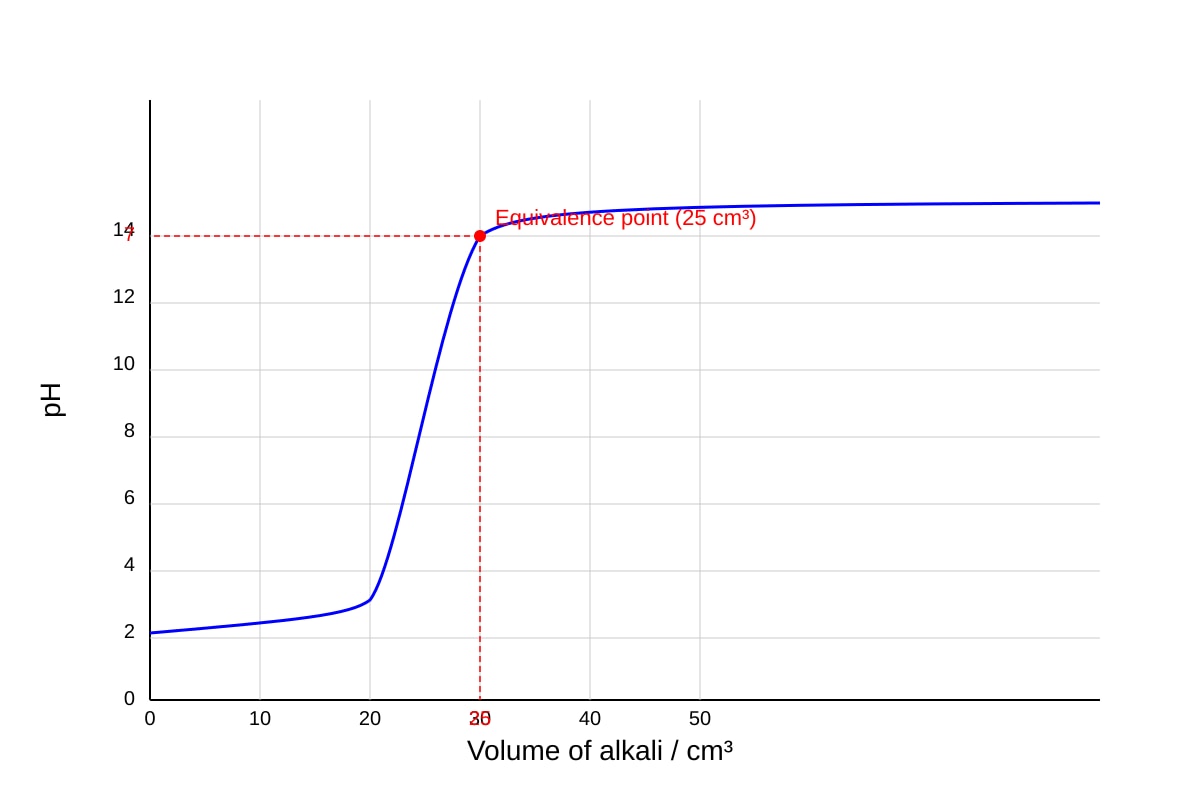
14. [2 marks]
(a) [1] pH 7 (from graph at equivalence).
(b) [1] 25 cm³.
Teaching note: Equivalence point from graph is at 25 cm³, pH 7 for strong acid-strong alkali.
Section C: Calculations and Extended Reasoning (18 marks)
15. [2 marks]
n = c × V = 0.200 × 0.500 = 0.100 mol. [2]
Teaching note: Use n = cV, V in dm³.
16. [4 marks]
(a) [2] n(NaOH) = 0.100 × (25.0/1000) = 0.00250 mol.
(b) [2] n(HCl) = n(NaOH) = 0.00250 mol; c = 0.00250 / (20.0/1000) = 0.125 mol/dm³.
Teaching note: HCl + NaOH → NaCl + H₂O, 1:1 ratio.
17. [4 marks]
(a) [2] CuO(s) + H₂SO₄(aq) → CuSO₄(aq) + H₂O(l)
(b) [2] Evaporate filtrate to saturation; cool to crystallise; filter and dry crystals. (any 2 steps)
Teaching note: Excess CuO removed by filtration.
18. [3 marks]
CaO reacts with water: CaO + H₂O → Ca(OH)₂. [1]
Ca(OH)₂ is a base, neutralises acid in soil, raising pH. [1]
Higher pH improves nutrient availability for crops. [1]
Teaching note: Bases increase pH by neutralising H⁺.
19. [5 marks]
(a) [2] Initial HCl = 0.0500 × 1.00 = 0.0500 mol; reacted = 0.0500 – 0.0200 = 0.0300 mol.
(b) [1] CaCO₃ + 2HCl → CaCl₂ + CO₂ + H₂O; mol CaCO₃ = 0.0300/2 = 0.0150 mol.
(c) [2] Mᵣ(CaCO₃) = 40+12+48 = 100; mass = 0.0150 × 100 = 1.50 g.
Teaching note: 1:2 ratio with HCl.
20. [3 marks]
HCl conducts better than CH₃COOH at same concentration. [1]
HCl is strong acid, fully ionized: HCl → H⁺ + Cl⁻. [1]
CH₃COOH is weak, partially ionized: CH₃COOH ⇌ CH₃COO⁻ + H⁺, fewer ions. [1]
Teaching note: More ions = higher conductivity.