AI Generated Exam Paper
Secondary 3 Chemistry Practice Paper 1
Free Kimi AI-generated Sec 3 Chemistry Practice Paper 1 with questions, answers, and O Level-style practice for Singapore students preparing for exams.
These static practice materials are generated from the site's syllabus and paper-generation workflow, with source and model context shown so students and parents can evaluate the material before use.
Questions
TuitionGoWhere Practice Paper - Chemistry Secondary 3
TuitionGoWhere Practice Paper (AI)
| Field | Details |
|---|---|
| Subject: | Chemistry |
| Level: | Secondary 3 (G3/Express) |
| Paper: | Practice Paper |
| Duration: | 1 hour 15 minutes |
| Total Marks: | 60 |
| Version: | 1 of 5 |
| Name: | _________________________ |
| Class: | _________________________ |
| Date: | _________________________ |
Instructions to Candidates
Write your name, class, and date in the spaces provided above.
This paper consists of three sections:
- Section A: 10 multiple-choice questions (10 marks)
- Section B: 5 structured questions (30 marks)
- Section C: 2 data-based / practical application questions (20 marks)
Answer all questions.
Write your answers in the spaces provided. For questions requiring calculations, show all working clearly. Marks will be awarded for correct method even if the final answer is incorrect.
The use of an approved calculator is expected where appropriate.
A copy of the Periodic Table is available if required.
Section A: Multiple Choice Questions (10 marks)
Answer all questions. Each question carries 1 mark.
1. Which of the following is a property of all acids? A. They turn red litmus paper blue B. They have a pH greater than 7 C. They produce hydrogen ions in aqueous solution D. They feel soapy to touch
Answer: ______
2. A farmer adds calcium hydroxide to acidic soil. What type of reaction occurs? A. Combustion B. Neutralisation C. Precipitation D. Redox
Answer: ______
3. Which salt is formed when magnesium oxide reacts with sulfuric acid? A. Magnesium sulfate B. Magnesium sulfite C. Magnesium chloride D. Magnesium hydrogensulfate
Answer: ______
4. The pH of a solution changes from 3 to 6. What happens to the hydrogen ion concentration? A. It decreases by a factor of 2 B. It decreases by a factor of 3 C. It decreases by a factor of 10 D. It decreases by a factor of 1000
Answer: ______
5. Which method is most suitable for preparing a sample of insoluble lead(II) chloride? A. Titration of lead(II) hydroxide with hydrochloric acid B. Direct combination of lead(II) nitrate solution with sodium chloride solution C. Reacting lead metal with dilute hydrochloric acid D. Neutralisation of lead(II) oxide with hydrochloric acid followed by crystallisation
Answer: ______
6. A student tests an unknown solution with universal indicator, which turns orange. Which statement is correct? A. The solution is strongly alkaline B. The solution is neutral C. The solution is weakly acidic D. The solution is strongly acidic
Answer: ______
7. What is the chemical formula of the salt formed from hydrochloric acid and aluminium hydroxide? A. AlCl B. AlCl₂ C. AlCl₃ D. Al₂Cl₃
Answer: ______
8. Which pair of substances will react to produce a gas at room temperature? A. Sodium hydroxide and copper(II) sulfate B. Zinc and dilute sulfuric acid C. Potassium carbonate and calcium nitrate D. Ammonia and hydrochloric acid
Answer: ______
9. A 25.0 cm³ sample of 0.100 mol/dm³ sodium hydroxide is exactly neutralised by 20.0 cm³ of sulfuric acid. What is the concentration of the sulfuric acid? A. 0.0625 mol/dm³ B. 0.0800 mol/dm³ C. 0.125 mol/dm³ D. 0.200 mol/dm³
Answer: ______
10. Which statement about concentrated sulfuric acid is correct? A. It is a weak acid B. It has a pH of approximately 5 C. It is a dehydrating agent D. It does not react with metals
Answer: ______
Section A Total: 10 marks
Section B: Structured Questions (30 marks)
Answer all questions in the spaces provided.
11. The table below shows information about four common laboratory acids.
| Acid | Formula | Type | Typical concentration (mol/dm³) |
|---|---|---|---|
| Hydrochloric acid | HCl | Strong monoprotic | 2.0 |
| Sulfuric acid | H₂SO₄ | Strong diprotic | 1.0 |
| Nitric acid | HNO₃ | Strong monoprotic | 2.0 |
| Ethanoic acid | CH₃COOH | Weak monoprotic | 2.0 |
(a) Explain what is meant by a "strong acid". [2]
(b) Calculate the concentration of hydrogen ions, [H⁺], in 2.0 mol/dm³ hydrochloric acid. Explain your answer. [2]
(c) A student has 25.0 cm³ of 2.0 mol/dm³ ethanoic acid. Calculate the maximum volume of 1.0 mol/dm³ sodium hydroxide that can be neutralised by this acid. [2]
(d) Explain why sulfuric acid is described as "diprotic" and state how this affects its neutralising capacity compared to hydrochloric acid of the same concentration. [2]
(Total: 8 marks)
12. A student prepares a sample of pure, dry copper(II) sulfate crystals using the following method:
- Step 1: Add excess copper(II) oxide to warm dilute sulfuric acid
- Step 2: Filter the mixture
- Step 3: Heat the filtrate gently to concentrate the solution
- Step 4: Allow the concentrated solution to cool and crystallise
- Step 5: Filter off the crystals and dry between filter papers
(a) Write a balanced chemical equation, including state symbols, for the reaction in Step 1. [2]
(b) Explain why excess copper(II) oxide is used rather than exactly the right amount. [1]
(c) Explain why the mixture is filtered in Step 2. [1]
(d) Explain why the concentrated solution is allowed to cool slowly rather than being plunged into ice water. [2]
(e) Suggest one modification to Step 5 that would produce larger, more regular crystals. [1]
(Total: 7 marks)
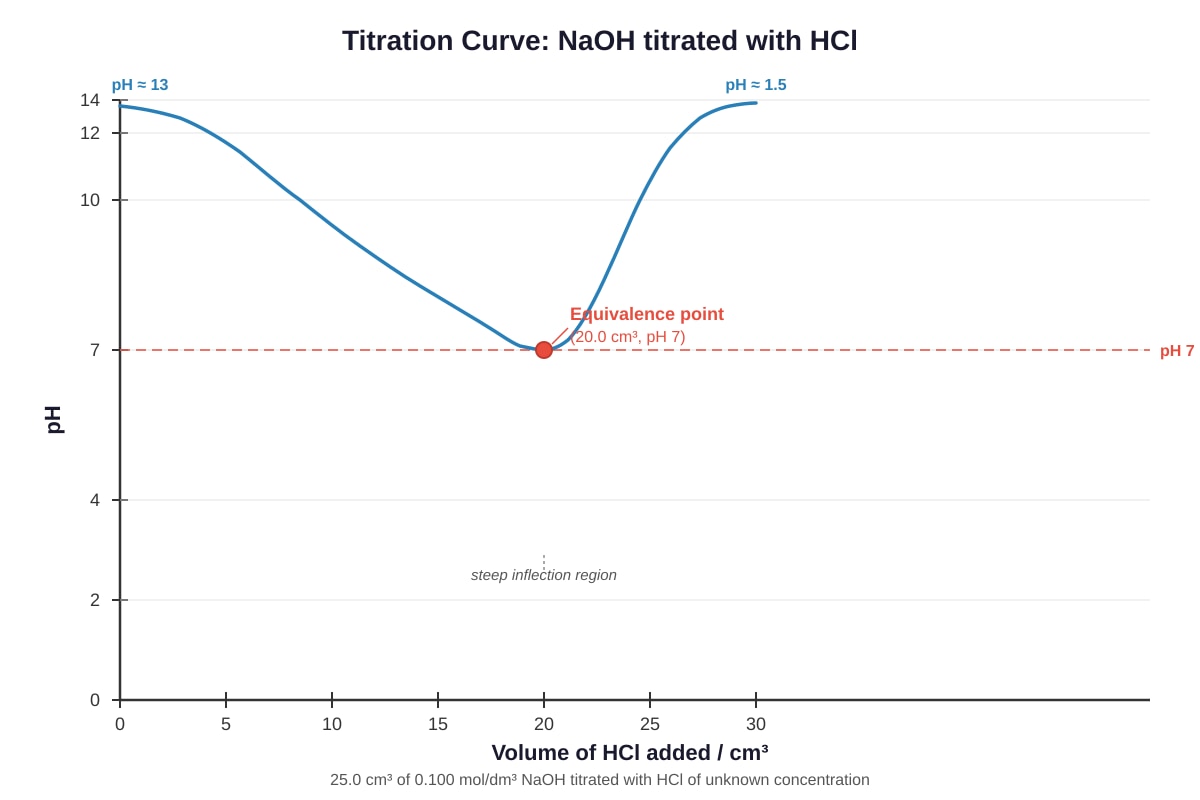
13. The diagram below shows the titration curve obtained when 25.0 cm³ of 0.100 mol/dm³ sodium hydroxide is titrated with hydrochloric acid of unknown concentration.
<image_placeholder> id: Q13-fig1 type: graph linked_question: Q13 description: Titration curve showing pH on y-axis against volume of HCl added (cm³) on x-axis labels: x-axis "Volume of HCl added / cm³" (0, 5, 10, 15, 20, 25, 30); y-axis "pH" (0, 2, 4, 7, 10, 12, 14); equivalence point marked at 20.0 cm³ where pH = 7; curve starts at pH ≈ 13, gradually decreases, steep vertical section around 20 cm³ from pH 10 to pH 3, then level at pH ≈ 1.5 values: initial pH ≈ 13; equivalence point at 20.0 cm³, pH = 7; final pH ≈ 1.5 after 25 cm³ must_show: smooth S-shaped curve; equivalence point clearly at (20.0, 7); steep inflection; axes labels with units; pH 7 horizontal dashed line </image_placeholder>
(a) Use the graph to determine the volume of hydrochloric acid required to reach the equivalence point. [1]
(b) Calculate the concentration of the hydrochloric acid. [2]
(c) Explain why the pH changes very rapidly in the region of the equivalence point. [2]
(d) Suggest a suitable indicator for this titration and explain your choice. [2]
(Total: 7 marks)
14. Farmers use various substances to control soil pH for optimal crop growth.
(a) Suggest why a farmer might add calcium carbonate (limestone) to acidic soil rather than sodium hydroxide. [2]
(b) Write a chemical equation for the reaction of calcium carbonate with nitric acid in the soil. [2]
(c) Over-application of calcium carbonate can make soil too alkaline. A soil sample has a pH of 8.5. Suggest one substance that could be added to decrease the pH and write an ionic equation for the reaction that occurs. [2]
(d) Explain how soil pH affects the availability of nutrients to plants. [1]
(Total: 7 marks)
15. Ammonia is a common alkaline gas used in the production of fertilisers.
(a) Write a balanced equation for the reaction of ammonia gas with hydrogen chloride gas. [1]
(b) Name the white solid produced in the reaction in part (a) and identify the type of bonding present in this compound. [2]
(c) A student prepares ammonia solution by bubbling ammonia gas through water. The resulting solution has a pH of 11. Calculate the concentration of hydroxide ions, [OH⁻], in this solution. [Kw = 1.0 × 10⁻¹⁴ mol²/dm⁶ at 25°C] [2]
(d) Explain why ammonia solution is described as a weak base even though it produces a relatively high pH. [2]
(Total: 7 marks)
Section B Total: 30 marks
Section C: Data Analysis and Practical Application (20 marks)
Answer both questions in the spaces provided.
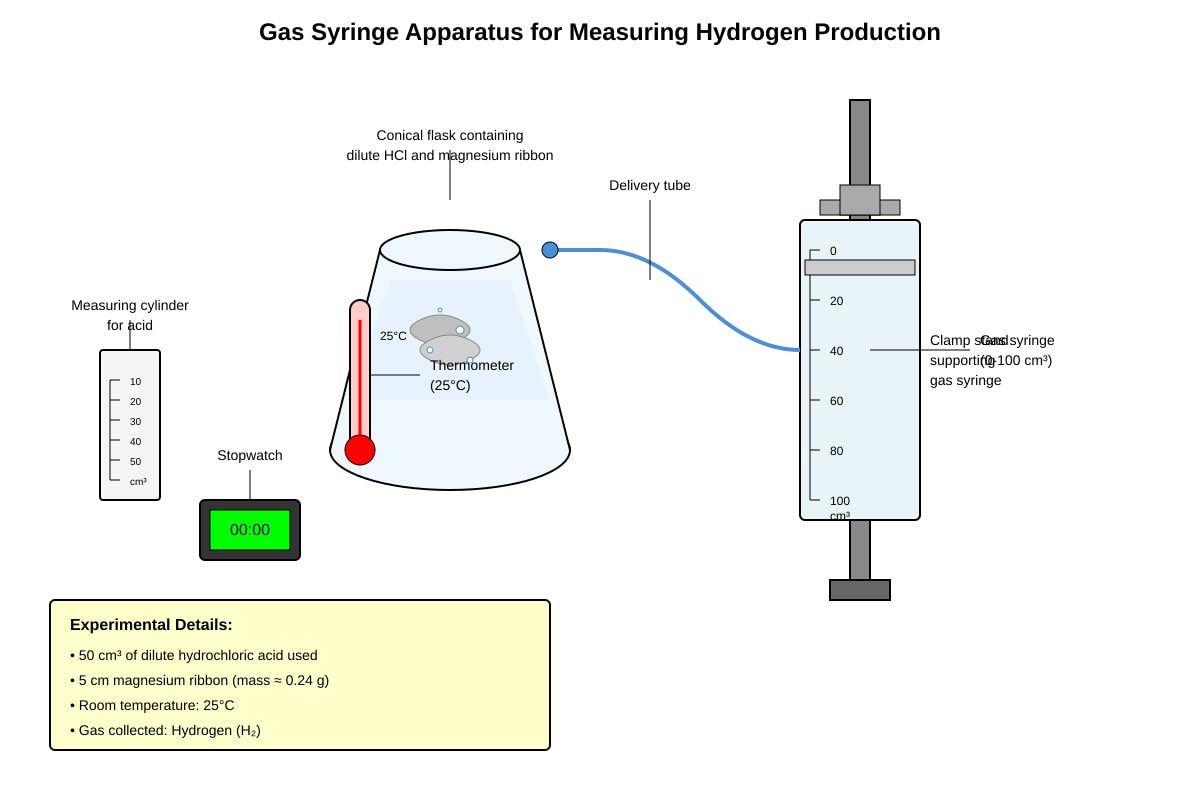
16. A group of students investigates the effect of concentration on the rate of reaction between magnesium ribbon and hydrochloric acid. They use the following apparatus:
<image_placeholder> id: Q16-setup type: experimental_setup linked_question: Q16 description: Gas syringe apparatus for measuring hydrogen production labels: conical flask containing dilute HCl and magnesium ribbon; gas syringe connected via delivery tube; stopwatch; measuring cylinder for acid; thermometer values: 50 cm³ acid used; 5 cm magnesium ribbon ( mass ≈ 0.24 g ); room temperature 25°C must_show: labelled conical flask, delivery tube, gas syringe with scale markings (0-100 cm³), stopwatch, clamp stand supporting gas syringe </image_placeholder>
The students carry out five experiments using different concentrations of hydrochloric acid, keeping all other variables constant. Their results are shown below:
| Experiment | Concentration of HCl (mol/dm³) | Time for gas syringe to reach 50 cm³ (s) | Rate (cm³/s) |
|---|---|---|---|
| 1 | 0.5 | 100 | |
| 2 | 1.0 | 50 | |
| 3 | 1.5 | 33 | |
| 4 | 2.0 | 25 | |
| 5 | 2.5 | 20 |
(a) Complete the table by calculating the rate of reaction for each experiment. Give your answers to two significant figures. [2]
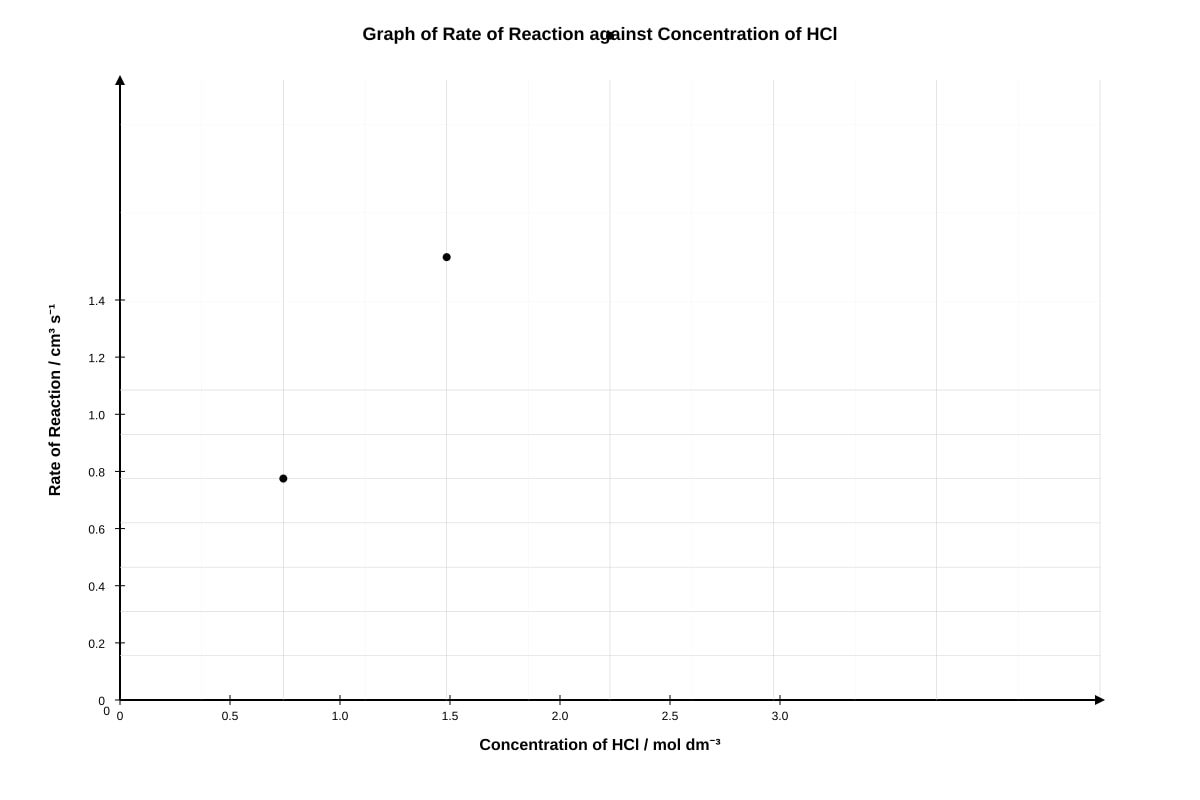
(b) Plot a graph of rate of reaction (y-axis) against concentration of HCl (x-axis) on the grid below. [3]
<image_placeholder> id: Q16-graph type: graph linked_question: Q16 description: Blank grid for student to plot rate vs concentration graph labels: x-axis "Concentration of HCl / mol dm⁻³" (0, 0.5, 1.0, 1.5, 2.0, 2.5, 3.0); y-axis "Rate / cm³ s⁻¹" (0, 0.2, 0.4, 0.6, 0.8, 1.0, 1.2, 1.4); grid lines at 0.25 intervals on x, 0.1 on y values: points to plot: (0.5, 0.50), (1.0, 1.0), (1.5, 1.5), (2.0, 2.0), (2.5, 2.5) must_show: origin at (0,0); linear scales; labeled axes with units; grid for student plotting </image_placeholder>
(c) Describe the relationship between concentration and rate of reaction shown by your graph. [2]
(d) Explain this relationship in terms of particle collision theory. [3]
(e) State two variables that must be kept constant in this investigation and explain why each must be controlled. [2]
(f) Explain why the rate would be lower if the investigation were repeated at 15°C instead of 25°C. [2]
(Total: 14 marks)
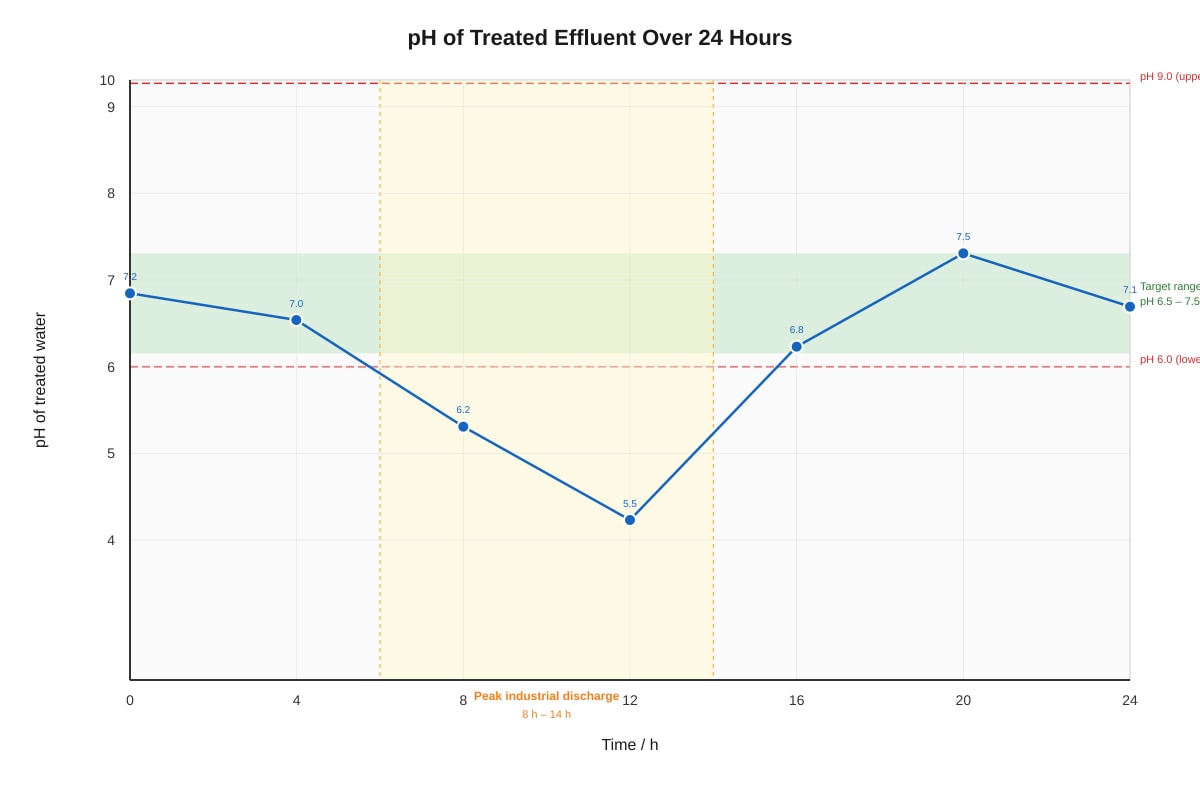
17. A wastewater treatment plant neutralises acidic industrial effluent before releasing it into rivers. The plant uses a continuous flow system with automatic pH monitoring.
<image_placeholder> id: Q17-chart type: chart linked_question: Q17 description: Line graph showing pH of treated water over a 24-hour period labels: x-axis "Time / h" (0, 4, 8, 12, 16, 20, 24); y-axis "pH of treated water" (4, 5, 6, 7, 8, 9, 10); target range shaded between pH 6.5 and pH 7.5; acceptable discharge limit lines at pH 6.0 and pH 9.0 values: Midnight (0 h): pH 7.2; 4 h: pH 7.0; 8 h: pH 6.2; 12 h: pH 5.5; 16 h: pH 6.8; 20 h: pH 7.5; 24 h: pH 7.1 must_show: title "pH of Treated Effluent Over 24 Hours"; target range shaded green; limit lines dashed red at pH 6.0 and pH 9.0; data points connected by line; peak industrial discharge period marked 8 h – 14 h </image_placeholder>
(a) State the time period during which the treated effluent falls below the acceptable discharge limit. [1]
(b) The plant uses calcium hydroxide slurry to neutralise the acid. Calculate the mass of calcium hydroxide needed to neutralise 1000 dm³ of effluent with pH 2.0. [Molar mass of Ca(OH)₂ = 74 g/mol; assume complete ionisation of acid] [4]
(c) The operators notice that between 8 h and 14 h, the pH drops despite constant addition of calcium hydroxide. Suggest two possible reasons for this observation. [2]
(d) Explain why the target pH range is 6.5–7.5 rather than exactly 7.0, and why the acceptable limits extend to pH 6.0 and pH 9.0. [3]
(Total: 10 marks)
Section C Total: 20 marks
End of Paper
Paper Total: 60 marks
BLANK PAGE
Answers
TuitionGoWhere Practice Paper Answers - Chemistry Secondary 3
Version 1 of 5
Section A: Multiple Choice Answers (10 marks)
| Question | Answer | Explanation |
|---|---|---|
| 1 | C | All acids produce hydrogen ions (H⁺) when dissolved in water. This is the defining characteristic of acids (Arrhenius definition). A is incorrect (acids turn blue litmus red); B is incorrect (acids have pH < 7); D is incorrect (bases feel soapy). |
| 2 | B | Adding a base (calcium hydroxide) to an acid (acidic soil) is a neutralisation reaction, producing salt and water. |
| 3 | A | Magnesium oxide + sulfuric acid → magnesium sulfate + water. The salt takes its name from the metal (magnesium) and the acid radical (sulfate from sulfuric acid). |
| 4 | D | pH is a logarithmic scale: each pH unit represents a 10-fold change in [H⁺]. From pH 3 to pH 6 is 3 units, so [H⁺] decreases by 10³ = 1000 times. |
| 5 | B | Lead(II) chloride is insoluble, so it cannot be prepared by titration or crystallisation from solution. Precipitation by mixing two soluble salts (lead(II) nitrate + sodium chloride) is the standard method. Lead metal does not react with dilute HCl. |
| 6 | C | Universal indicator: red = strong acid; orange = weak acid; yellow = very weak acid; green = neutral; blue = weak base; purple = strong base. |
| 7 | C | Aluminium has a +3 oxidation state, so forms Al³⁺ ions. Three chloride ions (Cl⁻) are needed for charge balance: AlCl₃. |
| 8 | B | Zinc + dilute sulfuric acid → zinc sulfate + hydrogen gas. A produces a precipitate (Cu(OH)₂); C produces a precipitate (CaCO₃); D produces a salt (ammonium chloride) but no gas. |
| 9 | A | NaOH: moles = 0.100 × 0.0250 = 0.00250 mol. H₂SO₄ is diprotic, so moles H₂SO₄ = 0.00250 ÷ 2 = 0.00125 mol. Concentration = 0.00125 ÷ 0.0200 = 0.0625 mol/dm³. |
| 10 | C | Concentrated sulfuric acid is a strong dehydrating agent, removing water from compounds. It is a strong acid (A incorrect), has very low pH (B incorrect), and does react with many metals (D incorrect). |
Section B: Structured Answers (30 marks)
Question 11 (8 marks)
(a) A strong acid completely ionises/dissociates in aqueous solution to produce hydrogen ions. [1] Unlike weak acids, no acid molecules remain undissociated in solution (equilibrium lies fully to the right). [1]
Teaching note: The key distinction is completeness of dissociation. Strong acids have a very large acid dissociation constant, Ka ≈ very high.
(b) [H⁺] = 2.0 mol/dm³ [1]
Explanation: HCl is a strong monoprotic acid, so it dissociates completely: HCl → H⁺ + Cl⁻. Therefore [H⁺] = [HCl] = 2.0 mol/dm³. [1]
Common error: Students sometimes think [H⁺] = 2 × [HCl] due to confusion with diprotic acids.
(c) Moles of ethanoic acid = 2.0 × 0.0250 = 0.050 mol [1]
Since ethanoic acid is monoprotic, moles NaOH = 0.050 mol
Volume of NaOH = 0.050 ÷ 1.0 = 0.050 dm³ = 50.0 cm³ [1]
Teaching note: Even though ethanoic acid is weak, the stoichiometry is still 1:1 with NaOH. The weakness affects rate and pH at equivalence, not the total amount that reacts.
(d) "Diprotic" means each molecule can donate two protons (hydrogen ions) to a base. [1] Therefore 1 mol/dm³ H₂SO₄ has the same neutralising capacity as 2 mol/dm³ HCl. [1]
Question 12 (7 marks)
(a) CuO(s) + H₂SO₄(aq) → CuSO₄(aq) + H₂O(l) [2]
Marking: Correct formulae [1]; correct state symbols and balancing [1]
Teaching note: Copper(II) oxide is a basic oxide (metal oxide). It reacts with acids to form salt + water. The oxide must be insoluble enough to filter off excess, but soluble enough to react.
(b) To ensure all the acid reacts / acid is the limiting reactant [1], so the filtrate contains only copper(II) sulfate and no unreacted acid.
Teaching note: Excess insoluble reactant is a standard technique. It ensures complete reaction and can be removed by filtration.
(c) To remove unreacted/excess copper(II) oxide [1], which is insoluble.
(d) Slow cooling allows larger, more regular crystals to form [1] because ions have time to arrange themselves into an ordered lattice structure. Rapid cooling produces small, irregular crystals. [1]
(e) Pat dry with fresh filter papers (instead of rubbing) / leave to dry in a warm oven or desiccator / allow to air dry [1]
Teaching note: Rubbing damages crystal structure; excessive heat can cause decomposition (CuSO₄·5H₂O loses water of crystallisation).
Question 13 (7 marks)
(a) 20.0 cm³ [1] (reading from equivalence point on graph)
(b) Moles NaOH = 0.100 × 0.0250 = 0.00250 mol [1]
HCl + NaOH → NaCl + H₂O (ratio 1:1)
Moles HCl = 0.00250 mol
Concentration HCl = 0.00250 ÷ 0.0200 = 0.125 mol/dm³ [1]
Teaching note: This is a strong acid-strong base titration with 1:1 stoichiometry. The calculation is straightforward mole-to-mole conversion.
(c) Near the equivalence point, small additions of acid cause large changes in [H⁺] [1] because the solution contains very little alkali left to buffer against added acid, and water's ion product means tiny excess H⁺ shifts pH dramatically. [1]
Teaching note: Before equivalence, OH⁻ is in excess; after, H⁺ is in excess. The transition is steep because Kw = [H⁺][OH⁻] = 10⁻¹⁴ is very small.
(d) Methyl orange or phenolphthalein [1]
Methyl orange: red in acid, yellow/orange in alkali, sharp colour change at pH 3.1–4.4 (suitable for strong acid-strong base); or phenolphthalein: colourless in acid, pink in alkali, pH 8.3–10. [1]
Teaching note: For strong acid-strong base titrations, any indicator with transition range crossing pH 7 works. The steep vertical section ensures sharp colour change regardless.
Question 14 (7 marks)
(a) Calcium carbonate is insoluble/slowly reacting [1], so it neutralises acid gradually without making soil too alkaline; sodium hydroxide is too strong, corrosive, and would make soil dangerously alkaline. [1]
Teaching note: Practical considerations — cost, safety, and controlled release are important. CaCO₃ acts as a "slow-release" neutraliser.
(b) CaCO₃(s) + 2HNO₃(aq) → Ca(NO₃)₂(aq) + H₂O(l) + CO₂(g) [2]
Marking: Correct formulae and balancing [1]; correct state symbols (CO₂ gas essential) [1]
(c) Substance: Ammonium salts / sulfur / peat / iron(II) sulfate / dilute acid [1]
Ionic equation: H⁺(aq) + OH⁻(aq) → H₂O(l) [1] (or for carbonate/bicarbonate systems: CO₂ + OH⁻ → HCO₃⁻ etc.)
Teaching note: For slight pH reduction, mild acids or acid-forming salts are used. Never use strong acids directly on soil.
(d) Extreme pH causes nutrients to become insoluble/unavailable or damages root structure / affects microbial activity. [1]
Question 15 (7 marks)
(a) NH₃(g) + HCl(g) → NH₄Cl(s) [1]
(State symbols earn credit but not required for mark)
(b) Ammonium chloride [1]; ionic bonding (and covalent within NH₄⁺ ion, but primarily ionic lattice) [1]
Teaching note: NH₄Cl consists of NH₄⁺ and Cl⁻ ions in an ionic lattice. The ammonium ion itself contains covalent N-H bonds, but the inter-particle bonding is ionic.
(c) Kw = [H⁺][OH⁻] = 1.0 × 10⁻¹⁴
pH = 11, so [H⁺] = 10⁻¹¹ mol/dm³ [1]
[OH⁻] = Kw / [H⁺] = 1.0 × 10⁻¹⁴ / 10⁻¹¹ = 1.0 × 10⁻³ mol/dm³ [1]
(d) Ammonia is weak because it partially ionises in water: NH₃ + H₂O ⇌ NH₄⁺ + OH⁻ [1], establishing an equilibrium with significant NH₃ molecules remaining unionised. The relatively high pH comes from sufficient OH⁻ being produced, but the equilibrium position lies to the left. [1]
Teaching note: "Weak" refers to degree of dissociation, not concentration or resulting pH. A dilute strong base can have lower pH than a concentrated weak base.
Section C: Data Analysis and Practical Application (20 marks)
Question 16 (14 marks)
(a)
| Experiment | Rate (cm³/s) |
|---|---|
| 1 | 0.50 |
| 2 | 1.0 (or 1.00) |
| 3 | 1.5 (or 1.52 to 2 sig fig: 1.5) |
| 4 | 2.0 (or 2.00) |
| 5 | 2.5 (or 2.50) |
Calculation: Rate = 50 cm³ ÷ time
- Exp 1: 50/100 = 0.50 [1]
- Exp 2–5: correct values [1]
Note: Accept 2 significant figures throughout, or 3 for experiments 2 and 4. Must show consistency.
(b) Plotting [3 marks]:
- Correct axes with labels and units [1]
- All five points correctly plotted [1]
- Straight line of best fit through origin [1]
Expected answer: Linear relationship through (0,0), (0.5, 0.50), (1.0, 1.0), (1.5, 1.5), (2.0, 2.0), (2.5, 2.5)
(c) The graph shows a directly proportional/linear relationship [1]: as concentration increases, rate increases proportionally. Doubling concentration doubles the rate. [1]
(d) Higher concentration means more acid particles per unit volume [1], leading to more frequent collisions between H⁺ ions and magnesium atoms per unit time [1]. Since only collisions with sufficient activation energy are successful, more frequent collisions mean more successful collisions per second, increasing rate. [1]
Teaching note: This is the collision theory explanation. Must mention both particle density and collision frequency; mentioning energy/activation energy completes the explanation.
(e) Any two from:
- Temperature — affects kinetic energy and collision frequency
- Surface area of magnesium — affects exposed reaction sites
- Volume of acid — must exceed amount needed to complete reaction
- Mass/length of magnesium ribbon — must be constant to compare rate fairly
[1 each explanation; max 2 marks]
(f) At 15°C, particles have less kinetic energy [1] than at 25°C, so fewer particles possess the activation energy needed for successful collisions, and collision frequency is lower. [1]
Question 17 (10 marks)
(a) 8 h to approximately 14 h / between 8 h and 12–14 h [1]
Reading from graph: pH drops below 6.0 at ~8 h, rises above 6.0 at ~14–16 h. Accept "8 h to 14 h" or "morning to early afternoon."
(b) pH 2.0 means [H⁺] = 10⁻² = 0.01 mol/dm³ [1]
Moles H⁺ in 1000 dm³ = 0.01 × 1000 = 10 mol [1]
Ca(OH)₂ + 2H⁺ → Ca²⁺ + 2H₂O (or Ca(OH)₂ + 2HCl → CaCl₂ + 2H₂O)
Moles Ca(OH)₂ needed = 10 ÷ 2 = 5.0 mol [1]
Mass Ca(OH)₂ = 5.0 × 74 = 370 g [1]
Teaching note: Industrial calculations often use approximation pH = -log[H⁺] directly. The acid is assumed fully dissociated for simplicity. Ca(OH)₂ provides 2 moles OH⁻ per mole, so stoichiometric ratio is 1:2 with H⁺.
(c) Any two from:
- Increased flow rate/volume of acidic effluent during peak industrial period [1]
- Stronger/more concentrated acid input during that period [1]
- Temporary equipment malfunction in dosing system [1]
- Reaction of Ca(OH)₂ with other acidic substances in waste stream [1]
(d) pH 6.5–7.5 is a safety margin allowing for:
- Natural variation in river pH (6.5–8.5 typical) [1]
- Small measurement/dosing errors without compromising safety [1]
- Buffering capacity of receiving water [1]
Wider limits (6.0–9.0) allow for occasional brief excursions during equipment adjustment or unusual events, while still protecting aquatic life from acute harm. [1 max from this paragraph]
Marking: Up to 3 marks for balanced explanation of why exact neutrality is impractical and why some tolerance exists.
Summary Mark Allocation
| Section | Marks |
|---|---|
| A | 10 |
| B | 30 |
| C | 20 |
| Total | 60 |
End of Answer Key