AI Generated Exam Paper
Secondary 3 Chemistry Practice Paper 1
Free Sec 3 Chemistry Practice Paper 1, HY3 AI version, with questions, answers, and O Level-style practice for Singapore students.
These static practice materials are generated from the site's syllabus and paper-generation workflow, with source and model context shown so students and parents can evaluate the material before use.
Questions
TuitionGoWhere Practice Paper - Chemistry Secondary 3
TuitionGoWhere Practice Paper (AI) — Version 1 of 5
Subject: Chemistry
Level: Secondary 3
Paper: Practice Paper (Topic: Acids, Bases & Salts)
Duration: 60 minutes
Total Marks: 40
Name: ______________________
Class: ____________
Date: ____________
Instructions:
- This practice paper contains 20 questions on Acids, Bases & Salts.
- Section A: Questions 1–8 (8 marks)
- Section B: Questions 9–14 (14 marks)
- Section C: Questions 15–20 (18 marks)
- Write your answers in the spaces provided.
- Use proper chemical notation and include units where required.
- Show all working clearly for calculation questions.
Section A (8 marks)
1. Which solid compound is added to acidic soil to increase its pH? [1]
2. State the colour of litmus paper in a solution of pH 3. [1]
3. Name the salt formed when hydrochloric acid reacts with sodium hydroxide. [1]
4. Give the formula of the ion responsible for alkalinity in aqueous solutions. [1]
5. Which two compounds can be reacted together to form ammonium chloride? [1]
6. State whether a solution of pH 7 is acidic, neutral, or alkaline. [1]
7. Name one indicator that is green at pH 7. [1]
8. Write the chemical formula of sulfuric acid. [1]
Section B (14 marks)
9. A student adds nitric acid to potassium hydroxide until neutral.
(a) Write a balanced equation with state symbols. [2]
(b) Name the salt formed. [1]
(a) ____________________________________________
(b) ____________________________________________
10. A soil sample has pH 4. Explain how adding calcium oxide increases the pH. [2]
11. Describe how you would prepare pure, dry crystals of zinc sulfate starting from zinc oxide and dilute sulfuric acid. Include the method name and key steps. [3]
12. Classify each of the following as strong acid, weak acid, strong base, or weak base:
(a) ethanoic acid [1]
(b) sodium hydroxide [1]
(c) ammonia solution [1]
(a) ____________ (b) ____________ (c) ____________
13. The table shows pH values of four solutions.
| Solution | pH |
|---|---|
| W | 2 |
| X | 7 |
| Y | 9 |
| Z | 12 |
Which solution is most acidic? Which is most alkaline? [2]
Most acidic: ____________ Most alkaline: ____________
14. Write the ionic equation for the neutralization of an acid by an alkali. [2]
Section C (18 marks)
15. A titration was carried out to find the concentration of hydrochloric acid using sodium hydroxide. Three concordant titres were recorded: 21.40 cm³, 21.50 cm³, 21.45 cm³. A rough run was 23.10 cm³.
Calculate the average volume of acid used. [2]
16. The average volume of hydrochloric acid from Q15 was 21.45 cm³. This acid has concentration 0.100 mol/dm³. Calculate the number of moles of HCl in this volume. [2]
17. Aluminum oxide is amphoteric.
(a) Write an equation for its reaction with hydrochloric acid. [2]
(b) Write an equation for its reaction with sodium hydroxide solution. [2]
(a) ____________________________________________
(b) ____________________________________________
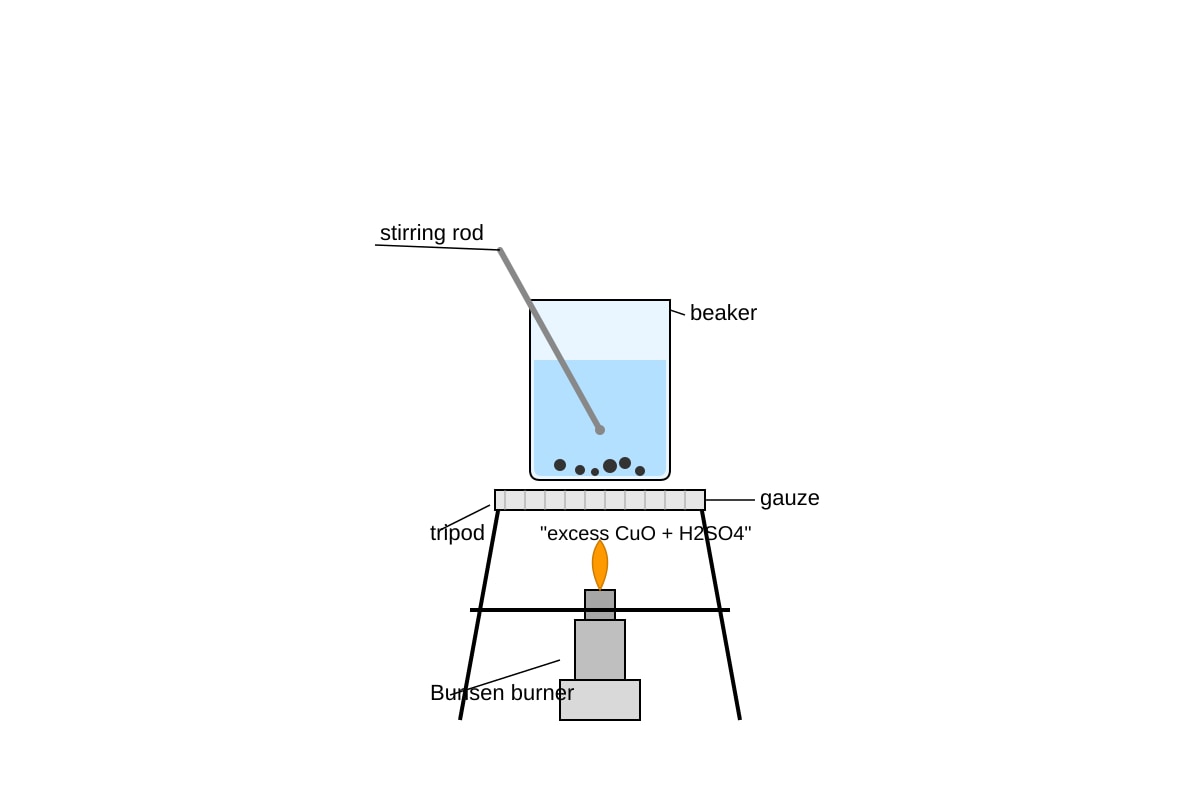
18. A student prepared copper(II) sulfate by adding excess copper(II) oxide to sulfuric acid.
Image pending generation: experimental_setup for Q18.
(a) Why is excess copper(II) oxide added? [1]
(b) State the next two steps to obtain pure dry crystals. [2]
(c) Name the method used. [1]
(a) ____________________________________________
(b) ____________________________________________
(c) ____________________________________________
19. 25.0 cm³ of 0.200 mol/dm³ sodium hydroxide is neutralized by 20.0 cm³ of sulfuric acid.
(a) Calculate moles of NaOH. [2]
(b) Using 2NaOH + H₂SO₄ → Na₂SO₄ + 2H₂O, find moles of H₂SO₄. [1]
(c) Calculate concentration of H₂SO₄ in mol/dm³. [2]
(a) ____________________________________________
(b) ____________________________________________
(c) ____________________________________________
20. A farmer has soil of pH 5. He wants to add a solid to raise pH to near 7 without making it too alkaline.
(a) Suggest a suitable compound and explain. [2]
(b) Why should he not use sodium hydroxide? [1]
(a) ____________________________________________
(b) ____________________________________________
Answers
TuitionGoWhere Practice Paper - Chemistry Secondary 3 (Answers)
Version 1 of 5 — Answer Key & Teaching Notes
Section A
1. [1] Calcium oxide (CaO) or calcium hydroxide (Ca(OH)₂) or calcium carbonate (CaCO₃).
Teaching note: Bases neutralize acid in soil; solid base is used to raise pH. Common trap: naming NaCl (neutral salt).
2. [1] Red.
Teaching note: pH < 7 is acidic; litmus is red in acid, blue in alkali.
3. [1] Sodium chloride.
Teaching note: HCl + NaOH → NaCl + H₂O. Salt from acid (HCl) and base (NaOH).
4. [1] OH⁻ (hydroxide ion).
Teaching note: Alkaline solutions contain OH⁻ ions from bases.
5. [1] Ammonia (NH₃) and hydrochloric acid (HCl).
Teaching note: Ammonium salts form from ammonia + acid: NH₃ + HCl → NH₄Cl.
6. [1] Neutral.
Teaching note: pH 7 is the neutral point at 25 °C.
7. [1] Universal indicator (or bromothymol blue).
Teaching note: Universal indicator is green at pH 7.
8. [1] H₂SO₄.
Teaching note: Sulfuric acid has two H⁺ and sulfate SO₄²⁻.
Section B
9. [3]
(a) [2] HNO₃(aq) + KOH(aq) → KNO₃(aq) + H₂O(l)
(b) [1] Potassium nitrate.
Teaching note: Acid + alkali → salt + water. Salt name from acid (nitric → nitrate) and base (potassium).
10. [2] Calcium oxide reacts with water to form calcium hydroxide (Ca(OH)₂), a base; this neutralizes H⁺ ions in acidic soil, raising pH.
Marking: 1 mark for CaO → Ca(OH)₂/base formation, 1 mark for neutralization of acid.
11. [3] Method: Direct combination/neutralization. Steps: (1) Add excess ZnO to dilute H₂SO₄ and warm; (2) Filter to remove excess ZnO; (3) Evaporate filtrate and cool to crystallize; dry crystals.
Marking: 1 method, 2 key steps (excess, filter, evaporate/cool).
12. [3] (a) weak acid (b) strong base (c) weak base.
Teaching note: Ethanoic acid partially ionizes; NaOH fully ionizes; NH₃ partially ionizes.
13. [2] Most acidic: W (pH 2); Most alkaline: Z (pH 12).
Marking: 1 each.
14. [2] H⁺(aq) + OH⁻(aq) → H₂O(l)
Teaching note: Ionic equation removes spectator ions.
Section C
15. [2] Average = (21.40 + 21.50 + 21.45) / 3 = 21.45 cm³.
Working: Exclude rough (23.10). Concordant within 0.1 cm³.
Marking: 1 for correct exclusion, 1 for arithmetic + unit.
16. [2] V = 21.45 cm³ = 0.02145 dm³; n = c × V = 0.100 × 0.02145 = 0.002145 mol (2.15×10⁻³ mol).
Marking: 1 conversion, 1 calculation.
17. [4]
(a) [2] Al₂O₃ + 6HCl → 2AlCl₃ + 3H₂O
(b) [2] Al₂O₃ + 2NaOH + 3H₂O → 2NaAl(OH)₄ (or Al₂O₃ + 2NaOH → 2NaAlO₂ + H₂O)
Teaching note: Amphoteric reacts with acid and alkali.
18. [4]
(a) [1] To ensure all acid reacts (complete neutralization).
(b) [2] Filter mixture; evaporate filtrate to saturation and cool to crystallize, then dry.
(c) [1] Neutralization / direct combination.
Image note: Setup shows excess solid; after reaction, filter removes it.
19. [5]
(a) [2] n(NaOH) = 0.200 × (25.0/1000) = 0.00500 mol.
(b) [1] From 2:1 ratio, n(H₂SO₄) = 0.00500/2 = 0.00250 mol.
(c) [2] c = n/V = 0.00250 / (20.0/1000) = 0.125 mol/dm³.
Marking: stepwise as shown.
20. [3]
(a) [2] Calcium carbonate (CaCO₃) or Ca(OH)₂; mildly raises pH, less harsh than strong base.
(b) [1] NaOH is strong base, may overshoot to high pH, harm plants.
Free quiz and exam paper access
Enter your details to view this paper
Your access is remembered on this device.