From Real Exams Exam Paper
Secondary 3 Chemistry Semestral Assessment 2 (End of Year) Paper 5
Free Sec 3 Chemistry SA2 Paper 5, Nemo3 Exam version, with questions, answers, and O Level-style practice for Singapore students.
These static practice materials are generated from the site's syllabus and paper-generation workflow, with source and model context shown so students and parents can evaluate the material before use.
Questions
Free quiz and exam paper access
Enter your details to view this paper
Your access is remembered on this device.
Answers
TuitionGoWhere Practice Paper - Chemistry Secondary 3 SA2 Version 5 - Answer Key
Total Marks: 60
Section A: Structured Questions [30 marks]
Question 1 [4 marks]
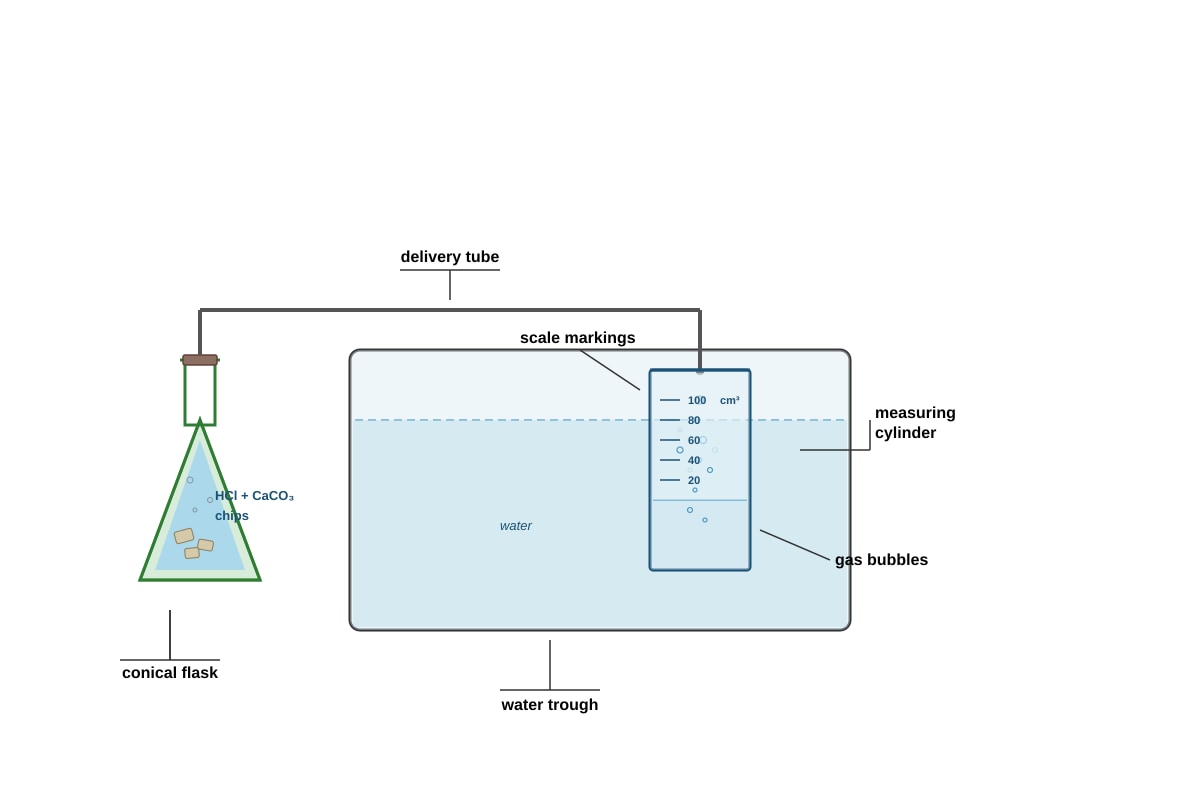
(a) CaCO₃(s) + 2HCl(aq) → CaCl₂(aq) + H₂O(l) + CO₂(g) [1]
Marking note: 1 mark for correct formulae and balancing. State symbols required for full mark.
(b)
Image pending generation: graph for Q1.
Marking points:
- Axes correctly labelled with quantities and units [1]
- Curve shape: steep initial slope decreasing to zero (plateau) [1]
Teaching note: The graph is curved because the reaction rate decreases as reactants are used up. The plateau occurs when the limiting reagent (CaCO₃) is completely consumed. Theoretical yield: 2.0 g CaCO₃ = 0.02 mol → 0.02 mol CO₂ = 480 cm³ at RTP, but limited by HCl: 0.05 mol HCl → 0.025 mol CO₂ = 600 cm³. So CaCO₃ is limiting, max volume ≈ 480 cm³ at RTP. However, at room temperature with gas syringe, expect ~50 cm³ in the time frame shown.
(c) The reaction stops because the calcium carbonate (limiting reagent) is completely used up. [1]
Alternative acceptable answer: One of the reactants is completely consumed.
Common mistake: Saying "the acid runs out" — HCl is in excess (0.05 mol HCl vs 0.02 mol CaCO₃ requires 0.04 mol HCl).
Question 2 [5 marks]
(a) NH₃(g) + HCl(g) → NH₄Cl(s) [1]
Marking note: State symbols essential. This is the gas-phase reaction forming solid ammonium chloride (white smoke).
(b) Molar mass of NH₄Cl = 14 + 4 + 35.5 = 53.5 g/mol Moles of NH₄Cl = 5.35 g / 53.5 g/mol = 0.100 mol Volume = 250 cm³ = 0.250 dm³ Concentration = 0.100 mol / 0.250 dm³ = 0.400 mol/dm³ [2]
Marking: 1 mark for correct moles calculation, 1 mark for correct concentration with unit.
Step-by-step:
- Calculate molar mass: N=14, H=4×1=4, Cl=35.5 → 53.5 g/mol
- Moles = mass / molar mass = 5.35 / 53.5 = 0.100 mol
- Volume in dm³ = 250 / 1000 = 0.250 dm³
- Concentration = moles / volume = 0.100 / 0.250 = 0.400 mol/dm³
(c) Ammonium chloride dissociates into NH₄⁺ and Cl⁻ ions in water. The ammonium ion (NH₄⁺) undergoes hydrolysis: NH₄⁺(aq) + H₂O(l) ⇌ NH₃(aq) + H₃O⁺(aq). This produces H₃O⁺ ions, making the solution acidic (pH < 7). [2]
Marking points:
- NH₄⁺ undergoes hydrolysis / reacts with water [1]
- Produces H₃O⁺ / H⁺ ions / makes solution acidic [1]
Teaching note: Cl⁻ is the conjugate base of a strong acid (HCl) so it does not hydrolyse. NH₄⁺ is the conjugate acid of a weak base (NH₃) so it hydrolyses to produce acidic solution.
Question 3 [6 marks]
(a) (i) Solution A (pH 1) [1] (ii) Solution D (pH 13) [1] (iii) Solution C (pH 10) [1]
Teaching note: Strong acid pH ≈ 1 for 0.1 M; strong base pH ≈ 13 for 0.1 M; weak base pH ≈ 10-11 for 0.1 M; neutral pH = 7.
(b) Hydrochloric acid (Solution A) is a strong acid and ionises completely in water: HCl → H⁺ + Cl⁻, giving a high [H⁺] = 0.1 mol/dm³, pH = 1. Aqueous ammonia (Solution C) is a weak base and ionises partially: NH₃ + H₂O ⇌ NH₄⁺ + OH⁻, giving a lower [OH⁻] < 0.1 mol/dm³, so pH = 10 (pOH = 4). [2]
Marking points:
- HCl fully ionised / strong acid [1]
- NH₃ partially ionised / weak base [1]
Common mistake: Confusing "ionisation" with "dissolution". Both dissolve, but extent of ionisation differs.
(c) H⁺(aq) + OH⁻(aq) → H₂O(l) [1]
Marking note: Ionic equation only — no spectator ions (Na⁺, Cl⁻). State symbols not required but accepted.
Question 4 [5 marks]
(a) Calcium oxide (CaO). It is a basic oxide that reacts with water to form calcium hydroxide, Ca(OH)₂, which neutralises acid in the soil, raising the pH. Ammonium sulfate is acidic (NH₄⁺ hydrolyses) and would lower pH further. Potassium nitrate is neutral and would not change pH. [2]
Marking points:
- Correct choice: CaO [1]
- Correct explanation: basic oxide, forms alkali, neutralises acid [1]
(b) CaO(s) + H₂O(l) → Ca(OH)₂(aq) [1]
Marking note: State symbols required. This is an exothermic reaction (slaking of lime).
(c) Molar mass of CaO = 40 + 16 = 56 g/mol Moles = 5.6 g / 56 g/mol = 0.10 mol [2]
Marking: 1 mark for correct molar mass, 1 mark for correct moles with unit.
Question 5 [5 marks]
(a) Lead(II) iodide, PbI₂ [1]
(b) Pb(NO₃)₂(aq) + 2KI(aq) → PbI₂(s) + 2KNO₃(aq) [1]
Marking note: State symbols essential — PbI₂ is (s) precipitate.
(c) Pb²⁺(aq) + 2I⁻(aq) → PbI₂(s) [1]
Marking note: Spectator ions (K⁺, NO₃⁻) omitted. State symbol for precipitate required.
(d) Moles of Pb(NO₃)₂ = 0.5 mol/dm³ × 0.020 dm³ = 0.010 mol Moles of KI = 0.5 mol/dm³ × 0.020 dm³ = 0.010 mol
Stoichiometry: 1 mol Pb²⁺ reacts with 2 mol I⁻ KI is limiting (0.010 mol I⁻ requires 0.005 mol Pb²⁺, but 0.010 mol Pb²⁺ available)
Moles of PbI₂ formed = 0.010 mol I⁻ × (1 mol PbI₂ / 2 mol I⁻) = 0.0050 mol Molar mass of PbI₂ = 207 + 2×127 = 461 g/mol Mass = 0.0050 mol × 461 g/mol = 2.3 g (2 s.f.) [2]
Marking points:
- Identify limiting reagent (KI) [1]
- Correct mass calculation with unit [1]
Common mistake: Using Pb(NO₃)₂ as limiting reagent → 4.6 g (incorrect).
Question 6 [5 marks]
(a) Phenolphthalein. Colour change: colourless (in acid) to pink (in alkali) at end-point. [1]
Marking note: Both name and colour change required. "Pink to colourless" is also acceptable if described from alkali to acid perspective.
(b) Titration volumes: 1: 24.50 cm³ 2: 24.30 cm³ 3: 24.35 cm³
Concordant titres: Titrations 2 and 3 (difference = 0.05 cm³ ≤ 0.10 cm³) Average volume = (24.30 + 24.35) / 2 = 24.33 cm³ (or 24.3 cm³) [2]
Marking points:
- Correct selection of concordant titres (2 and 3) [1]
- Correct average calculation [1]
Common mistake: Averaging all three titres. Titration 1 is not concordant (differs by 0.15-0.20 cm³).
(c) Reaction: HCl(aq) + NaOH(aq) → NaCl(aq) + H₂O(l) Mole ratio = 1:1
Moles HCl = 0.100 mol/dm³ × 0.0250 dm³ = 0.00250 mol Moles NaOH = 0.00250 mol (1:1 ratio) Volume NaOH = 24.33 cm³ = 0.02433 dm³ Concentration NaOH = 0.00250 mol / 0.02433 dm³ = 0.103 mol/dm³ (3 s.f.) [2]
Marking points:
- Correct moles of HCl [1]
- Correct concentration of NaOH with unit [1]
Section B: Free Response Questions [30 marks]
Question 7 [6 marks]
(a) CuCO₃(s) → CuO(s) + CO₂(g) [1]
Marking note: State symbols required. Copper(II) carbonate decomposes to black CuO and CO₂ gas.
(b) Thermal stability increases down the group / with decreasing charge density of the metal cation.
Ca²⁺ has the lowest charge density (largest ionic radius, charge +2) → CaCO₃ most stable (no decomposition at Bunsen temperature). Zn²⁺ has higher charge density (smaller radius, charge +2) → ZnCO₃ decomposes at moderate temperature (120 s). Cu²⁺ has the highest charge density (smallest radius, charge +2) → CuCO₃ least stable, decomposes most readily (45 s).
Higher charge density of cation polarises the carbonate ion (CO₃²⁻) more strongly, weakening the C–O bonds and making decomposition easier. [3]
Marking points:
- Trend identified: CuCO₃ < ZnCO₃ < CaCO₃ (least to most stable) [1]
- Link to charge density / ionic radius [1]
- Explanation of polarisation weakening C–O bond [1]
Teaching note: Charge density = charge / ionic radius. Ca²⁺ (100 pm) < Zn²⁺ (74 pm) < Cu²⁺ (73 pm). Higher charge density → greater polarising power → easier decomposition.
(c) Observation: The black residue (CuO) dissolves in dilute HCl to form a blue/green solution. [1] Equation: CuO(s) + 2HCl(aq) → CuCl₂(aq) + H₂O(l) [1]
Marking note: "Blue solution" or "blue-green solution" accepted. CuCl₂ is blue in dilute solution.
Question 8 [7 marks]
(a) Temperature: 450°C; Pressure: 1–2 atm (atmospheric pressure); Catalyst: Vanadium(V) oxide (V₂O₅) [2]
Marking: 1 mark for temperature and catalyst, 1 mark for pressure. "Atmospheric pressure" or "1–2 atm" accepted.
(b) Effect on equilibrium: Increasing pressure shifts equilibrium to the side with fewer gas moles (forward reaction: 3 mol gas → 2 mol gas), so yield of SO₃ increases. [1] Effect on rate: Increasing pressure increases concentration of gaseous reactants, increasing collision frequency, so rate of reaction increases. [1]
Marking points:
- Equilibrium shifts right (fewer gas moles) [1]
- Rate increases (higher concentration/collision frequency) [1]
(c) At lower temperatures, the equilibrium yield of SO₃ would be higher (exothermic forward reaction favoured by low temperature). However, the reaction rate would be too slow for economical production. 450°C is a compromise: high enough for a reasonable rate (with catalyst), but not so high that equilibrium yield becomes too low. [2]
Marking points:
- Lower temperature gives higher equilibrium yield [1]
- But rate too slow / compromise temperature [1]
(d) H₂S₂O₇(l) + H₂O(l) → 2H₂SO₄(aq) [1]
Marking note: Oleum + water → sulfuric acid. State symbols optional but good practice.
Question 9 [6 marks]
Procedure to identify the three solutions:
-
Test with litmus paper: Dip red and blue litmus paper into each solution.
- Hydrochloric acid: Red litmus stays red, blue litmus turns red.
- Sodium hydroxide: Red litmus turns blue, blue litmus stays blue.
- Sodium chloride: No change to either litmus paper (neutral).
-
Test with magnesium ribbon: Add a small piece of Mg ribbon to each solution.
- Hydrochloric acid: Effervescence (bubbles), magnesium disappears, colourless gas (H₂) produced.
- Sodium hydroxide: No reaction (Mg does not react with cold NaOH).
- Sodium chloride: No reaction.
-
Test with ammonium chloride solution: Add (NH₄)₂SO₄ / NH₄Cl solution to each.
- Sodium hydroxide: Pungent smell of ammonia gas (NH₃) evolved (NH₄⁺ + OH⁻ → NH₃ + H₂O).
- Hydrochloric acid: No gas evolved.
- Sodium chloride: No gas evolved.
Distinguishing summary:
- Acidic + reacts with Mg → HCl
- Alkaline + releases NH₃ with NH₄Cl → NaOH
- Neutral + no reaction with Mg or NH₄Cl → NaCl [6]
Marking scheme (6 marks total):
- Litmus test described with correct observations for all three [2]
- Magnesium test described with correct observations [2]
- Ammonium chloride test described with correct observations [1]
- Clear conclusion distinguishing all three [1]
Alternative valid procedures accepted (e.g., using pH meter, conductivity, etc. if logically sound).
Question 10 [6 marks]
(a)
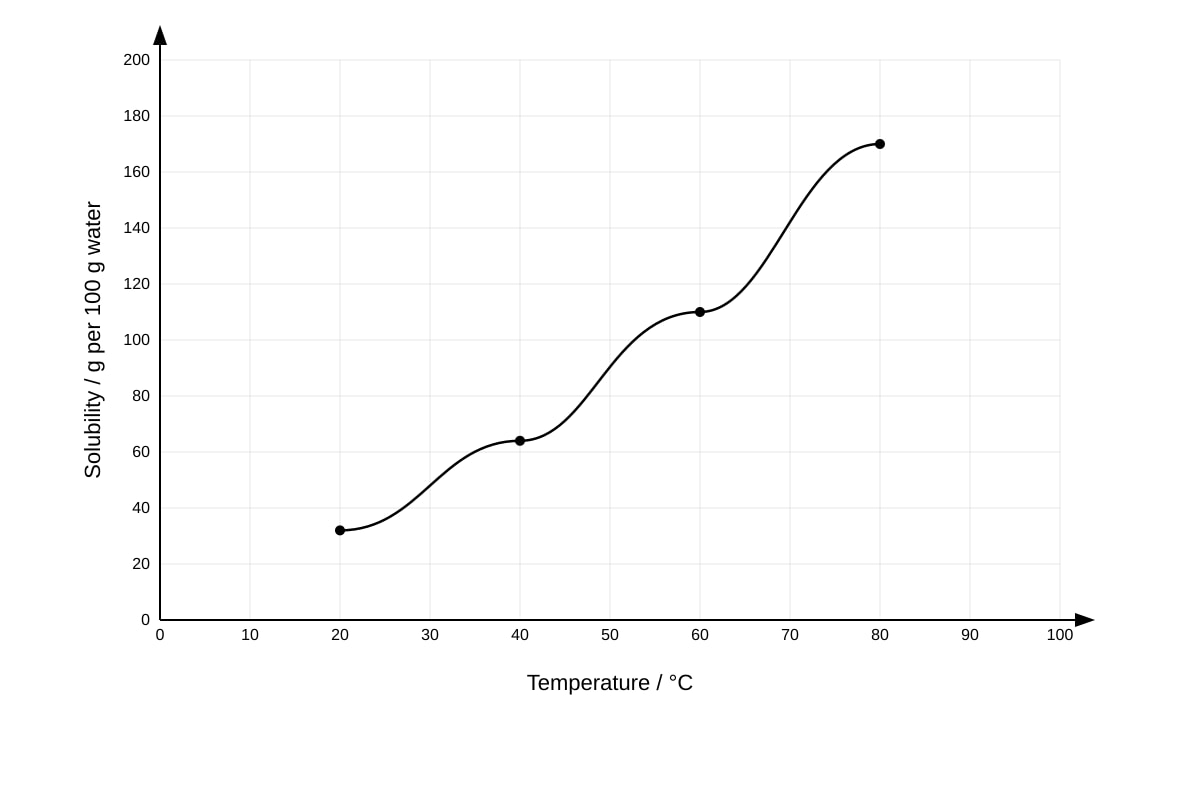
Image pending generation: graph for Q10.
Marking: 1 mark for all points plotted correctly, 1 mark for smooth curve with labelled axes.
(b) At 80°C: Solubility = 170 g per 100 g water Mass of KNO₃ in 200 g saturated solution at 80°C: In 100 g water + 170 g KNO₃ = 270 g solution, there is 170 g KNO₃ In 200 g solution: (170/270) × 200 = 125.9 g KNO₃ Water present = 200 - 125.9 = 74.1 g
At 20°C: Solubility = 32 g per 100 g water Max KNO₃ that can dissolve in 74.1 g water = (32/100) × 74.1 = 23.7 g
Mass crystallised = 125.9 - 23.7 = 102 g (or 102.2 g) [3]
Marking points:
- Correct mass of KNO₃ in 200 g solution at 80°C [1]
- Correct mass of KNO₃ remaining dissolved at 20°C [1]
- Correct mass crystallised with unit [1]
Alternative method using ratio: At 80°C: 170 g KNO₃ per 100 g water → total solution = 270 g Fraction KNO₃ = 170/270 At 20°C: 32 g KNO₃ per 100 g water → total solution = 132 g Fraction KNO₃ = 32/132 Mass crystallised = 200 × (170/270 - 32/132) = 102 g
(c) Dissolving most solid salts is endothermic (requires energy to break lattice). By Le Chatelier's principle, increasing temperature shifts equilibrium to the right (endothermic direction), increasing solubility. [1]
Teaching note: "Breaking ionic lattice requires energy" is the key concept.
Question 11 [5 marks]
(a) A weak acid is an acid that partially ionises / dissociates in water to produce a low concentration of H⁺ ions. [1]
Marking note: "Partially ionises" or "partially dissociates" essential. "Does not fully ionise" accepted.
(b) (i) pH: Ethanoic acid has a higher pH (less acidic, pH ≈ 2.9) than hydrochloric acid (pH = 1). [1] (ii) Electrical conductivity: Ethanoic acid has lower conductivity (fewer ions) than hydrochloric acid. [1] (iii) Rate of reaction with Mg: Ethanoic acid reacts slower (lower [H⁺]) than hydrochloric acid. [1]
Marking: Each comparison 1 mark. Must be comparative (higher/lower, faster/slower).
(c) The reaction produces sodium ethanoate (CH₃COONa). The ethanoate ion (CH₃COO⁻) is the conjugate base of a weak acid, so it undergoes hydrolysis: CH₃COO⁻ + H₂O ⇌ CH₃COOH + OH⁻, producing OH⁻ ions and making the solution alkaline (pH > 7). [1]
Marking note: Key points — salt of weak acid + strong base → alkaline solution due to anion hydrolysis.
End of Answer Key