From Real Exams Exam Paper
Secondary 3 Chemistry Semestral Assessment 2 (End of Year) Paper 5
Free Sec 3 Chemistry SA2 Paper 5, Kimi2.6 Exam version, with questions, answers, and O Level-style practice for Singapore students.
These static practice materials are generated from the site's syllabus and paper-generation workflow, with source and model context shown so students and parents can evaluate the material before use.
Questions
Free quiz and exam paper access
Enter your details to view this paper
Your access is remembered on this device.
Answers
TuitionGoWhere Practice Paper - Chemistry Secondary 3
Answer Key and Marking Scheme
Version: Version 5 of 5
Paper: SA2 Practice Paper
Total Marks: 60
SECTION A
[Total: 20 marks]
1. B — Calcium carbonate [1]
Teaching note: Calcium carbonate (CaCO₃) is a cheap, insoluble base commonly used by farmers to neutralise acidic soil. It raises pH gradually without making the soil too alkaline.
2. B — 3 [1]
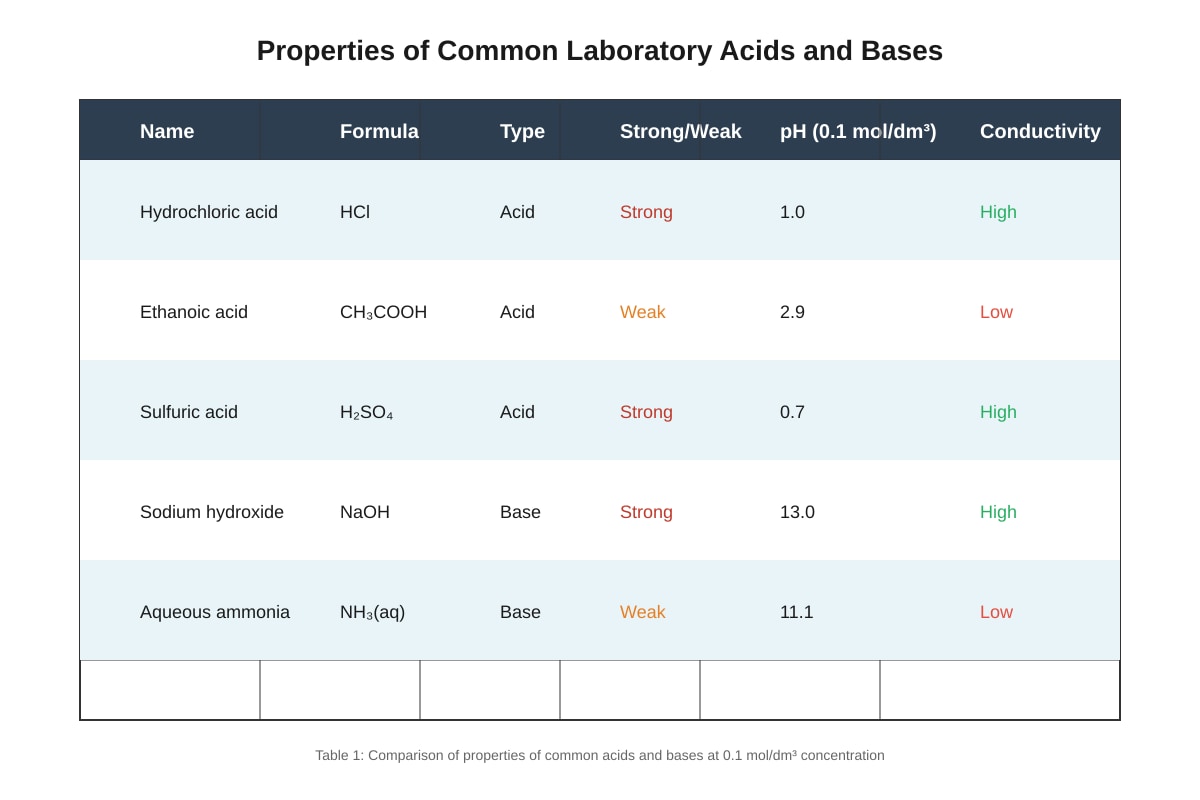
Teaching note: Ethanoic acid is a weak acid, so even at 1.0 mol/dm³ concentration it only partially ionises. The pH is higher than 1 (which would be for a strong acid at this concentration) but still strongly acidic. Typical pH ≈ 2–3 for 1.0 mol/dm³ ethanoic acid.
3. B — K₂SO₄ [1]
Teaching note: Potassium has a +1 charge (Group I). Sulfate has a −2 charge (SO₄²⁻). To balance charges, we need two potassium ions for each sulfate ion: K₂SO₄. The "2" subscript goes with K, not with sulfate in brackets.
Common mistake: Writing KSO₄ forgets to balance the 2− charge of sulfate with two K⁺ ions.
4. C — OH⁻ [1]
Teaching note: Aqueous ammonia (NH₃(aq)) is a weak base. It partially ionises in water: NH₃ + H₂O ⇌ NH₄⁺ + OH⁻. The hydroxide ions (OH⁻) make the solution alkaline. The ammonium ion (NH₄⁺) is the conjugate acid, not the cause of alkalinity.
5. B — Hydrogen [1]
Teaching note: At the cathode (negative electrode), H⁺ ions from the acid gain electrons (reduction): 2H⁺ + 2e⁻ → H₂. This applies to electrolysis of dilute acids or aqueous solutions containing H⁺.
6. B — Aqueous sodium hydroxide and phenolphthalein [1]
Teaching note: Phenolphthalein is colourless in acid and neutral solutions, but turns pink/purple in alkaline solutions (pH > 8.3). Aqueous NaOH is strongly alkaline, so the mixture gives a purple/pink colour.
7. C — 20.0 g [1]
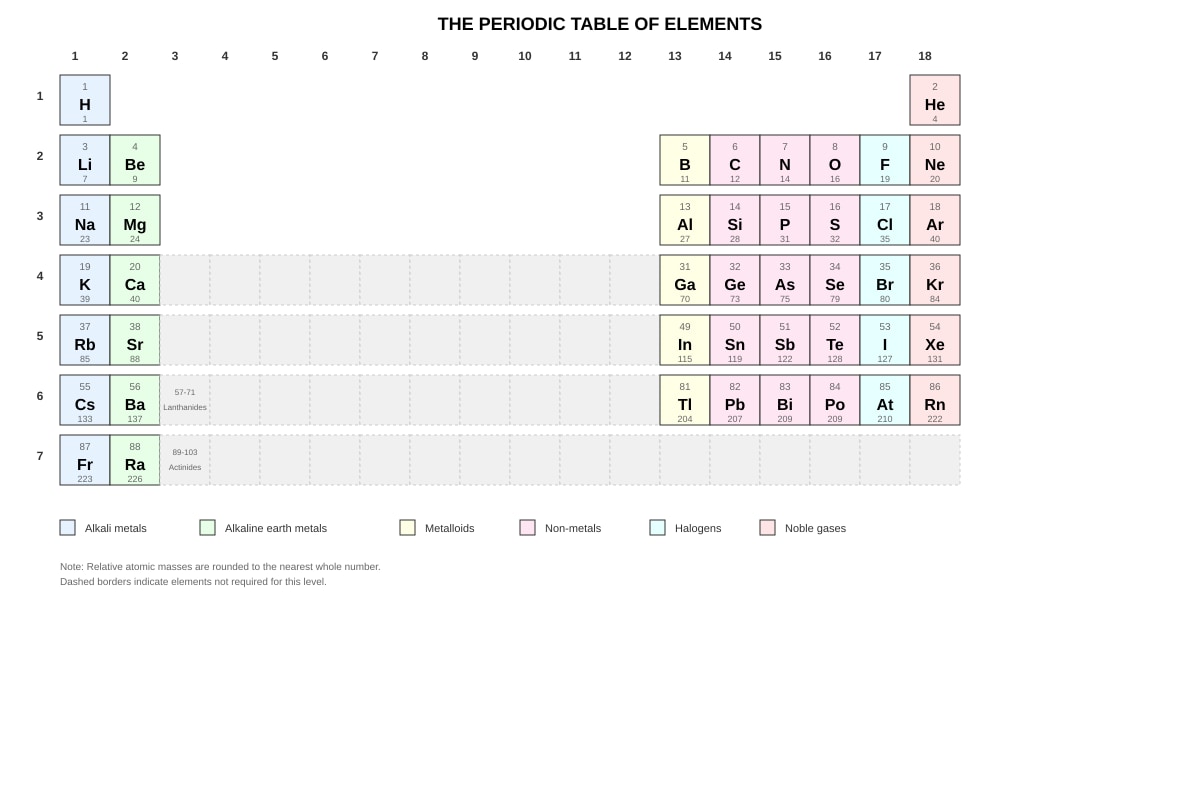
Teaching note: Molar mass of NaOH = 23 + 16 + 1 = 40 g/mol.
Moles needed = concentration × volume = 2.0 × (250/1000) = 0.50 mol.
Mass = moles × molar mass = 0.50 × 40 = 20.0 g.
8. C — It ionises partially in water [1]
Teaching note: A weak acid is defined by partial ionisation in water. Strong acids ionise completely (≈100%). Weak acids establish an equilibrium with mostly undissociated molecules: HA ⇌ H⁺ + A⁻.
9. B — Filtration [1]
Teaching note: Insoluble salts are prepared by precipitation (mixing two aqueous solutions). The insoluble solid is separated by filtration, washed with distilled water, and dried. Evaporation/crystallisation is for soluble salts.
10. A — 4 [1]
Teaching note: The pH scale is logarithmic. Each unit decrease represents 10× increase in H⁺ concentration (acidity). pH 5 → pH 4 means 10× more acidic (10× more H⁺ ions).
11. C — Pipette [1]
Teaching note: A pipette delivers a fixed, accurate volume (e.g., 25.0 cm³) to one decimal place. A burette measures variable volumes accurately. Measuring cylinders and beakers are too imprecise for titration work.
12. A — Neutralisation [1]
Teaching note: Zinc oxide (ZnO) is a basic oxide. It reacts with acid to form salt + water: ZnO + 2HNO₃ → Zn(NO₃)₂ + H₂O. This is the classic acid + base → salt + water neutralisation reaction.
13. B — Reacts with carbonates to produce carbon dioxide [1]
Teaching note: All acids react with carbonates to produce CO₂ gas (effervescence). This is a characteristic test for acids. Options A, C, D describe base properties.
14. B — Dark blue solution [1]
Teaching note: With excess NH₃(aq), the initial pale blue precipitate of Cu(OH)₂ dissolves to form a dark blue complex ion [Cu(NH₃)₄(H₂O)₂]²⁺. This is a distinctive test for Cu²⁺ ions.
15. B — CaCO₃ + 2HCl → CaCl₂ + H₂O + CO₂ [1]
Teaching note: Calcium is +2, so calcium chloride is CaCl₂ (not CaCl). We need 2HCl to provide 2Cl⁻ ions. The equation must also balance for H and O: H₂O + CO₂ accounts for H₂CO₃ decomposition.
16. B — Phenolphthalein or methyl orange [1]
Teaching note: Both indicators give sharp colour changes at the equivalence point of strong acid-strong base titrations. Phenolphthalein: colourless → pink (pH 8.3–10). Methyl orange: red → yellow (pH 3.1–4.4). Universal indicator changes gradually and is unsuitable for detecting endpoints precisely.
17. C — Na₂CO₃ [1]
Teaching note: A normal salt contains only metal cations and acid anions—no replaceable hydrogen. Na₂CO₃ (sodium carbonate) has Na⁺ and CO₃²⁻ only. NaHCO₃ and NaHSO₄ are acid salts (contain H that can be replaced). H₂CO₃ is an acid, not a salt.
18. A — 3.1 – 4.4 [1]
Teaching note: Methyl orange changes from red (acid) to yellow (alkali) between pH 3.1 and 4.4. Phenolphthalein range is 8.3–10.0. Universal indicator has wide range (~pH 3–11).
19. C — Ammonia [1]
Teaching note: Ammonia (NH₃) is alkaline and turns red litmus blue. This is a classic test for ammonia gas. CO₂ and SO₂ are acidic; chlorine bleaches litmus.
20. B — To evaporate some water and concentrate the solution [1]
Teaching note: Gentle heating before crystallisation removes some solvent, creating a saturated solution. Cooling then causes crystallisation. Over-heating would evaporate to dryness, giving powder not crystals.
SECTION B
[Total: 24 marks]
21. (a) An acid is a substance that ionises/dissociates in water to produce hydrogen ions (H⁺) as the only positive ions. [1]
Teaching note: The Arrhenius definition for this level. H⁺ ions make the solution acidic. "Forms H⁺ ions in water" is acceptable.
(b) HCl(g) + H₂O(l) → H⁺(aq) + Cl⁻(aq)
OR HCl(g) → H⁺(aq) + Cl⁻(aq) [1]
Teaching note: HCl is covalent in gaseous state. It must dissolve in water to ionise and show acidic properties.
(c) Dry HCl does not ionise [1] because there is no water present to enable ionisation [1]. Moist litmus paper contains water, so HCl dissolves and ionises to produce H⁺ ions, turning the paper red [1 max for second part].
Mark breakdown: [1] for explaining dry conditions prevent ionisation; [1] for explaining moisture enables ionisation producing H⁺.
Teaching note: This is a classic test question. The key is ionisation requires water. Dry HCl = covalent molecules; aqueous HCl = ionised H⁺ and Cl⁻.
22. (a) Mg(s) + H₂SO₄(aq) → MgSO₄(aq) + H₂(g) [2]
Marking: [1] correct formulae and balancing; [1] correct state symbols. Deduct [1] if state symbols missing or incorrect.
Teaching note: Magnesium is more reactive than hydrogen, so displaces it from acid. State symbols: (s) metal, (aq) solutions, (g) hydrogen gas.
(b) Test: Place a lighted splint near the gas [1]. Observation: The splint extinguishes with a 'pop' sound [1].
Teaching note: The "pop" test is specific for hydrogen. Do not accept "burning splint" without "pop" or mention of squeaky pop.
(c) Ethanoic acid is a weak acid [1] so it ionises partially in water, producing fewer H⁺ ions than sulfuric acid (a strong acid) at the same concentration [1]. Therefore, the frequency of collisions between H⁺ ions and magnesium atoms is lower, giving a slower rate of reaction [1 max].
Mark breakdown: [1] identifying ethanoic as weak; [1] fewer H⁺ ions at same concentration; [1] therefore slower collision rate/reaction rate.
Common mistake: Saying "ethanoic acid has lower concentration" — the question states same concentration. The difference is degree of ionisation, not concentration.
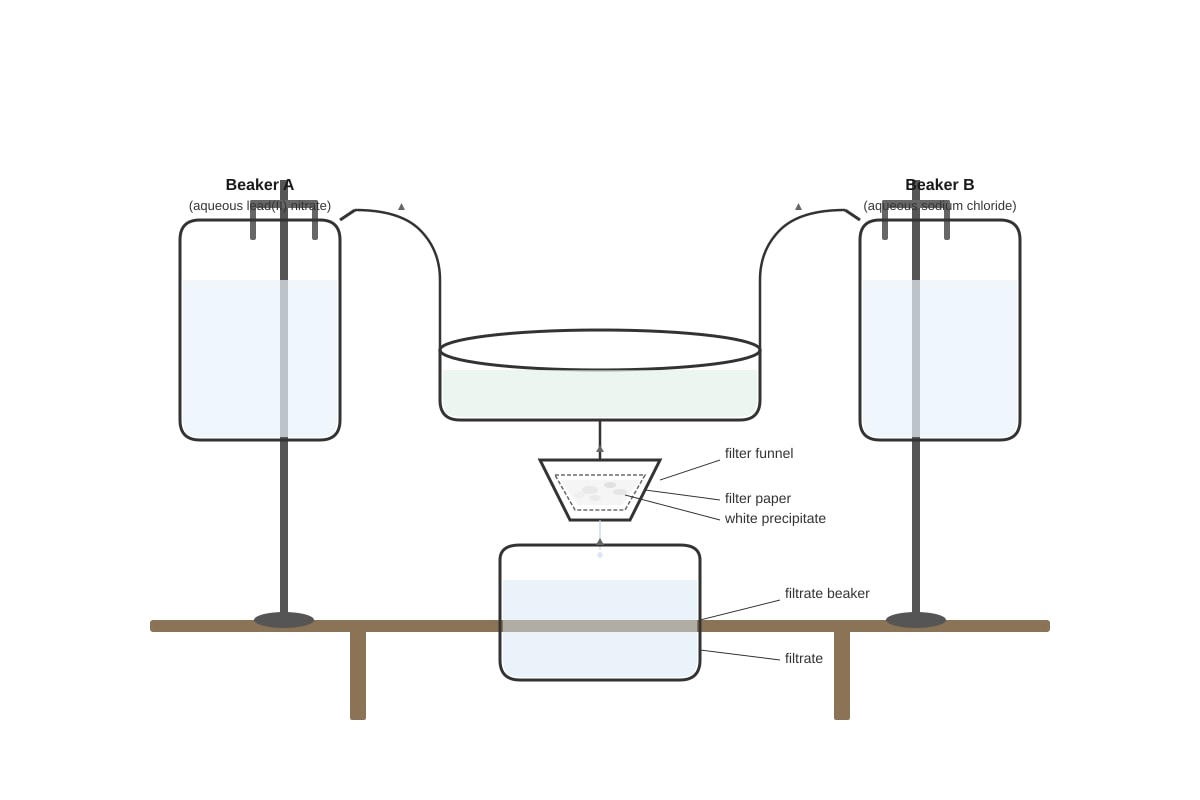
23. (a) Precipitation [1]
Teaching note: Also accept "double decomposition" or "method of precipitation."
(b) PbCl₂ [1]
Teaching note: Lead(II) chloride. Roman numeral (II) indicates Pb²⁺ charge.
(c) Pb(NO₃)₂(aq) + 2NaCl(aq) → PbCl₂(s) + 2NaNO₃(aq) [2]
Marking: [1] correct formulae; [1] balancing and state symbols. Accept ionic equation: Pb²⁺(aq) + 2Cl⁻(aq) → PbCl₂(s) for [2] marks if fully correct.
(d) Lead(II) chloride is insoluble in water [1] so it would precipitate out during the titration, preventing accurate measurement of the endpoint [1 max].
Marking: [1] for identifying insolubility.
(e) Silver chloride / AgCl [1]. Add dilute ammonia solution: silver chloride dissolves [1] (or mention it remains white/turns from white to colourless in excess ammonia; contrast with silver bromide and silver iodide).
Alternative: Mercury(I) chloride / Hg₂Cl₂ (white, turns black with NH₃).
Alternative test for chloride: Dissolve in ammonia, then re-precipitate with acid, or flame test if compound available.
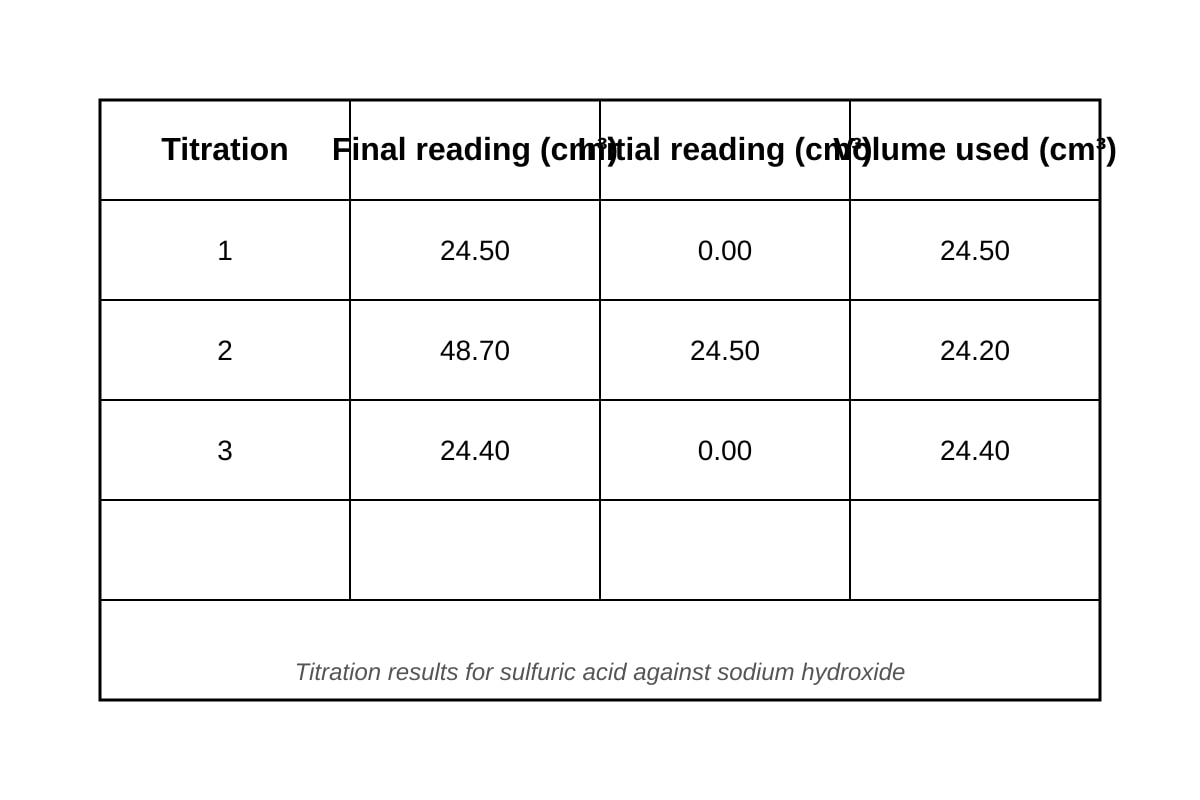
24. (a) Results that are within 0.10–0.20 cm³ of each other [1] indicating consistent, reliable measurement [1 max].
Teaching note: Concordant means close agreement — typically within 0.10 cm³ or 0.20 cm³ depending on school. Accept reasonable numerical definition.
(b) Concordant results: Titration 2 (24.20 cm³) and Titration 3 (24.40 cm³). Titration 1 is not concordant.
Mean volume = (24.20 + 24.40) / 2 = 24.30 cm³ [2]
Marking: [1] correct selection of concordant results (ignore 24.50); [1] correct calculation to 2 decimal places.
Common mistake: Averaging all three values. Always exclude non-concordant results.
(c)
Step 1: Moles of NaOH = concentration × volume
= 0.200 × (25.0/1000)
= 0.200 × 0.0250
= 0.00500 mol [1]
Step 2: From equation, 2 mol NaOH reacts with 1 mol H₂SO₄
Mole ratio NaOH : H₂SO₄ = 2 : 1
Moles of H₂SO₄ = 0.00500 / 2 = 0.00250 mol [1]
Step 3: Concentration of H₂SO₄ = moles / volume
= 0.00250 / (24.30/1000)
= 0.00250 / 0.02430
= 0.103 mol/dm³ [1] to 3 sig figs
Acceptable range: 0.103 mol/dm³ or 0.1029 mol/dm³.
Marking: [1] correct moles NaOH; [1] correct mole ratio application; [1] correct final concentration with unit. Unit must be mol/dm³ or M.
25. (a) Orange / red-orange / orange-red [1]
Teaching note: pH 4.5 is strongly acidic. Universal indicator is red at pH 3–4, orange at pH 5, orange-yellow at pH 6. pH 4.5 is between these, so orange/red-orange is expected.
(b) Calcium carbonate / CaCO₃ [1] or calcium hydroxide / Ca(OH)₂ [1] or calcium oxide / CaO [1]. It is insoluble/only slightly soluble so it does not make the soil too alkaline [1] and it is cheap/safe to handle compared with sodium hydroxide which is corrosive and would make the soil too alkaline [1 max].
Marking: [1] suitable compound; [1] valid explanation (safety, gradual pH change, or cost).
Teaching note: Sodium hydroxide is strongly soluble and corrosive. It would raise pH too much and damage plants/soil structure. Insoluble bases like CaCO₃ act slowly and are self-limiting.
(c) CaCO₃ + 2H⁺ → Ca²⁺ + H₂O + CO₂ [1]
OR CaCO₃ + H₂SO₄ → CaSO₄ + H₂O + CO₂ [1]
Accept: Any valid acid-carbonate reaction showing neutralisation. The key is H⁺ being consumed.
SECTION C
[Total: 16 marks]
26. (a) Sulfuric acid is diprotic/dibasic [1] meaning each molecule produces two H⁺ ions when fully ionised [1]: H₂SO₄ → 2H⁺ + SO₄²⁻. Hydrochloric acid is monoprotic, producing only one H⁺ per molecule [1 max]: HCl → H⁺ + Cl⁻. Therefore 0.1 mol/dm³ H₂SO₄ produces 0.2 mol/dm³ H⁺, giving a lower pH [1].
Marking: [1] identifying H₂SO₄ as diprotic; [1] explaining more H⁺ produced at same concentration; [1] linking to lower pH (more acidic).
Teaching note: pH = −log[H⁺]. More H⁺ means lower (more negative) log value. 0.1 M HCl has [H⁺] = 0.1, pH ≈ 1.0. 0.1 M H₂SO₄ has [H⁺] ≈ 0.2, pH ≈ 0.7.
(b) Water is neutral with pH 7 at 25°C but is technically an extremely weak acid/base (amphoteric) [1] so not all substances with pH 7 fit neatly [1 max]. More importantly, some salts dissolved in water can produce pH values that don't match simple acid/base classification — e.g., salts of weak acid + strong base (like sodium carbonate, pH ~11 though it's a salt not a base) or salts of strong acid + weak base (like ammonium chloride, pH < 7 though it's a salt not an acid) [1 max for valid example].
Marking: [1] identifying water as exception or amphoteric; [1] valid example of salt hydrolysis or other exception.
Teaching note: The statement works for simple Arrhenius acids/bases but breaks down with salts that hydrolyse. This tests deeper understanding beyond rote memorisation.
(c)
At start (excess acid): pH is low (≈1–2) [1] due to high [H⁺] from HCl.
During reaction: pH gradually rises [1] as H⁺ ions are consumed by OH⁻ ions: H⁺ + OH⁻ → H₂O. The change is slow at first, then rapid near equivalence point [1].
At equivalence point: pH = 7 [1] for strong acid-strong base titration. All H⁺ neutralised; only salt (NaCl) and water present.
After excess NaOH: pH rises steeply then levels off at high value (≈12–13) [1] due to excess OH⁻ ions.
Marking: [1] initial pH; [1] rising trend with explanation; [1] equivalence pH = 7; [1] final high pH with explanation.
27. (a)
Method: Titration / acid + excess insoluble base [1]
Procedure:
- Add excess copper(II) oxide to warm dilute sulfuric acid [1] — warming speeds up reaction; excess ensures all acid reacts.
- Stir and continue heating until no more oxide dissolves [1] — indicates reaction complete, acid used up.
- Filter off excess copper(II) oxide [1] — leaves pure copper(II) sulfate solution.
- Heat filtrate gently to concentrate/evaporate some water [1] — until saturated (crystallisation point).
- Leave to cool and crystallise [1] — crystals form as solubility decreases.
- Filter off crystals, wash with distilled water, dry between filter paper or in warm oven [1].
Marking breakdown: [1] correct method identification; max [4] for procedure steps — need at least 4 distinct correct steps for full marks.
Teaching note: This is the standard method for preparing soluble salts from insoluble bases. Cannot use direct titration (no indicator endpoint with coloured solutions easily visible, and CuO is insoluble anyway).
(b)(i)
Theoretical % water in CuSO₄·5H₂O = (mass of water / total mass) × 100
= (90 / 250) × 100
= 36.0% [2]
Marking: [1] correct substitution; [1] correct answer with % sign.
(ii)
Experimental % water = (mass lost / original mass) × 100
= (2.50 − 1.60) / 2.50 × 100
= 0.90 / 2.50 × 100
= 36.0% [1]
This matches the theoretical 36.0%, so the result is consistent with the formula CuSO₄·5H₂O [1 max].
Marking: [1] correct experimental calculation; [1] valid comparison and conclusion.
Alternative acceptable answer: If student calculated 36% in (b)(i), then notes experimental value equals theoretical, confirming formula.
END OF ANSWER KEY
TOTAL MARKS: 60