From Real Exams Exam Paper
Secondary 3 Chemistry Semestral Assessment 2 (End of Year) Paper 5
Free Sec 3 Chemistry SA2 Paper 5, HY3 Exam version, with questions, answers, and O Level-style practice for Singapore students.
These static practice materials are generated from the site's syllabus and paper-generation workflow, with source and model context shown so students and parents can evaluate the material before use.
Questions
TuitionGoWhere Practice Paper - Chemistry Secondary 3
TuitionGoWhere Secondary School (AI)
Subject: Chemistry
Level: Secondary 3
Paper: SA2 Practice Paper (Version 5 of 5)
Duration: 60 minutes
Total Marks: 60
Name: ________________________
Class: ________
Date: ____________
Instructions:
- Answer all questions in the spaces provided.
- Use a calculator where necessary.
- Show all working clearly for calculation questions.
- Use proper chemical notation and state symbols where required.
Section A: Multiple Choice and Short Answer (Questions 1–8) [16 marks]
1. Which solid compound is added to acidic soil to increase its pH? [1]
2. Name two compounds that react together to form ammonium chloride. [1]
________________________ and ________________________
3. State the colour change of litmus paper when dipped into a solution of sodium hydroxide. [1]
4. Give the formula of the salt formed when nitric acid reacts with potassium hydroxide. [1]
5. Which of the following is an amphoteric compound? [1]
A. Sodium chloride
B. Zinc oxide
C. Copper(II) sulphate
D. Hydrochloric acid
6. A farmer adds calcium oxide to his fields. State one reason why this raises soil pH. [1]
7. Write the ionic equation for the neutralisation of an acid by an alkali. [1]
8. State whether a solution of pH 3 is acidic, neutral, or alkaline. [1]
Section B: Structured and Data Interpretation (Questions 9–14) [24 marks]
9. The table below shows titration readings for acid R with alkali S.
| Trial | Volume of R used (cm³) |
|---|---|
| Rough | 22.8 |
| 1 | 22.1 |
| 2 | 22.3 |
| 3 | 22.2 |
(a) Identify the concordant results. [1]
(b) Calculate the average volume of R required for complete neutralisation. [2]
10. Calculate the number of moles of acid in 1.50 dm³ of R if its concentration is 0.200 mol/dm³. [2]
11. Zinc oxide is amphoteric.
(a) Write a balanced equation for zinc oxide reacting with hydrochloric acid. [2]
(b) Write a balanced equation for zinc oxide reacting with sodium hydroxide solution. [2]
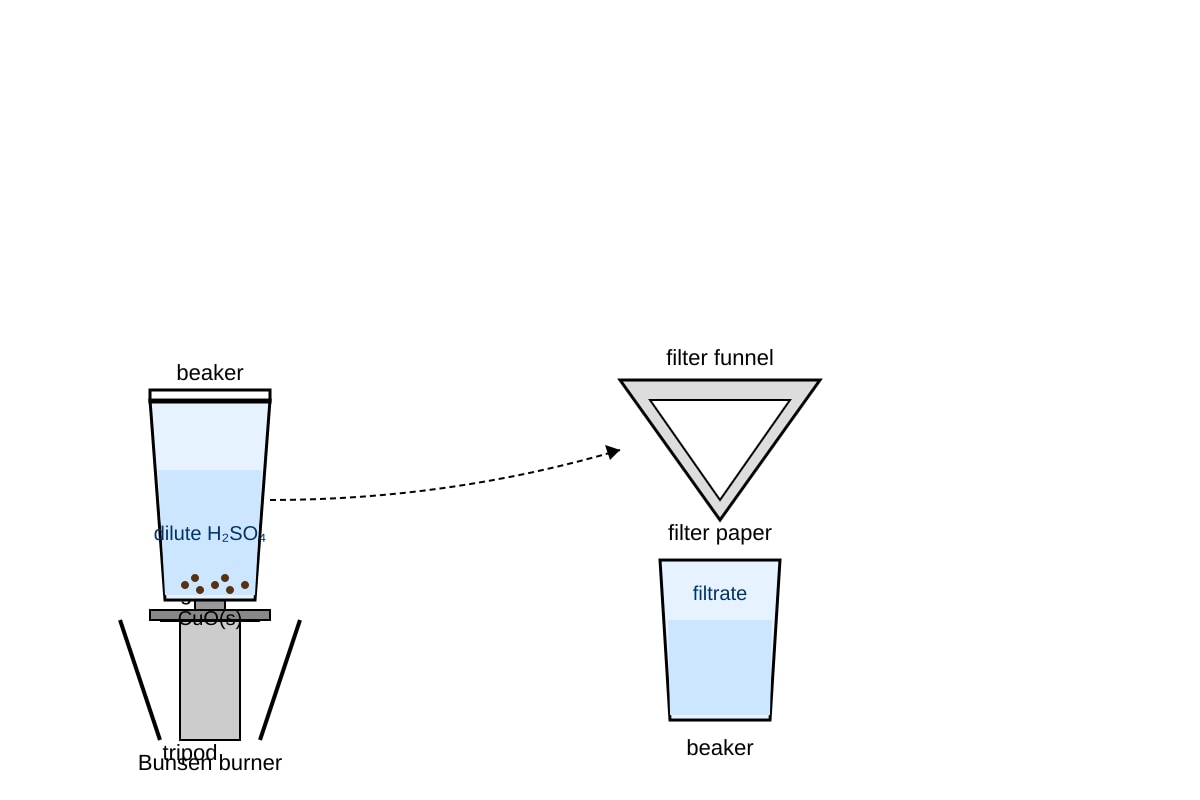
12. The diagram shows a setup for preparing a soluble salt by reacting an insoluble base with an acid.
Image pending generation: experimental_setup for Q12.
(a) Name the insoluble base used above. [1]
(b) Why is excess base added? [1]
(c) Name the salt formed in the filtrate. [1]
13. A student tested four solutions with universal indicator and recorded the colours and pH below.
| Solution | Colour of UI | pH |
|---|---|---|
| P | Red | 2 |
| Q | Green | 7 |
| R | Blue | 9 |
| S | Purple | 12 |
(a) Which solution is the strongest acid? [1]
(b) Which solution is alkaline but weak? [1]
(c) State the colour of UI in a neutral solution. [1]
14. Explain why calcium carbonate is used to treat acidic lakes. [2]
Section C: Calculation and Extended Response (Questions 15–20) [20 marks]
15. 25.0 cm³ of 0.100 mol/dm³ hydrochloric acid is neutralised by 20.0 cm³ of sodium hydroxide solution. Calculate the concentration of the sodium hydroxide solution. [3]
16. A sample of 5.00 g of calcium carbonate reacts with excess hydrochloric acid:
CaCO3+2HCl→CaCl2+CO2+H2O
Given Mr of CaCO₃ = 100.
(a) Calculate moles of CaCO₃ used. [1]
(b) Calculate volume of CO₂ gas produced at room conditions (1 mol = 24.0 dm³). [2]
17. Describe how you would prepare a pure, dry sample of lead(II) sulphate from lead(II) nitrate and sodium sulphate solutions. [4]
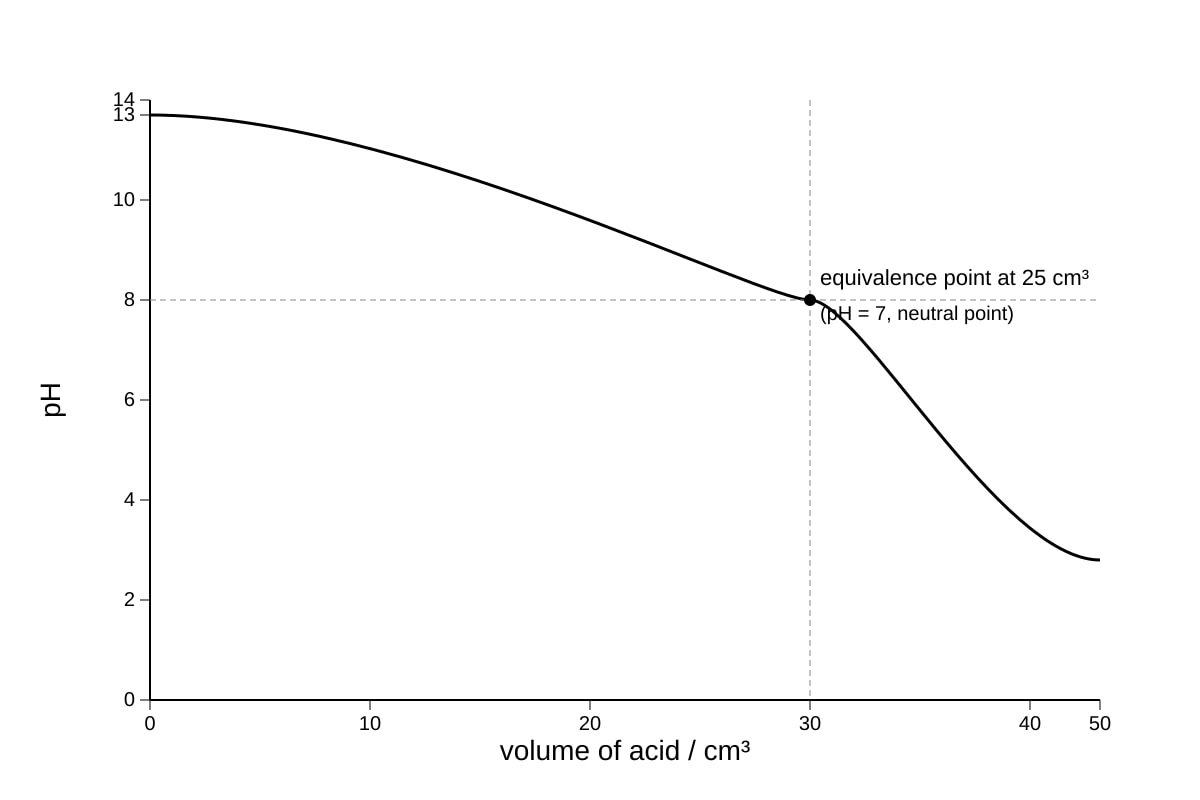
18. The graph shows pH change when acid is added to alkali.
Image pending generation: graph for Q18.
(a) State the volume of acid at neutralisation. [1]
(b) State the pH at neutralisation. [1]
(c) Name the type of reaction shown. [1]
19. Compare the properties of a strong acid and a weak acid of the same concentration. [3]
20. A student adds powdered magnesium carbonate to dilute sulphuric acid until no more reacts.
(a) Name the salt formed. [1]
(b) Write the balanced equation for the reaction. [2]
(c) How would you obtain the dry salt from the mixture? [2]
Answers
TuitionGoWhere Practice Paper - Chemistry Secondary 3 (Version 5) Answer Key
Total Marks: 60
Section A (Q1–8)
1. [1] Calcium oxide (CaO) / calcium hydroxide (Ca(OH)₂) / calcium carbonate (CaCO₃).
Teaching note: Acidic soil has low pH; adding a base (solid) raises pH. Common trap: naming NaCl (neutral salt).
2. [1] Ammonia (NH₃) and hydrochloric acid (HCl).
Teaching note: Ammonium salts form from ammonia + acid. For NH₄Cl: NH₃ + HCl → NH₄Cl.
3. [1] Blue.
Teaching note: NaOH is alkaline; litmus turns blue in alkali.
4. [1] KNO₃.
Teaching note: HNO₃ + KOH → KNO₃ + H₂O. Salt = metal from base + non-metal from acid.
5. [1] B. Zinc oxide.
Teaching note: Amphoteric = reacts with both acids and alkalis. ZnO + 2HCl → ZnCl₂ + H₂O; ZnO + 2NaOH → Na₂ZnO₂ + H₂O.
6. [1] It is a base / it neutralises acid in soil.
Teaching note: CaO + H₂O → Ca(OH)₂ (alkali) neutralises H⁺.
7. [1] H++OH−→H2O
Teaching note: Core neutralisation ionic equation.
8. [1] Acidic.
Teaching note: pH < 7 is acidic.
Section B (Q9–14)
9. [3]
(a) [1] Trials 1, 2, 3 (22.1, 22.3, 22.2 cm³) are concordant (within 0.1–0.2 cm³).
(b) [2] Average = (22.1 + 22.3 + 22.2) / 3 = 66.6 / 3 = 22.2 cm³.
Marking: 1 mark concordant identified, 1 mark correct avg with unit.
10. [2] n = c × V = 0.200 × 1.50 = 0.300 mol.
Working: V in dm³ already. Unit mol.
11. [4]
(a) [2] ZnO + 2HCl → ZnCl₂ + H₂O
(b) [2] ZnO + 2NaOH → Na₂ZnO₂ + H₂O (or ZnO + 2NaOH + H₂O → Na₂[Zn(OH)₄])
Marking: 1 eq balanced, 1 correct products each.
12. [3]
(a) [1] Copper(II) oxide (CuO).
(b) [1] To ensure all acid reacts (excess drives reaction to completion).
(c) [1] Copper(II) sulphate (CuSO₄).
From image: beaker with CuO + H₂SO₄ → CuSO₄ + H₂O, filtered.
13. [3]
(a) [1] P (pH 2).
(b) [1] R (pH 9, weak alkali).
(c) [1] Green.
14. [2] Calcium carbonate is a base that neutralises acid in lake water (CaCO₃ + 2H⁺ → Ca²⁺ + CO₂ + H₂O), raising pH to safer level.
Marking: 1 base/neutralise, 1 effect on pH.
Section C (Q15–20)
15. [3]
n(HCl) = cV = 0.100 × (25.0/1000) = 0.00250 mol.
HCl + NaOH → NaCl + H₂O (1:1) → n(NaOH) = 0.00250 mol.
c(NaOH) = n/V = 0.00250 / (20.0/1000) = 0.125 mol/dm³.
Marking: 1 mole HCl, 1 mole NaOH, 1 concentration.
16. [3]
(a) [1] n = 5.00/100 = 0.0500 mol.
(b) [2] 1:1 ratio → n(CO₂)=0.0500 mol; V = 0.0500 × 24.0 = 1.20 dm³.
Marking: 1 mol, 1 volume calc.
17. [4] Mix lead(II) nitrate and sodium sulphate solutions [1]; filter precipitate [1]; wash with distilled water [1]; dry between filter papers / warm oven [1].
Note: PbSO₄ insoluble, prepared by precipitation.
18. [3]
(a) [1] 25 cm³.
(b) [1] 7.
(c) [1] Neutralisation.
From graph: equivalence at x=25, pH=7.
19. [3] Same concentration: strong acid fully dissociates (more H⁺, lower pH) [1]; weak acid partially dissociates (fewer H⁺, higher pH) [1]; both react with bases but strong reacts faster [1].
20. [5]
(a) [1] Magnesium sulphate (MgSO₄).
(b) [2] MgCO₃ + H₂SO₄ → MgSO₄ + CO₂ + H₂O.
(c) [2] Filter to remove excess MgCO₃ [1]; evaporate filtrate to crystallisation [1]; dry crystals.
Free quiz and exam paper access
Enter your details to view this paper
Your access is remembered on this device.