From Real Exams Exam Paper
Secondary 3 Chemistry Semestral Assessment 2 (End of Year) Paper 4
Free Sec 3 Chemistry SA2 Paper 4, Kimi2.6 Exam version, with questions, answers, and O Level-style practice for Singapore students.
These static practice materials are generated from the site's syllabus and paper-generation workflow, with source and model context shown so students and parents can evaluate the material before use.
Questions
Free quiz and exam paper access
Enter your details to view this paper
Your access is remembered on this device.
Answers
TuitionGoWhere Exam Practice (AI) - Answer Key
Secondary 3 Chemistry SA2
Version 4 of 5
Topic: Acids, Bases and Salts
Total Marks: 60
SECTION A ANSWERS
1. [1 mark]
Answer: Any one: turns blue litmus paper red / has a pH less than 7 / reacts with metals/carbonates/bases to produce salts / produces hydrogen ions (H⁺) in water.
Teaching note: Acids are proton donors. The characteristic properties all stem from the presence of H⁺(aq) ions in aqueous solution.
2. [1 mark]
Answer: Ca(OH)₂
Teaching note: Calcium is in Group II with a +2 charge. Hydroxide ion is OH⁻ with a -1 charge. Two hydroxide ions balance one calcium ion.
3. [1 mark]
Answer: 7
Teaching note: Pure water is neutral. The ionic product of water at 25°C gives equal concentrations of H⁺ and OH⁻, each 1 × 10⁻⁷ mol/dm³, so pH = 7.
4. [1 mark]
Answer: Hydrogen
Teaching note: Active metals (above hydrogen in the reactivity series) displace hydrogen from acids. Zinc + HCl → zinc chloride + H₂(g).
5. [1 mark]
Answer: sodium sulfate + carbon dioxide + water
(Award [1] only if all three products named; accept sodium sulfate + water + carbon dioxide in any order)
Teaching note: Acid + carbonate → salt + water + carbon dioxide. This is a key general reaction pattern for acids.
6. [1 mark]
Answer: Hydroxide ion / OH⁻(aq)
Teaching note: Ammonia is a weak base: NH₃(aq) + H₂O(l) ⇌ NH₄⁺(aq) + OH⁻(aq). The OH⁻ ions cause alkaline properties, not NH₃ molecules directly.
7. [1 mark]
Answer: Calcium oxide (CaO) / calcium hydroxide (Ca(OH)₂) / calcium carbonate (CaCO₃) — any acceptable base that is safe for agricultural use.
Common mistake: Students sometimes suggest sodium hydroxide, which is too strongly alkaline and would damage plants. Agricultural lime is preferred.
8. [1 mark]
Answer: Red / orange-red / pink
Teaching note: Methyl orange: red in acid (pH < 3.1), orange in neutral, yellow in alkali (pH > 4.4). In practice, "red" or "orange" both indicate acidic conditions.
9. [2 marks]
Answer: MgO(s) + 2HNO₃(aq) → Mg(NO₃)₂(aq) + H₂O(l)
Marking: [1] for correct formulas, [1] for balancing and state symbols (or omit state symbols if not penalized at this level; award [1] for balanced equation without states).
Teaching note: Basic metal oxide + acid → salt + water. Magnesium is Group II, so forms Mg²⁺ and requires two NO₃⁻ ions.
10. [2 marks]
Answer: Sodium hydroxide is highly soluble, so the reaction mixture would contain excess sodium hydroxide that cannot be easily removed from the sodium chloride crystals. / The product cannot be separated from excess reactant by simple filtration since both are soluble. / Titration would be needed to use exact amounts; otherwise impure product results.
Marking: [1] for recognizing both NaOH and NaCl are soluble, [1] for consequence (cannot separate excess reactant easily / need to use stoichiometric amounts).
Teaching note: To prepare a salt from two soluble reactants (acid + alkali), titration must be used to find the exact neutralization point. Crystallization alone cannot separate excess alkali from the salt.
11. [2 marks]
Answer: Add magnesium ribbon (or zinc metal / any reactive metal) to each solution; [1] the acid will produce effervescence/bubbles of hydrogen gas, while sodium chloride shows no reaction. [1]
OR: Add sodium carbonate; [1] acid produces effervescence of CO₂, sodium chloride shows no reaction. [1]
OR: Use blue litmus paper; [1] turns red in acid, [1] no change in sodium chloride.
Teaching note: The key difference is that HCl contains H⁺ ions (acidic properties), while NaCl is neutral with no H⁺ excess.
12. [2 marks]
Answer: A basic oxide is a metal oxide that reacts with acids to form salts and water only; [1] example: magnesium oxide / calcium oxide / copper(II) oxide / any metal oxide. [1]
Teaching note: Most metal oxides are basic oxides. They do not react with bases. Amphoteric oxides (e.g., Al₂O₃, ZnO) react with both acids and bases.
13. [2 marks]
Working: pH = -log[H⁺], so [H⁺] = 10^(-pH)
At pH 3: [H⁺] = 10⁻³ mol/dm³
At pH 6: [H⁺] = 10⁻⁶ mol/dm³
Ratio = 10⁻³ / 10⁻⁶ = 10³ = 1000
Answer: The hydrogen ion concentration has decreased by a factor of 1000 (or become 1/1000 of the original). [2]
Marking: [1] for correct ratio calculation or stating [H⁺] values, [1] for factor of 1000.
Common mistake: Students often say "factor of 3" confusing pH difference with concentration ratio. The scale is logarithmic.
14. [Total: 4 marks]
(a) [1 mark]
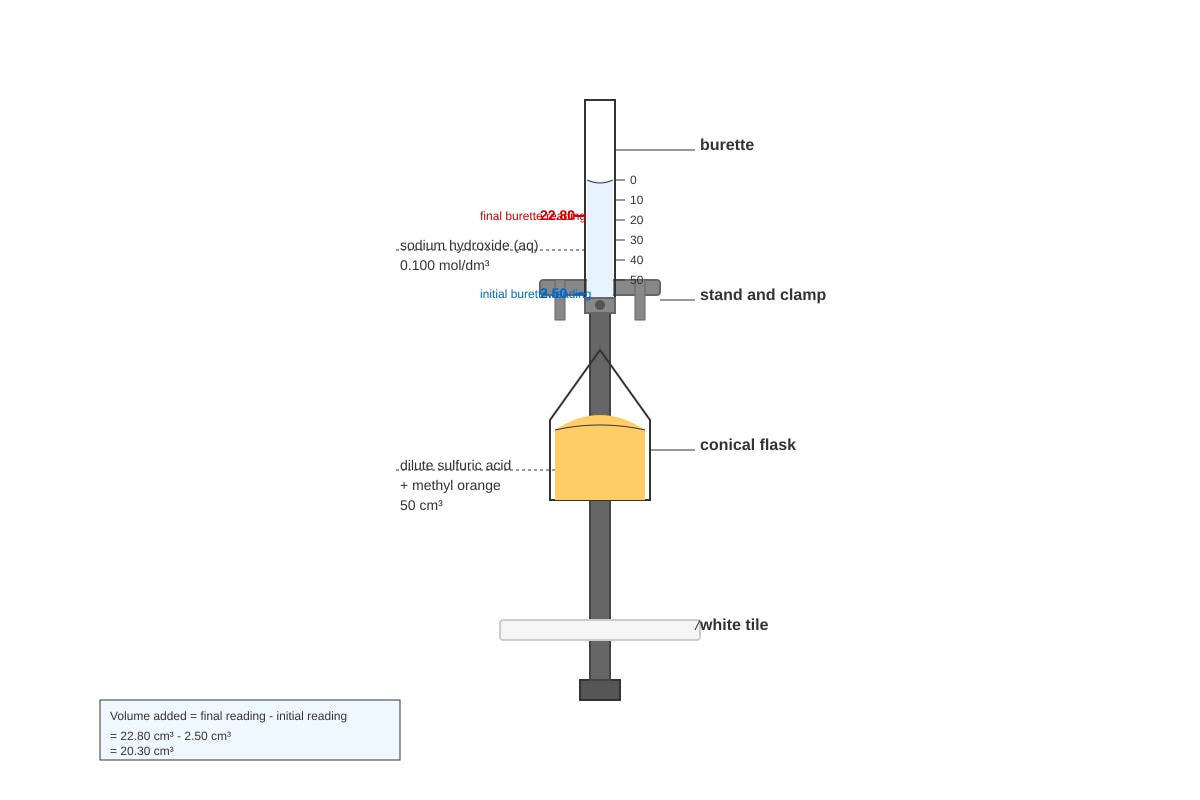
Working: Final reading − Initial reading = 22.80 − 2.50 = 20.30 cm³
Answer: 20.30 cm³ [1]
(b) [3 marks]
Working:
Moles of NaOH = concentration × volume = 0.100 × (20.30/1000) = 0.100 × 0.02030 = 2.030 × 10⁻³ mol
From equation: 2 mol NaOH reacts with 1 mol H₂SO₄
Moles of H₂SO₄ = 2.030 × 10⁻³ ÷ 2 = 1.015 × 10⁻³ mol
Concentration of H₂SO₄ = moles ÷ volume = (1.015 × 10⁻³) ÷ (25.0/1000) = (1.015 × 10⁻³) ÷ 0.0250 = 0.0406 mol/dm³
Answer: 0.0406 mol/dm³ or 0.041 mol/dm³ (2 s.f.) [3]
Marking: [1] for moles of NaOH, [1] for moles of H₂SO₄ using 2:1 ratio, [1] for final concentration with correct unit.
Teaching note: Always convert cm³ to dm³ by dividing by 1000. The mole ratio from the balanced equation is crucial—students often miss the 2:1 ratio.
15. [Total: 4 marks]
(a) [1 mark]
Answer: Ammonium chloride (NH₄Cl) and calcium hydroxide (Ca(OH)₂) — any ammonium salt + strong base acceptable.
(b) [2 marks]
Answer: 2NH₄Cl(s) + Ca(OH)₂(s) → CaCl₂(s) + 2NH₃(g) + 2H₂O(l)
Or for ammonium sulfate: (NH₄)₂SO₄ + Ca(OH)₂ → CaSO₄ + 2NH₃ + 2H₂O
Marking: [1] for correct formulas, [1] for balancing.
(c) [1 mark]
Answer: Hold damp red litmus paper at the mouth of the test tube; [1] it turns blue in the presence of ammonia gas. / White fumes with HCl gas.
Teaching note: Ammonia is the only common alkaline gas. It turns red litmus blue and forms white solid ammonium chloride with hydrogen chloride gas.
SECTION B ANSWERS
16. [Total: 10 marks]
(a) [2 marks]
Answer: A strong acid is an acid that completely dissociates/ionizes in water to produce hydrogen ions; [1] at equilibrium, essentially all acid molecules are converted to ions. [1]
Or: A strong acid has a high degree of ionization in aqueous solution. [1] The position of equilibrium lies far to the right. [1]
Teaching note: "Strong" refers to degree of dissociation, not concentration. HCl → H⁺ + Cl⁻ (≈100%). Weak acids like ethanoic acid partially dissociate: CH₃COOH ⇌ CH₃COO⁻ + H⁺.
(b)(i) [2 marks]
Answer: Hydrochloric acid has a lower pH (more acidic) than ethanoic acid; [1] because HCl is a strong acid that fully dissociates, producing a higher concentration of H⁺(aq) ions compared to ethanoic acid which is a weak acid and only partially dissociates at the same concentration. [1]
Teaching note: Same concentration of acid molecules, but different [H⁺]. For 2.0 mol/dm³ HCl, [H⁺] ≈ 2.0 mol/dm³. For 2.0 mol/dm³ CH₃COOH, [H⁺] ≈ 0.06 mol/dm³ (pH ≈ 2.2).
(b)(ii) [3 marks]
Answer: The same volume of hydrogen gas is produced; [1] both acids have the same concentration (2.0 mol/dm³) and same volume (25.0 cm³), so they contain the same number of moles of acid molecules that can potentially donate H⁺; [1] magnesium is in excess, so all acid is consumed, and since each mole of acid provides the same stoichiometric amount of H⁺ that forms H₂ (2H⁺ → H₂), the total H₂ produced is the same. [1]
Teaching note: This is a common exam trap. The rate differs (faster with HCl), but total yield depends on total moles of available H⁺, which is the same when concentration and volume are equal. Both are monoprotic in terms of stoichiometric reaction with Mg (though HCl fully dissociates, both ultimately provide 2 mol H⁺ per mole of acid formula unit for the purpose of Mg reaction counting).
(c)(i) [1 mark]
Answer: Sodium carbonate (Na₂CO₃) / potassium carbonate (K₂CO₃) / any soluble metal carbonate.
(c)(ii) [2 marks]
Answer: 2CH₃COOH(aq) + Na₂CO₃(s) → 2CH₃COONa(aq) + H₂O(l) + CO₂(g)
Or with K₂CO₃: 2CH₃COOH + K₂CO₃ → 2CH₃COOK + H₂O + CO₂
Marking: [1] for correct formulas and state symbols, [1] for balancing.
17. [Total: 10 marks]
(a) [4 marks]
(i) Method S [1] — CuO is insoluble in water, so excess can be filtered off after reaction, then crystallize the filtrate.
(ii) Method P [1] — Both KOH and HNO₃ are soluble; titration gives exact stoichiometric amounts for crystallization without excess reactant contamination.
(iii) Method T [1] — Both reactants soluble, product insoluble; precipitation allows direct filtration, washing, and drying of the solid salt.
(iv) Method Q [1] — Zn is reactive enough to displace H from dilute H₂SO₄; excess solid zinc can be filtered off.
(b) [2 marks]
Answer: Copper is below hydrogen in the reactivity series of metals; [1] so it cannot displace hydrogen from dilute acids. No reaction occurs between copper metal and dilute sulfuric acid. [1]
Teaching note: Only metals above hydrogen in the reactivity series react with dilute acids to produce H₂. Cu, Ag, Au, Pt do not.
(c) [4 marks]
Answer:
-
Mix equal volumes (or stoichiometric amounts) of lead(II) nitrate solution and sodium sulfate solution in a beaker. [1]
-
Stir the mixture and allow the white precipitate of lead(II) sulfate to settle. [1]
-
Filter the mixture using filter paper and funnel. [1]
-
Wash the residue with distilled water to remove soluble impurities (sodium nitrate, excess reactants). [1]
-
Dry the residue between filter papers or in a warm oven to obtain pure, dry lead(II) sulfate.
Marking note: Steps 1-2 can be combined. Essential points: mixing solutions, filtering, washing residue, drying. Must mention washing to remove soluble impurities for full marks.
18. [Total: 20 marks]
(a)(i) [1 mark]
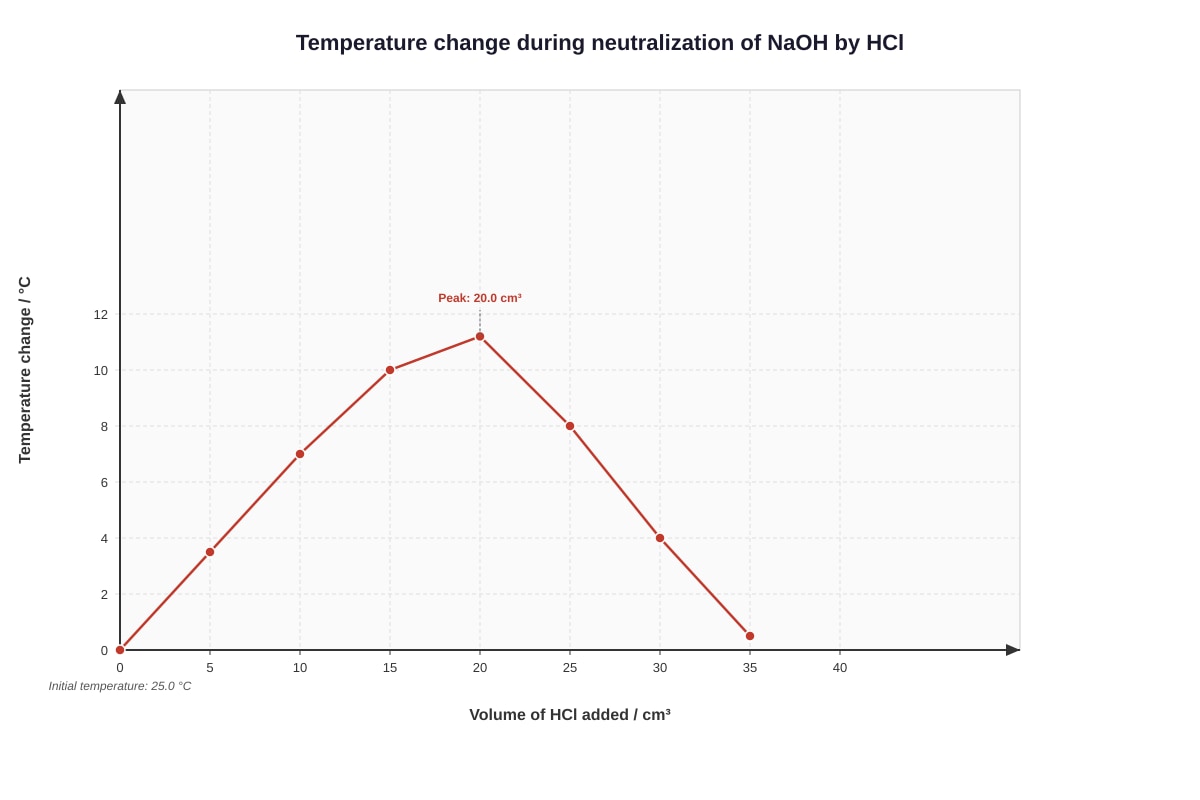
Answer: 11.2 °C (accept 11.0–11.5 °C if reading from graph; exact value expected from data points is 11.2 °C)
(a)(ii) [1 mark]
Answer: 20.0 cm³ (where the peak/maximum temperature change occurs)
(a)(iii) [2 marks]
Answer: After complete neutralization, any additional hydrochloric acid added is in excess; [1] this excess acid dilutes the reaction mixture and does not react further (no more NaOH remaining), so no more heat is produced from neutralization; the added cooler acid causes the overall temperature to decrease. [1]
Teaching note: The temperature rise comes from the exothermic neutralization. Once NaOH is used up, adding more HCl at room temperature cools the mixture by dilution and by being at lower temperature.
(b) [4 marks]
Working:
From (a)(ii): 25.0 cm³ NaOH neutralized by 20.0 cm³ HCl
Moles of NaOH = 2.0 × (25.0/1000) = 2.0 × 0.0250 = 0.050 mol
Equation: NaOH + HCl → NaCl + H₂O
Mole ratio 1:1
Moles of HCl = 0.050 mol
Concentration of HCl = 0.050 ÷ (20.0/1000) = 0.050 ÷ 0.0200 = 2.50 mol/dm³
Answer: 2.50 mol/dm³ [4]
Marking: [1] moles of NaOH, [1] mole ratio and moles of HCl, [1] correct volume conversion, [1] final concentration with unit.
(c) [4 marks]
Answer:
Volume of acid: Same volume (20.0 cm³) needed. [1]
Maximum temperature change: Approximately the same (11.2 °C or very similar). [1]
Explanation: Both NaOH and KOH are strong bases with the same concentration (2.0 mol/dm³) and same volume (25.0 cm³); [1] they both provide the same number of moles of OH⁻ ions for neutralization. Since the same moles of H⁺ + OH⁻ react, the same amount of heat energy is released, requiring the same volume of acid for neutralization and producing the same temperature rise (assuming same heat capacity and heat losses). [1]
Teaching note: All strong bases with same [OH⁻] behave identically in neutralization stoichiometry and enthalpy. The cation (Na⁺ vs K⁺) is a spectator ion.
(d)(i) [2 marks]
Answer: Ca(OH)₂(s) + 2HCl(aq) → CaCl₂(aq) + 2H₂O(l)
Marking: [1] correct formulas, [1] balancing and state symbols.
(d)(ii) [3 marks]
Answer: Difficulty: Calcium hydroxide is only sparingly soluble in water, so it is difficult to add it in precise small amounts or to know exactly how much has dissolved and reacted; [1] the undissolved solid makes it hard to judge when exact neutralization has occurred. [1] Effect: The stoichiometric ratio cannot be determined accurately because you cannot measure the exact amount of Ca(OH)₂ that has reacted; excess solid may be present even after neutralization, or the reaction may be incomplete, giving an inaccurate endpoint. [1]
Alternative answer: Difficulty in stirring uniformly / uneven distribution of solid. Must link to inaccurate stoichiometric determination.
(d)(iii) [3 marks]
Working:
From (b): concentration of HCl = 2.50 mol/dm³
Moles of HCl in 25.0 cm³ = 2.50 × 0.0250 = 0.0625 mol
From equation: Ca(OH)₂ + 2HCl → CaCl₂ + 2H₂O
Mole ratio 1:2
Moles of Ca(OH)₂ needed = 0.0625 ÷ 2 = 0.03125 mol
Relative molecular mass of Ca(OH)₂ = 40 + 2×(16+1) = 40 + 34 = 74
Mass of Ca(OH)₂ = 0.03125 × 74 = 2.3125 g
Answer: 2.31 g or 2.3125 g or 2.3 g (2 s.f.) [3]
Marking: [1] moles of HCl, [1] using 1:2 ratio to find moles of Ca(OH)₂, [1] mass calculation with unit.
END OF ANSWER KEY