From Real Exams Exam Paper
Secondary 3 Chemistry Semestral Assessment 2 (End of Year) Paper 4
Free Sec 3 Chemistry SA2 Paper 4, HY3 Exam version, with questions, answers, and O Level-style practice for Singapore students.
These static practice materials are generated from the site's syllabus and paper-generation workflow, with source and model context shown so students and parents can evaluate the material before use.
Questions
TuitionGoWhere Practice Paper - Chemistry Secondary 3
TuitionGoWhere Secondary School (AI)
Subject: Chemistry
Level: Secondary 3
Paper: SA2 Practice (Version 4 of 5)
Duration: 60 minutes
Total Marks: 60
Name: ___________________________
Class: ____________
Date: ____________
Instructions:
- Answer all questions in the spaces provided.
- Use blue or black pen.
- Show all working clearly for calculation questions.
- Section A: 10 short questions (1 mark each). Section B: 6 structured questions (2–4 marks each). Section C: 4 data/interpretation questions (3–5 marks each).
- The total marks for this paper are 60.
Section A (10 marks)
Answer each question. Each question carries 1 mark.
1. Which solid compound is added to acidic soil to increase its pH? [1]
2. Name two compounds that react together to form an ammonium salt. [1]
3. State the colour of litmus paper in a solution of pH 9. [1]
4. Give the formula of the ion responsible for acidic properties. [1]
5. Which type of oxide is magnesium oxide: acidic, basic, or amphoteric? [1]
6. Write the state symbol for a substance in aqueous solution. [1]
7. Name the salt formed when hydrochloric acid reacts with sodium hydroxide. [1]
8. What is the pH of a neutral solution at 25 °C? [1]
9. Which indicator is extracted from lichens and turns red in acid? [1]
10. Give one example of a weak acid found in daily life. [1]
Section B (24 marks)
Structured questions. Show your working where required.
11. A student adds calcium oxide to acidic soil. (a) Name the type of compound calcium oxide is. [1] (b) Explain how it increases soil pH. [2]
12. (a) What is an amphoteric oxide? [1] (b) Name one example of an amphoteric oxide. [1] (c) Write a balanced equation for its reaction with hydrochloric acid. [2]
13. The following titration data were recorded for neutralising acid R with alkali:
| Trial | Volume of R used / cm³ |
|---|---|
| 1 (rough) | 22.5 |
| 2 | 21.8 |
| 3 | 21.9 |
| 4 | 21.7 |
(a) Identify the concordant results. [1] (b) Calculate the average volume of R required. [2]
14. The concentration of acid R is 0.100 mol/dm³. (a) Calculate the number of moles of acid in 1.00 dm³ of R. [1] (b) Calculate the number of moles of acid in 250 cm³ of R. [2]
15. A student prepares copper(II) sulfate by reacting excess copper(II) oxide with dilute sulfuric acid. (a) Name the method used to obtain the solid salt. [1] (b) Describe two steps after filtration to obtain dry crystals. [2]
16. Solution S has pH 2 and solution T has pH 5. (a) Which solution has the higher hydrogen ion concentration? [1] (b) Calculate how many times greater the hydrogen ion concentration is in S compared to T. [2]
Section C (26 marks)
Data interpretation and extended response.
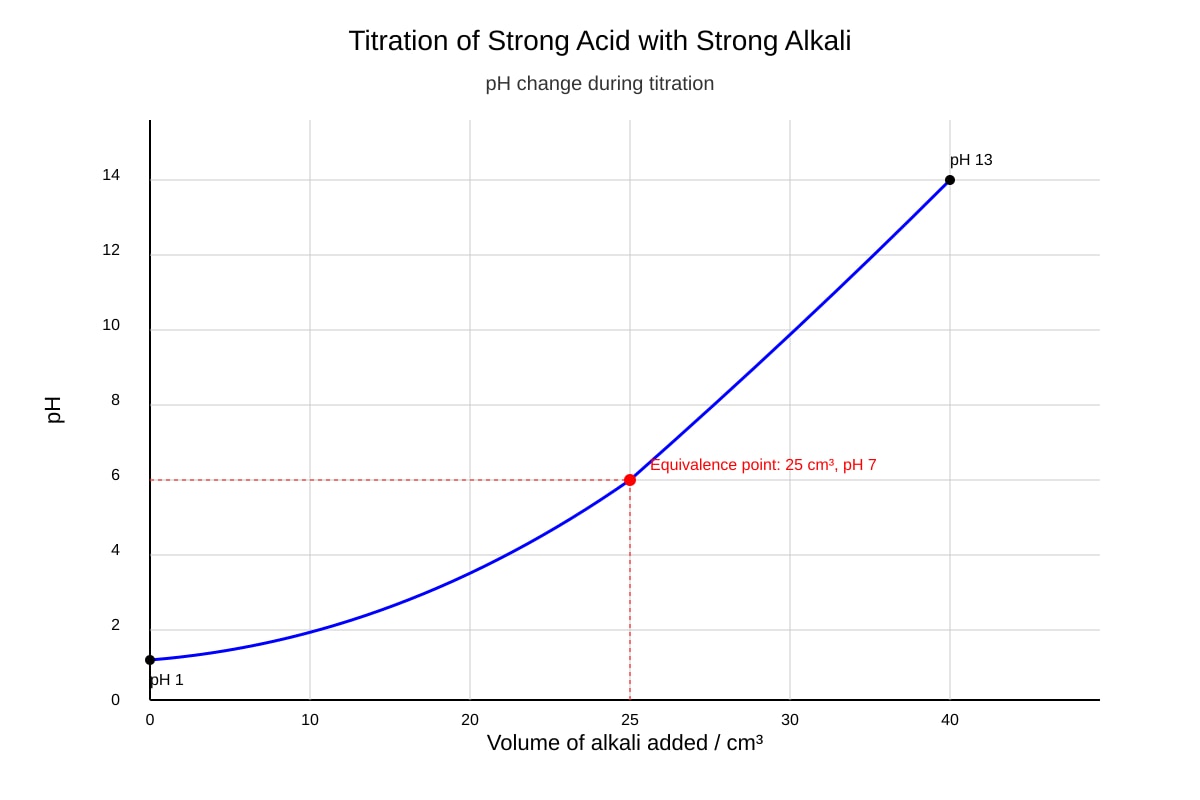
17. The diagram shows the pH change during titration of acid with alkali.
Image pending generation: graph for 17.
(a) State the volume of alkali at the neutral point. [1] (b) State the pH at the equivalence point. [1] (c) Name a suitable indicator for this titration. [1]
18. A farmer has soil of pH 4.5. He wants to raise it to pH 6.5. (a) State a solid compound he can add. [1] (b) Explain why adding too much of this compound may harm plants. [2] (c) Suggest a method to monitor the soil pH after treatment. [1]
19. A sample of impure calcium carbonate (chalk) contains 80% CaCO₃ by mass. 5.00 g of the sample reacts with excess hydrochloric acid: CaCO3+2HCl→CaCl2+CO2+H2O (a) Calculate the mass of pure CaCO₃ in the sample. [1] (b) Calculate the moles of CaCO₃ reacted. (Relative atomic masses: Ca = 40, C = 12, O = 16) [2] (c) Calculate the volume of CO₂ produced at room temperature and pressure (molar volume = 24 dm³/mol). [2]
20. The table shows properties of three oxides.
| Oxide | pH of solution | Reaction with acid? | Reaction with alkali? |
|---|---|---|---|
| X | 2 | No | Yes |
| Y | 12 | Yes | No |
| Z | 7 (insoluble) | Yes | Yes |
(a) Classify X, Y, Z as acidic, basic, or amphoteric. [3] (b) Give one example of an oxide of type Z. [1] (c) Explain why Z is described as amphoteric using its reactions. [1]
Answers
TuitionGoWhere Practice Paper - Chemistry Secondary 3 (Answers)
Version 4 — SA2 Practice
Section A Answers (10 marks)
1. Calcium oxide (CaO) / calcium hydroxide (Ca(OH)₂) / calcium carbonate (CaCO₃). [1]
Teaching note: Acidic soil has low pH; adding a base (solid) raises pH. Common trap: naming NaCl (neutral salt).
2. Ammonia (NH₃) and an acid e.g. hydrochloric acid (HCl). [1]
Teaching note: Ammonium salts form from NH₃ (or NH₄OH) + acid. Trap: giving only one reactant.
3. Blue. [1]
Teaching note: pH 9 is alkaline; litmus turns blue in alkali.
4. H⁺ (hydrogen ion). [1]
Teaching note: Acids release H⁺ in water.
5. Basic. [1]
Teaching note: Metal oxides are usually basic; MgO is a base.
6. (aq). [1]
Teaching note: State symbols: (s) solid, (l) liquid, (g) gas, (aq) aqueous.
7. Sodium chloride (NaCl). [1]
Teaching note: HCl + NaOH → NaCl + H₂O.
8. 7. [1]
Teaching note: Neutral at 25 °C is pH 7.
9. Litmus. [1]
Teaching note: Litmus from lichens, red in acid, blue in alkali.
10. Ethanoic acid (vinegar) / citric acid (lemon) / carbonic acid. [1]
Teaching note: Weak acids partially ionise.
Section B Answers (24 marks)
11. (a) Base / basic oxide. [1]
(b) CaO reacts with water in soil to form Ca(OH)₂ (alkali) which neutralises acid in soil, raising pH. [2]
Marking: 1 for CaO → Ca(OH)₂, 1 for neutralisation raises pH.
12. (a) Oxide that reacts with both acids and alkalis. [1]
(b) Aluminium oxide (Al₂O₃) / zinc oxide (ZnO). [1]
(c) Al₂O₃ + 6HCl → 2AlCl₃ + 3H₂O [2]
Marking: 1 equation balanced, 1 correct formulae/state if required.
13. (a) Trials 2, 3, 4 (21.8, 21.9, 21.7 cm³). [1]
(b) Average = (21.8 + 21.9 + 21.7) / 3 = 65.4 / 3 = 21.8 cm³. [2]
Marking: 1 for excluding rough, 1 for correct average with unit.
14. (a) n = c × V = 0.100 × 1.00 = 0.100 mol. [1]
(b) V = 250 cm³ = 0.250 dm³; n = 0.100 × 0.250 = 0.0250 mol. [2]
Marking: 1 conversion, 1 answer.
15. (a) Crystallisation. [1]
(b) Evaporate filtrate to saturation / warm to concentrate; leave to cool and crystallise; filter crystals; dry between filter paper. [2] (any 2 steps)
Marking: 1 each.
16. (a) S (pH 2). [1]
(b) [H⁺] ratio = 10^(5−2) = 10³ = 1000 times. [2]
Marking: 1 for using 10^(ΔpH), 1 for 1000.
Section C Answers (26 marks)
17. (a) 25 cm³. [1]
(b) 7. [1]
(c) Phenolphthalein / methyl orange (strong acid-strong alkali). [1]
18. (a) CaO / Ca(OH)₂ / CaCO₃. [1]
(b) Excess base makes soil too alkaline, harming plant growth / nutrients unavailable. [2]
(c) Use pH meter / litmus paper / soil test kit. [1]
19. (a) Mass pure = 5.00 × 0.80 = 4.00 g. [1]
(b) Mᵣ(CaCO₃) = 40+12+48 = 100; n = 4.00/100 = 0.0400 mol. [2]
(c) n(CO₂)=n(CaCO₃)=0.0400 mol; V = 0.0400 × 24 = 0.960 dm³. [2]
20. (a) X acidic [1], Y basic [1], Z amphoteric [1].
(b) Al₂O₃ / ZnO. [1]
(c) Z reacts with both acid and alkali showing dual behaviour. [1]
Free quiz and exam paper access
Enter your details to view this paper
Your access is remembered on this device.