From Real Exams Exam Paper
Secondary 3 Chemistry Semestral Assessment 2 (End of Year) Paper 4
Free Sec 3 Chemistry SA2 Paper 4, DeepSeek Exam version, with questions, answers, and O Level-style practice for Singapore students.
These static practice materials are generated from the site's syllabus and paper-generation workflow, with source and model context shown so students and parents can evaluate the material before use.
Questions
Free quiz and exam paper access
Enter your details to view this paper
Your access is remembered on this device.
Answers
TuitionGoWhere Practice Paper – Chemistry Secondary 3
SA2 – Acids, Bases & Salts – Version 4 of 5
ANSWER KEY AND MARKING SCHEME
Total Marks: 60
Section A: Short Answer Questions (20 marks)
1. State what is meant by the term strong acid. [1]
Answer: A strong acid is an acid that completely ionises/dissociates in water to produce H⁺ ions. [1]
Marking notes:
- Award [1] for "completely ionises" or "fully dissociates"
- Do not accept "concentrated" or "produces many H⁺ ions" without reference to complete ionisation
2. A student adds solid calcium oxide to a sample of acidic soil. Explain why the pH of the soil increases. [2]
Answer: Calcium oxide is a base/metal oxide [1]. It reacts with/neutralises the acids/H⁺ ions in the soil, removing them and causing the pH to increase [1].
Alternative answer: Calcium oxide reacts with water in the soil to form calcium hydroxide, which is alkaline. The OH⁻ ions neutralise the H⁺ ions in the acidic soil, increasing the pH.
Marking notes:
- Award [1] for identifying calcium oxide as a base/alkaline substance
- Award [1] for explaining neutralisation of H⁺ ions
- Accept ionic equation: CaO + 2H⁺ → Ca²⁺ + H₂O
3. Ammonium nitrate is an important fertiliser. Name the two compounds that can be reacted together to produce ammonium nitrate. [2]
Answer:
- Compound 1: Ammonia / Ammonium hydroxide [1]
- Compound 2: Nitric acid [1]
Marking notes:
- Accept NH₃ or NH₄OH for Compound 1
- Accept HNO₃ for Compound 2
- Both must be correct for full marks
4. Define the term amphoteric and give one example of an amphoteric oxide. [2]
Answer:
- Definition: An amphoteric substance is one that can react with both acids and bases/alkalis [1]
- Example: Aluminium oxide (Al₂O₃) / Zinc oxide (ZnO) / Lead(II) oxide (PbO) [1]
Marking notes:
- Award [1] for definition showing reaction with both acids and bases
- Award [1] for any correct amphoteric oxide
- Accept amphoteric hydroxides e.g., Al(OH)₃, Zn(OH)₂
5. A student tests an unknown solution and finds that it turns blue litmus paper red. State what this observation tells you about the solution. [1]
Answer: The solution is acidic / contains H⁺ ions / has a pH less than 7. [1]
Marking notes:
- Any one correct statement for [1]
- Do not accept "it is an acid" without qualification (some acidic salts also turn blue litmus red)
6. Write a balanced chemical equation, including state symbols, for the reaction between dilute sulfuric acid and aqueous sodium hydroxide. [2]
Answer: H₂SO₄(aq) + 2NaOH(aq) → Na₂SO₄(aq) + 2H₂O(l) [2]
Marking notes:
- Award [1] for correct formulae
- Award [1] for correct balancing and state symbols
- Deduct [1] if state symbols are missing or incorrect
- Accept ionic equation: H⁺(aq) + OH⁻(aq) → H₂O(l) for [2]
7. Explain why a solution of hydrogen chloride in water conducts electricity, but a solution of hydrogen chloride in methylbenzene does not. [3]
Answer: In water, hydrogen chloride ionises/dissociates to form H⁺ and Cl⁻ ions [1]. These ions are mobile/free to move and can carry electric current [1]. In methylbenzene (an organic solvent), hydrogen chloride does not ionise and exists as molecules, so there are no mobile ions to conduct electricity [1].
Marking notes:
- Award [1] for ionisation in water producing H⁺ and Cl⁻
- Award [1] for mobile ions carrying current
- Award [1] for no ionisation in methylbenzene / exists as molecules
- Key concept: Water is a polar solvent that promotes ionisation; methylbenzene is non-polar
8. State the colour change observed when a few drops of methyl orange indicator are added to a solution of potassium hydroxide. [1]
Answer: Methyl orange turns yellow (from orange). [1]
Marking notes:
- Accept "yellow" or "turns yellow"
- Potassium hydroxide is alkaline; methyl orange is yellow in alkaline solutions
- Do not accept "orange" or "red"
9. A student prepares copper(II) sulfate crystals by reacting excess copper(II) oxide with warm dilute sulfuric acid. Describe the steps the student should take after the reaction is complete to obtain dry crystals of copper(II) sulfate. [3]
Answer:
- Filter the mixture to remove excess/unreacted copper(II) oxide [1]
- Heat/evaporate the filtrate to obtain a saturated/hot concentrated solution [1]
- Allow the solution to cool and crystallise, then filter and dry the crystals (between filter paper / in a warm oven) [1]
Marking notes:
- Award [1] for filtration step
- Award [1] for evaporation to saturation point (not to dryness)
- Award [1] for cooling, crystallisation, and drying
- Do not award marks for "heat to dryness" as this would produce powder, not crystals
10. Explain the difference between a strong acid and a concentrated acid. [3]
Answer: A strong acid refers to the degree of ionisation/dissociation — it completely ionises in water to produce H⁺ ions [1]. A concentrated acid refers to the amount of acid dissolved in a given volume of water — it contains a large amount of acid per unit volume [1]. A strong acid can be dilute (small amount of acid in large volume of water), and a weak acid can be concentrated (large amount of acid in small volume of water) [1].
Marking notes:
- Award [1] for defining strong acid in terms of complete ionisation
- Award [1] for defining concentrated acid in terms of amount/quantity per volume
- Award [1] for explaining that the two terms describe different properties (strength vs concentration) with an example or clarification
- Key distinction: Strength = extent of ionisation; Concentration = amount of solute per volume
Section B: Structured Questions (20 marks)
11. Titration calculation
(a) Identify which trials are concordant. Explain your choice. [2]
Answer: Trials 2 and 3 are concordant [1]. They differ by 0.00 cm³ (both are 24.70 cm³), which is within ±0.10 cm³ [1].
Marking notes:
- Award [1] for identifying Trials 2 and 3
- Award [1] for stating the difference is within ±0.10 cm³ (or 0.00 cm³)
- Trial 1 (24.80 cm³) is also within 0.10 cm³ of Trial 3 but the rough trial is excluded; accept if student includes Trial 1 as concordant with reasoning
(b) Calculate the average volume of hydrochloric acid used. Give your answer to two decimal places. [2]
Answer: Average = (24.80 + 24.70 + 24.70) ÷ 3 = 74.20 ÷ 3 = 24.73 cm³ [2]
Alternative: If only Trials 2 and 3 used: (24.70 + 24.70) ÷ 2 = 24.70 cm³ [2]
Marking notes:
- Award [1] for correct method (sum of concordant volumes ÷ number of trials)
- Award [1] for correct answer with two decimal places and units
- Accept 24.73 cm³ or 24.70 cm³ depending on concordant selection
(c) Calculate the number of moles of hydrochloric acid used in the average titre. [2]
Answer: Moles = concentration × volume (in dm³) = 0.100 × (24.73 ÷ 1000) [1] = 0.100 × 0.02473 = 0.00247 mol (or 2.47 × 10⁻³ mol) [1]
Marking notes:
- Award [1] for correct conversion of cm³ to dm³ and substitution
- Award [1] for correct answer with units
- Accept answer based on student's average from (b); error carried forward (ECF)
(d) Calculate the concentration of the sodium hydroxide solution in mol/dm³. [2]
Answer: From equation: HCl + NaOH → NaCl + H₂O Mole ratio HCl : NaOH = 1 : 1 [1] Moles of NaOH = moles of HCl = 0.00247 mol Concentration of NaOH = moles ÷ volume (in dm³) = 0.00247 ÷ (25.0 ÷ 1000) = 0.00247 ÷ 0.0250 = 0.0988 mol/dm³ [1]
Marking notes:
- Award [1] for identifying 1:1 mole ratio and calculating moles of NaOH
- Award [1] for correct concentration with units
- Accept ECF from part (c)
12. Properties of compounds
(a) Identify the type of bonding and structure present in compound W. Explain your answer using the data in the table. [3]
Answer: Compound W has ionic bonding with a giant ionic lattice structure [1]. Evidence:
- High melting point (801 °C) — large amount of energy needed to overcome strong electrostatic forces between ions [1]
- Conducts electricity in aqueous solution but not as a solid — ions are free to move in solution but locked in place in the solid lattice [1]
Marking notes:
- Award [1] for correct bonding and structure type
- Award [1] for linking high melting point to strong ionic bonds/electrostatic forces
- Award [1] for linking conductivity pattern to mobile ions in solution vs fixed ions in solid
(b) Compound Z is a weak acid. Explain, in terms of ionisation, why compound Z conducts electricity weakly in aqueous solution. [2]
Answer: Compound Z is a weak acid, meaning it partially ionises/dissociates in water [1]. Only a small proportion of molecules produce H⁺ ions, so there are few mobile ions to carry electric current, resulting in weak conductivity [1].
Marking notes:
- Award [1] for "partially ionises"
- Award [1] for linking partial ionisation to few mobile ions and weak conductivity
- Contrast with strong acid: complete ionisation → many ions → high conductivity
(c) Suggest the type of bonding and structure present in compound X. Explain your answer. [3]
Answer: Compound X has covalent bonding with a giant covalent/giant molecular structure [1]. Evidence:
- Very high melting point (1610 °C) — large amount of energy needed to break many strong covalent bonds [1]
- Insoluble in water and does not conduct electricity — no ions present; electrons are localised in covalent bonds [1]
Marking notes:
- Award [1] for correct bonding and structure type (accept giant covalent/macromolecular)
- Award [1] for linking high melting point to strong covalent bonds throughout the structure
- Award [1] for linking insolubility and non-conductivity to absence of mobile ions/electrons
- Example: silicon dioxide (SiO₂) fits this description
(d) Compound Y is a liquid at room temperature and does not mix with water. Name the type of bonding present in compound Y and describe the forces between its molecules. [2]
Answer: Compound Y has covalent bonding within its molecules [1]. The forces between molecules are weak van der Waals' forces / weak intermolecular forces [1].
Marking notes:
- Award [1] for covalent bonding (within molecules)
- Award [1] for weak van der Waals' forces or weak intermolecular forces (between molecules)
- Low melting point (-95 °C) and insolubility in water are consistent with simple molecular structure
Section C: Data-Based and Application Questions (20 marks)
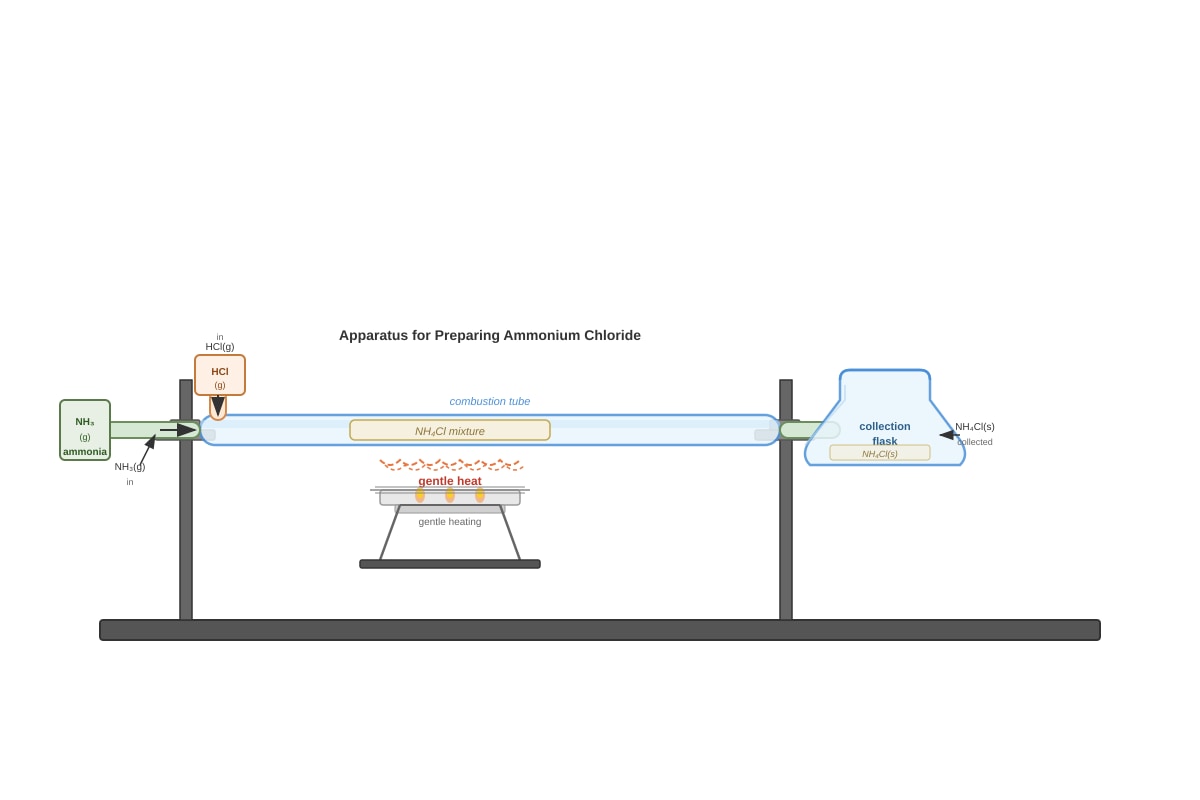
13. Preparation of ammonium chloride
(a) Name the two reactants used to prepare ammonium chloride in this experiment. [1]
Answer: Ammonia and hydrogen chloride [1]
Marking notes:
- Accept NH₃ and HCl
- Both must be named for [1]
(b) Write a balanced chemical equation, including state symbols, for the reaction that occurs. [2]
Answer: NH₃(g) + HCl(g) → NH₄Cl(s) [2]
Marking notes:
- Award [1] for correct formulae
- Award [1] for correct state symbols and balancing
- State symbols: NH₃(g), HCl(g), NH₄Cl(s)
(c) Explain why the ammonium chloride collects further along the tube rather than at the point where the reactants meet. [2]
Answer: Ammonium chloride forms as a white solid/smoke when the two gases meet and react [1]. The solid particles are carried further along the tube by the flow of gases before settling/depositing [1].
Alternative explanation: The reaction is exothermic and the product sublimes, then recondenses further along the cooler part of the tube.
Marking notes:
- Award [1] for identifying that a solid forms
- Award [1] for explaining why it deposits further along (gas flow / sublimation and condensation)
(d) Suggest why this method is not suitable for preparing ammonium nitrate. [2]
Answer: Ammonium nitrate is formed from ammonia and nitric acid [1]. Nitric acid is a liquid/aqueous solution at room temperature, not a gas, so it cannot be mixed with ammonia gas in the same way [1]. Heating nitric acid would cause it to decompose rather than vaporise safely.
Marking notes:
- Award [1] for identifying that nitric acid is not a gas
- Award [1] for explaining the practical difficulty (liquid vs gas / decomposition on heating)
- Accept: Nitric acid is thermally unstable/decomposes on heating
14. Soil pH and treatment
(a) State which field does not need any treatment before planting. Explain your answer. [2]
Answer: Field A does not need treatment [1]. The soil pH (5.2) is within the optimum range for potatoes (5.0 – 6.0) [1].
Marking notes:
- Award [1] for identifying Field A
- Award [1] for explaining that pH 5.2 falls within the 5.0–6.0 range
(b) For Field C, the farmer adds calcium hydroxide to the soil. Explain, using an ionic equation, how calcium hydroxide increases the soil pH. [3]
Answer: Calcium hydroxide is a base that provides OH⁻ ions in the soil [1]. These OH⁻ ions neutralise the excess H⁺ ions in the acidic soil [1].
Ionic equation: H⁺(aq) + OH⁻(aq) → H₂O(l) [1]
Marking notes:
- Award [1] for identifying OH⁻ ions from calcium hydroxide
- Award [1] for explaining neutralisation of H⁺ ions
- Award [1] for correct ionic equation
- Accept: Ca(OH)₂(s) + 2H⁺(aq) → Ca²⁺(aq) + 2H₂O(l)
(c) The farmer also considers using calcium carbonate instead of calcium hydroxide for Field C. State one advantage and one disadvantage of using calcium carbonate. [2]
Answer:
- Advantage: Calcium carbonate is cheaper / more readily available / less likely to over-neutralise (it is insoluble and reacts slowly) / less caustic/safer to handle [1]
- Disadvantage: Calcium carbonate reacts more slowly / is less effective at raising pH quickly / produces CO₂ gas which may be undesirable [1]
Marking notes:
- Award [1] for any valid advantage
- Award [1] for any valid disadvantage
- Accept other reasonable answers
15. Reaction rate investigation
(a) Write a balanced chemical equation, including state symbols, for the reaction between calcium carbonate and hydrochloric acid. [2]
Answer: CaCO₃(s) + 2HCl(aq) → CaCl₂(aq) + H₂O(l) + CO₂(g) [2]
Marking notes:
- Award [1] for correct formulae
- Award [1] for correct balancing and state symbols
- State symbols must be correct: CaCO₃(s), HCl(aq), CaCl₂(aq), H₂O(l), CO₂(g)
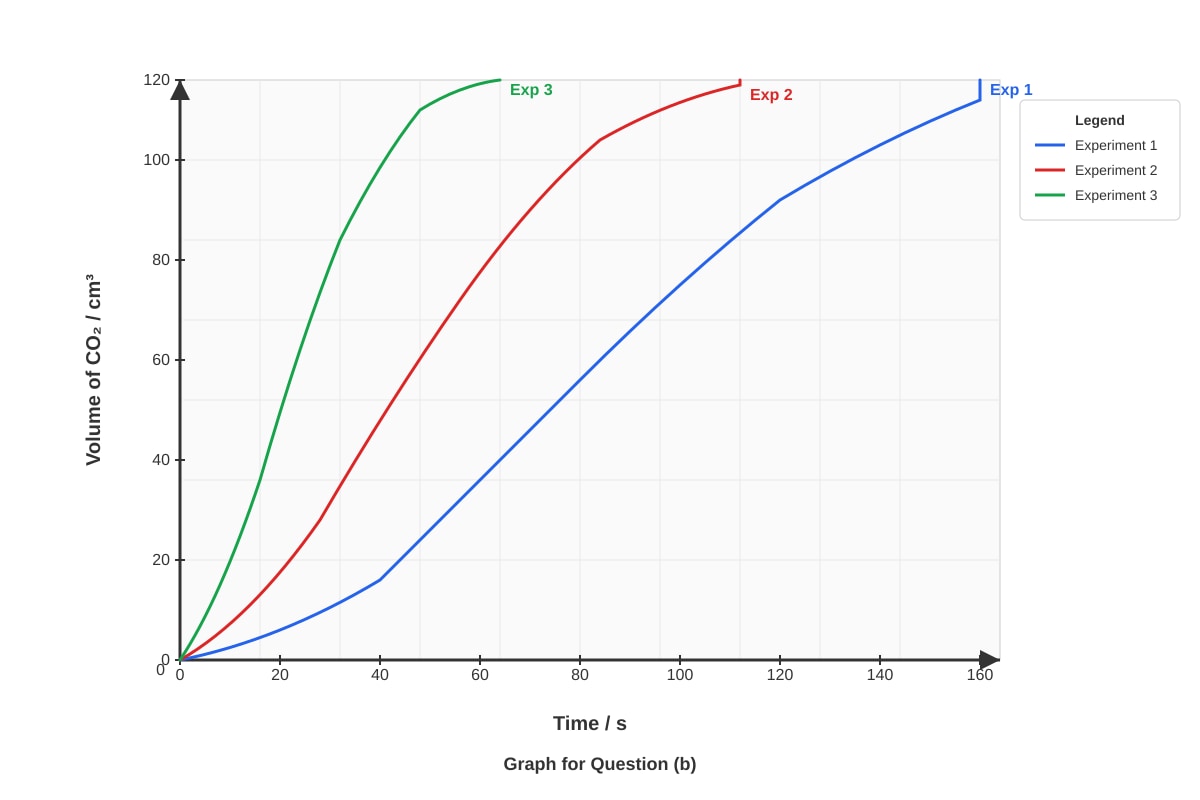
(b) On the axes below, sketch and label the curves you would expect for Experiment 1, Experiment 2, and Experiment 3. [4]
Answer: Three curves should be drawn on the same axes:
- Experiment 2 (powdered, 1.0 mol/dm³): Steepest initial gradient, reaches the same final volume as Experiment 1, but levels off earliest [1]
- Experiment 3 (large chips, 2.0 mol/dm³): Steeper initial gradient than Experiment 1, reaches a higher final volume (double the volume of Experiment 1) [1]
- Experiment 1 (large chips, 1.0 mol/dm³): Least steep initial gradient, reaches the lowest final volume [1]
- All curves correctly labelled and starting from origin [1]
Marking notes:
- Award [1] for each curve with correct relative steepness and final volume
- Award [1] for correct labelling
- Experiment 1 and 2: same amount of CaCO₃ and HCl → same final volume of CO₂
- Experiment 3: same amount of CaCO₃ but double concentration of HCl → same rate as Experiment 1 if CaCO₃ is limiting, but HCl is in excess; if CaCO₃ is limiting, final volume is the same as Experiment 1. Accept either interpretation with correct reasoning.
(c) Explain why the curve for Experiment 2 is steeper than the curve for Experiment 1. [2]
Answer: In Experiment 2, the marble chips are powdered, giving a larger surface area [1]. This increases the frequency of collisions between reactant particles, so the rate of reaction is faster [1].
Marking notes:
- Award [1] for identifying larger surface area of powdered marble
- Award [1] for linking to increased collision frequency and faster rate
- Reference to collision theory required for full marks
(d) State and explain whether the final volume of gas produced in Experiment 3 is greater than, less than, or the same as the final volume in Experiment 1. [2]
Answer: The final volume of gas is the same [1]. Both experiments use the same mass of marble chips (same amount of CaCO₃), and CaCO₃ is the limiting reactant in both cases. The amount of CO₂ produced depends on the amount of CaCO₃, not the concentration of acid [1].
Alternative answer (if HCl is limiting): The final volume is greater because Experiment 3 uses 2.0 mol/dm³ HCl, providing twice the number of moles of HCl. If HCl is the limiting reactant, more CO₂ is produced.
Marking notes:
- Award [1] for correct prediction with reasoning
- Award [1] for identifying the limiting reactant and explaining the relationship
- Accept either interpretation if reasoning is consistent and scientifically correct
END OF ANSWER KEY
Marking scheme based on Singapore O-Level Chemistry assessment standards. © TuitionGoWhere Exam Practice (AI)