From Real Exams Exam Paper
Secondary 3 Chemistry Semestral Assessment 2 (End of Year) Paper 3
Free Sec 3 Chemistry SA2 Paper 3, Kimi2.6 Exam version, with questions, answers, and O Level-style practice for Singapore students.
These static practice materials are generated from the site's syllabus and paper-generation workflow, with source and model context shown so students and parents can evaluate the material before use.
Questions
Free quiz and exam paper access
Enter your details to view this paper
Your access is remembered on this device.
Answers
TuitionGoWhere Exam Practice (AI) - ANSWER KEY
Chemistry Secondary 3 SA2 - Version 3 of 5
Total Marks: 60
SECTION A: Multiple Choice and Short Response (Total: 20 marks)
1. Answer: B — Rainwater (pH 6) [1]
Explanation: Rainwater is a weak acid due to dissolved carbon dioxide forming carbonic acid. Vinegar (pH 3) and lemon juice (pH 2) are weak acids but more acidic. Hydrochloric acid (pH 1) is a strong acid. The weak acid with highest pH (least acidic) is rainwater.
2. Magnesium sulfate / MgSO₄ [1]
Explanation: Base + Acid → Salt + Water. MgO + H₂SO₄ → MgSO₄ + H₂O. The metal from the base (Mg) combines with the acid radical (SO₄²⁻).
3. Colour changes from green to purple/blue [2]
Marking: [1] for stating purple/blue/violet; [1] for noting initial green (neutral) or acknowledging the change direction. Accept "blue-violet".
Explanation: Universal indicator in neutral water is green. Ammonia solution is a weak alkali (pH ~11), which turns universal indicator purple/blue. Common error: confusing with litmus (turns blue in alkali, not red).
4. CaCO₃(s) + 2HNO₃(aq) → Ca(NO₃)₂(aq) + H₂O(l) + CO₂(g) [2]
Marking: [1] for correct formulae and balancing; [1] for correct state symbols.
Common error: Forgetting CO₂ is a gas, or writing H₂CO₃ instead of H₂O + CO₂.
5. (a) A proton (H⁺ ion) acceptor [1]
Note: Brønsted-Lowry definition focuses on proton transfer, unlike Arrhenius (OH⁻ producer in water) or Lewis (electron pair donor).
(b) Water / H₂O OR ammonia / NH₃ OR sodium hydrogen carbonate / NaHCO₃ [1]
Explanation: These are amphiprotic/amphoteric substances. Water accepts H⁺ to form H₃O⁺ or donates H⁺ to form OH⁻.
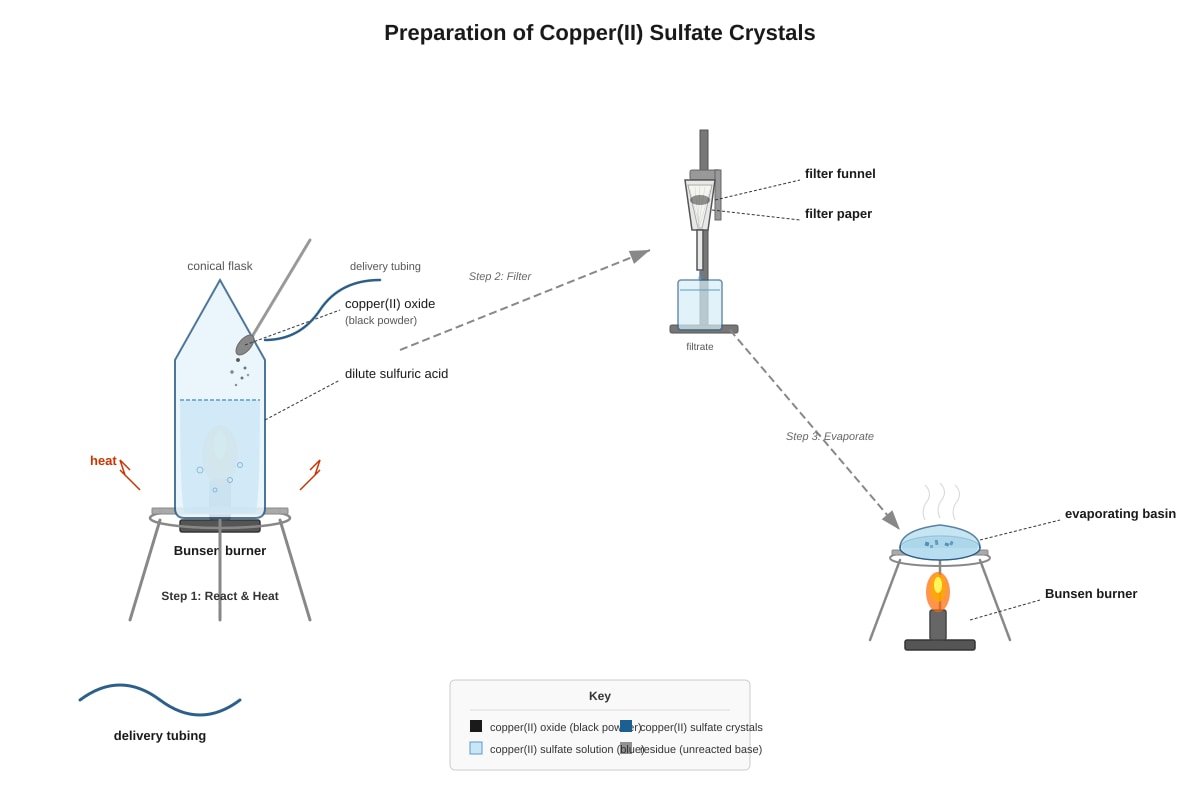
6. Excess acid would remain in the solution; excess copper(II) oxide can be removed by filtration, leaving pure salt solution; excess acid would make the final product impure/contaminated with acid [2]
Marking: [1] for stating excess base is removable by filtration; [1] for stating excess acid would contaminate product or cannot be easily removed.
Key concept: When preparing soluble salts from insoluble bases, excess insoluble reactant ensures all acid reacts and can be filtered off. Soluble excess reactant cannot be removed by filtration.
7.
| Indicator | In acid | In base |
|---|---|---|
| Litmus | red | blue |
| Phenolphthalein | colourless | pink/magenta |
[2]
Marking: [1] for both litmus colours correct; [1] for both phenolphthalein colours correct.
8. H⁺(aq) + OH⁻(aq) → H₂O(l) [2]
Marking: [1] for correct ions; [1] for correct state symbols and balanced equation.
Explanation: This is the net ionic equation for all strong acid-strong base neutralisations. Spectator ions (e.g., Na⁺, Cl⁻) are not included.
9. (a) Acidic [1] (pH < 7)
(b) Calcium oxide / CaO / calcium hydroxide / Ca(OH)₂ / calcium carbonate / CaCO₃ [1]
Explanation: These are bases that react with acidic soil. CaCO₃ is preferred for gentle pH adjustment. Avoid suggesting NaOH (too strong, harmful to plants and soil structure).
10. Add acid slowly to water (never water to acid); stir constantly; use a heat-resistant container; wear safety goggles and gloves; work in a fume cupboard if concentrated [2]
Marking: [1] for "add acid to water" with stirring; [1] for any valid safety precaution (goggles, gloves, fume cupboard, lab coat).
Critical safety point: "AAA" — Always Add Acid (to water). Adding water to concentrated acid causes violent exothermic reaction where boiling acid can splash.
SECTION B: Structured Questions (Total: 24 marks)
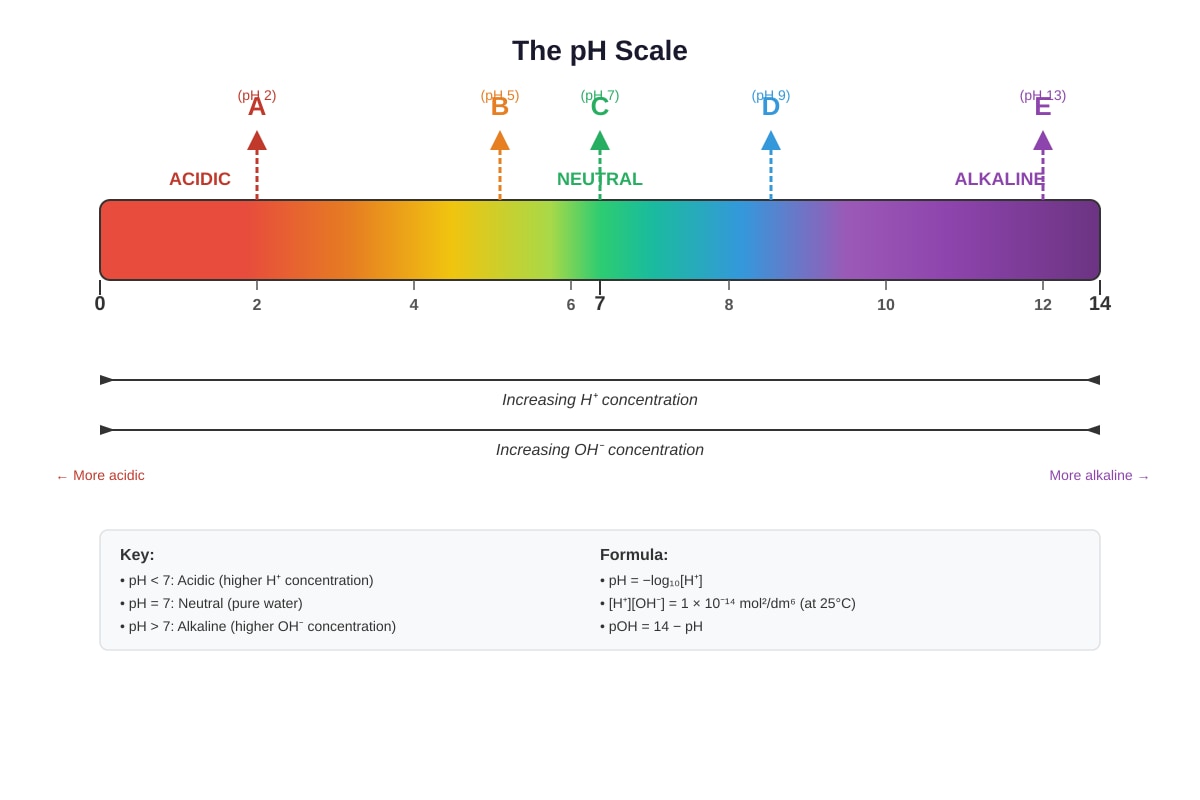
11. (a) (i) C (pH 7 = neutral = pure water) [1]
(ii) E (pH 13 = strong alkali) [1]
(b) H⁺ / hydrogen ion / hydronium ion (H₃O⁺) [1]
(c) Test with red litmus paper: D (alkali) turns red litmus blue; B (weak acid) does not change red litmus colour/stays red [1]. Then add zinc carbonate (or any named carbonate/hydrogen carbonate/metal) to B: effervescence/fizzing observed due to CO₂ production [1]. Or add universal indicator: B turns orange/yellow, D turns blue/purple [1].
Marking: [1] for correct litmus test outcomes; [1] for valid second test with correct expected result for B; [1] for second test correctly distinguishing B and D.
12. (a) Moles of Zn = mass / molar mass = 6.5 g / 65 g/mol = 0.10 mol [2]
Marking: [1] for formula or correct substitution; [1] for correct answer with unit.
(b) Mole ratio Zn : ZnSO₄ = 1 : 1, so moles of ZnSO₄ = 0.10 mol [1] Mass of ZnSO₄ = moles × molar mass = 0.10 × 161 = 16.1 g [1]
Marking: [1] for correct mole ratio or moles of product; [1] for correct final mass with unit.
(c) Heat the solution to evaporate some water and concentrate it [1]; allow to cool so crystals form [1]; filter to collect crystals, wash with distilled water, and dry between filter papers or in a warm oven [1]
Marking: [1] each for any two distinct correct steps in sensible order. All three steps (evaporate/concentrate, cool to crystallise, filter and dry) needed for full marks.
Common error: Heating to dryness causes loss of water of crystallisation or decomposition.
13. (a) Nitrogen (from air/fractional distillation of liquid air) [1]; Hydrogen (from natural gas/methane) [1] [2]
(b) N₂(g) + 3H₂(g) ⇌ 2NH₃(g) [2]
Marking: [1] for correct formulae and balancing; [1] for correct state symbols and reversible arrow.
(c) Any two from: Temperature 450°C [1]; Pressure 150-250 atm / 200 atm [1]; Iron catalyst [1]; Recycling unreacted N₂ and H₂ [1] [2]
(d) Ammonia is liquefied (boiling point -33°C) to separate it from unreacted nitrogen and hydrogen [1]; these gases are recycled back into the reactor to improve yield and reduce waste [1]
Marking: [1] for liquefaction as separation method; [1] for recycling unreacted gases.
14. (a) (i) Method: P [1] Explanation: Both reactants are soluble; titration allows precise determination of neutralisation point to obtain pure sodium chloride without excess reactant [1]
(ii) Method: R [1] Explanation: Lead(II) iodide is insoluble/precipitate; precipitation is the standard method for preparing insoluble salts [1]
(iii) Method: Q [1] Explanation: Copper(II) oxide is insoluble in water; adding excess to acid ensures complete reaction, then excess is filtered off [1]
Note: Method P (titration) is unsuitable for copper(II) sulfate because both CuO and H₂SO₄ would need to be carefully measured — but CuO is insoluble and cannot be used in burette/pipette. Method R would give copper(II) nitrate or chloride, not sulfate.
(b) Sodium reacts violently/explosively with water/acid [1]; producing hydrogen gas which is flammable/explosive [1]; reaction is too vigorous/dangerous to control safely [1]
Alternative: Sodium is too reactive; safer to neutralise with sodium hydroxide/carbonate by titration (Method P).
Marking: [1] for identifying danger/violence; [1] for identifying flammable hydrogen; [1] for concluding unsuitability due to safety.
15. (a) Any two from: Pipette is more accurate/precise (to ±0.05 cm³ vs ±1 cm³ for measuring cylinder) [1]; delivers exactly 25.0 cm³ [1]; standard volumetric glassware for consistent results [1]; measuring cylinder has larger error/less precise [1] [2]
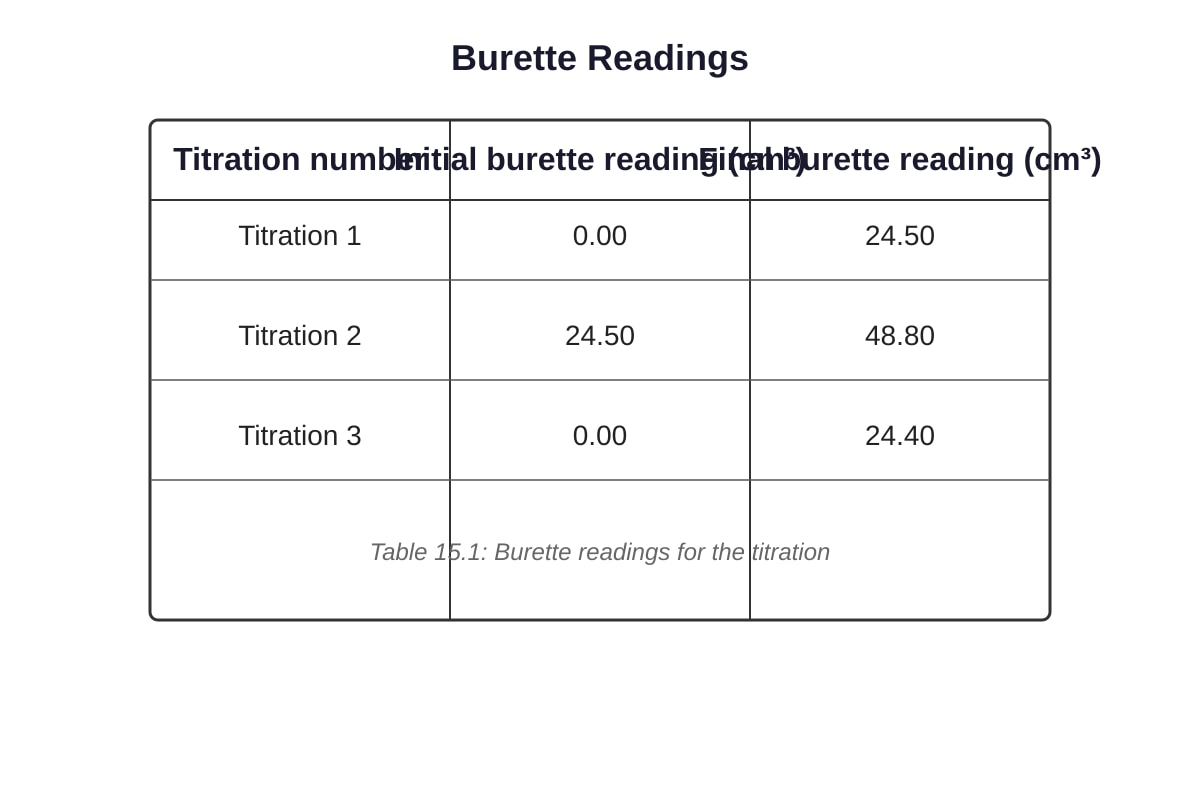
(b) Titre 1: 24.50 - 0.00 = 24.50 cm³
Titre 2: 48.80 - 24.50 = 24.30 cm³
Titre 3: 24.40 - 0.00 = 24.40 cm³ [1]
Mean = (24.40 + 24.30) / 2 = 24.35 cm³ [1]
Note: Titration 1 is rough/concordance check; use 2 and 3 as they agree within 0.10 cm³. If all three used: (24.50 + 24.30 + 24.40)/3 = 24.40 cm³ — accept with note about concordance.
(c) Moles of H₂SO₄ = concentration × volume (in dm³) = 0.100 × (24.35 / 1000) = 0.100 × 0.02435 = 0.002435 mol ≈ 2.44 × 10⁻³ mol [2]
Marking: [1] for correct formula with volume conversion; [1] for correct answer.
(d) From equation: 2 mol NaOH : 1 mol H₂SO₄ Moles of NaOH = 2 × 0.002435 = 0.00487 mol [2]
Marking: [1] for correct mole ratio from equation; [1] for correct answer.
(e) Concentration = moles / volume (in dm³) = 0.00487 / (25.0 / 1000) = 0.00487 / 0.0250 = 0.195 mol/dm³ [2]
Accept 0.1948 mol/dm³ or 0.19/0.195 mol/dm³ depending on rounding. Marking: [1] for correct formula with volume conversion; [1] for correct answer with unit.
SECTION C: Data Analysis and Extended Response (Total: 16 marks)
16. (a) HCl is a strong acid that completely ionises/dissociates in water [1]: HCl → H⁺ + Cl⁻, giving high concentration of H⁺ ions [1]. CH₃COOH is a weak acid that partially ionises in equilibrium [1]: CH₃COOH ⇌ CH₃COO⁻ + H⁺, giving lower H⁺ concentration at same overall concentration. Hence HCl has lower pH.
Marking: [1] for correct description of strong acid complete dissociation; [1] for correct description of weak acid partial dissociation; [1] for linking H⁺ concentration to pH (or pH = -log[H⁺]).
(b) The temperature rise indicates heat released during neutralisation [1]. HCl is fully ionised, so all H⁺ immediately available for neutralisation — maximum heat per mole released [1]. CH₃COOH must partially ionise as H⁺ is consumed; this ionisation is endothermic or energy is used to dissociate more acid molecules, reducing net heat released [1]. Hence temperature rise is smaller for weak acid-strong base neutralisation.
Alternative accepted explanation: Some heat energy absorbed in continuing dissociation of weak acid during reaction.
Marking: [1] for recognising temperature rise related to neutralisation enthalpy; [1] for strong acid having all H⁺ ions ready; [1] for weak acid requiring energy for further ionisation/dissociation during reaction.
17. (a) CuO(s) + H₂SO₄(aq) → CuSO₄(aq) + H₂O(l) [2]
Marking: [1] for correct formulae; [1] for balancing and state symbols.
(b) To speed up the reaction/increase rate of reaction [1]; but not boil violently/avoid spitting/safety control/excessive evaporation of acid before reaction completes [1]
Marking: [1] for rate increase; [1] for safety/control reason.
(c) Add copper(II) oxide until no more dissolves [1]; or black solid remains at bottom and does not disappear with further stirring/heating [1]
Marking: [1] for test method; [1] for correct observation indicating excess.
(d) Heating to dryness would cause: loss of water of crystallisation / decomposition of salt / crystals become powdery/anhydrous [1]; or crystals may spit/split from evaporating basin / thermal decomposition of copper(II) sulfate to CuO + SO₃ at high temperatures [1]
Marking: [1] for identifying correct chemical problem; [1] for physical consequence or further explanation.
(e) Step 1: Moles of H₂SO₄ used = concentration × volume = 1.0 × (50/1000) = 0.050 mol [1]
Step 2: Mole ratio H₂SO₄ : CuSO₄·5H₂O = 1 : 1, so theoretical moles of crystals = 0.050 mol [1]
Step 3: Theoretical mass = 0.050 × 250 = 12.5 g [1]
Step 4: Percentage yield = (actual mass / theoretical mass) × 100 = (12.4 / 12.5) × 100 = 99.2% [1]
Marking: [1] each for steps 1-4. Accept 99% or 99.2%. If rounded differently in intermediate steps, accept consistent working.
Common error: Forgetting to convert cm³ to dm³, or using wrong mole ratio.
TOTAL MARKS: 60
End of Answer Key