From Real Exams Exam Paper
Secondary 3 Chemistry Semestral Assessment 2 (End of Year) Paper 2
Free Sec 3 Chemistry SA2 Paper 2, Kimi2.6 Exam version, with questions, answers, and O Level-style practice for Singapore students.
These static practice materials are generated from the site's syllabus and paper-generation workflow, with source and model context shown so students and parents can evaluate the material before use.
Questions
Free quiz and exam paper access
Enter your details to view this paper
Your access is remembered on this device.
Answers
TuitionGoWhere Exam Practice (AI) — Answer Key
Secondary 3 Chemistry SA2 Practice Paper (Version 2)
Subject: Chemistry
Level: Secondary 3 (Express/G3)
Total Marks: 60
SECTION A: SHORT ANSWER QUESTIONS [20 marks]
Question 1 [2 marks]
(a) The soil is acidic. [1 mark]
Teaching note: pH < 7 indicates acidic conditions. Pure water has pH 7 (neutral), and pH > 7 indicates alkaline conditions. A pH of 5.2 is well below 7, confirming acidity. This acidity often arises from natural decomposition processes or acid rain leaching into agricultural soils.
(b) Calcium carbonate / CaCO₃ (accept calcium oxide / CaO, or calcium hydroxide / Ca(OH)₂) [1 mark]
Teaching note: To raise soil pH (reduce acidity), a base must be added. Calcium carbonate is preferred in agriculture because:
- It is cheap and readily available as limestone
- It reacts gently with acid in soil: CaCO₃ + 2H⁺ → Ca₂⁺ + H₂O + CO₂
- It adds calcium ions beneficial for plant growth
Avoid: NaOH or KOH (too soluble, would damage plants); NaCl (neutral salt, no pH effect).
Question 2 [3 marks]
(a) Normal salt / ammonium salt [1 mark]
Teaching note: When ammonia (a base) reacts with sulfuric acid (acid), the product contains no replaceable hydrogen — it's a normal salt, not an acid salt. Specifically, it's an ammonium salt containing the NH₄⁺ cation.
(b) [2 marks]
Marking breakdown: Correct formulae [1], correct balancing and state symbols [1]
Teaching note: Ammonia is a weak base that accepts protons from sulfuric acid. The 2:1 molar ratio reflects sulfuric acid's diprotic nature. State symbols: ammonia is a gas commonly bubbled into aqueous acid; the product remains in solution unless crystallised.
Question 3 [2 marks]
(a) [1 mark]
Teaching note: This is an acid-base reaction where the basic oxide (MgO) neutralises nitric acid. The salt formed is magnesium nitrate. MgO is insoluble, so excess can be filtered off — a key advantage in salt preparation.
(b) To ensure all the nitric acid has reacted / to react completely with the acid. [1 mark]
Teaching note: Excess insoluble base ensures no acid remains in the final product. Since MgO is insoluble, unreacted excess can be removed by filtration, leaving only the desired salt solution. If acid were in excess, it would contaminate the crystallised product.
Question 4 [3 marks]
(a) Solution Z [1 mark] — it has the highest pH (13.0), so it has the highest concentration of OH⁻ ions. [1 mark]
Teaching note: pH and hydroxide ion concentration are inversely related through the ionic product of water: [H⁺][OH⁻] = 1.0 × 10⁻¹⁴ mol²/dm⁶ at 25°C.
- pH 13.0 → [H⁺] = 10⁻¹³ mol/dm³ → [OH⁻] = 10⁻¹ mol/dm³ = 0.1 mol/dm³
- pH 1.0 → [OH⁻] = 10⁻¹³ mol/dm³ (very low)
Higher pH always means higher [OH⁻] and lower [H⁺].
(b) [H⁺] = 10⁻ᵖᴴ = 10⁻¹·⁰ = 0.10 mol/dm³ [1 mark]
Teaching note: The pH scale is logarithmic: pH = −log₁₀[H⁺], so [H⁺] = 10⁻ᵖᴴ. A pH of 1.0 corresponds to 0.10 mol/dm³ hydrogen ions — very acidic, typical of strong dilute acids.
Question 5 [3 marks]
(a) Molar mass of CaCO₃ = 40 + 12 + (16 × 3) = 100 g/mol
[1 mark]
Teaching note: Always show the molar mass calculation as working. The formula units ensure dimensional analysis: g ÷ (g/mol) = mol.
(b) From equation: 1 mol CaCO₃ → 1 mol CO₂
[2 marks]
Teaching note: At room temperature and pressure (r.t.p.), 1 mol of any gas occupies 24.0 dm³.
Marking breakdown: Correct mole ratio and moles of CO₂ [1]; correct volume calculation with unit [1].
Common error: Using 22.4 dm³ (STP, 0°C) instead of 24.0 dm³ (r.t.p., 25°C). Always check which condition applies.
Question 6 [2 marks]
Solid sodium chloride: Ions are fixed in position in the lattice structure, so there are no mobile charge carriers. [1 mark]
Molten sodium chloride: Heat overcomes ionic bonds, allowing Na⁺ and Cl⁻ ions to move freely and conduct electricity. [1 mark]
Teaching note: Electrical conductivity requires mobile charge carriers. In solids, strong electrostatic forces hold ions in fixed positions. Upon melting, thermal energy disrupts the lattice, freeing ions to migrate toward oppositely charged electrodes. This principle distinguishes ionic from covalent compounds.
Question 7 [3 marks]
(a) Oxygen [1 mark]
Teaching note: At inert electrodes with dilute sulfuric acid (essentially electrolysing water), the less reactive anion (OH⁻ from water dissociation) is discharged preferentially over SO₄²⁻. The OH⁻ oxidation produces oxygen gas.
(b) Insert a glowing splint into the gas; it relights. [1 mark]
Teaching note: This is the definitive test for oxygen. The glowing splint test is specific — no other common gas relights a glowing splint. (Hydrogen produces a 'pop' with a burning splint; chlorine bleaches damp litmus.)
(c)
or
[1 mark]
Teaching note: Both equations are acceptable. The first is simpler for acidic conditions; the second shows water reduction explicitly. At the cathode, reduction occurs (gain of electrons). H⁺ ions from water dissociation are reduced to hydrogen gas.
Question 8 [2 marks]
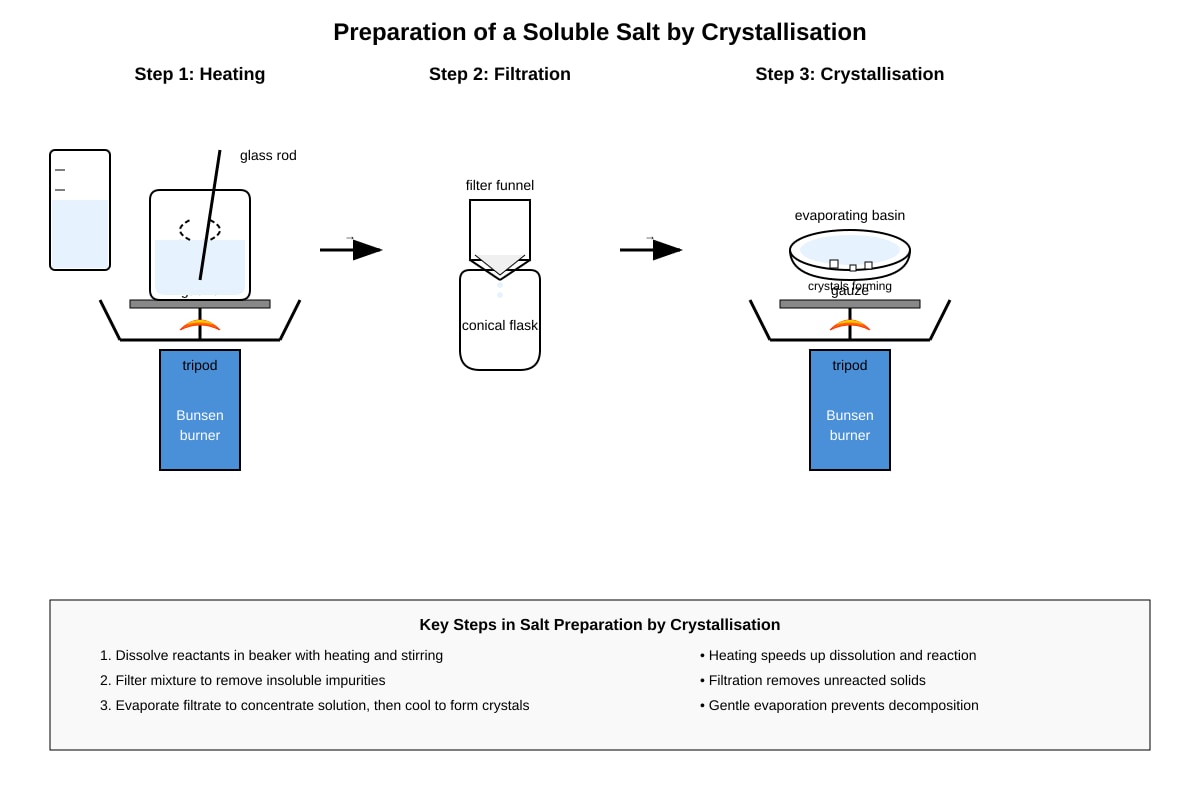
- Add excess copper(II) oxide to warm dilute sulfuric acid and stir
- Continue until no more copper(II) oxide dissolves (excess remains)
- Filter to remove excess copper(II) oxide
- Heat the filtrate gently to evaporate some water until saturated
- Leave to cool and crystallise
- Filter, wash with cold distilled water, and dry between filter paper [2 marks]
Marking breakdown: Any 4 valid steps [1]; excess base + filtering + crystallisation by cooling mentioned [1]
Teaching note: This is preparation of a soluble salt from an insoluble base. Key principles:
- Excess insoluble base ensures complete acid reaction
- Filtration removes excess base
- Controlled evaporation + cooling yields pure crystals (evaporating to dryness gives impure, powdery product)
- Washing removes impurities; cold water minimizes product loss
SECTION B: DATA ANALYSIS AND APPLICATION QUESTIONS [25 marks]
Question 9 [8 marks]
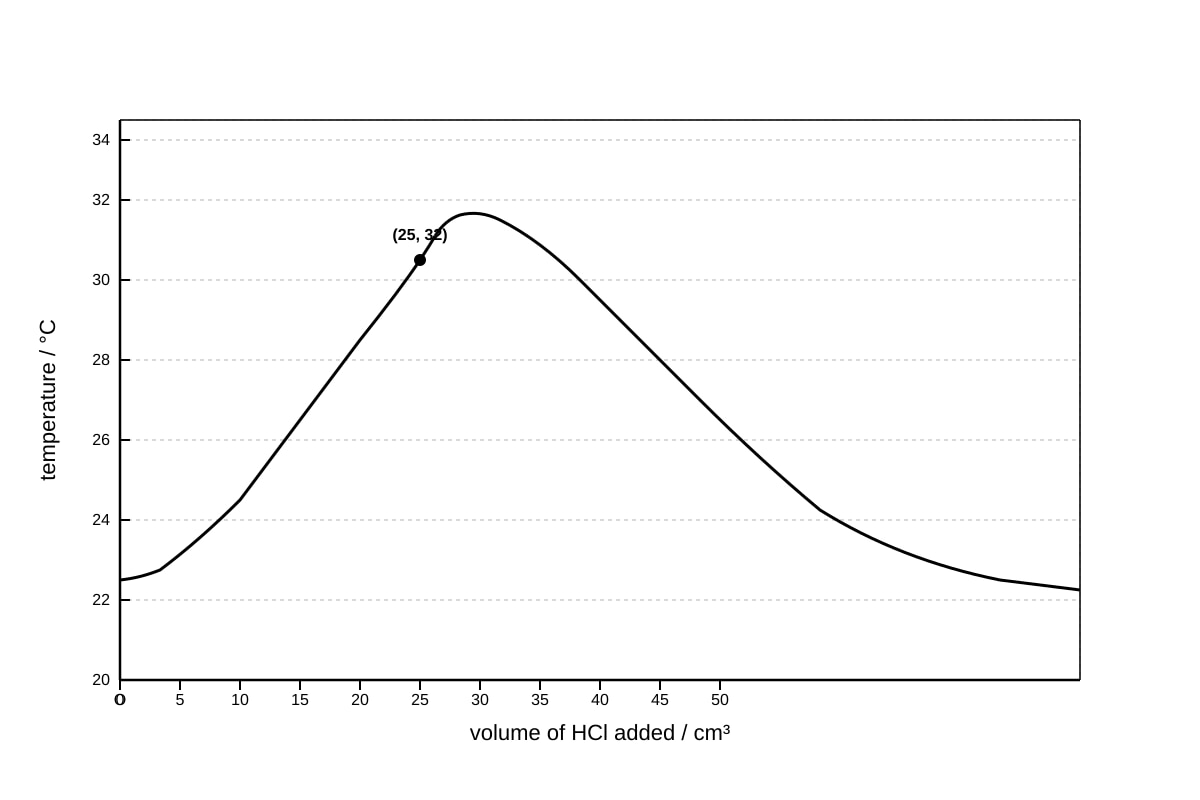
(a) (i) 25 cm³ [1 mark]
Teaching note: The graph shows maximum temperature at 25 cm³ — this is the equivalence point where moles of acid exactly neutralise moles of base. Beyond this point, excess acid is added with no more exothermic neutralisation, so temperature falls.
(a) (ii)
- Neutralisation is an exothermic reaction / energy is released when H⁺ and OH⁻ combine to form water [1 mark]
- As more acid is added (up to equivalence point), more water molecules form, releasing more heat energy, raising the temperature [1 mark]
Teaching note: The fundamental enthalpy change: H⁺(aq) + OH⁻(aq) → H₂O(l) ΔH = −57.3 kJ/mol. This ionic reaction releases thermal energy. Temperature rises while net neutralisation occurs; once base is exhausted, adding cool acid dilutes and cools the mixture.
(b)
- Prediction: Lower maximum temperature reached with ethanoic acid [1 mark]
- Ethanoic acid is a weak acid / partially dissociated in water [1 mark]
- Some energy released is used to complete the dissociation of ethanoic acid molecules (ionisation is endothermic), so less net heat energy is available to raise the solution temperature [1 mark]
Teaching note: Strong acids (HCl) fully dissociate; weak acids (CH₃COOH) establish equilibrium: CH₃COOH ⇌ CH₃COO⁻ + H⁺. During neutralisation, Le Chatelier's principle shifts this right, but breaking the O-H bond in ethanoic acid requires energy. The total enthalpy change of neutralisation is less exothermic for weak acid-strong base than strong acid-strong base.
(c)
[2 marks]
Marking breakdown: Correct moles of NaOH [0.5]; correct moles and concentration of HCl with unit [1.5]
Question 10 [7 marks]
(a)
- dilute sulfuric acid: Solution A [1 mark]
- aqueous sodium carbonate: Solution B [1 mark]
- aqueous barium nitrate: Solution C [1 mark]
Reasoning:
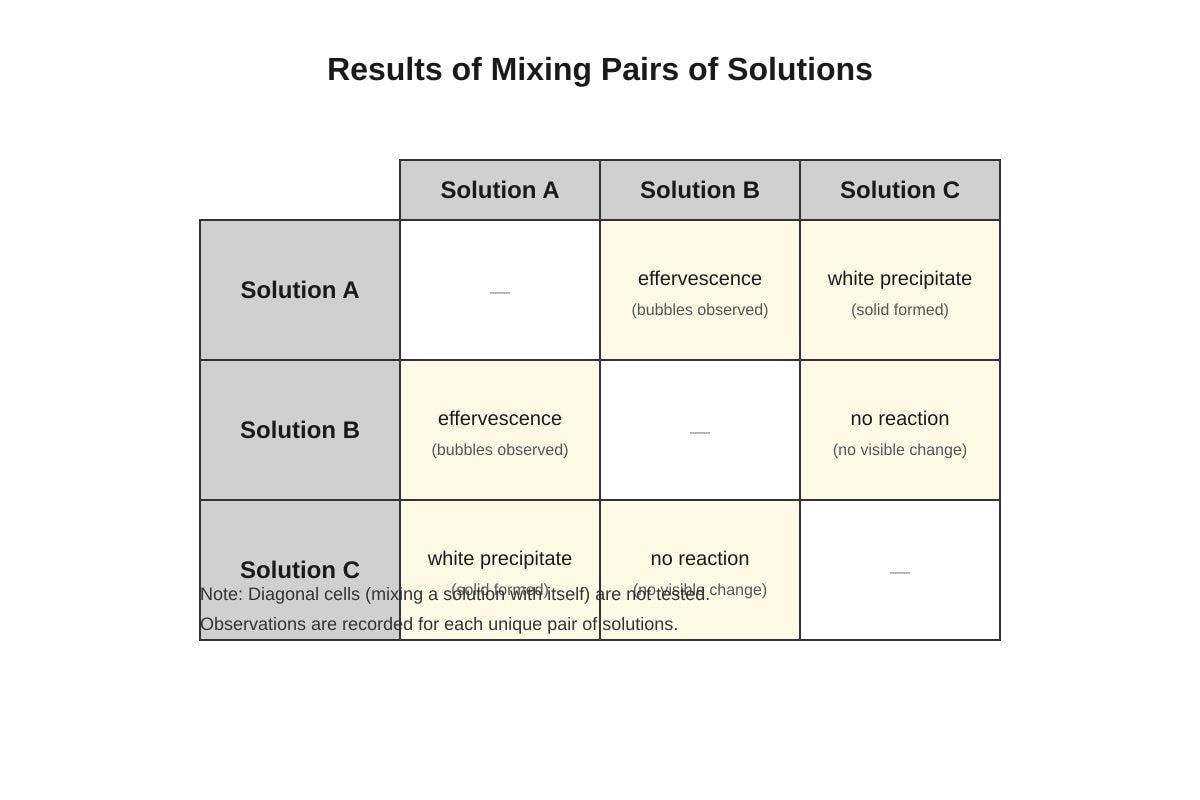
- A + B: effervescence → acid + carbonate produces CO₂ gas. So A and B are H₂SO₄ and Na₂CO₃ (pair)
- A + C: white precipitate → sulfate test with Ba²⁺ gives BaSO₄(s). So A contains SO₄²⁻ and C contains Ba²⁺
- Therefore A = H₂SO₄, C = Ba(NO₃)₂, and B = Na₂CO₃ by elimination
- B + C = no reaction confirms: carbonate + barium nitrate would give BaCO₃ precipitate if both were concentrated, but with dilute solutions and competing equilibria, no visible reaction occurs at these conditions
(b) (i) [2 marks]
Marking breakdown: Correct spectator ions identified and omitted [1]; correct equation with state symbols [1]
Teaching note: Sodium and sulfate ions are spectators. The essential reaction is carbonate ion with hydrogen ions. State symbols: CO₃²⁻(aq) from soluble sodium carbonate, H⁺(aq) from sulfuric acid.
(b) (ii)
- A base (carbonate ion) reacts with an acid (hydrogen ions from sulfuric acid) to form a salt (sodium sulfate) and water [1 mark]
- The H⁺ ions from the acid are used up / pH rises toward 7 [1 mark]
Question 11 [5 marks]
(a)
[2 marks]
Marking breakdown: Correct moles of NaOH [1]; correct moles of acid with 1:1 justification [1]
(b)
[3 marks]
Teaching note: This unusually low percentage suggests either the tablets are very old (hydrolysis to salicylic acid and ethanoic acid), poorly manufactured, or the student lost material during dissolution. In real analysis, multiple titrations would be performed.
Marking breakdown: Correct mass calculation [1]; correct percentage setup [1]; correct answer with interpretation [1]
Question 12 [5 marks]
(a) (i)
- To ensure all the potassium carbonate has reacted / to prevent excess acid remaining [1 mark]
- The effervescence (CO₂ gas) is a visible indicator that unreacted carbonate remains; when it stops, all carbonate has reacted [1 mark]
Teaching note: Unlike titration which uses an indicator to detect endpoint, this "add until reaction ceases" method relies on the observable property of the reaction itself. The beaker allows easy stirring and visual monitoring.
(a) (ii)
- Gentle evaporation produces a saturated solution near the crystallisation point [1 mark]
- Cooling then allows slow crystal formation, giving large, pure crystals with regular structure; evaporating to dryness causes rapid, impure crystallisation and possible decomposition [1 mark]
Teaching note: Slow crystallisation allows ions to pack regularly, excluding impurities. Rapid evaporation traps solvent and impurities. Hydrated potassium chloride crystals (though KCl is not typically hydrated, the principle applies generally) need controlled conditions.
(b) Potassium metal is too reactive / reacts violently with water and acid, producing hydrogen gas which may explode; the reaction is uncontrollable and dangerous. [1 mark]
Teaching note: Potassium is Group 1, reactivity increases down the group. With acid: 2K + 2HCl → 2KCl + H₂, violently exothermic. Potassium may even ignite. This is not a safe or practical laboratory method.
SECTION C: LONGER RESPONSE QUESTIONS [15 marks]
Question 13 [5 marks]
(a) (i) [1 mark]
(a) (ii)
- It prevents mixing of chlorine and sodium hydroxide / prevents chlorine reacting with sodium hydroxide [1 mark]
- It allows OH⁻ ions to migrate to the anode compartment while blocking bulk flow, maintaining separation of products [1 mark]
Teaching note: Without the diaphragm: 2NaOH + Cl₂ → NaCl + NaClO + H₂O (disproportionation of chlorine in hot alkali). This contaminates products and reduces efficiency. The diaphragm is a semi-permeable barrier.
(b)
- Environmental: Chlorine is toxic and damages ozone / contributes to organochlorine pollution; or mercury cell process causes pollution [1 mark]
- Safety: Chlorine is poisonous by inhalation; causes respiratory damage; hydrogen gas is explosive when mixed with air [1 mark]
Question 14 [5 marks]
(a) [1 mark]
(b)
[3 marks]
Marking breakdown: Moles calculation [1]; correct molar mass of hydrate (including water of crystallisation) [1]; final mass [1]
Teaching note: Water of crystallisation is part of the crystal structure — must be included in molar mass. Seven water molecules: 7 × 18 = 126 g/mol total contribution.
(c) [0.5 mark]
Reason: Some product lost during filtration/crystallisation / not all zinc carbonate pure / some product remains dissolved in mother liquor / incomplete reaction [0.5 mark]
Question 15 [5 marks]
(a)
- Sulfur dioxide dissolves in water droplets: SO₂ + H₂O → H₂SO₃ (sulfurous acid) [1 mark]
- Sulfurous acid is oxidised by atmospheric oxygen: 2H₂SO₃ + O₂ → 2H₂SO₄ (sulfuric acid) [1 mark]
- Or catalysed oxidation: 2SO₂ + O₂ → 2SO₃ (with metal oxide catalyst), then SO₃ + H₂O → H₂SO₄ [1 mark]
Teaching note: This is a multi-step atmospheric process. The oxidation may be catalysed by metal ions (Fe³⁺, Mn²⁺) in atmospheric particulates. Nitrogen oxides (NOₓ) act as catalysts in some pathways.
(b)
- Acid rain lowers lake pH / increases H⁺ concentration, making water too acidic for many species [1 mark]
- Fish eggs fail to develop; shell-forming organisms (molluscs, crustaceans) cannot build calcium structures; aluminum ions leach from soil and become toxic to fish gills; overall food web disruption reduces biodiversity [1 mark]
Teaching note: pH change affects enzyme function and metabolic processes. The 0.5 pH unit change can double [H⁺]. Aluminum toxicity (Al³⁺ released from Al(OH)₃ in acid conditions) is often more directly lethal than pH itself.
MARK SUMMARY
| Section | Marks |
|---|---|
| A (Q1-8) | 20 |
| B (Q9-12) | 25 |
| C (Q13-15) | 15 |
| Total | 60 |