From Real Exams Exam Paper
Secondary 3 Chemistry Semestral Assessment 2 (End of Year) Paper 2
Free Sec 3 Chemistry SA2 Paper 2, HY3 Exam version, with questions, answers, and O Level-style practice for Singapore students.
These static practice materials are generated from the site's syllabus and paper-generation workflow, with source and model context shown so students and parents can evaluate the material before use.
Questions
TuitionGoWhere Exam Practice (AI) — SA2 Practice Paper
Secondary 3 Chemistry — Acids, Bases & Salts (Version 2 of 5)
School: TuitionGoWhere Secondary School (AI)
Subject: Chemistry
Level: Secondary 3
Paper: SA2 Practice Paper (Version 2)
Duration: 60 minutes
Total Marks: 60
Name: ______________________
Class: _________
Date: ___________
Instructions:
- Answer all questions in the spaces provided.
- Use a pen with black or blue ink.
- Show all working clearly for calculation questions.
- State units where required.
- The total mark for this paper is 60.
Section A: Multiple Choice and Short Answer (Questions 1–8) [16 marks]
1. Which solid compound is added to acidic soil to increase its pH? [1]
2. Name two compounds that react together to form an ammonium salt. [1]
3. State the colour change observed when universal indicator is added to a solution of hydrochloric acid. [1]
4. Give the formula of the salt formed when nitric acid reacts with potassium hydroxide. [1]
5. Which of the following is an amphoteric oxide? [1]
A. Na₂O
B. SO₂
C. Al₂O₃
D. CO₂
6. A farmer adds calcium oxide to his fields. State one reason why this compound is used rather than sodium hydroxide. [1]
7. Write the ionic equation for the reaction between an acid and a base. [1]
8. State whether a solution of pH 9 is acidic, neutral, or alkaline. [1]
Section B: Structured Response and Data Interpretation (Questions 9–14) [24 marks]
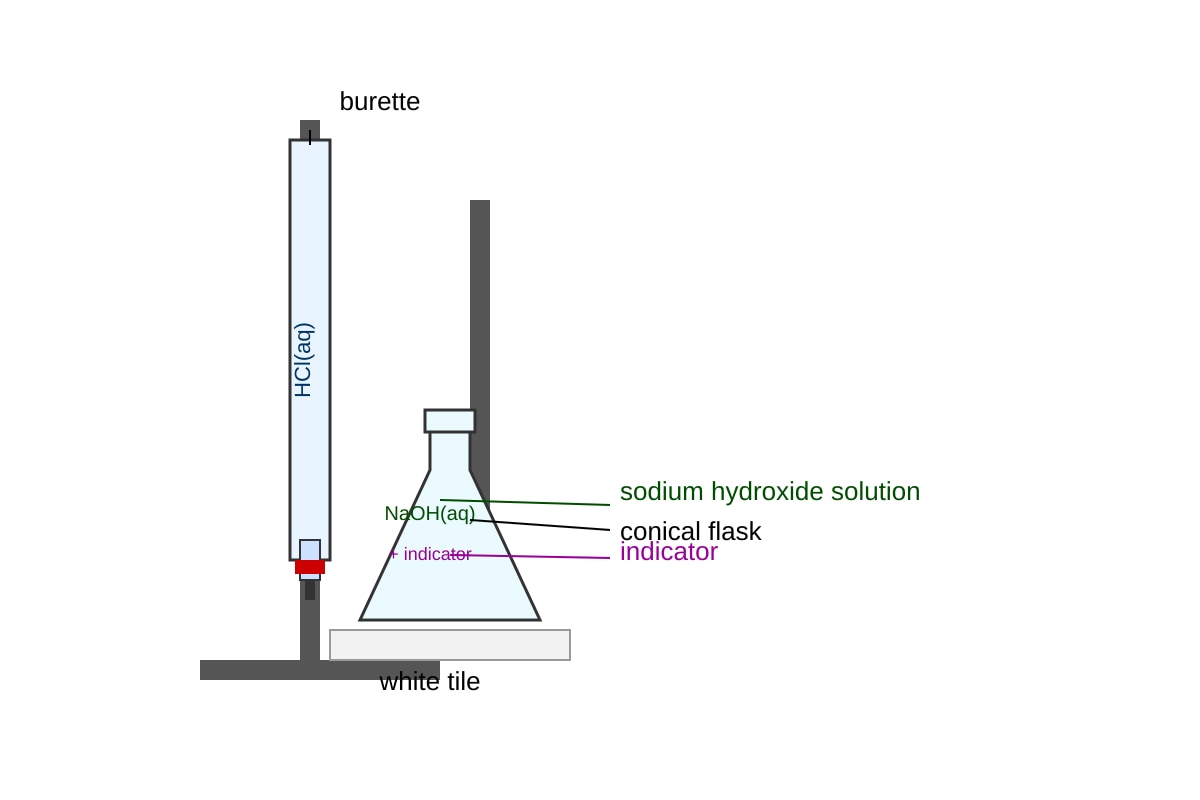
9. The diagram below shows the setup used to prepare a soluble salt by titration.
Image pending generation: experimental_setup for Q9.
(a) Name the indicator that would be suitable for a strong acid–strong base titration. [1]
(b) Describe the colour change at the end point. [1]
(c) Why is a white tile used? [1]
10. A student recorded the following titration volumes of acid R needed to neutralise 25.0 cm³ of sodium hydroxide:
| Trial | Volume of R / cm³ |
|---|---|
| 1 (rough) | 22.5 |
| 2 | 21.8 |
| 3 | 21.9 |
| 4 | 21.7 |
Calculate the average volume of R required for complete neutralisation. [2]
11. Using the average volume from Q10, calculate the number of moles of acid R in 1.00 dm³ of solution if its concentration is 0.100 mol/dm³. [2]
12. Zinc oxide is an amphoteric oxide.
(a) Write a balanced equation for its reaction with hydrochloric acid. [2]
(b) Write a balanced equation for its reaction with sodium hydroxide solution. [2]
13. The table shows pH values of solutions A–D.
| Solution | pH |
|---|---|
| A | 2 |
| B | 7 |
| C | 11 |
| D | 5 |
(a) Which solution is strongest acid? [1]
(b) Which solution is alkaline? [1]
(c) State what happens to the pH when an acid is added to solution B. [1]
14. A student prepares copper(II) sulfate by adding excess copper(II) oxide to sulfuric acid.
(a) Why is copper(II) oxide added in excess? [1]
(b) Name the method used to remove the excess solid. [1]
(c) State how the salt is obtained from the filtrate. [1]
Section C: Extended Calculation and Explanation (Questions 15–20) [20 marks]
15. 25.0 cm³ of 0.200 mol/dm³ hydrochloric acid is neutralised by 20.0 cm³ of sodium hydroxide solution. Calculate the concentration of the sodium hydroxide solution in mol/dm³. [3]
16. Explain why calcium carbonate is used to treat acidic soil and write the equation for its reaction with acid rain (assume acid rain contains sulfuric acid). [3]
17. A sample of 5.00 g of impure sodium carbonate reacts with excess hydrochloric acid. The produced gas is measured as 0.896 dm³ at room temperature and pressure (molar volume = 24.0 dm³/mol). Calculate the percentage purity of the sodium carbonate. [4]
18. State and explain two differences between a strong acid and a concentrated acid. [3]
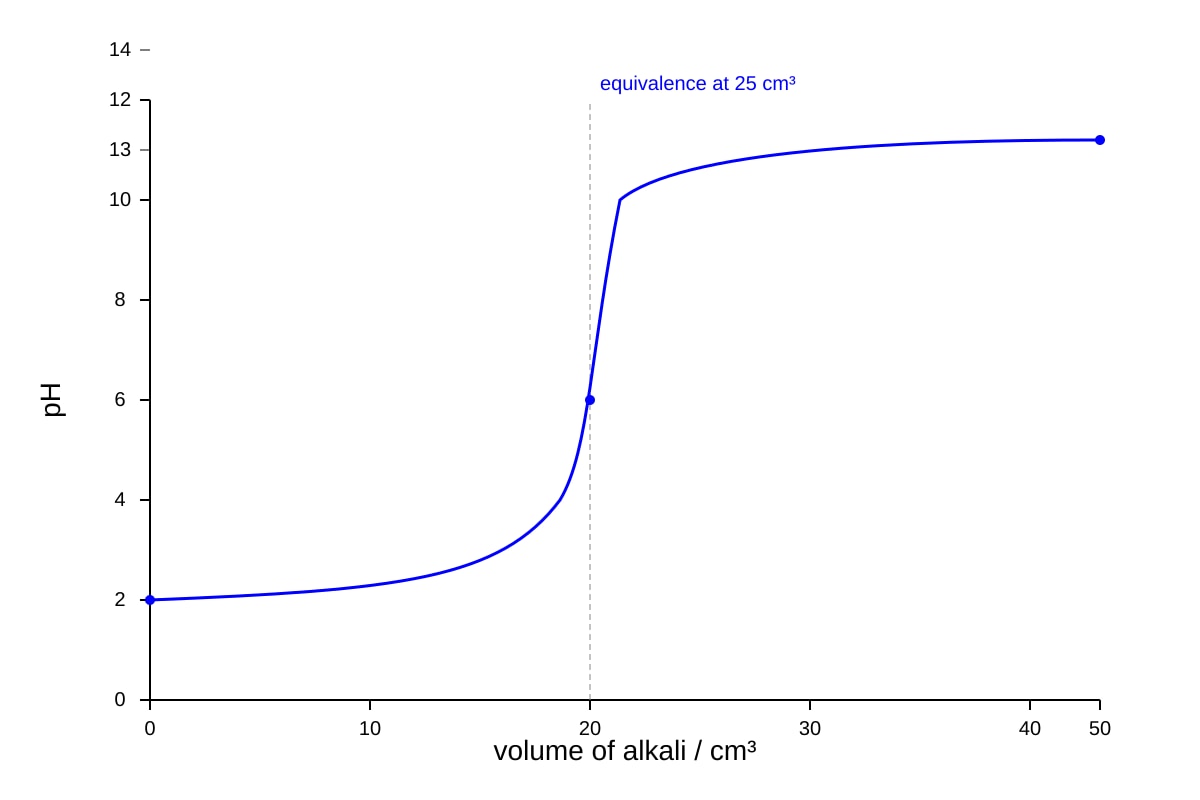
19. The following graph shows pH change during titration of acid with alkali.
Image pending generation: graph for Q19.
(a) What volume of alkali gives neutralisation? [1]
(b) Deduce the original pH of the acid. [1]
(c) State the type of titration (strong acid–strong base / weak acid–strong base / strong acid–weak base). [1]
20. A student suggests using potassium hydroxide to neutralise a spill of sulfuric acid in a lake. Discuss whether this is a suitable method, giving two chemical reasons. [3]
Answers
TuitionGoWhere Exam Practice (AI) — SA2 Practice Paper Answer Key
Secondary 3 Chemistry — Acids, Bases & Salts (Version 2 of 5)
Total Marks: 60
Section A Answers (16 marks)
1. Calcium oxide / CaO (or calcium hydroxide / Ca(OH)₂, or calcium carbonate / CaCO₃) [1]
Teaching note: Acidic soil has pH < 7. To increase pH we add a base (alkaline solid). Common soil amendments are CaO, Ca(OH)₂, CaCO₃. Trap: do not name NaCl (neutral salt).
2. Ammonia (NH₃) and an acid e.g. hydrochloric acid (HCl) [1]
Teaching note: Ammonium salts form from NH₃ (or NH₄OH) + acid. Example: NH₃ + HCl → NH₄Cl. Trap: must name both reactants.
3. Red [1]
Teaching note: Universal indicator in strong acid (pH 1–3) shows red.
4. KNO₃ [1]
Teaching note: HNO₃ + KOH → KNO₃ + H₂O. Salt = metal from base + nitrate from acid.
5. C. Al₂O₃ [1]
Teaching note: Amphoteric oxides react with both acids and alkalis. Al₂O₃ is amphoteric; Na₂O basic; SO₂/CO₂ acidic.
6. Calcium oxide is less soluble / cheaper / safer (less caustic) than NaOH [1]
Teaching note: NaOH is highly soluble and corrosive; CaO is safer for fields.
7. H⁺(aq) + OH⁻(aq) → H₂O(l) [1]
Teaching note: Net ionic equation for neutralisation.
8. Alkaline [1]
Teaching note: pH > 7 is alkaline.
Section B Answers (24 marks)
9.
(a) Phenolphthalein (or methyl orange) [1]
(b) Colourless to pink (if phenolphthalein) [1]
(c) To help see colour change clearly [1]
10. Concordant: 21.8, 21.9, 21.7 (exclude rough 22.5). Average = (21.8+21.9+21.7)/3 = 65.4/3 = 21.8 cm³ [2]
Mark: 1 for identifying concordant, 1 for correct avg with unit.
11. n = c × V = 0.100 mol/dm³ × 1.00 dm³ = 0.100 mol [2]
Mark: 1 formula, 1 answer with unit.
12.
(a) ZnO + 2HCl → ZnCl₂ + H₂O [2]
(b) ZnO + 2NaOH → Na₂ZnO₂ + H₂O (or ZnO + 2NaOH + H₂O → Na₂[Zn(OH)₄]) [2]
Mark: 1 each equation balanced.
13.
(a) A [1] (b) C [1] (c) pH decreases [1]
14.
(a) To ensure all acid reacts [1]
(b) Filtration [1]
(c) Evaporation / crystallisation [1]
Section C Answers (20 marks)
15. HCl + NaOH → NaCl + H₂O (1:1)
n(HCl) = 0.200 × (25.0/1000) = 0.00500 mol
n(NaOH) = 0.00500 mol
c(NaOH) = 0.00500 / (20.0/1000) = 0.250 mol/dm³ [3]
Mark: 1 moles acid, 1 moles base, 1 concentration.
16. CaCO₃ neutralises acid: CaCO₃ + H₂SO₄ → CaSO₄ + CO₂ + H₂O [3]
Mark: 1 use, 1 equation, 1 explanation (raises pH, mild).
17. n(CO₂) = 0.896/24.0 = 0.0373 mol
Na₂CO₃ + 2HCl → 2NaCl + CO₂ + H₂O, so n(Na₂CO₃) = 0.0373 mol
M(Na₂CO₃) = 106 g/mol, mass = 0.0373×106 = 3.96 g
Purity = (3.96/5.00)×100 = 79.2% [4]
Mark: 1 gas moles, 1 stoich, 1 mass, 1 %.
18. Strong = fully dissociated; concentrated = high moles per dm³. They are independent. [3]
Mark: 1 def strong, 1 def concentrated, 1 independence.
19.
(a) 25 cm³ [1] (b) 2 [1] (c) strong acid–strong base [1]
20. KOH neutralises H₂SO₄ (2KOH + H₂SO₄ → K₂SO₄ + 2H₂O) but produces salt; may overshoot pH; costly. [3]
Mark: 1 reaction, 1 reason suitability, 1 reason limitation.
Free quiz and exam paper access
Enter your details to view this paper
Your access is remembered on this device.