From Real Exams Exam Paper
Secondary 3 Chemistry Semestral Assessment 2 (End of Year) Paper 1
Free Sec 3 Chemistry SA2 Paper 1, Nemo3 Exam version, with questions, answers, and O Level-style practice for Singapore students.
These static practice materials are generated from the site's syllabus and paper-generation workflow, with source and model context shown so students and parents can evaluate the material before use.
Questions
TuitionGoWhere Practice Paper - Chemistry Secondary 3
TuitionGoWhere Secondary School (AI)
Subject: Chemistry
Level: Secondary 3 (Express/G3)
Paper: SA2 Practice Paper Version 1
Duration: 1 hour 30 minutes
Total Marks: 60
Name: ________________________
Class: ________________________
Date: ________________________
Instructions to Candidates
- Write your name, class, and date in the spaces provided above.
- Answer all questions in the spaces provided.
- The number of marks is given in brackets [ ] at the end of each question or part question.
- The total marks for this paper is 60.
- You are advised to spend approximately 45 minutes on Section A and 45 minutes on Section B.
- A Periodic Table is provided on the last page.
- Show all working for calculation questions.
- Write chemical equations with state symbols where appropriate.
Section A: Structured Questions [30 marks]
Answer all questions in this section.
Question 1 [4 marks]
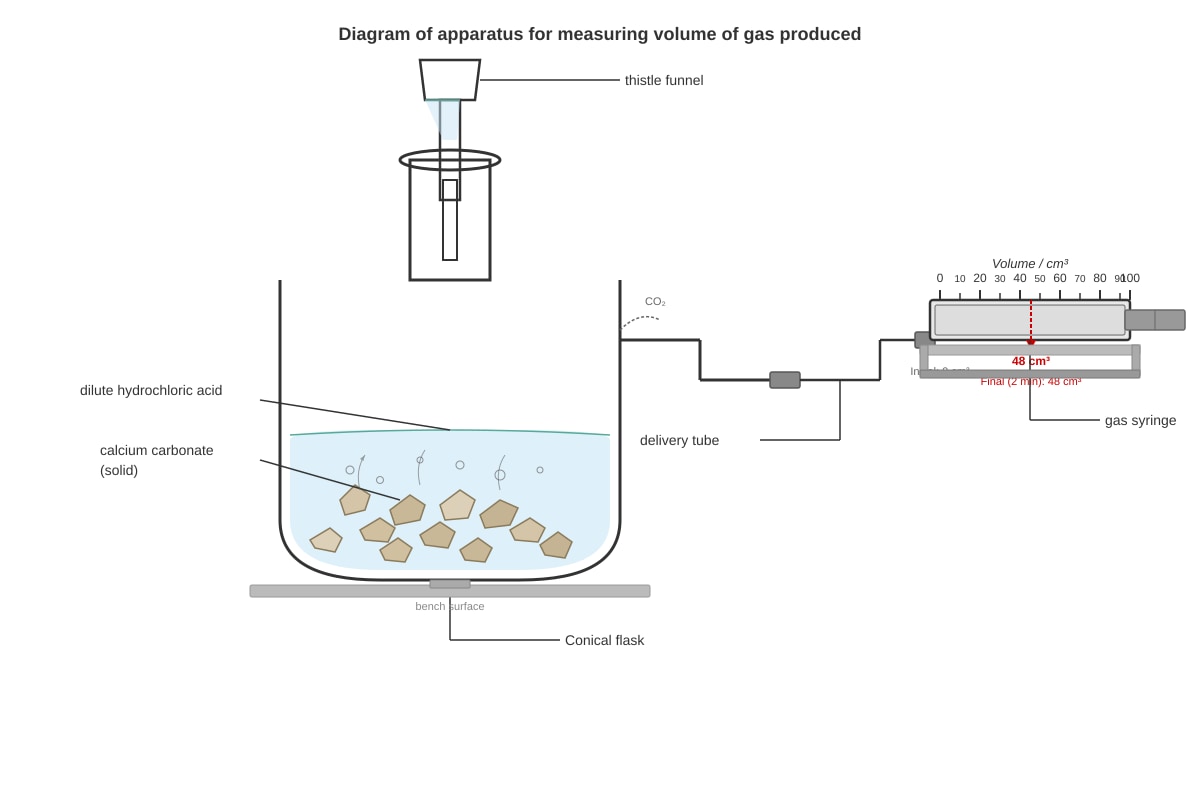
A student investigates the reaction between dilute hydrochloric acid and solid calcium carbonate. The apparatus shown below is used to measure the volume of gas produced.
<image_placeholder> id: Q1-fig1 type: experimental_setup linked_question: Q1 description: Gas syringe apparatus for measuring carbon dioxide evolution from reaction of calcium carbonate with hydrochloric acid. Conical flask with side-arm delivery tube connected to gas syringe. Calcium carbonate chips in flask, dilute HCl added via thistle funnel. labels: Conical flask, calcium carbonate (solid), dilute hydrochloric acid, delivery tube, gas syringe, volume markings on syringe (0-100 cm³) values: Initial gas syringe reading: 0 cm³; Final gas syringe reading after 2 minutes: 48 cm³ must_show: Gas syringe with clear volume scale, conical flask with solid chips, delivery tube connection, thistle funnel for acid addition </image_placeholder>
(a) Write a balanced chemical equation, with state symbols, for the reaction between calcium carbonate and dilute hydrochloric acid. [2]
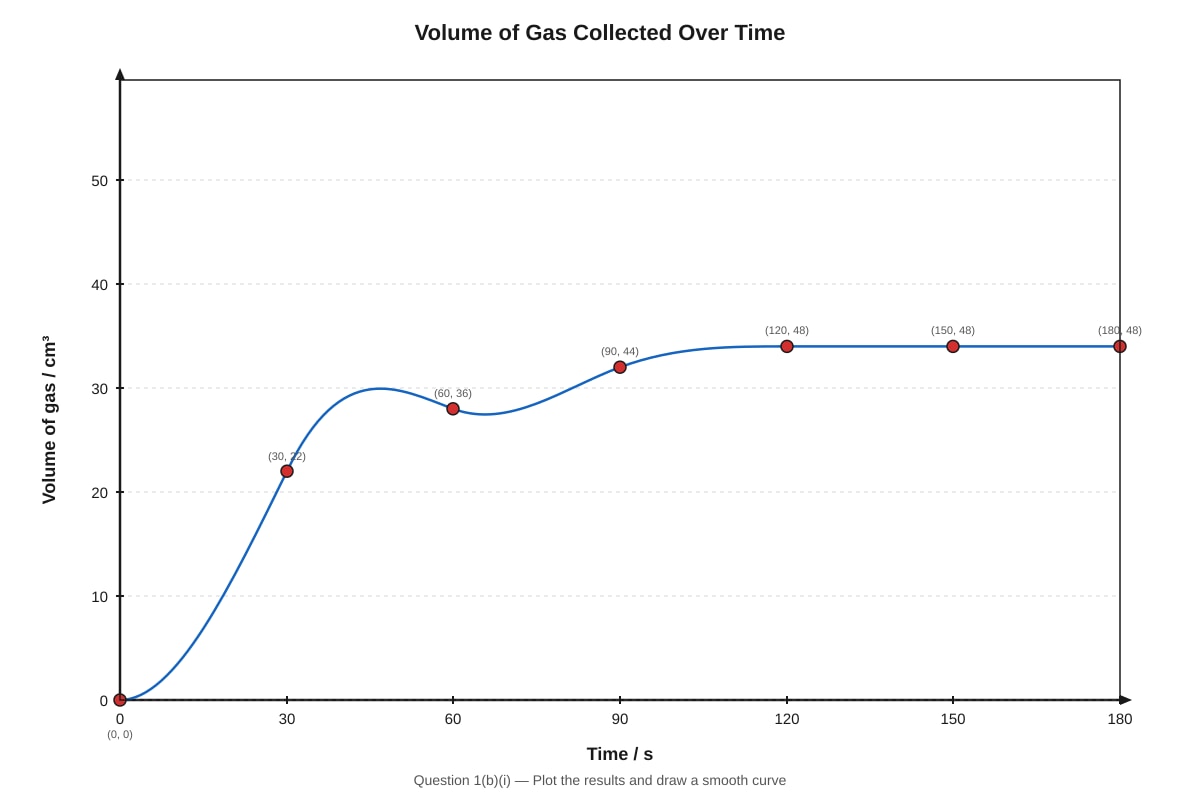
(b) The student records the volume of gas collected every 30 seconds. The results are shown in the table below.
| Time / s | 0 | 30 | 60 | 90 | 120 | 150 | 180 |
|---|---|---|---|---|---|---|---|
| Volume of gas / cm³ | 0 | 22 | 36 | 44 | 48 | 48 | 48 |
(i) Plot the results on the grid below and draw a smooth curve through the points. [1]
<image_placeholder> id: Q1-fig2 type: graph linked_question: Q1 description: Graph axes for plotting volume of gas vs time. X-axis: Time/s from 0 to 180. Y-axis: Volume of gas/cm³ from 0 to 50. labels: X-axis: Time / s (0, 30, 60, 90, 120, 150, 180); Y-axis: Volume of gas / cm³ (0, 10, 20, 30, 40, 50) values: Data points: (0,0), (30,22), (60,36), (90,44), (120,48), (150,48), (180,48) must_show: Labeled axes with appropriate scales, grid lines, plotted points, smooth curve through points </image_placeholder>
(ii) Use your graph to determine the average rate of reaction between 30 s and 90 s. Give your answer in cm³/s. [1]
Question 2 [5 marks]
Ammonium sulfate, (NH₄)₂SO₄, is a common fertiliser. It can be prepared by the reaction between aqueous ammonia and dilute sulfuric acid.
(a) Write the balanced chemical equation, with state symbols, for the preparation of ammonium sulfate from aqueous ammonia and dilute sulfuric acid. [2]
(b) A student prepares a sample of ammonium sulfate crystals using 25.0 cm³ of 1.00 mol/dm³ sulfuric acid and excess aqueous ammonia.
(i) Calculate the number of moles of sulfuric acid used. [1]
(ii) Hence, calculate the theoretical mass of ammonium sulfate that can be obtained. [1]
(iii) The student obtains 2.85 g of dry ammonium sulfate crystals. Calculate the percentage yield. [1]
Question 3 [6 marks]
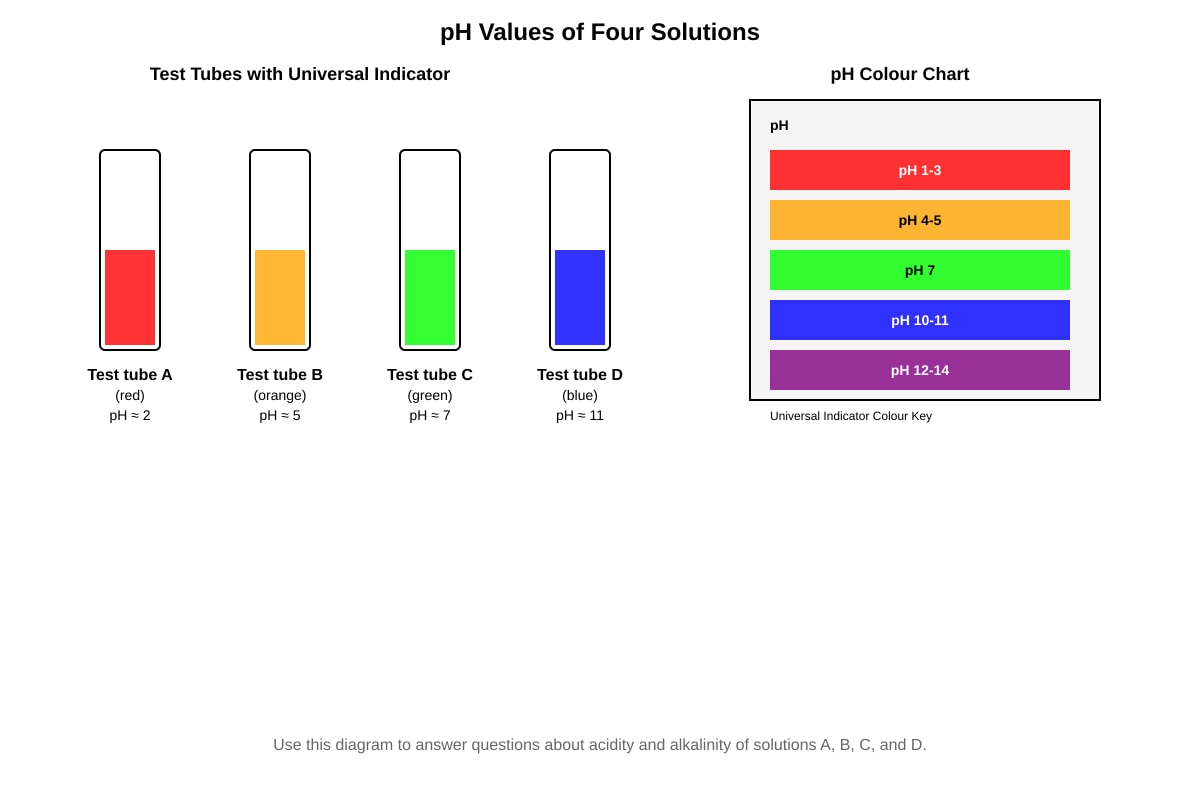
The diagram below shows the pH values of four solutions, A, B, C, and D.
<image_placeholder> id: Q3-fig1 type: diagram linked_question: Q3 description: Four test tubes labeled A, B, C, D with universal indicator showing different colours. pH chart alongside showing colour-pH correlation. labels: Test tube A (red), Test tube B (orange), Test tube C (green), Test tube D (blue); pH colour chart: red=1-3, orange=4-5, green=7, blue=10-11 values: Approximate pH values: A ≈ 2, B ≈ 5, C ≈ 7, D ≈ 11 must_show: Four test tubes with distinct universal indicator colours, pH colour reference chart </image_placeholder>
(a) Identify which solution(s) is/are: (i) strongly acidic [1] (ii) weakly acidic [1] (iii) neutral [1] (iv) strongly alkaline [1]
(b) Solution A is hydrochloric acid. Solution D is sodium hydroxide. When equal volumes of Solution A and Solution D of the same concentration are mixed, the resulting solution has a pH of 7. Explain why. [2]
Question 4 [5 marks]
A student carries out a titration to determine the concentration of a solution of sodium hydroxide. She uses 25.0 cm³ of 0.100 mol/dm³ hydrochloric acid and a burette filled with the sodium hydroxide solution. Phenolphthalein indicator is used.
(a) State the colour change observed at the end-point. [1]
(b) The student repeats the titration three times. Her burette readings are shown below.
| Titration | 1 | 2 | 3 |
|---|---|---|---|
| Final reading / cm³ | 24.50 | 24.30 | 24.45 |
| Initial reading / cm³ | 0.20 | 0.10 | 0.25 |
| Volume used / cm³ | 24.30 | 24.20 | 24.20 |
(i) Complete the table by calculating the volume used for each titration. [1]
(ii) Calculate the average volume of sodium hydroxide used, ignoring any anomalous result. [1]
(iii) Calculate the concentration of the sodium hydroxide solution in mol/dm³. [2]
Question 5 [5 marks]
Lead(II) sulfate, PbSO₄, is an insoluble salt. It can be prepared by precipitation.
(a) Name two suitable aqueous solutions that can be mixed to prepare lead(II) sulfate by precipitation. [1]
(b) Write the ionic equation, with state symbols, for the precipitation of lead(II) sulfate. [2]
(c) Describe the procedure to obtain a pure, dry sample of lead(II) sulfate from the reaction mixture. [2]
Question 6 [5 marks]
The table below shows the observations when three different metals, X, Y, and Z, are added to dilute hydrochloric acid and to cold water.
| Metal | Reaction with dilute HCl | Reaction with cold water |
|---|---|---|
| X | Vigorous effervescence, gas pops with lighted splint | No reaction |
| Y | Steady effervescence, gas pops with lighted splint | Very slow reaction, gas pops with lighted splint |
| Z | No reaction | No reaction |
(a) Identify the gas produced in the reactions with dilute HCl. [1]
(b) Arrange metals X, Y, and Z in order of reactivity, starting with the most reactive. [1]
(c) Metal Y is magnesium. Write the balanced chemical equation, with state symbols, for the reaction of magnesium with dilute hydrochloric acid. [1]
(d) Explain why metal Z does not react with dilute hydrochloric acid. [1]
(e) Metal X reacts with steam to form a black solid and the same gas as in (a). Name the black solid. [1]
Section B: Free Response Questions [30 marks]
Answer all questions in this section.
Question 7 [8 marks]
A student investigates the neutralisation reaction between sodium hydroxide and hydrochloric acid using a temperature change method.
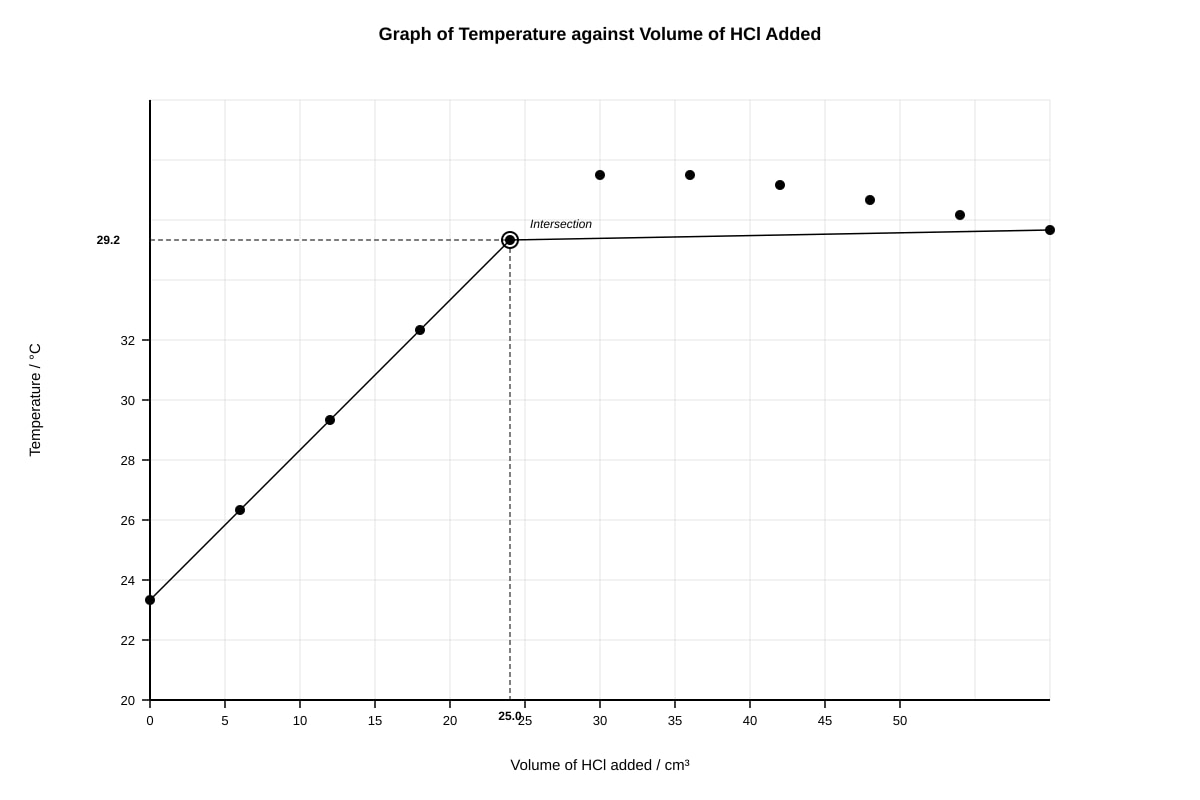
The student places 50.0 cm³ of 1.00 mol/dm³ sodium hydroxide in a polystyrene cup and measures its initial temperature. She then adds 5.0 cm³ portions of 1.00 mol/dm³ hydrochloric acid, stirs, and records the temperature after each addition. The results are shown below.
| Volume of HCl added / cm³ | 0 | 5.0 | 10.0 | 15.0 | 20.0 | 25.0 | 30.0 | 35.0 | 40.0 | 45.0 | 50.0 |
|---|---|---|---|---|---|---|---|---|---|---|---|
| Temperature / °C | 22.0 | 23.8 | 25.6 | 27.4 | 29.2 | 30.5 | 30.5 | 30.3 | 30.0 | 29.7 | 29.4 |
(a) Plot a graph of temperature against volume of HCl added on the grid below. Draw two straight lines of best fit and extrapolate them to find the intersection point. [3]
<image_placeholder> id: Q7-fig1 type: graph linked_question: Q7 description: Graph axes for temperature vs volume of HCl added. X-axis: Volume of HCl added/cm³ from 0 to 50. Y-axis: Temperature/°C from 20 to 32. labels: X-axis: Volume of HCl added / cm³ (0, 5, 10, 15, 20, 25, 30, 35, 40, 45, 50); Y-axis: Temperature / °C (20, 22, 24, 26, 28, 30, 32) values: Data points as per table above must_show: Labeled axes with appropriate scales, plotted points, two straight lines of best fit (rising and falling), intersection point clearly marked </image_placeholder>
(b) From your graph, determine the volume of HCl required for complete neutralisation. [1]
(c) Calculate the heat energy released during the neutralisation, assuming the specific heat capacity of the solution is 4.2 J/g°C and the density is 1.0 g/cm³. [2]
(d) Calculate the molar enthalpy change of neutralisation, ΔHₙ, in kJ/mol. [2]
Question 8 [7 marks]
Copper(II) oxide is a basic oxide. It reacts with nitric acid to form copper(II) nitrate.
(a) Write the balanced chemical equation, with state symbols, for the reaction between copper(II) oxide and dilute nitric acid. [2]
(b) A student adds excess copper(II) oxide to 50.0 cm³ of 0.500 mol/dm³ nitric acid. The mixture is heated and stirred until no more solid dissolves.
(i) Explain why excess copper(II) oxide is used. [1]
(ii) Calculate the maximum mass of copper(II) nitrate trihydrate, Cu(NO₃)₂·3H₂O, that can be obtained. [Relative formula mass: Cu(NO₃)₂·3H₂O = 241.6] [2]
(iii) Describe how the student can obtain pure, dry crystals of copper(II) nitrate trihydrate from the reaction mixture. [2]
Question 9 [8 marks]
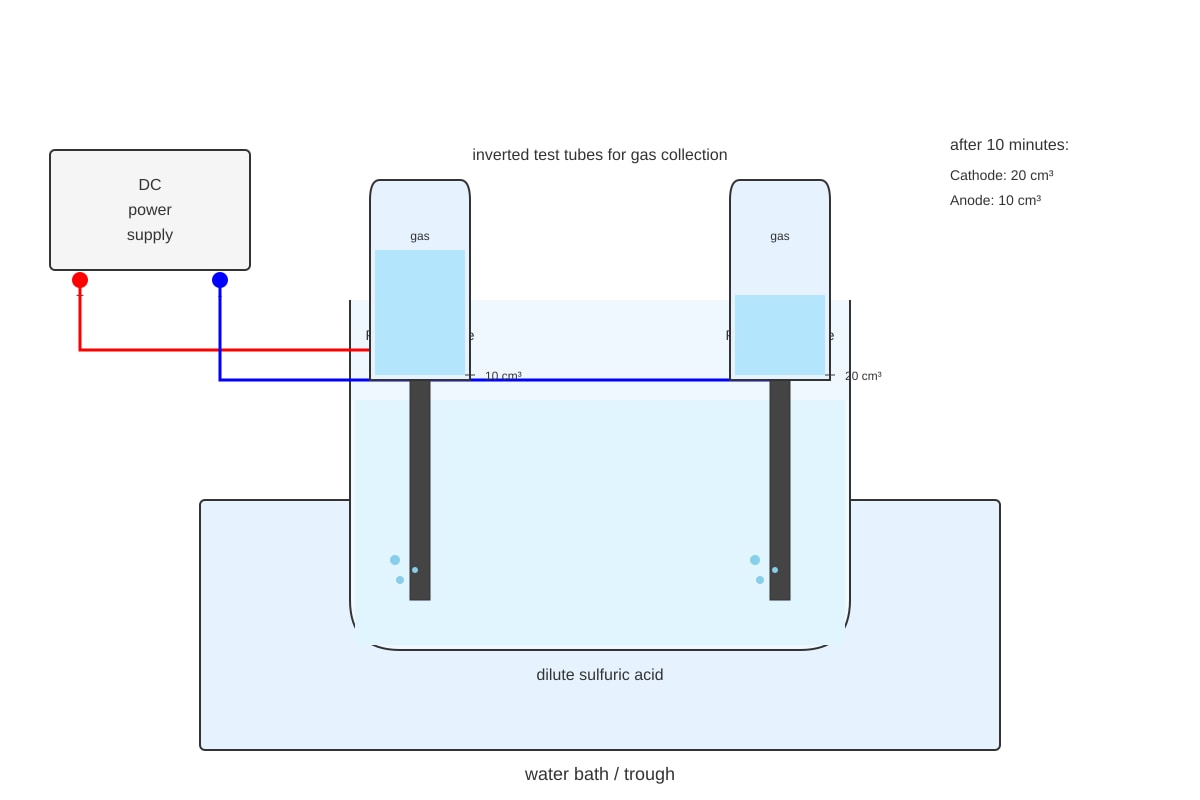
The diagram below shows the set-up for the electrolysis of dilute sulfuric acid using inert electrodes.
<image_placeholder> id: Q9-fig1 type: experimental_setup linked_question: Q9 description: Electrolysis apparatus for dilute sulfuric acid. Two platinum/graphite electrodes in a beaker of dilute H₂SO₄, connected to DC power supply. Gas collection via inverted test tubes over each electrode. labels: Platinum/graphite anode (+), platinum/graphite cathode (-), dilute sulfuric acid, DC power supply, inverted test tubes for gas collection, water bath/trough values: Volume of gas at cathode after 10 minutes: 20 cm³; Volume of gas at anode after 10 minutes: 10 cm³ must_show: Complete electrolysis circuit, electrodes in solution, gas collection tubes with volume markings, polarity labels </image_placeholder>
(a) Write the half-equation for the reaction at the cathode. [1]
(b) Write the half-equation for the reaction at the anode. [1]
(c) Name the gases collected at the cathode and anode. [1]
(d) Explain why the volume of gas collected at the cathode is twice the volume collected at the anode. [2]
(e) After electrolysis, the solution around the anode becomes acidic. Explain why. [1]
(f) If concentrated hydrochloric acid is used instead of dilute sulfuric acid, name the gas produced at the anode. [1]
(g) State one safety precaution when carrying out this electrolysis. [1]
Question 10 [7 marks]
A student is given three unlabelled bottles containing solid salts: sodium chloride, calcium carbonate, and ammonium chloride. She carries out the following tests on each salt.
Test 1: Add dilute hydrochloric acid to a small amount of each solid. Observe any gas evolution.
Test 2: Heat a small amount of each solid strongly in a test tube. Observe any changes.
Test 3: Dissolve a small amount of each solid in water and test the pH of the solution.
The results are shown below.
| Salt | Test 1 (dilute HCl) | Test 2 (strong heating) | Test 3 (pH of solution) |
|---|---|---|---|
| P | No visible reaction | No visible change | pH 7 |
| Q | Effervescence, gas turns limewater milky | Decomposes, gas turns limewater milky, white solid remains | pH 9 |
| R | No visible reaction | Sublimes, white fumes form, condenses on cooler parts of tube | pH 5 |
(a) Identify salts P, Q, and R. [3]
(b) Write the balanced chemical equation, with state symbols, for the reaction of salt Q with dilute hydrochloric acid. [1]
(c) Write the balanced chemical equation, with state symbols, for the thermal decomposition of salt Q. [1]
(d) Explain why the solution of salt R has a pH of 5. [2]
End of Paper
Periodic Table (Selected Elements)
| Group → | 1 | 2 | 13 | 14 | 15 | 16 | 17 | 18 |
|---|---|---|---|---|---|---|---|---|
| Period 1 | H | He | ||||||
| Period 2 | Li | Be | B | C | N | O | F | Ne |
| Period 3 | Na | Mg | Al | Si | P | S | Cl | Ar |
| Period 4 | K | Ca | Ga | Ge | As | Se | Br | Kr |
Relative Atomic Masses: H=1, He=4, Li=7, Be=9, B=11, C=12, N=14, O=16, F=19, Ne=20, Na=23, Mg=24, Al=27, Si=28, P=31, S=32, Cl=35.5, Ar=40, K=39, Ca=40, Cu=63.5, Zn=65, Pb=207
Answers
TuitionGoWhere Practice Paper - Chemistry Secondary 3 SA2 Version 1 - Answer Key
Total Marks: 60
Section A: Structured Questions [30 marks]
Question 1 [4 marks]
(a) CaCO₃(s) + 2HCl(aq) → CaCl₂(aq) + H₂O(l) + CO₂(g) [2]
Marking: 1 mark for correct formulae of all reactants and products with correct state symbols; 1 mark for correct balancing.
Common mistakes: Missing state symbols; writing CO₂ as (aq) instead of (g); incorrect balancing (e.g., forgetting the 2 in front of HCl).
(b)(i) Graph plotted correctly with:
- Axes labeled with units and appropriate scales [1]
- All 7 points plotted accurately [1]
- Smooth curve through points showing initial steep rise then plateau [1]
[Note: In this answer key, the graph description replaces the actual drawn graph. Students should draw on the provided grid.]
(b)(ii) Average rate = (Volume at 90 s – Volume at 30 s) / (90 – 30)
= (44 – 22) / 60
= 22 / 60
= 0.367 cm³/s (or 0.37 cm³/s) [1]
Teaching note: Average rate over a time interval = change in volume / change in time. The reaction slows down as reactants areactant is used up, so the curve flattens.
Question 2 [5 marks]
(a) 2NH₃(aq) + H₂SO₄(aq) → (NH₄)₂SO₄(aq) [2]
Marking: 1 mark for correct formulae with state symbols; 1 mark for balancing.
(b)(i) Moles of H₂SO₄ = concentration × volume (in dm³)
= 1.00 mol/dm³ × (25.0 / 1000) dm³
= 0.0250 mol [1]
(b)(ii) Mole ratio H₂SO₄ : (NH₄)₂SO₄ = 1 : 1
Moles of (NH₄)₂SO₄ = 0.0250 mol
Molar mass of (NH₄)₂SO₄ = 2(14+4) + 32 + 4(16) = 132 g/mol
Theoretical mass = 0.0250 × 132 = 3.30 g [1]
(b)(iii) Percentage yield = (actual yield / theoretical yield) × 100%
= (2.85 / 3.30) × 100%
= 86.4% [1]
Teaching note: Percentage yield is always ≤ 100%. Common errors: using wrong molar mass, not converting cm³ to dm³, or inverting the yield fraction.
Question 3 [6 marks]
(a)(i) Solution A (pH ≈ 2) [1]
(a)(ii) Solution B (pH ≈ 5) [1]
(a)(iii) Solution C (pH ≈ 7) [1]
(a)(iv) Solution D (pH ≈ 11) [1]
Teaching note: Universal indicator colours: Red = strongly acidic (pH 1-3), Orange/Yellow = weakly acidic (pH 4-6), Green = neutral (pH 7), Blue/Purple = alkaline (pH 8-14).
(b) Hydrochloric acid is a strong acid (fully dissociated: HCl → H⁺ + Cl⁻). Sodium hydroxide is a strong base (fully dissociated: NaOH → Na⁺ + OH⁻). When equal volumes of same concentration are mixed, moles of H⁺ = moles of OH⁻. They react completely: H⁺(aq) + OH⁻(aq) → H₂O(l). The resulting solution contains only NaCl(aq), a neutral salt from strong acid + strong base, which does not hydrolyse. Hence pH = 7. [2]
Marking: 1 mark for identifying complete neutralisation (H⁺ = OH⁻); 1 mark for explaining resulting salt is neutral (no hydrolysis).
Question 4 [5 marks]
(a) Colourless to pink (or pale pink) [1]
Teaching note: Phenolphthalein is colourless in acid/neutral, pink in alkali. At end-point, slight excess NaOH turns it pink.
(b)(i) Volumes used:
Titration 1: 24.50 – 0.20 = 24.30 cm³
Titration 2: 24.30 – 0.10 = 24.20 cm³
Titration 3: 24.45 – 0.25 = 24.20 cm³ [1]
(b)(ii) Titration 1 (24.30) is anomalous (differs by 0.10 cm³ from the other two concordant titres).
Average volume = (24.20 + 24.20) / 2 = 24.20 cm³ [1]
Teaching note: Concordant titres are those within 0.10 cm³ (or 0.20 cm³ depending on school policy). Always ignore anomalous results when averaging.
(b)(iii) Reaction: HCl(aq) + NaOH(aq) → NaCl(aq) + H₂O(l)
Mole ratio = 1 : 1
Moles HCl = 0.100 × (25.0/1000) = 0.00250 mol
Moles NaOH = 0.00250 mol (1:1 ratio)
Concentration NaOH = moles / volume (dm³) = 0.00250 / (24.20/1000) = 0.103 mol/dm³ [2]
Marking: 1 mark for correct moles of HCl; 1 mark for correct concentration calculation with units.
Question 5 [5 marks]
(a) Any soluble lead(II) salt (e.g., lead(II) nitrate, Pb(NO₃)₂) and any soluble sulfate (e.g., sodium sulfate, Na₂SO₄, or sulfuric acid, H₂SO₄) [1]
Teaching note: Both reactants must be aqueous/soluble. Lead(II) nitrate + sodium sulfate is the classic school preparation.
(b) Pb²⁺(aq) + SO₄²⁻(aq) → PbSO₄(s) [2]
Marking: 1 mark for correct ions with state symbols; 1 mark for correct product with (s) state symbol. Spectator ions (Na⁺, NO₃⁻) must not appear.
(c) 1. Filter the reaction mixture to collect the precipitate (PbSO₄) as residue. [1]
2. Wash the residue with distilled water to remove soluble impurities. [1]
3. Dry the residue between filter papers / in a low-temperature oven / in a desiccator. [1]
Marking: Any 2 of the 3 steps for 2 marks. Must mention filtration, washing with distilled water, and drying.
Question 6 [5 marks]
(a) Hydrogen (H₂) [1]
Test: Lighted splint gives a 'pop' sound.
(b) X > Y > Z (most reactive to least reactive) [1]
Reasoning: X reacts vigorously with dilute HCl but not cold water → above Mg but below Ca in reactivity series. Y (Mg) reacts steadily with HCl and slowly with cold water. Z reacts with neither → below H in reactivity series (e.g., Cu, Ag, Au).
(c) Mg(s) + 2HCl(aq) → MgCl₂(aq) + H₂(g) [1]
(d) Metal Z is less reactive than hydrogen / lies below hydrogen in the reactivity series. It cannot displace hydrogen from acids. [1]
(e) Copper(II) oxide (CuO) [1]
Teaching note: Metal X is likely copper (reacts with steam but not cold water or dilute HCl). Cu(s) + H₂O(g) → CuO(s) + H₂(g). The black solid is CuO.
Section B: Free Response Questions [30 marks]
Question 7 [8 marks]
(a) Graph with:
- Axes labeled, correct scales [1]
- All 11 points plotted accurately [1]
- Two straight lines of best fit: rising (0–25 cm³) and falling (25–50 cm³), extrapolated to intersect [1]
[Note: Students draw on provided grid. The intersection should be at 25.0 cm³ HCl added, 30.5°C.]
(b) Volume of HCl for complete neutralisation = 25.0 cm³ (from intersection of extrapolated lines) [1]
Teaching note: The intersection method eliminates heat loss errors. At equivalence point, moles HCl = moles NaOH. Since concentrations are equal (1.00 M), volumes are equal: 25.0 cm³ NaOH requires 25.0 cm³ HCl.
(c) Total volume at neutralisation = 50.0 + 25.0 = 75.0 cm³
Mass of solution = 75.0 g (density 1.0 g/cm³)
Temperature rise ΔT = 30.5 – 22.0 = 8.5°C
Heat energy released = m × c × ΔT = 75.0 × 4.2 × 8.5 = 2677.5 J (or 2.68 kJ) [2]
Marking: 1 mark for correct mass and ΔT; 1 mark for correct calculation with units.
(d) Moles of HCl used at neutralisation = 1.00 × (25.0/1000) = 0.0250 mol
Moles of water formed = 0.0250 mol (1:1 ratio)
ΔHₙ = – (heat released) / moles of water = –2677.5 / 0.0250 = –107,100 J/mol = –107 kJ/mol [2]
Marking: 1 mark for correct moles; 1 mark for correct ΔH with negative sign and units (kJ/mol).
Teaching note: ΔH is negative because heat is released (exothermic). Standard enthalpy of neutralisation for strong acid + strong base ≈ –57 kJ/mol. The higher value here is due to heat loss not fully compensated by the graphical method, or the approximation of specific heat capacity.
Question 8 [7 marks]
(a) CuO(s) + 2HNO₃(aq) → Cu(NO₃)₂(aq) + H₂O(l) [2]
Marking: 1 mark for correct formulae with state symbols; 1 mark for balancing.
(b)(i) To ensure all the nitric acid is completely reacted / used up. Copper(II) oxide is the limiting reagent in terms of the reaction going to completion; excess solid can be filtered off afterwards. [1]
(b)(ii) Moles HNO₃ = 0.500 × (50.0/1000) = 0.0250 mol
Mole ratio HNO₃ : Cu(NO₃)₂ = 2 : 1
Moles Cu(NO₃)₂ = 0.0250 / 2 = 0.0125 mol
Moles Cu(NO₃)₂·3H₂O = 0.0125 mol (1:1)
Mass = 0.0125 × 241.6 = 3.02 g [2]
Marking: 1 mark for correct moles of Cu(NO₃)₂; 1 mark for correct mass with units.
(b)(iii) 1. Filter the hot mixture to remove excess CuO (residue). [1]
2. Heat the filtrate to evaporate some water until saturated (crystallisation point). [1]
3. Cool the hot saturated solution to allow crystals to form. [1]
4. Filter to collect crystals, wash with cold distilled water, dry between filter papers. [1]
Marking: Any 2 of the 4 steps for 2 marks. Key steps: filter excess solid, evaporate to saturation, cool to crystallise, filter and dry crystals.
Question 9 [7 marks]
(a) 2H⁺(aq) + 2e⁻ → H₂(g) [1]
(b) 4OH⁻(aq) → O₂(g) + 2H₂O(l) + 4e⁻ [1]
Alternative: 2H₂O(l) → O₂(g) + 4H⁺(aq) + 4e⁻ (also acceptable for dilute H₂SO₄)
(c) Cathode: Hydrogen; Anode: Oxygen [1]
(d) At cathode: 2H⁺ + 2e⁻ → H₂ (2 moles e⁻ produce 1 mole H₂)
At anode: 4OH⁻ → O₂ + 2H₂O + 4e⁻ (4 moles e⁻ produce 1 mole O₂)
For the same quantity of electricity (same moles of electrons), moles of H₂ : moles of O₂ = 2 : 1.
Since equal moles of gas occupy equal volumes (Avogadro's law), volume H₂ : volume O₂ = 2 : 1. [2]
Marking: 1 mark for correct mole ratio of electrons to gas; 1 mark for linking to volume ratio via Avogadro's law.
(e) At anode, OH⁻ is discharged (4OH⁻ → O₂ + 2H₂O + 4e⁻), removing OH⁻ from solution. H⁺ from water dissociation (H₂O ⇌ H⁺ + OH⁻) remains, making the solution acidic. [1]
Teaching note: As OH⁻ is removed, equilibrium shifts right, increasing [H⁺].
(f) Chlorine (Cl₂) [1]
Reasoning: In concentrated HCl, Cl⁻ is discharged in preference to OH⁻: 2Cl⁻ → Cl₂ + 2e⁻.
(g) Carry out in a fume cupboard / well-ventilated area (gases produced may be toxic/flammable). OR: Do not use naked flames near the apparatus (hydrogen is flammable). [1]
Question 10 [7 marks]
(a) P = Sodium chloride (NaCl)
Q = Calcium carbonate (CaCO₃)
R = Ammonium chloride (NH₄Cl) [3]
Reasoning:
- P: No reaction with HCl (Cl⁻ not displaced), no decomposition on heating, neutral solution → NaCl.
- Q: Effervescence with HCl (CO₂), thermal decomposition gives CO₂ + CaO, solution pH 9 (CO₃²⁻ hydrolyses: CO₃²⁻ + H₂O ⇌ HCO₃⁻ + OH⁻) → CaCO₃.
- R: No reaction with HCl, sublimes on heating (NH₄Cl ⇌ NH₃ + HCl), solution pH 5 (NH₄⁺ hydrolyses: NH₄⁺ + H₂O ⇌ NH₃ + H₃O⁺) → NH₄Cl.
(b) CaCO₃(s) + 2HCl(aq) → CaCl₂(aq) + H₂O(l) + CO₂(g) [1]
(c) CaCO₃(s) → CaO(s) + CO₂(g) [1]
(d) Ammonium chloride dissolves to give NH₄⁺(aq) and Cl⁻(aq). The ammonium ion is the conjugate acid of a weak base (NH₃) and undergoes hydrolysis: NH₄⁺(aq) + H₂O(l) ⇌ NH₃(aq) + H₃O⁺(aq). This produces H₃O⁺, making the solution acidic (pH < 7). [2]
Marking: 1 mark for identifying NH₄⁺ hydrolysis; 1 mark for correct equilibrium equation or description of H⁺/H₃O⁺ production.
End of Answer Key