From Real Exams Exam Paper
Secondary 3 Chemistry Semestral Assessment 2 (End of Year) Paper 1
Free Sec 3 Chemistry SA2 Paper 1, HY3 Exam version, with questions, answers, and O Level-style practice for Singapore students.
These static practice materials are generated from the site's syllabus and paper-generation workflow, with source and model context shown so students and parents can evaluate the material before use.
Questions
TuitionGoWhere Practice Paper - Chemistry Secondary 3
TuitionGoWhere Secondary School (AI)
Subject: Chemistry
Level: Secondary 3
Paper: SA2 Practice Paper (Version 1 of 5)
Duration: 60 minutes
Total Marks: 60
Name: ___________________________
Class: ____________
Date: ____________
Instructions:
- Answer all questions in the spaces provided.
- Use blue or black pen.
- Show all working clearly for calculation questions.
- State units where required.
- The paper is divided into three sections: Section A (20 marks), Section B (20 marks), Section C (20 marks).
Section A: Multiple Choice and Short Answer (20 marks)
1. Which solid compound is added to acidic soil to increase its pH? [1]
2. Name two compounds that react together to form an ammonium salt. [1]
3. State the colour change when universal indicator is added to a solution of hydrochloric acid. [1]
4. Give the formula of the salt formed when nitric acid reacts with potassium hydroxide. [1]
5. Which of the following is an amphoteric compound? [1]
A. Sodium chloride
B. Zinc oxide
C. Copper(II) sulphate
D. Calcium carbonate
6. A farmer adds calcium oxide to his fields. State one reason why this raises soil pH. [1]
7. Write the ionic equation for the neutralisation of an acid by an alkali. [1]
8. Name the gas produced when hydrochloric acid reacts with sodium carbonate. [1]
9. State whether sulphuric acid is a strong or weak acid. [1]
10. What is the pH of a neutral solution at 25 °C? [1]
11. Which two reactants are needed to prepare lead(II) chloride by precipitation? [1]
12. State the name of the method used to obtain copper(II) sulphate crystals from its solution. [1]
13. Give one example of a weak base. [1]
14. Write the balanced chemical equation for the reaction between magnesium oxide and sulphuric acid. [1]
15. State the change in pH when an alkali is added to an acid during titration. [1]
16. Name the product formed when ammonia dissolves in water. [1]
17. Which ion is responsible for acidic properties? [1]
18. State the formula of calcium hydroxide. [1]
19. Give the name of the salt formed from the reaction of sulphuric acid and zinc. [1]
20. State one use of neutralisation in daily life. [1]
Section B: Structured and Data Interpretation (20 marks)
21. The table below shows the pH of four solutions.
| Solution | pH |
|---|---|
| P | 2 |
| Q | 7 |
| R | 9 |
| S | 13 |
(a) Which solution is the strongest acid? [1]
(b) Which solution is alkaline? [1]
(c) State what happens to the pH of solution P when a little sodium hydroxide is added. [1]
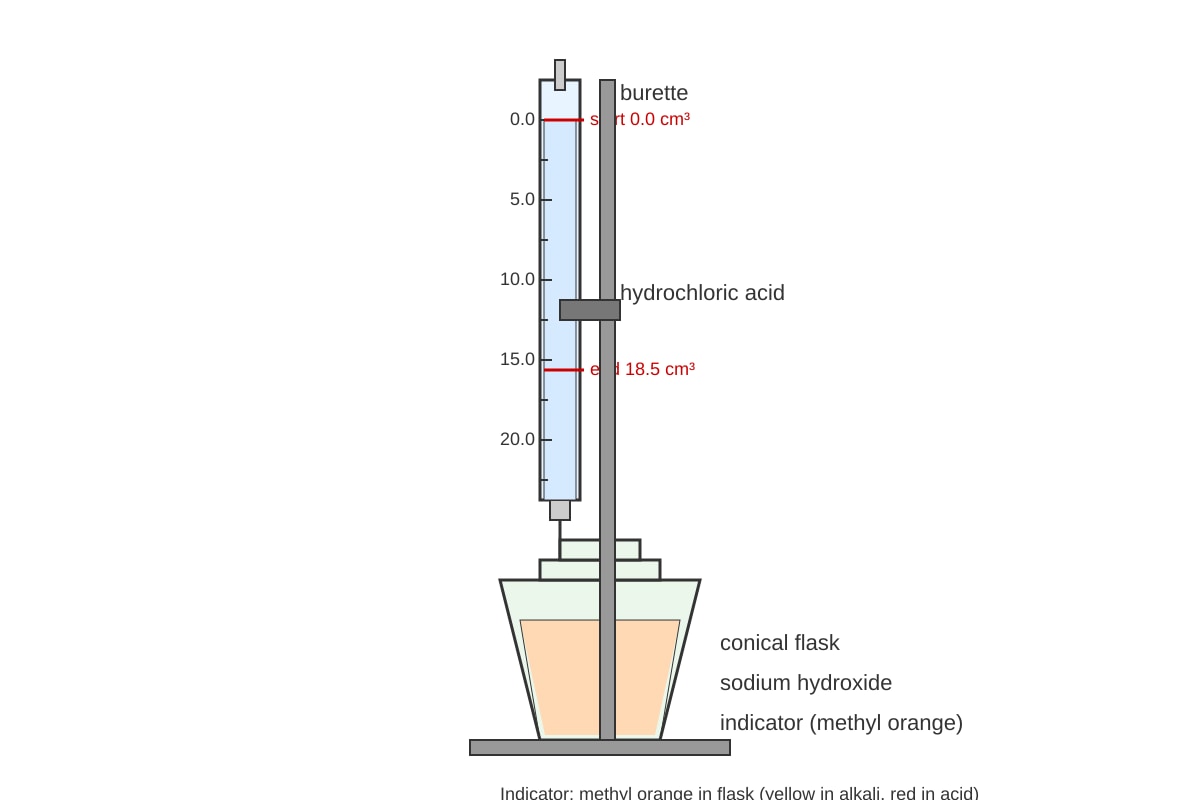
22. The diagram shows a titration setup.
Image pending generation: experimental_setup for 22.
(a) Name the indicator used if the solution turns from yellow to red. [1]
(b) Calculate the volume of acid used. [1]
(c) State the colour of the solution at the end point. [1]
23. A student collected the following titration volumes of acid R for neutralisation with alkali:
Rough: 21.4 cm³; Trial 1: 19.6 cm³; Trial 2: 19.5 cm³; Trial 3: 19.7 cm³.
(a) Identify the concordant results. [1]
(b) Calculate the average volume of R required. [1]
24. (a) Define an amphoteric substance. [1]
(b) Give one example and write equations to show it reacts with both HCl and NaOH. [3]
25. A sample of R has concentration 0.500 mol/dm³.
(a) Calculate the number of moles of acid in 1.00 dm³ of R. [1]
(b) Calculate the number of moles in 250 cm³ of R. [1]
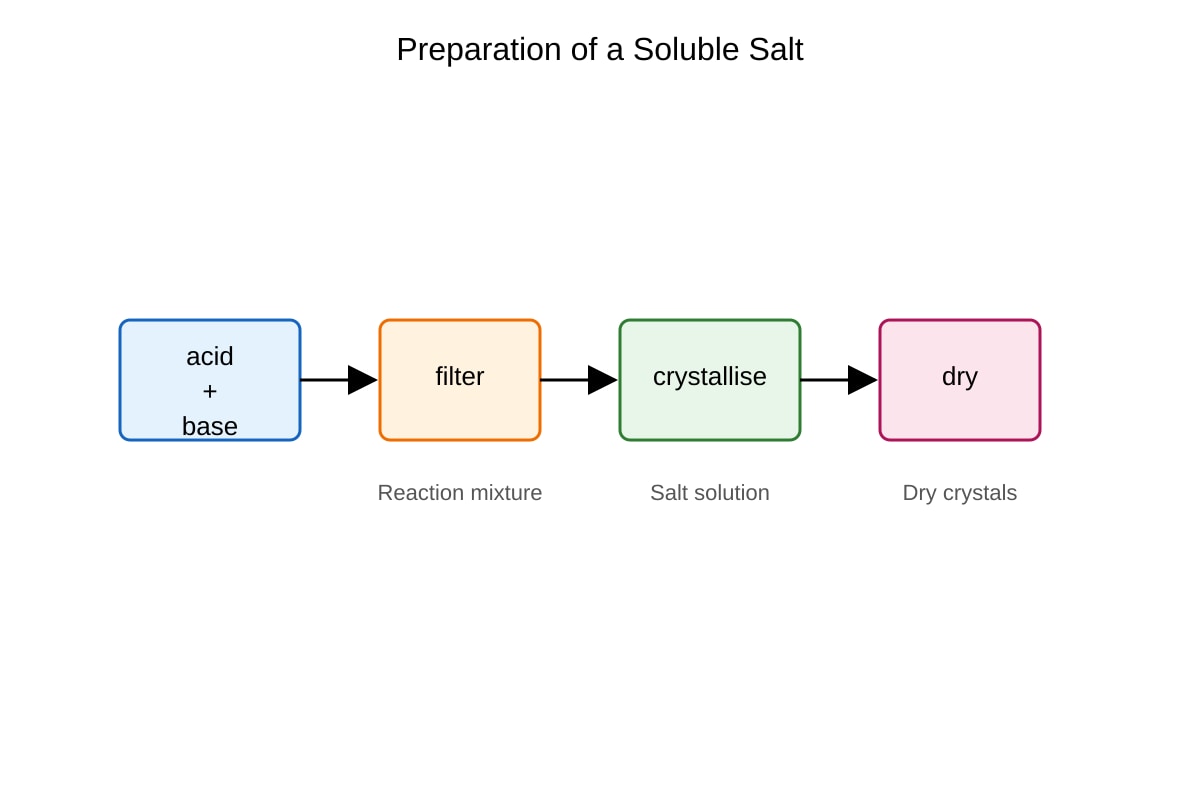
26. The flowchart shows preparation of a soluble salt.
Image pending generation: diagram for 26.
(a) Name the method of salt preparation shown. [1]
(b) Why is filtration needed? [1]
(c) How are crystals dried? [1]
Section C: Extended Response and Calculation (20 marks)
27. A farmer has soil of pH 4. He wants to raise it to pH 7.
(a) Name a solid compound he can add. [1]
(b) Explain how it increases pH. [2]
(c) Write an equation for its reaction with H⁺ ions. [1]
28. 25.0 cm³ of 0.100 mol/dm³ NaOH is neutralised by HCl of unknown concentration. 20.0 cm³ of HCl is used.
(a) Calculate moles of NaOH. [2]
(b) Calculate concentration of HCl. [2]
29. Compare the preparation of sodium chloride and lead(II) chloride.
(a) State method for sodium chloride. [1]
(b) State method for lead(II) chloride. [1]
(c) Explain why different methods are used. [2]
30. An industrial process uses neutralisation to treat waste acid.
(a) State why waste acid is harmful. [1]
(b) Name a base used to neutralise it. [1]
(c) Give one environmental benefit. [1]
(d) Write an equation for sulphuric acid with calcium carbonate. [1]
31. A student tests four solutions with pH meter and records:
| Solution | pH |
|---|---|
| A | 1 |
| B | 6 |
| C | 8 |
| D | 12 |
(a) Which is most acidic? [1]
(b) Which is closest to neutral? [1]
(c) State the colour of litmus in D. [1]
(d) Explain the difference between strong and concentrated acid. [2]
32. Zinc oxide is amphoteric.
(a) Write equation with hydrochloric acid. [1]
(b) Write equation with sodium hydroxide. [1]
(c) State what this shows about zinc oxide. [1]
(d) Name another amphoteric oxide. [1]
Answers
TuitionGoWhere Practice Paper - Chemistry Secondary 3 (Answers)
Version 1 of 5 — SA2 Practice
Section A Answers (20 marks)
1. Calcium oxide (CaO) / calcium hydroxide (Ca(OH)₂) / calcium carbonate (CaCO₃). [1]
Teaching note: Acidic soil has low pH; adding a base (solid) neutralises acid and raises pH. Common trap: naming NaCl (neutral salt).
2. Ammonia (NH₃) and an acid e.g. hydrochloric acid (HCl). [1]
Teaching note: Ammonium salts form from NH₃ + acid → ammonium salt. Trap: only one reactant named.
3. Red. [1]
Teaching note: Universal indicator in strong acid (pH 1–3) is red.
4. KNO₃. [1]
Teaching note: HNO₃ + KOH → KNO₃ + H₂O. Salt from acid (nitrate) and base (potassium).
5. B. Zinc oxide. [1]
Teaching note: ZnO reacts with both acids and alkalis → amphoteric.
6. It is a base / reacts with H⁺ in soil. [1]
Teaching note: CaO + H₂O → Ca(OH)₂, which neutralises acid.
7. H⁺(aq) + OH⁻(aq) → H₂O(l). [1]
Teaching note: Net ionic equation for neutralisation.
8. Carbon dioxide (CO₂). [1]
Teaching note: 2HCl + Na₂CO₃ → 2NaCl + CO₂ + H₂O.
9. Strong acid. [1]
Teaching note: Sulphuric acid fully ionises in water.
10. 7. [1]
Teaching note: Neutral at 25 °C.
11. Lead(II) nitrate and sodium chloride (or any soluble Pb²⁺ and Cl⁻ salts). [1]
Teaching note: Pb(NO₃)₂ + 2NaCl → PbCl₂(s) + 2NaNO₃.
12. Crystallisation. [1]
Teaching note: Evaporate then cool to form crystals.
13. Ammonia / magnesium hydroxide. [1]
Teaching note: Weak bases partially ionise.
14. MgO + H₂SO₄ → MgSO₄ + H₂O. [1]
Teaching note: Balanced; Mg²⁺ and SO₄²⁻ form salt.
15. Increases. [1]
Teaching note: Alkali adds OH⁻, pH rises.
16. Ammonium hydroxide (NH₄OH) / aqueous ammonia. [1]
Teaching note: NH₃ + H₂O ⇌ NH₄OH.
17. H⁺ (hydrogen ion). [1]
Teaching note: Arrhenius acid releases H⁺.
18. Ca(OH)₂. [1]
Teaching note: Calcium is Ca²⁺, hydroxide OH⁻.
19. Zinc sulphate. [1]
Teaching note: Zn + H₂SO₄ → ZnSO₄ + H₂.
20. Treating wasp sting (alkali) / indigestion tablets / soil treatment. [1]
Section B Answers (20 marks)
21. (a) P [1] (b) R and S [1] (c) pH increases [1]
Note: Lowest pH = strongest acid. Alkali raises pH.
22. (a) Methyl orange [1] (b) 18.5 cm³ [1] (c) Red [1]
From image: start 0.0, end 18.5 → 18.5 cm³ used. Methyl orange yellow→red in acid.
23. (a) 19.5, 19.6, 19.7 cm³ [1] (b) (19.5+19.6+19.7)/3 = 19.6 cm³ [1]
Teaching note: Exclude rough (21.4). Concordant within 0.1 cm³.
24. (a) Substance reacting with both acid and base [1]
(b) ZnO: ZnO + 2HCl → ZnCl₂ + H₂O [1]; ZnO + 2NaOH → Na₂ZnO₂ + H₂O [1]; example ZnO [1]
Marking: 3 marks for equations + example.
25. (a) n = c×V = 0.500 × 1.00 = 0.500 mol [1]
(b) V = 250/1000 = 0.250 dm³; n = 0.500 × 0.250 = 0.125 mol [1]
26. (a) Crystallisation / evaporation [1] (b) Remove excess base [1] (c) Filter and dry in air [1]
Section C Answers (20 marks)
27. (a) CaO / Ca(OH)₂ / CaCO₃ [1]
(b) Base neutralises H⁺ in soil: Ca(OH)₂ + 2H⁺ → Ca²⁺ + 2H₂O, pH rises [2]
(c) CaO + 2H⁺ → Ca²⁺ + H₂O or CaCO₃ + 2H⁺ → Ca²⁺ + CO₂ + H₂O [1]
28. (a) n(NaOH) = 0.100 × (25.0/1000) = 0.00250 mol [2]
(b) n(HCl)=n(NaOH); c = 0.00250 / (20.0/1000) = 0.125 mol/dm³ [2]
29. (a) Titration / evaporation [1] (b) Precipitation [1]
(c) NaCl soluble → crystallise; PbCl₂ insoluble → filter [2]
30. (a) Corrodes / kills organisms [1] (b) CaO / Ca(OH)₂ [1] (c) Safer water [1]
(d) H₂SO₄ + CaCO₃ → CaSO₄ + CO₂ + H₂O [1]
31. (a) A [1] (b) B [1] (c) Blue [1]
(d) Strong = fully ionised; concentrated = much solute per volume [2]
32. (a) ZnO + 2HCl → ZnCl₂ + H₂O [1]
(b) ZnO + 2NaOH → Na₂ZnO₂ + H₂O [1]
(c) Amphoteric [1] (d) Al₂O₃ [1]
Free quiz and exam paper access
Enter your details to view this paper
Your access is remembered on this device.