AI Generated Quiz
Secondary 3 Biology Plant Biology Quiz
Free Sec 3 Biology Plant Biology quiz, HY3 AI version, with questions, answers, and O Level-style practice for Singapore students.
These static practice materials are generated from the site's syllabus and paper-generation workflow, with source and model context shown so students and parents can evaluate the material before use.
Questions

Free quiz and exam paper access
Enter your details to view this paper
Your access is remembered on this device.
Answers
Secondary 3 Biology Quiz - Plant Biology (Answer Key)
Total Marks: 40
Section A
1. B [1]
Plant cells have a rigid cell wall made of cellulose; animal cells do not. Mitochondria, ribosomes, and nuclei are present in both.
2. To carry out photosynthesis / trap light energy. [1]
Chloroplasts contain chlorophyll which absorbs light for photosynthesis.
3. Guard cells [1]
Guard cells change shape to open or close the stoma.
4. B [1]
Osmosis is the movement of water from a region of high water potential (soil) to low water potential (root hair cell) through a partially permeable membrane.
5. Phloem [1]
Phloem transports sucrose and amino acids from leaves to other parts.
6. Carbon dioxide [1]
CO₂ is taken in through stomata for photosynthesis.
7. B [1]
Concentrated salt solution has lower water potential than the cell; water leaves by osmosis, causing plasmolysis.
8. Carbon dioxide + water → glucose + oxygen [2]
(1 mark for reactants, 1 mark for products; sunlight/chlorophyll may be stated above arrow but not required for mark)
Teaching note: Balance not required at Sec 3; full equation: .
9. C [1]
Palisade mesophyll is near the upper surface to receive most light and has many chloroplasts.
10. Long hair-like projection / large surface area / thin wall. [1]
Increases surface area for absorption of water and minerals.
Section B
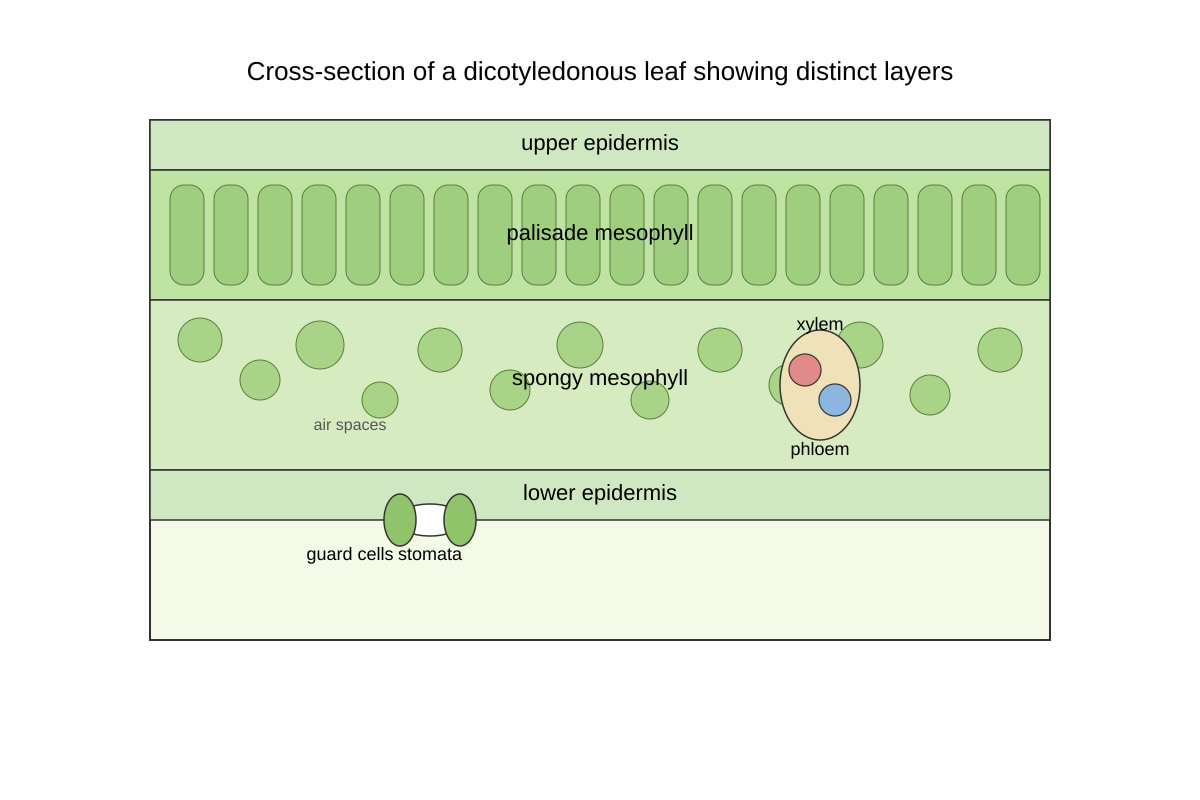
11. (a) Palisade mesophyll [1]
(b) Allow diffusion of gases (CO₂ and O₂) and water vapour. [1]
Teaching: Air spaces increase surface area for gas exchange.
12. [3]
Trend: Water loss increases as wind speed increases (1 mark).
Explanation: Wind removes water vapour from around the leaf, lowering humidity and increasing the concentration gradient for evaporation from stomata (1 mark). This speeds up transpiration (1 mark).
Marking: 1 for trend, 2 for reasoned explanation.
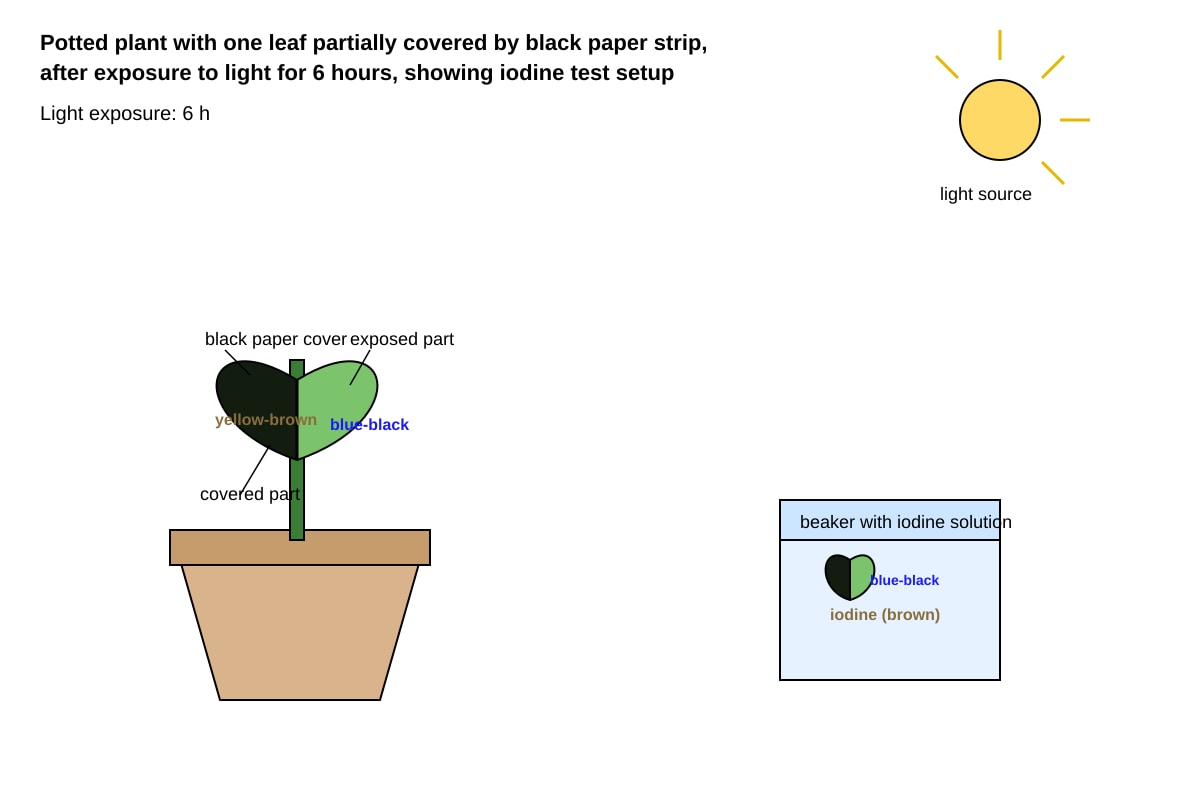
13. (a) To block light from reaching the covered part (control variable). [1]
(b) Blue-black [1]; shows starch is present, proving photosynthesis occurred where light was available [1].
Teaching: Iodine turns blue-black with starch.
14. [2]
- Xylem: dead cells, transports water/minerals upward, no companion cells.
- Phloem: living cells, transports food, has companion cells.
(1 mark each difference; accept any two valid)
15. Rate stays constant / plateaus [1]. Limiting factor: CO₂ concentration or temperature [1].
Teaching: At saturation, light no longer limits; another factor does.
Section C
16. [4]
- Long projection increases surface area for absorption (1)
- Thin wall shortens diffusion distance (1)
- Water enters by osmosis down water potential gradient (1)
- Mineral ions absorbed by active transport using ATP (1)
Teaching: Root hair is an extension of epidermal cell.
17. [4]
Soil → root hair cell (osmosis) (1) → cortex (via symplast/apoplast) (1) → xylem (1) → stem xylem → leaf xylem (1).
Teaching: Xylem vessels are continuous tubes.
18. (a) Rate rises from 10 to 30 °C then falls at 40 and sharply at 50 °C. [2] (1 for rise, 1 for fall)
(b) At 50 °C enzymes for photosynthesis denature / membrane damage reduces function. [2]
19. [4]
- Transpiration: loss of water vapour from leaves, passive, via xylem (2)
- Translocation: transport of organic food, active, via phloem (2)
Teaching: Different tissues, different energy use.
20. [6]
- Stomata allow CO₂ in and O₂ out for photosynthesis (2)
- Open in light for gas exchange, close in dark (1)
- Low water: guard cells lose turgor, stomata close to reduce water loss (2)
- This limits photosynthesis but conserves water (1)
Marking descriptors: 2 for role, 2 for response to low water, 2 for linking.