AI Generated Quiz
Secondary 3 Biology Genetics Inheritance Quiz
Free Sec 3 Biology Genetics Inheritance quiz, Kimi2.6 AI version, with questions, answers, and O Level-style practice for Singapore students.
These static practice materials are generated from the site's syllabus and paper-generation workflow, with source and model context shown so students and parents can evaluate the material before use.
Questions
Free quiz and exam paper access
Enter your details to view this paper
Your access is remembered on this device.
Answers
Secondary 3 Biology Quiz - Genetics Inheritance: ANSWER KEY
Section A: Multiple Choice
| Question | Answer | Explanation |
|---|---|---|
| 1 | B | The nucleus contains chromosomes made of DNA, which carries genetic information inherited from both parents. Ribosomes (A) make proteins; mitochondria (C) contain their own small amount of DNA but are not the main repository; the cell membrane (D) controls movement of substances. |
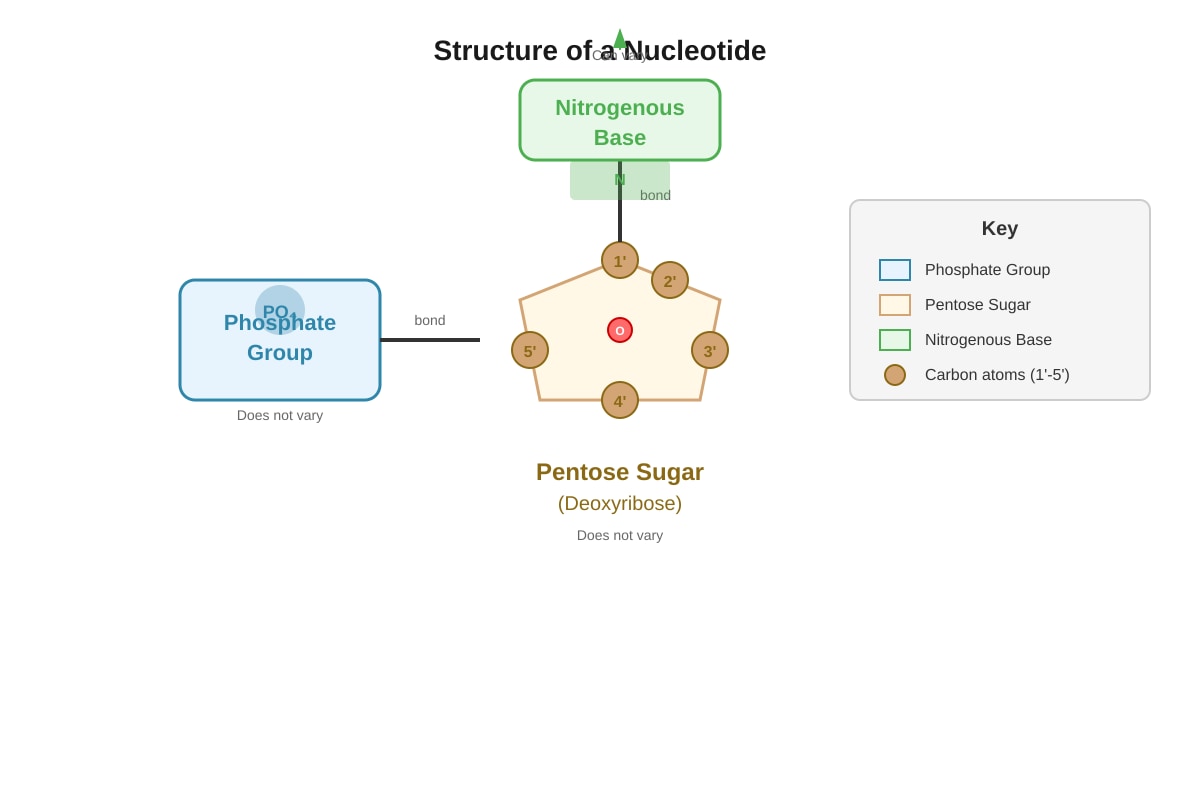
| 2 | C | The nitrogenous base varies — DNA contains adenine (A), thymine (T), cytosine (C), and guanine (G). The phosphate group (A) and deoxyribose sugar (B, D — same thing) are identical in all DNA nucleotides. |
| 3 | B | Metaphase I is when homologous chromosomes pair as bivalents and align at the equator. In Prophase I they pair up (synapsis), but bivalents are fully formed and visible at metaphase I. Prophase II (A) and subsequent stages have already separated homologous chromosomes. |
| 4 | C | Cross: Tt × tt. Gametes: T and t from first parent; t and t from second. Offspring: 1 Tt (tall) : 1 tt (short). This is a test cross used to determine unknown genotype. |
| 5 | B | Crossing over exchanges segments between homologous chromosomes, and independent assortment randomises which maternal/paternal chromosomes end up in each gamete. DNA replication occurs once before meiosis I (not twice — A is wrong). Halving chromosome number (C) maintains ploidy but doesn't directly create variation. |
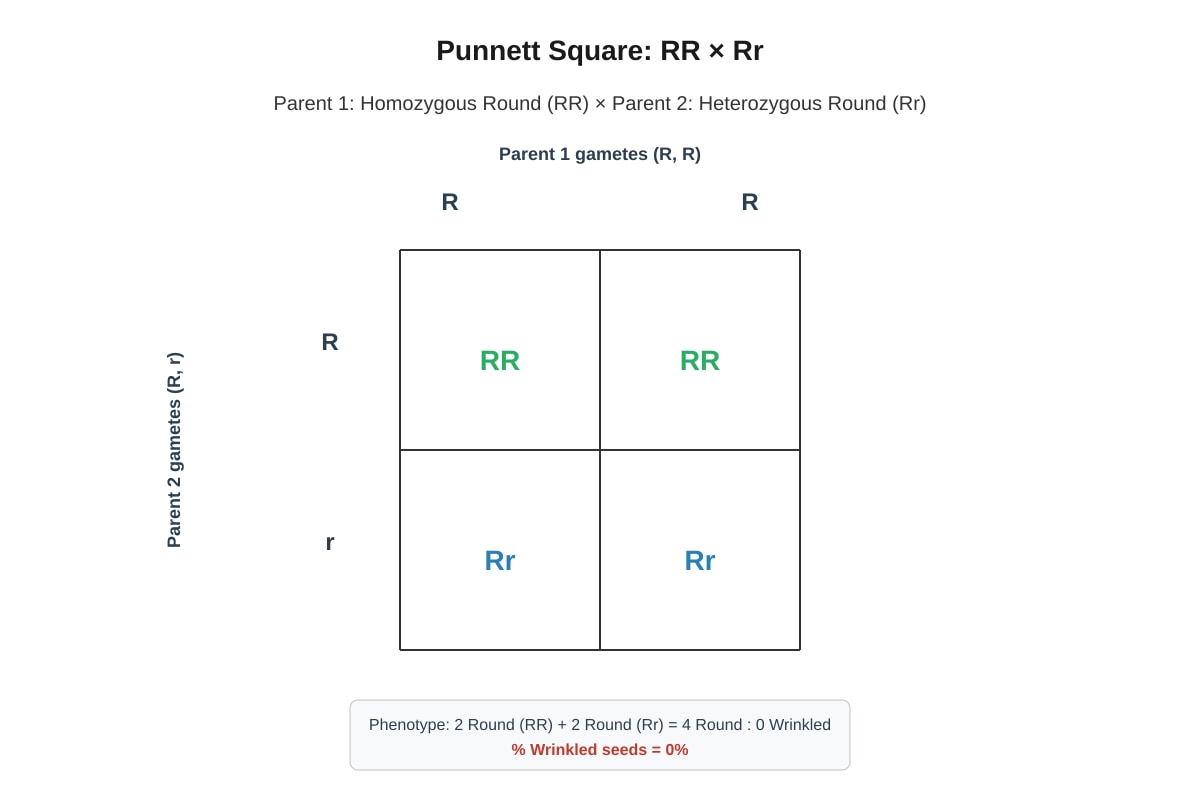
| 6 | A | Cross: RR × Rr. Gametes from RR: R, R. Gametes from Rr: R, r. Offspring genotypes: RR, RR, Rr, Rr. All have at least one dominant R allele, so 0% wrinkled (rr). |
| 7 | B | Asexual reproduction produces genetically identical offspring (clones) because only one parent contributes DNA. Sexual reproduction involves gametes (A), meiosis (C), and increases variation (D). |
| 8 | C | Using Hardy-Weinberg: p = 0.6, so q = 1 − 0.6 = 0.4. Heterozygote frequency = 2pq = 2 × 0.6 × 0.4 = 0.48. |
| 9 | C | Cross: XᶜY (colour-blind man) × XᴺXᶜ (carrier woman). For sons: mother can give Xᴺ or Xᶜ; father always gives Y. Probability son gets Xᶜ from mother = ½ = 50%. |
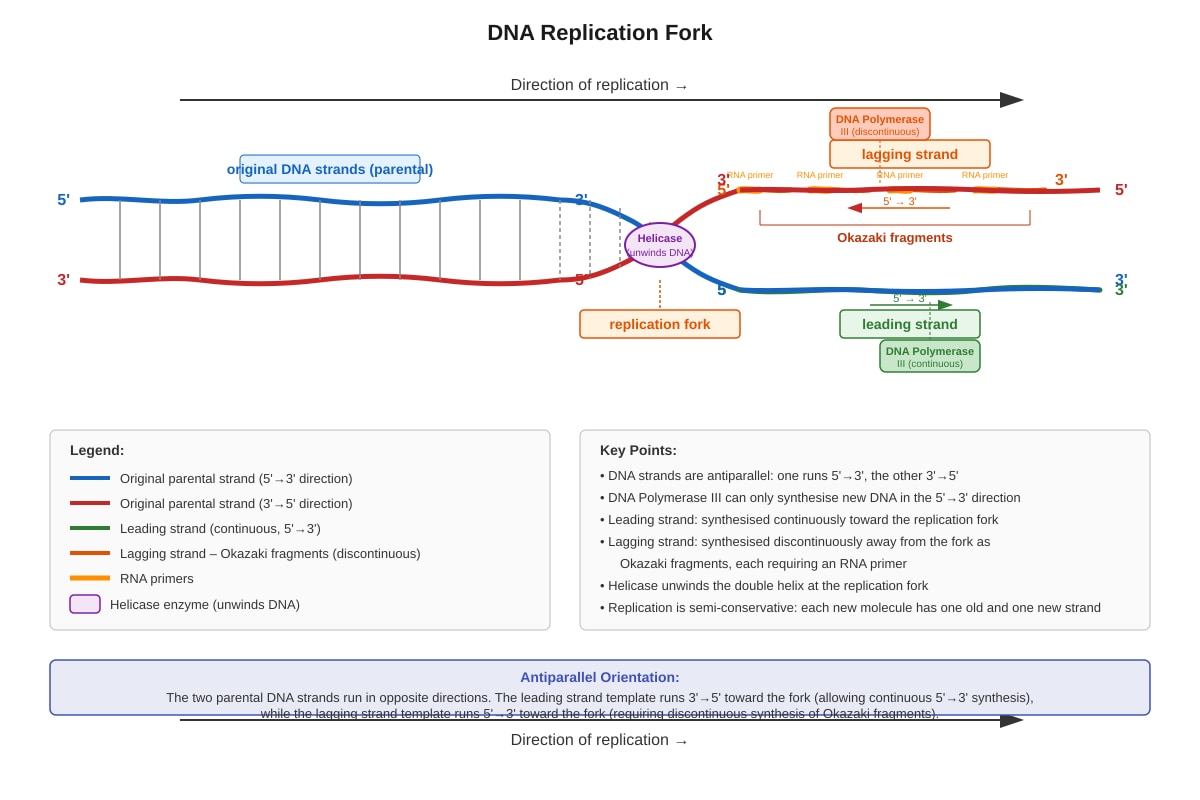
| 10 | C | DNA ligase joins Okazaki fragments by forming phosphodiester bonds. Helicase (A) unwinds DNA; DNA polymerase III (B) synthesises DNA; RNA primase (D) makes RNA primers. |
Section B: Short Answer
11. Two differences between RNA and DNA [2 marks]
| Mark point | Answer element |
|---|---|
| 1 | RNA contains ribose sugar; DNA contains deoxyribose sugar |
| 2 | RNA is typically single-stranded; DNA is double-stranded (or: RNA contains uracil instead of thymine; or RNA is generally shorter) |
Any two valid structural differences.
Teaching note: Deoxyribose lacks an oxygen atom at the 2' carbon compared to ribose. Uracil pairs with adenine just as thymine does, but thymine's methyl group provides greater chemical stability for long-term genetic storage.
12. Definition and explanation [3 marks]
| Mark point | Answer element |
|---|---|
| 1 | An allele is one of alternative forms of a gene occupying the same locus on homologous chromosomes |
| 2 | Alleles can be dominant or recessive |
| 3 | The phenotype depends on which alleles are present and whether the dominant allele masks the recessive one; homozygous dominant and heterozygotes show dominant phenotype; only homozygous recessive shows recessive phenotype |
Teaching note: Think of alleles as "versions" of a gene. For flower colour, one allele might code for purple pigment, another for white (no functional pigment). The dominant allele's trait appears when at least one copy is present.
13. Pedigree analysis [3 marks total]
(a) Recessive determination [2 marks]
| Mark point | Answer element |
|---|---|
| 1 | Recessive |
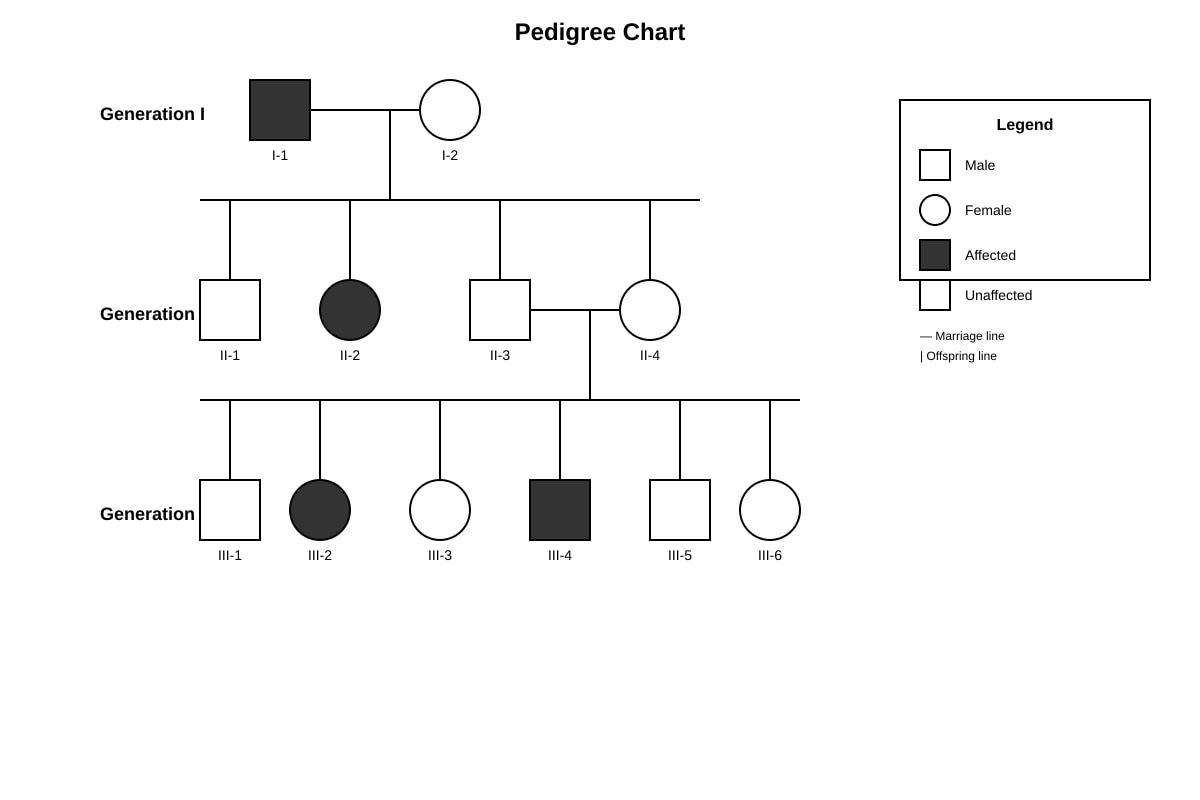
| 2 | The condition skips generation I (or: affected individual II-2 has unaffected parents I-1 and I-2; or: two unaffected parents I-1 and I-2 produced an affected offspring II-2) |
Teaching note: If a condition appears in offspring but not in either parent, parents must both be carriers (heterozygous). The hidden recessive allele is passed to ~25% of offspring. Dominant conditions cannot skip generations — an affected individual must have an affected parent.
(b) Genotype of II-2 [1 mark]
| Answer | aa (or cc/Cc with consistent notation — using problem's A/a: aa) |
Individual II-2 is affected, so must be homozygous recessive.
14. Mitosis vs meiosis [5 marks]
| Part | Mark | Answer element |
|---|---|---|
| (a) | 1 | Mitosis produces 2 daughter cells; meiosis produces 4 daughter cells |
| (b) | 2 | Mitosis: daughter cells have the same chromosome number as parent (diploid → diploid, or 2n → 2n); Meiosis: daughter cells have half the chromosome number (diploid → haploid, or 2n → n) |
| (c) | 2 | Mitosis produces identical cells for growth, repair, and asexual reproduction; Meiosis produces genetically varied gametes for sexual reproduction, introducing genetic variation |
Teaching note: The halving of chromosome number in meiosis is essential because fertilisation restores the diploid number. Without this reduction, chromosome number would double each generation.
15. DNA replication [3 marks]
(a) Enzyme [1 mark] | DNA helicase
(b) Lagging strand synthesis [2 marks]
| Mark point | Answer element |
|---|---|
| 1 | DNA polymerase can only add nucleotides in the 5' to 3' direction |
| 2 | The lagging strand template runs 3' to 5' relative to fork movement, so synthesis must occur away from the replication fork in short Okazaki fragments, later joined by DNA ligase |
Teaching note: Imagine walking on a moving walkway — the leading strand walks with the flow (continuous), while the lagging strand must walk against it in short bursts, re-starting with each new primer.
Section C: Structured Response
16. Monohybrid cross [7 marks]
(a) Parent genotypes [1 mark] | Black parent: BB; Brown parent: bb
(b) Genetic diagram [2 marks]
| Gametes | b | b |
|---|---|---|
| B | Bb | Bb |
| B | Bb | Bb |
1 mark for correct gametes; 1 mark for correct offspring genotypes
(c) Phenotypic ratio [1 mark] | All black (or 100% black, or 4 black : 0 brown)
(d) F₁ test cross [3 marks]
| Step | Working |
|---|---|
| F₁ genotype | All offspring are Bb (heterozygous black) |
| Cross | Bb × bb |
| Gametes | B, b from F₁; b, b from brown parent |
| Offspring | 1 Bb (black) : 1 bb (brown) |
| Probability of brown | ½ or 50% or 0.5 |
1 mark for identifying F₁ genotype; 1 mark for correct cross/diagram; 1 mark for probability with working
17. Sex-linked inheritance [7 marks]
(a) Carrier genotype [1 mark] | XᴴXʰ (or XᴴXᴴ, Hh with notation consistent)
(b) Genetic diagram [4 marks]
| Xᴴ | Xʰ | |
|---|---|---|
| Xᴴ | XᴴXᴴ = normal female | XᴴXʰ = carrier female |
| Y | XᴴY = normal male | XʰY = haemophiliac male |
- 1 mark: correct parental genotypes
- 1 mark: correct gametes shown
- 1 mark: offspring genotypes all correct
- 1 mark: offspring phenotypes all correct
(c) More common in males [2 marks]
| Mark point | Answer element |
|---|---|
| 1 | Males have XY so only one X chromosome; they are hemizygous for X-linked genes |
| 2 | A male needs only one recessive allele (XʰY) to show the disorder; females need two recessive alleles (XʰXʰ) — since h is rare, XʰXʰ is very unlikely |
Teaching note: Males are like having only one "vote" — whichever allele is on their single X chromosome wins. Females have two "votes," so the dominant normal allele usually masks the recessive disease allele.
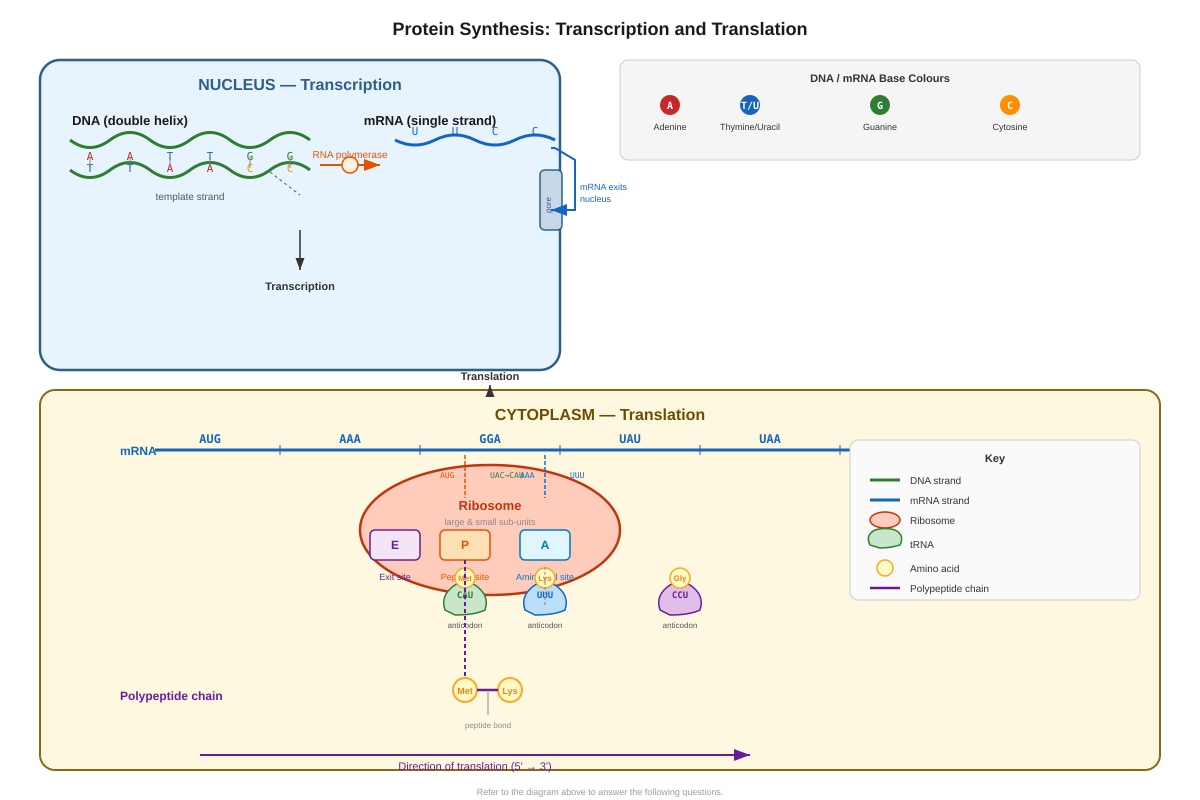
18. Protein synthesis [7 marks]
(a) Two stages [2 marks] | Transcription (DNA → RNA in nucleus) and Translation (RNA → protein at ribosome)
(b) mRNA sequence [2 marks]
DNA template: 5'-TAC AAA GGA TAT-3'
mRNA: 5'-AUG UUU CCU AUA-3'
1 mark for complementary bases; 1 mark for correct 5' to 3' direction and U instead of T
Teaching note: mRNA is synthesised 5' to 3', antiparallel to the template strand. The template strand is read 3' to 5'. Remember: A pairs with U (not T) in RNA.
(c) Codons determine amino acid sequence [3 marks]
| Mark point | Answer element |
|---|---|
| 1 | Each codon (three adjacent bases) on mRNA corresponds to a specific amino acid |
| 2 | tRNA molecules carry specific amino acids and have anticodons complementary to mRNA codons |
| 3 | At the ribosome, codon-anticodon pairing ensures amino acids are added in the correct sequence, building the polypeptide |
19. Hardy-Weinberg [6 marks]
(a) Frequency of c allele [2 marks]
| Step | Working |
|---|---|
| Number of c alleles | From cc: 200 × 2 = 400; From Cc: 1520 × 1 = 1520 |
| Total c alleles | 400 + 1520 = 1920 |
| Total alleles in population | 10 000 × 2 = 20 000 |
| Frequency q | 1920/20000 = 0.096 |
Alternative: q = √(200/10000) = √0.02 ≈ 0.141 if assuming H-W equilibrium — but question asks direct calculation from data. Mark scheme accepts direct count or H-W estimate with clear reasoning.
Correction for precise marking: Direct count preferred: total c alleles = (200×2) + 1520 = 1920; frequency = 1920/20000 = 0.096.
However, if student uses q² = 200/10000 = 0.02, then q = √0.02 ≈ 0.141 — this is also valid but less direct. The mark scheme should accept either method with correct working.
(b) Expected carrier frequency at H-W equilibrium [2 marks]
| Step | Working |
|---|---|
| q = 0.096 (from part a) | p = 1 − 0.096 = 0.904 |
| Heterozygote frequency 2pq | 2 × 0.904 × 0.096 = 0.174 or 17.4% |
Number expected = 0.174 × 10000 = 1740 (or ~1520 if using observed q to show discrepancy)
(c) Reasons for deviation from H-W [2 marks]
| Mark point | Answer element |
|---|---|
| 1 | Non-random mating / sexual selection / inbreeding |
| 2 | Mutation, migration/gene flow, small population size/genetic drift, or natural selection |
Any two distinct conditions
20. Dihybrid cross and χ² test [9 marks]
(a) Principle [1 mark] | Law of independent assortment (Mendel's Second Law)
(b) Phenotypic ratio [1 mark] | 9 : 3 : 3 : 1 (round yellow : round green : wrinkled yellow : wrinkled green)
(c) χ² calculation [5 marks]
Expected numbers (from 9:3:3:1 ratio, total 160):
- Round yellow: 9/16 × 160 = 90
- Round green: 3/16 × 160 = 30
- Wrinkled yellow: 3/16 × 160 = 30
- Wrinkled green: 1/16 × 160 = 10
| Phenotype | Observed (O) | Expected (E) | O − E | (O − E)² | (O − E)²/E |
|---|---|---|---|---|---|
| Round yellow | 87 | 90 | −3 | 9 | 0.100 |
| Round green | 31 | 30 | +1 | 1 | 0.033 |
| Wrinkled yellow | 29 | 30 | −1 | 1 | 0.033 |
| Wrinkled green | 13 | 10 | +3 | 9 | 0.900 |
| Total | 160 | 160 | χ² = 1.066 |
Mark allocation: 1 mark correct expected values; 1 mark correct (O−E); 1 mark correct (O−E)²; 1 mark correct final χ²; 1 mark intermediate working shown
(d) Null hypothesis and conclusion [2 marks]
| Element | Answer |
|---|---|
| Null hypothesis (H₀) | There is no significant difference between observed and expected results; the results fit the 9:3:3:1 ratio |
| Conclusion | χ² = 1.066 < critical value 7.815; Accept H₀ / reject null hypothesis at p=0.05: Results fit expected ratio; any difference is due to chance |
Teaching note: χ² measures "goodness of fit" — how likely are the observed deviations from expectation? Small χ² means observed values are close to expected. Always compare: if calculated < critical value, accept that deviation is random chance.
END OF ANSWER KEY