AI Generated Quiz
Secondary 3 Biology Genetics Inheritance Quiz
Free Sec 3 Biology Genetics Inheritance quiz, HY3 AI version, with questions, answers, and O Level-style practice for Singapore students.
These static practice materials are generated from the site's syllabus and paper-generation workflow, with source and model context shown so students and parents can evaluate the material before use.
Questions
Free quiz and exam paper access
Enter your details to view this paper
Your access is remembered on this device.
Answers
Secondary 3 Biology Quiz - Genetics Inheritance (Answer Key)
Total Marks: 40
Topic: Genetics Inheritance
Note: Syllabus-first content generated from LLM-inferred templates; not claimed as past-year derived.
Q1. B [1]
Teaching note: Human somatic cells have 46 chromosomes (23 pairs). Gametes (sperm/egg) are haploid, so they have 23. A is diploid somatic; C is after replication; D is wrong pair count.
Q2. B [1]
Teaching note: Homologous chromosomes are the pair (one from each parent) carrying same genes at same loci. Sister chromatids are copies; centromere is the join; alleles are gene forms.
Q3. B [1]
Teaching note: T dominant over t, so Tt shows tall phenotype. Genotype is heterozygous but phenotype is dominant trait.
Q4. A [1]
Teaching note: Rr × Rr → RR, Rr, Rr, rr. Only rr is homozygous recessive = 1/4.
Q5. B [1]
Teaching note: Meiosis includes crossing over and independent assortment, producing non-identical gametes. Mitosis makes identical cells.
Q6. [2]
Mark breakdown: 1 for "segment of DNA", 1 for "codes for trait/characteristic".
Answer: A gene is a short length of DNA on a chromosome that codes for a specific characteristic or protein.
Q7. [2]
Answer: DNA is the chemical molecule carrying genetic info; chromosome is a structure of DNA wound with protein visible during division. (Any 1 valid difference = 2)
Q8. [2]
Working: Father I^A i × Mother I^B i → gametes: I^A, i and I^B, i. Offspring: I^A I^B, I^A i, I^B i, ii.
Answer: I^A I^B, I^A i, I^B i, ii (all 4 listed = 2 marks).
Q9. [2]
Cross: RR × rr → all Rr.
Genotype: Rr [1]
Phenotype: red [1] (R dominant)
Q10. [2]
Answer: Males have one X and one Y (XY); if the X carries a recessive allele there is no second X to mask it, so trait shows. (1 mark concept, 1 mark application)
Q11. [3]
Punnett: Y from both parents top/left.
    Y    y
Y  YY   Yy
y  Yy   yy
Ratio: 1 YY : 2 Yy : 1 yy (3 marks for correct square + ratio).
Q12. [2]
Type: point mutation / substitution [1]
Effect: may change amino acid, protein malfunction, e.g., sickle-cell [1]
Q13. [2]
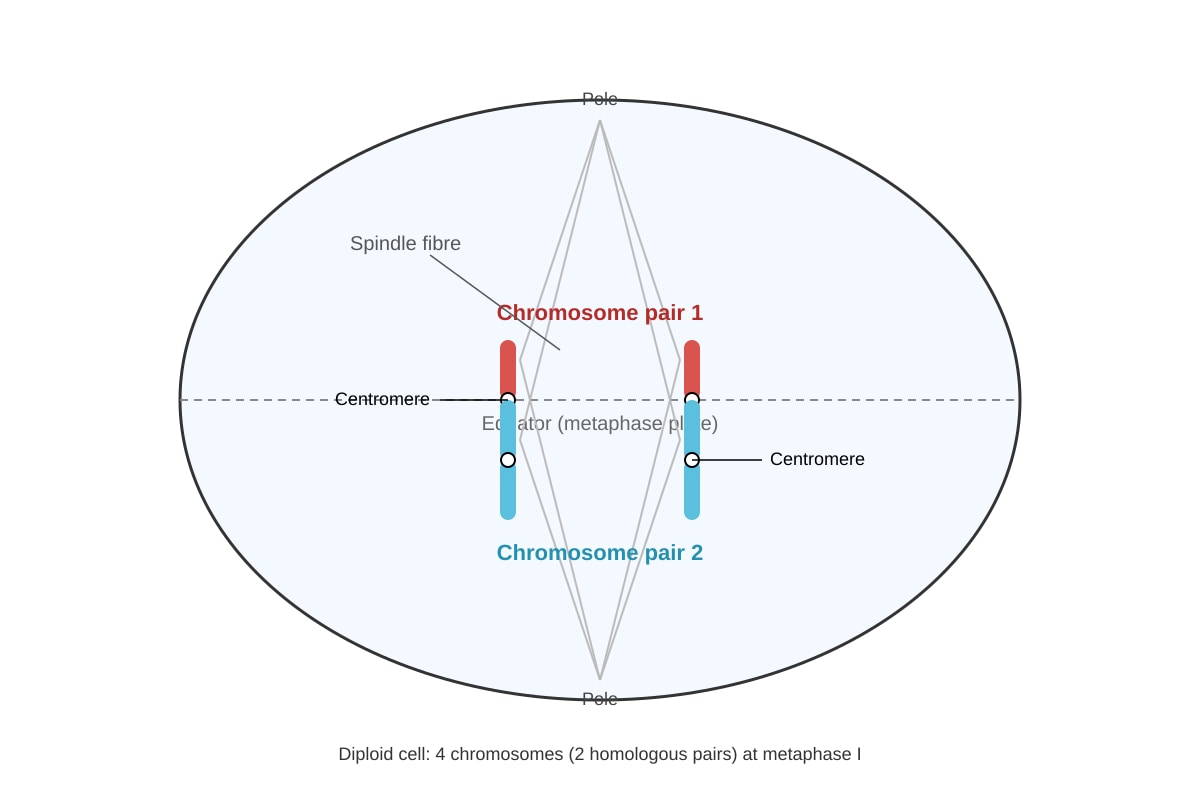
Stage: metaphase I [1] (from pairing of homologues)
Daughter cell after meiosis II: 2 chromosomes [1] (haploid, half of 4)
Q14. [2]
Any two: insulin production by bacteria, gene therapy, vaccines, cloning of proteins. (1 each)
Q15. [2]
Cross Bb × bb → Bb, Bb, bb, bb. Brown (bb) = 2/4 = 1/2. Answer: 50% or 1/2.
Q16. [4]
Marking: DNA carries genes (1); genes on chromosomes (1); gametes carry half set (1); fertilisation restores full set (1).
Answer: DNA contains genes. Genes are on chromosomes. Gametes contain one set of chromosomes from each parent. Fertilisation combines them so offspring inherit traits.
Q17. [4]
Pattern: codominance (roan = both expressed) [1]. F1 Rr crossed → RR (red), Rr (roan), rr (white) in 1:2:1 [3].
Answer explains codominance and gives ratio.
Q18. [4]
Mitosis: same number (diploid→diploid), no variation [2]. Meiosis: half number, variation via crossing over/assortment [2].
Q19. [4]
Cross: X^C X^c × X^C Y → sons: X^C Y (normal), X^c Y (blind). Chance colour-blind son = 1/4 overall, 1/2 of sons. Show Punnett [2], state 1/4 [2].
Q20. [4]
Mutation: change in DNA creates new allele, e.g., sickle-cell [2]. Recombination: crossing over in meiosis mixes alleles, e.g., new trait combos [2].