AI Generated Quiz
Secondary 3 Biology Evolution Diversity Quiz
Free Sec 3 Biology Evolution Diversity quiz, Kimi2.6 AI version, with questions, answers, and O Level-style practice for Singapore students.
These static practice materials are generated from the site's syllabus and paper-generation workflow, with source and model context shown so students and parents can evaluate the material before use.
Questions
Free quiz and exam paper access
Enter your details to view this paper
Your access is remembered on this device.
Answers
Secondary 3 Biology Quiz - Evolution Diversity (Answer Key)
Total Marks: 40
Section A: Multiple Choice
1. Answer: (a) Kingdom → Phylum → Class → Order → Family → Genus → Species
Explanation: This is the standard taxonomic hierarchy used in biological classification (Linnaean system). The hierarchy proceeds from the broadest category (Kingdom) to the most specific (Species). Each level becomes more exclusive. Option (b) reverses the order. Option (c) incorrectly places Class before Phylum. Option (d) incorrectly places Phylum before Kingdom.
2. Answer: (c) Species
Explanation: The biological species concept defines species as groups of actually or potentially interbreeding natural populations that are reproductively isolated from other such groups. Organisms of the same species can produce fertile offspring. Organisms of the same genus but different species may interbreed but typically produce infertile offspring (e.g., horse × donkey = mule, which is sterile). Same family or kingdom does not guarantee ability to interbreed.
3. Answer: (b) Belongs to the genus Homo and species sapiens
Explanation: In binomial nomenclature, the first name is the genus (capitalised, Homo) and the second is the specific epithet (lowercase, sapiens). The genus name may be abbreviated to a single letter after first use (e.g., H. sapiens). The species name is always written in italics or underlined. Option (a) reverses genus and species. Option (c) confuses genus with family. Option (d) is factually incorrect—sapiens means "wise" in Latin, not a person's name.
4. Answer: (c) A population of bacteria develops antibiotic resistance after exposure to antibiotics
Explanation: This directly demonstrates natural selection: pre-existing genetic variation in the bacterial population includes some resistant individuals; antibiotics act as a selection pressure killing non-resistant bacteria; resistant bacteria survive, reproduce, and pass resistance genes to offspring. Option (a) contradicts natural selection (not all offspring survive). Option (b) describes Lamarckism (inheritance of acquired characteristics), which is incorrect. Option (d) is biologically inaccurate.
5. Answer: (b) Divergent evolution from a common ancestor
Explanation: The pentadactyl limb is a homologous structure—structurally similar due to shared ancestry from a common tetrapod ancestor, even though the limbs are functionally adapted for different purposes (swimming, flying, walking, climbing). This is divergent evolution (one ancestor, multiple descendant forms). Convergent evolution (a) would produce analogous structures from unrelated ancestors (e.g., bird wing and insect wing). Artificial selection (c) implies human interference.
Section B: Structured Questions
6. [2 marks]
Definition: Biodiversity is the variety of life in a particular habitat or ecosystem, encompassing genetic diversity, species diversity, and ecosystem diversity. [1]
Importance: High biodiversity ensures ecosystem stability and resilience; provides resources for food, medicine, and industry; supports nutrient cycling and pollination services; increases chances that some species will survive environmental changes. [1]
Marking note: Accept "variety of living organisms" for definition. For importance, any two valid points or one well-explained point gains the mark.
7. [2 marks]
| Feature | Natural Selection | Artificial Selection |
|---|---|---|
| Agent of selection | Environmental conditions | Human choice/intention |
| Example | Darwin's finch beak adaptation to food sources | Selective breeding of dogs for specific traits |
[1 mark for clear distinction; 1 mark for valid example of each]
Explanation: Natural selection occurs without human intervention—organisms best suited to their environment survive and reproduce. Artificial selection (selective breeding) is when humans choose which organisms reproduce based on desired characteristics. Examples: natural selection = antibiotic resistance, industrial melanism, camouflage; artificial selection = crop domestication, dog breeds, dairy cattle, racing pigeons.
8. [2 marks]
Reason 1: The dodo had evolved in isolation without predators and therefore lacked fear responses/defences against humans and introduced animals (pigs, monkeys, rats). [1]
Reason 2: Humans hunted dodos for food and destroyed their habitat; introduced species competed for food or preyed on dodo eggs. [1]
Explanation: The dodo was endemic to Mauritius with no natural mammalian predators. It was flightless and nested on the ground, making it extremely vulnerable. This exemplifies how isolation on islands often leads to loss of defensive adaptations, causing rapid extinction when new predators arrive.
9. [3 marks]
(a) Chimpanzee is most closely related to humans. [0.5] It has zero amino acid differences compared to human cytochrome c, indicating identical protein structure and very recent common ancestry. [0.5]
(b) Pattern: As the organisms become more distantly related in evolutionary terms (from primates through mammals to fish to plants), the number of amino acid differences increases. [1] Suggestion: This indicates that more closely related organisms share more recent common ancestors and therefore have had less time for mutations to accumulate in their DNA/proteins. Cytochrome c is a conserved protein, so differences reflect evolutionary distance. [1]
10. [3 marks]
(a) Explanation of natural selection: [2]
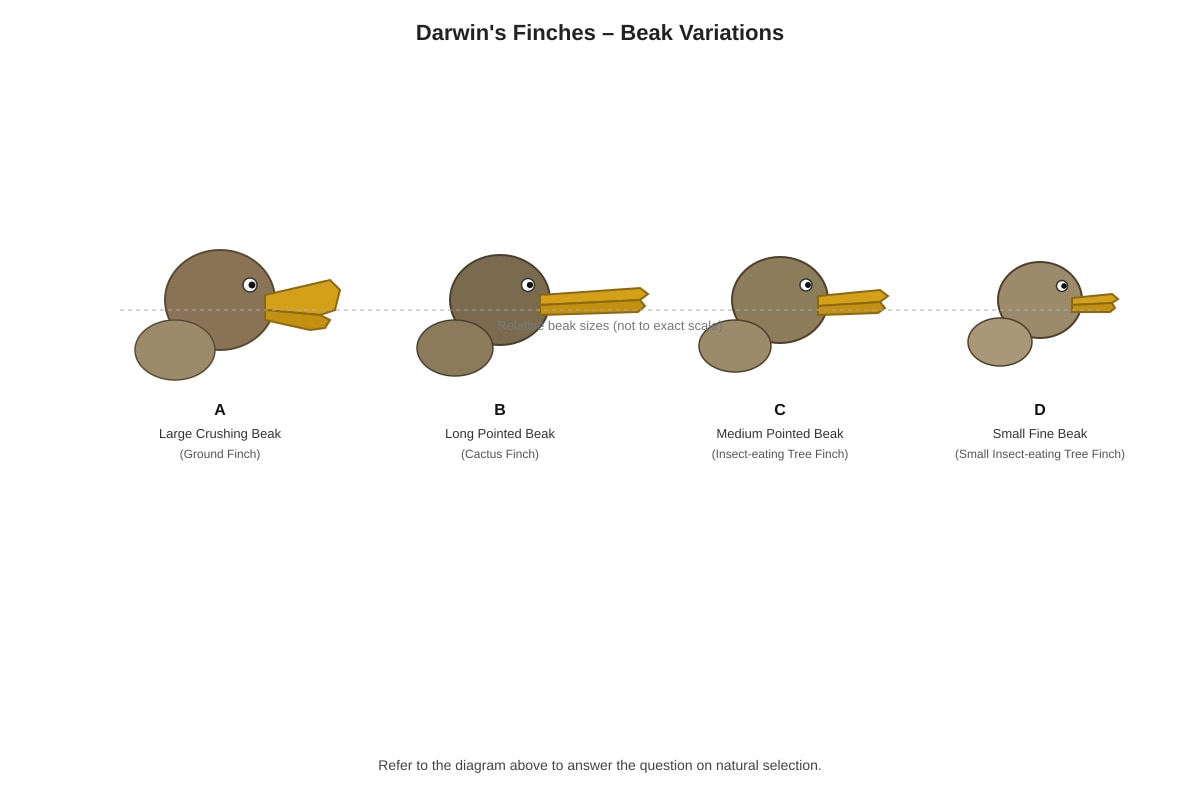
- Original ancestral finch population arrived on Galápagos with genetic variation in beak size/shape
- Different islands had different food sources: large hard seeds, cactus flowers, insects in bark
- Birds with beaks best suited to local food sources survived and reproduced more successfully (survival advantage)
- Over many generations, advantageous beak alleles increased in frequency, leading to distinct populations that became separate species
- This is adaptive radiation: one ancestor giving rise to many species exploiting different niches
(b) Prediction: [1] Species A (large crushing beak) would face reduced fitness/survival; individuals with smaller, more pointed beaks would be favoured; over generations, the population might evolve smaller beaks or decline if cannot adapt quickly enough.
11. [3 marks]
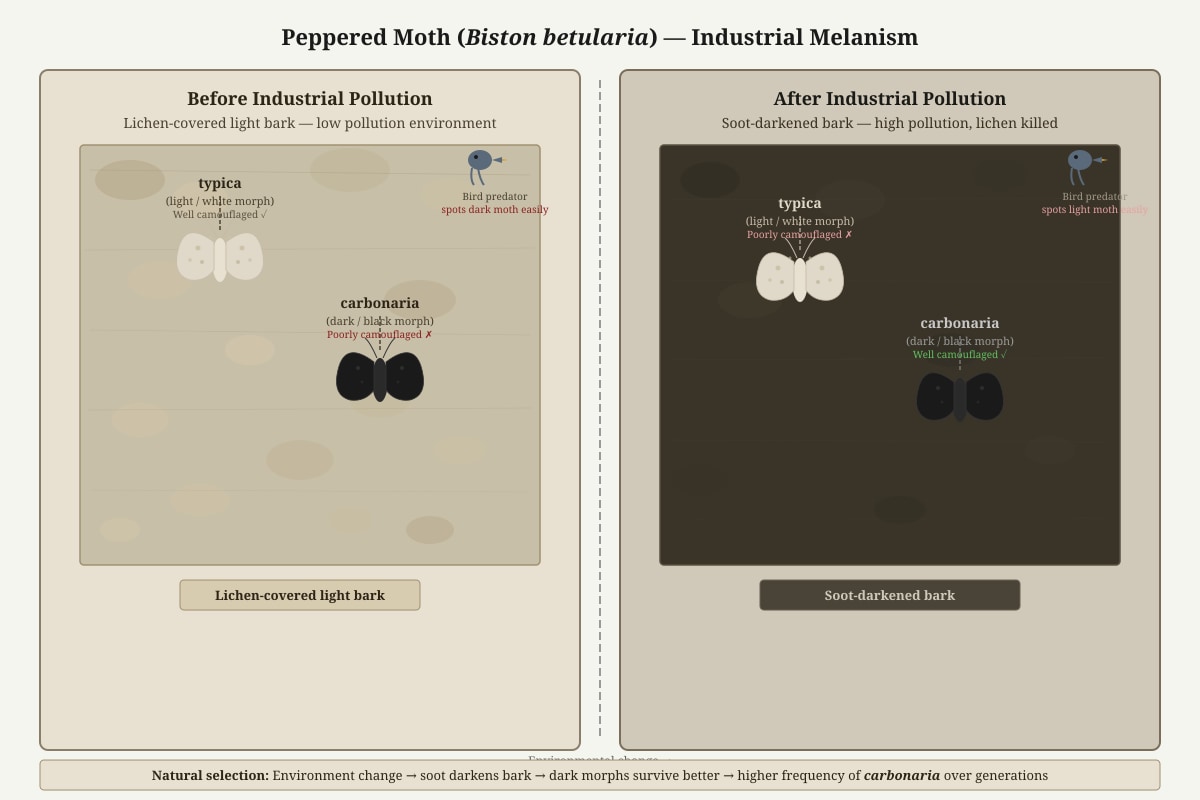
Explanation of industrial melanism:
Environmental change: [1] Industrial Revolution caused pollution (soot) that killed lichens and darkened tree bark in industrial areas.
Selection pressure: [1] Before pollution: light moths (typica) camouflaged on lichen-covered bark, dark moths (carbonaria) easily seen and eaten by birds (predation). After pollution: dark moths camouflaged on soot-darkened bark, light moths conspicuous and preyed upon. Birds act as selective agents.
Outcome over generations: [1] Predation differentially removed the conspicuous morph; surviving moths reproduced, passing on their colour alleles; frequency of dark moths increased dramatically in industrial areas (up to 98% by 1900), while light moths remained common in unpolluted rural areas. When clean air legislation reduced pollution, the trend reversed—demonstrating natural selection in action.
12. [3 marks]
(a) Reptilian characteristics: [1] Any two from: teeth in jaws; long bony tail; claws on wings
Avian characteristics: [1] Any two from: feathers; wings; wishbone (furcula)
(b) Transitional fossil explanation: [1] Archaeopteryx shows a mosaic of features—possessing both ancestral (reptilian) and derived (avian) characteristics. This provides direct fossil evidence of the evolutionary transition from dinosaurs/reptiles to birds, supporting the theory that birds evolved from theropod dinosaur ancestors. It shows intermediate stages in the evolution of flight.
13. [3 marks]
(a) Canis lupus familiaris [1] (or Canis lupus with explanation that domestic dog is the subspecies)
(b) Same species: Grey wolves and domestic dogs can interbreed and produce fertile offspring, satisfying the biological species concept. [1]
Different subspecies: They show consistent morphological, behavioural, and ecological differences due to domestication—dogs have undergone artificial selection for tameness, varied body sizes, coat colours, and behaviours not found in wild wolves; however, they remain genetically similar enough for successful interbreeding. [1]
14. [3 marks]
(a) Prediction: [2] Brown beetles have a survival advantage (camouflage = avoid predation) and will survive to reproduce more successfully than green beetles. Over many generations, the frequency of brown beetles will increase while green beetles decrease. Eventually, green beetles may become rare or eliminated from the population if the selection pressure remains constant. The population will become adapted (better camouflaged) to the brown soil environment.
(b) Changing selection pressure: [1] Any valid environmental change: soil colour changes to green (e.g., new vegetation cover, moss growth); introduction of a predator that uses smell rather than sight; migration of green beetles from another population; genetic mutation producing new colour variants.
15. [3 marks]
(a) Sources of genetic variation: [1] Any two from: mutation (gene/chromosomal); sexual reproduction/crossing over; independent assortment; random fertilisation; migration/gene flow
(b) Risk of extinction: [2] Low genetic variation means less diversity of alleles in the population. [1] If environmental conditions change (new disease, climate change, new predator), the population may lack alleles that confer survival advantage under new conditions. Without pre-existing favourable variants, natural selection cannot act to adapt the population quickly enough, increasing extinction risk. [1] Conversely, high genetic variation increases probability that some individuals will possess advantageous traits.
Section C: Data Analysis and Extended Response
16. [4 marks]
(a) Phylogenetic sequence (most closely → most distant): [1] Chimpanzee → Bonobo → Gorilla → Orangutan → Gibbon → Rhesus macaque
(b) Reliability of DNA comparison: [2]
- DNA is the genetic material passed from parents to offspring; mutations accumulate at relatively constant rates over time (molecular clock) [0.5]
- DNA sequence comparison is objective and quantifiable; physical characteristics can be misleading due to convergent evolution (analogous structures) or highly variable traits [0.5]
- Similar DNA sequences indicate recent common ancestry because less time has elapsed for mutations to accumulate; this is independent of superficial resemblance [0.5]
- Physical characteristics may result from similar environmental pressures rather than shared ancestry (e.g., streamlined shape in dolphins and sharks) [0.5]
(c) Additional evidence for same genus: [1] Any valid point: ability to interbreed/hybridise; similar chromosome numbers; shared anatomical features; overlapping geographical distribution in wild; similar behaviours/social structures; fossil evidence of recent divergence.
17. [4 marks]
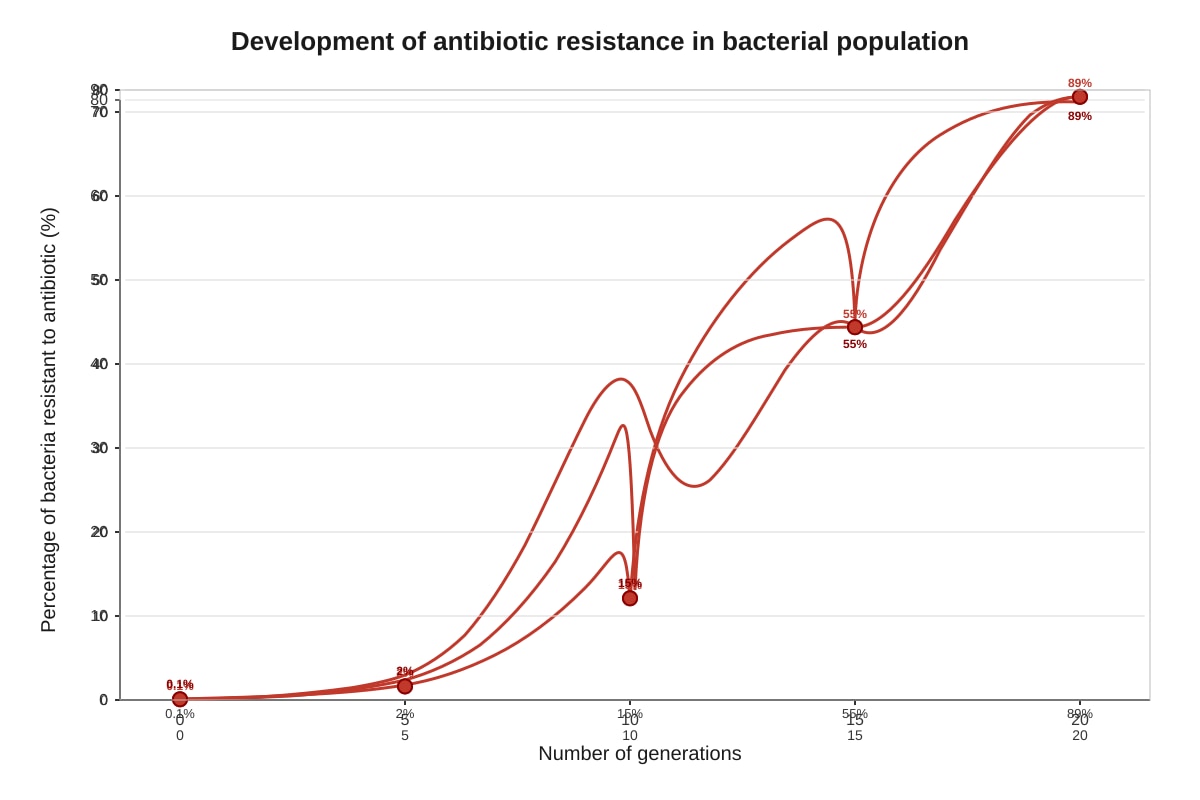
(a) Trend description: [1] The percentage of antibiotic-resistant bacteria starts very low (0.1%) and remains relatively low for the first 10 generations, then increases rapidly (exponentially/sigmoid growth) to reach 89% by generation 20.
(b) Natural selection mechanism: [3]
Variation: [0.5] The original bacterial population contained genetic variation; some individual bacteria had (by random mutation) genes conferring antibiotic resistance, even at very low frequency (0.1%).
Selection pressure: [0.5] The antibiotic in the environment killed susceptible bacteria. Resistant bacteria survived because the antibiotic could not destroy them (e.g., they produced enzyme to break down antibiotic, or had altered target site).
Inheritance: [0.5] Surviving resistant bacteria reproduced asexually (binary fission), copying their resistance genes to daughter cells. Resistance is heritable.
Change in population frequency: [0.5] Over successive generations, resistant bacteria became increasingly common; susceptible bacteria were continuously eliminated. By generation 20, resistant bacteria dominated the population (89%). This is evolution by natural selection—population adaptation to antibiotic presence.
Additional marking point: [0.5] The pattern shows characteristic lag phase (initial low frequency) followed by log phase (rapid increase) as resistant strains multiply without competition.
18. [3 marks]
(a) Continental drift evidence: [2]
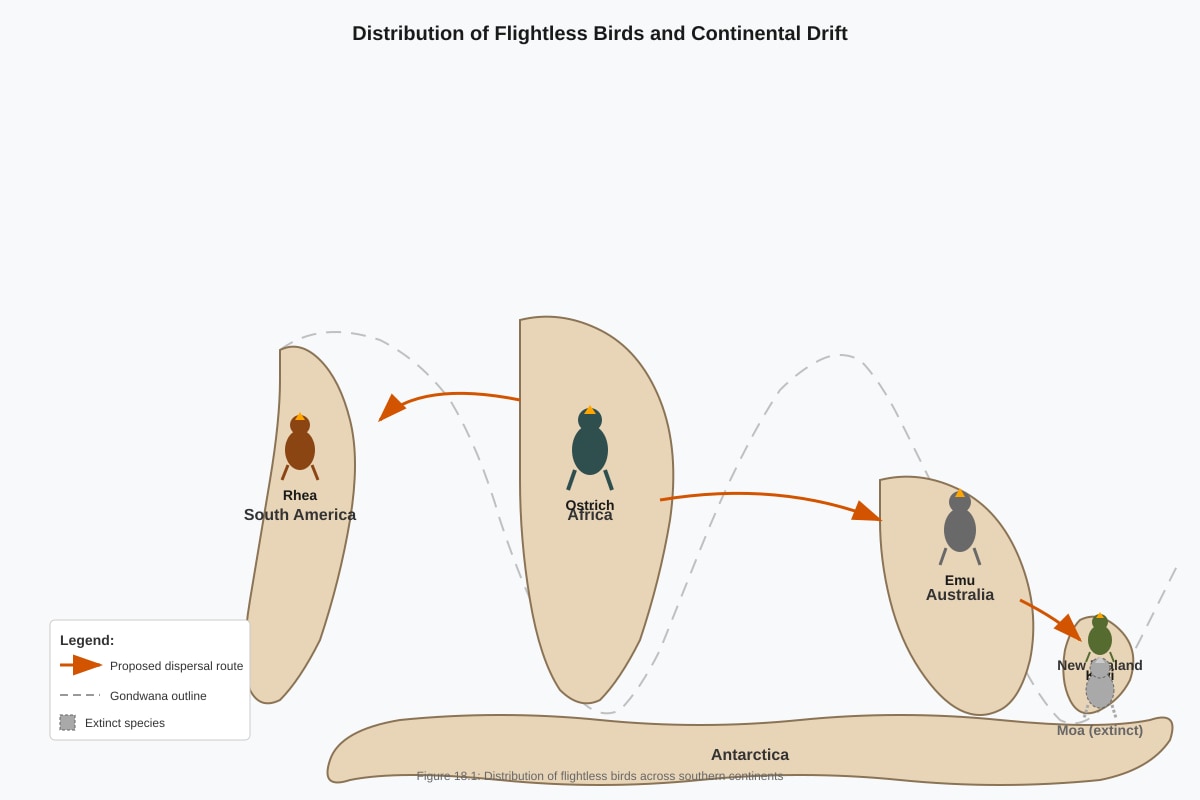
- Flightless birds (ratites) are found on southern continents that were once joined as Gondwana supercontinent [0.5]
- These birds cannot fly across oceans, so their distribution cannot be explained by dispersal over water [0.5]
- The pattern matches the breakup sequence: South America and Africa separated first (explaining rhea/ostrich similarity), then Australia/New Zealand (emu/kiwi/moa) [0.5]
- This supports vicariance biogeography: ancestral population was split by continental drift, then evolved independently on separated landmasses [0.5]
(b) Reason for flightlessness: [1] Energy saving—flight is metabolically expensive; in environments without predators (islands/continents without large carnivores), flight was unnecessary; larger body size evolved which reduces flight ability but improves running/defence; evolutionary trade-off allocated resources to other functions (egg production, fat storage, running speed).
19. [4 marks]
(a) Explanation of survival difference: [2]
- Singapore population has been exposed to insecticide for 25 years, providing prolonged selection pressure for resistance [0.5]
- The sodium channel mutation conferring resistance was already present (at low frequency) or arose by mutation; resistant mosquitoes survived and reproduced, increasing resistance allele frequency to 78% [0.5]
- Thailand population had only 3 years of exposure—insufficient time for selection to significantly increase resistance frequency (only 3% have mutation) [0.5]
- Higher proportion of Singapore mosquitoes carry the resistance allele, explaining 85% vs 12% survival at standard concentration [0.5]
(b) Evaluation of conclusion: [2]
- Support: Strong correlation: 78% mutation frequency corresponds with 85% survival; 3% mutation frequency corresponds with 12% survival. The gene codes for sodium channel—target of this insecticide class. [1]
- Limitation: Correlation does not prove causation; other genetic changes might confer resistance (e.g., metabolic detoxification genes, thicker cuticle); the mutation might be linked to another resistance gene rather than directly causal; further evidence needed (e.g., gene knockout/knockin experiments showing resistance loss/gain). [1]
- Conclusion: The hypothesis is strongly supported but not definitively proven by this evidence alone. Functional validation would strengthen the claim.
20. [4 marks]
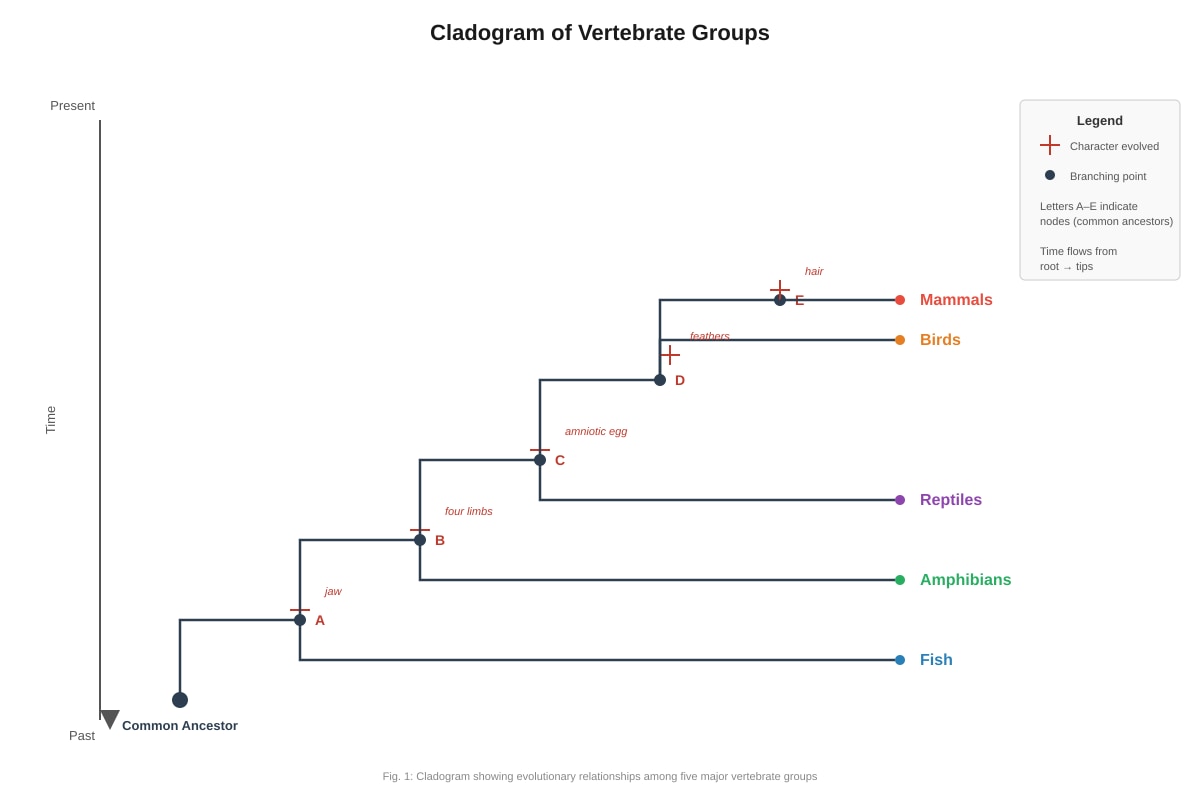
(a) Most recent common ancestor: [1] Reptiles and birds share the most recent common ancestor.
Explanation: [1] On the cladogram, reptiles and birds branch from the same node most recently (their lineages diverge later than any other pair). They share the most derived characteristics in common after their divergence point; both possess the amniotic egg, and birds branch from within the reptile clade (birds are phylogenetically nested within reptiles if we include extinct forms).
(b) Explanation of grouping: [2]
- Shared ancestry over superficial similarity: Phylogenetic classification prioritises shared derived characteristics (synapomorphies) from common ancestors over convergent or unique traits [0.5]
- Both reptiles and birds possess the amniotic egg, a key synapomorphy not found in amphibians or fish; this indicates shared common ancestor after divergence from mammals [0.5]
- Birds evolved from theropod dinosaurs (a reptile group); feathers are a derived trait of one reptilian lineage that led to birds [0.5]
- Hair in mammals evolved independently from a different ancestral lineage; mammals diverged before the amniotic egg diversified into the forms seen in reptiles/birds [0.5]
- Therefore, evolutionary history (homologous structures from shared ancestors) is more important for classification than unique adaptations that evolved after divergence.
END OF ANSWER KEY